
Inspiration
Many people need someone to talk to during ordinary stress, loneliness, grief, anxiety, or difficult moments—but may not feel ready to contact another person. I wanted to build a companion that feels warm and present while respecting privacy, staying honest that it is synthetic, and avoiding the claim that it replaces professional care.
What it does
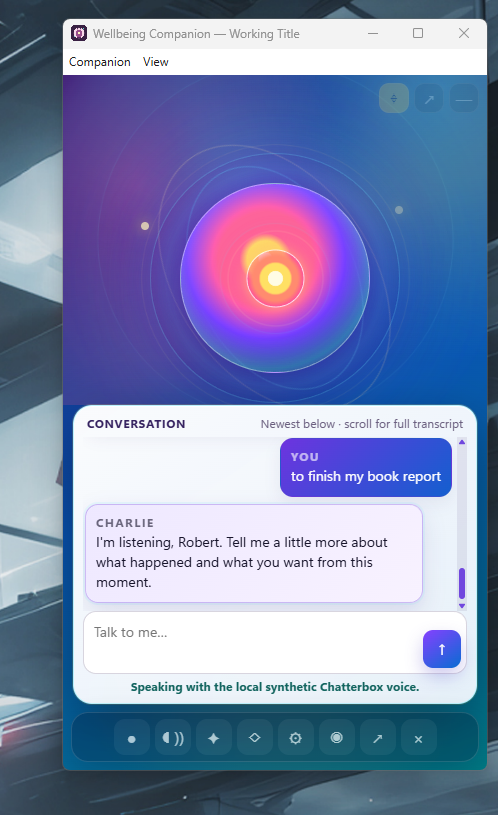
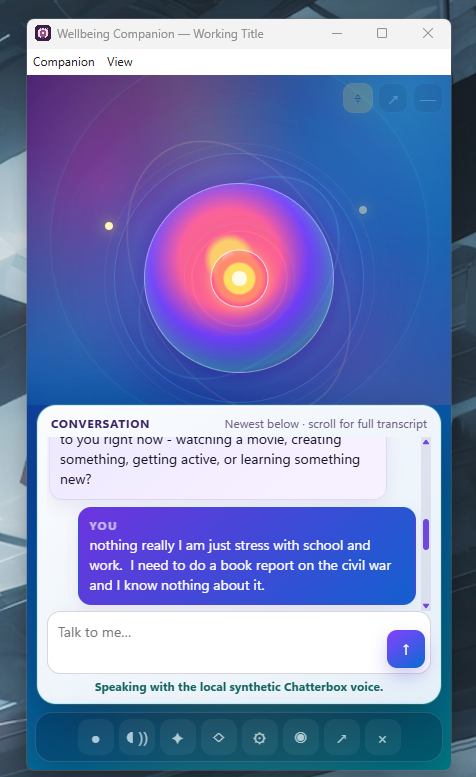
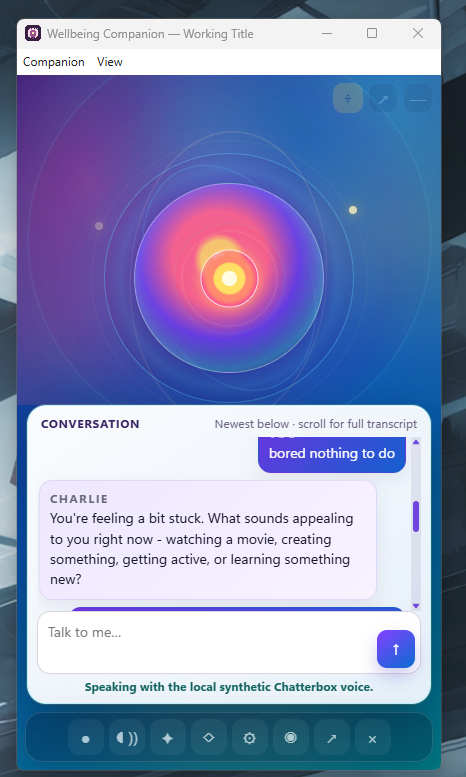
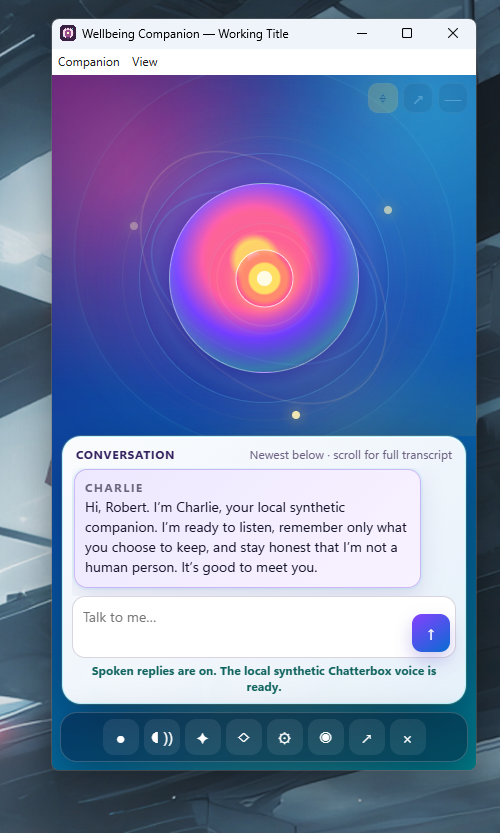
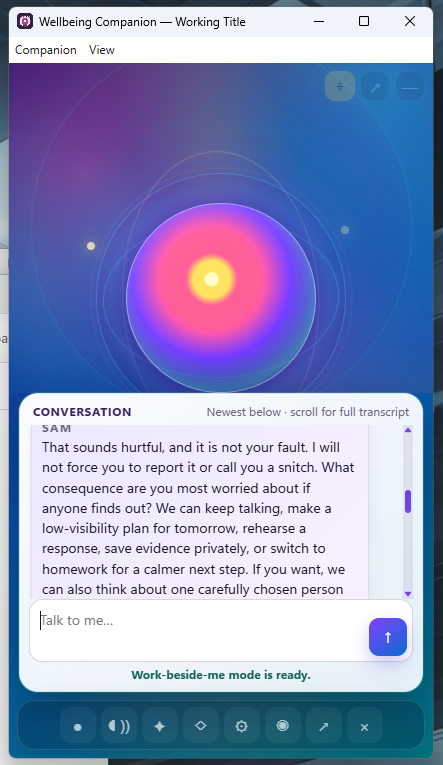
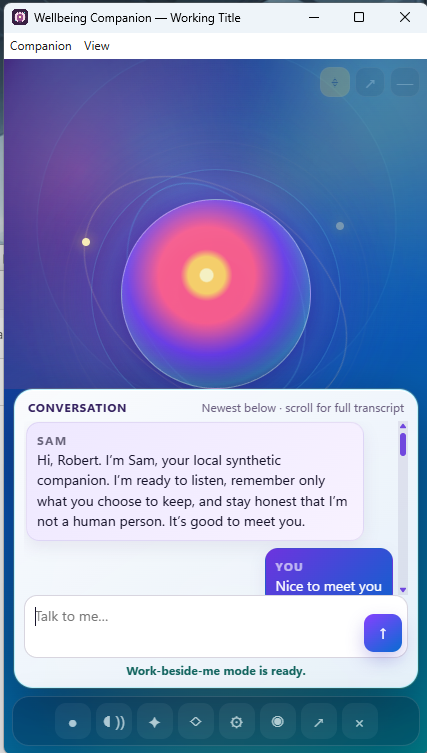
Here With You is a local-first wellbeing companion with a conversational desktop interface, spoken replies, and an expressive animated orb. It listens, responds to the user’s situation and emotional tone, and remembers only information the user chooses to keep. It supports everyday conversation as well as sadness, anger, nervousness, grief, bullying, and more serious distress. High-risk messages enter a tested safety path designed to prioritize immediate safety and appropriate real-world help.
How we built it
I built the application as a Python desktop experience with a local conversational model, local synthetic speech, persistent user-controlled memory, and a responsive animated interface. Flexible conversation handles normal interactions, while deterministic safety checks protect high-risk situations. I also created scenario-based tests covering moods and circumstances ranging from happiness and boredom to grief, anger, severe depression, and possible immediate danger.
Challenges we ran into
The hardest challenge was making replies feel natural instead of scripted while still maintaining a reliable safety boundary. The companion needed to understand conversational context, avoid repeatedly asking the same questions, and respond differently to very different emotional situations. I also worked through interface scaling, transcript readability, speaker defaults, local voice quality, and making the orb feel visibly alive while it speaks.
Accomplishments that we're proud of
I am proud that the project became a functioning local companion rather than only a concept. It combines private conversation, spoken responses, selective memory, an approachable visual identity, and explicit safety behavior in one desktop application. I am especially proud of the broad emotional test suite and of keeping the companion honest: it offers support without pretending to be human or presenting itself as a clinician.
What we learned
I learned that supportive conversation depends as much on continuity, timing, and wording as it does on the underlying model. A shorter response that clearly understands the user can feel more helpful than a long generic answer. I also learned that creative language generation and safety-critical decisions should not rely on exactly the same mechanism; a deterministic boundary makes serious situations more dependable.
What's next for Here With You — Local Wellbeing Companion
Next I want to improve contextual understanding, reduce scripted-sounding replies, expand user-controlled memory, strengthen the emotional evaluation suite, and make local inference faster. I also plan to refine the synthetic voice, give the orb more expressive motion while speaking, improve small-window and full-screen layouts, simplify installation, and continue testing with a wider range of real-life situations.
Built With
- aes-256-gcm
- electron
- faster-whisper
- local-chatterbox-speech
- node.js
- optional-local-ollama
- pbkdf2-sha-256
- pnpm
- powershell
- pwa
- react
- typescript
- vite
- vitest
- web-crypto-api
- windows-installer-tooling


Log in or sign up for Devpost to join the conversation.