-
-

Our hand drawn mascot, "Mama Bear".
-
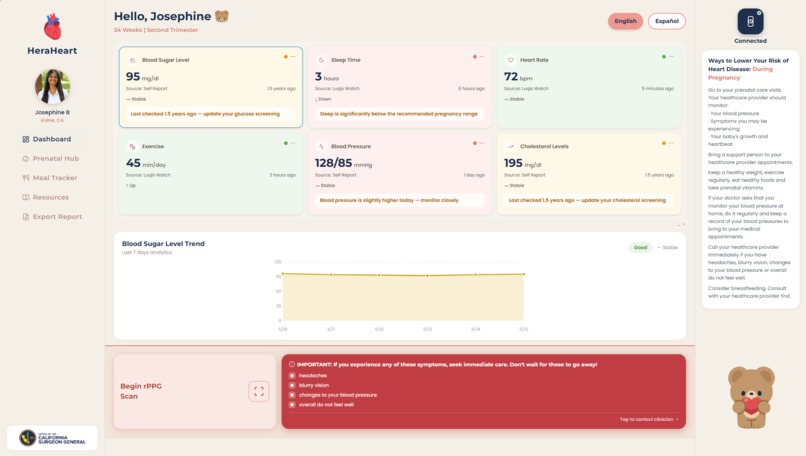
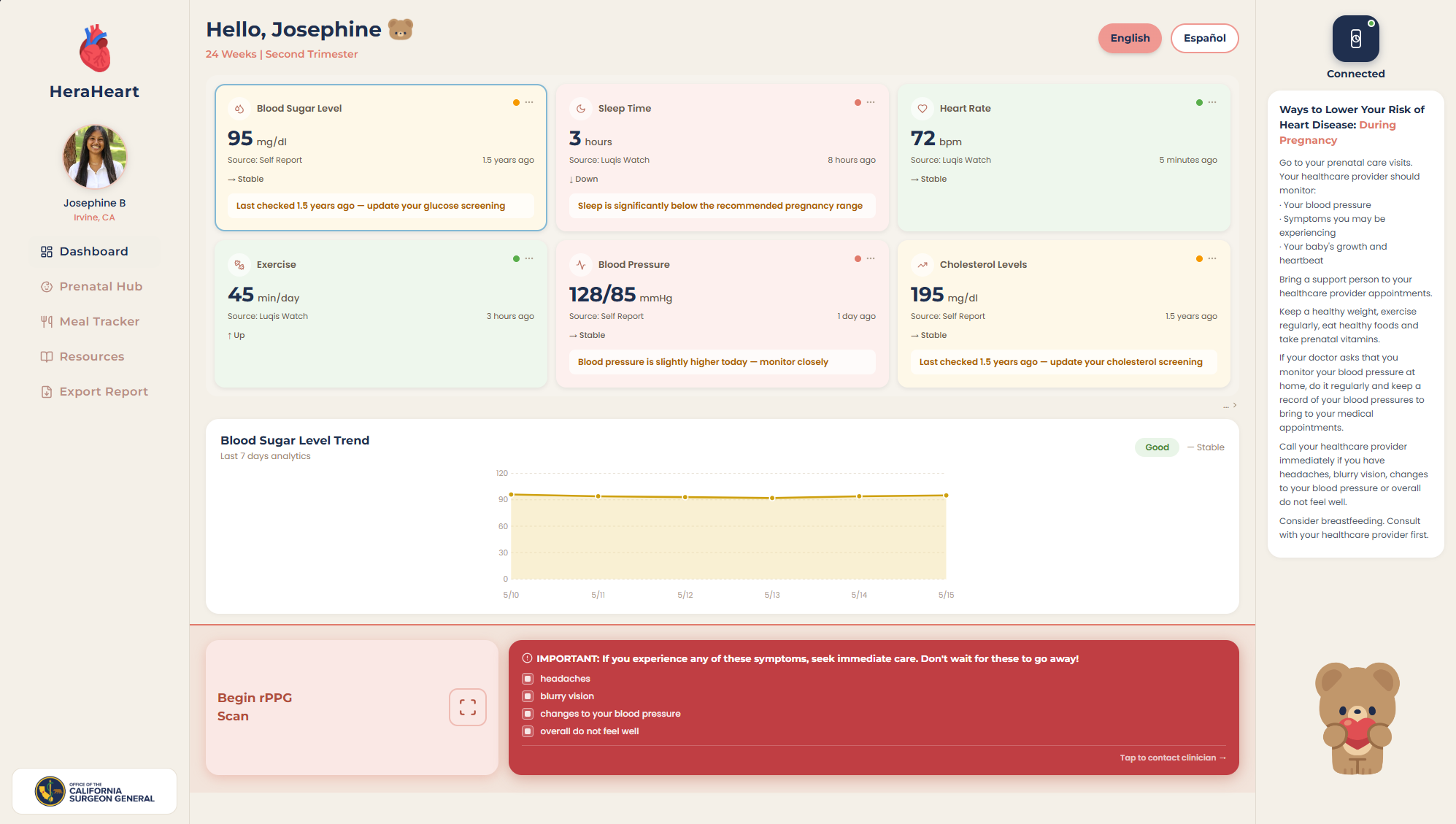
User dashboard that displays user vitals, trends, tips based on stage in pregnancy, and rPPG support.
-
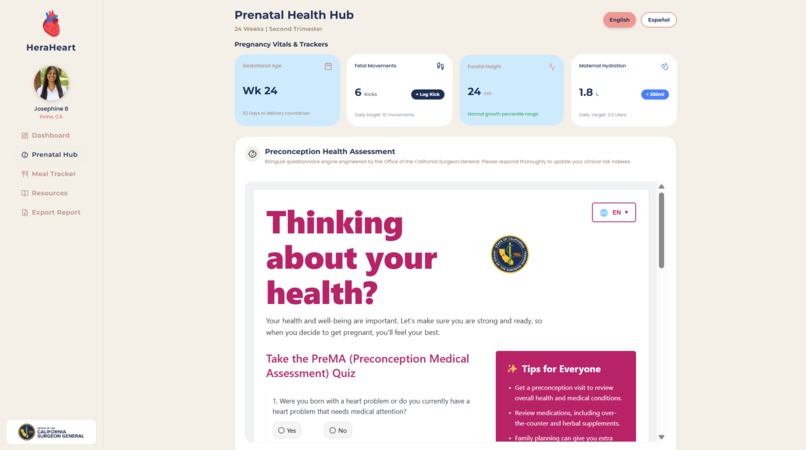
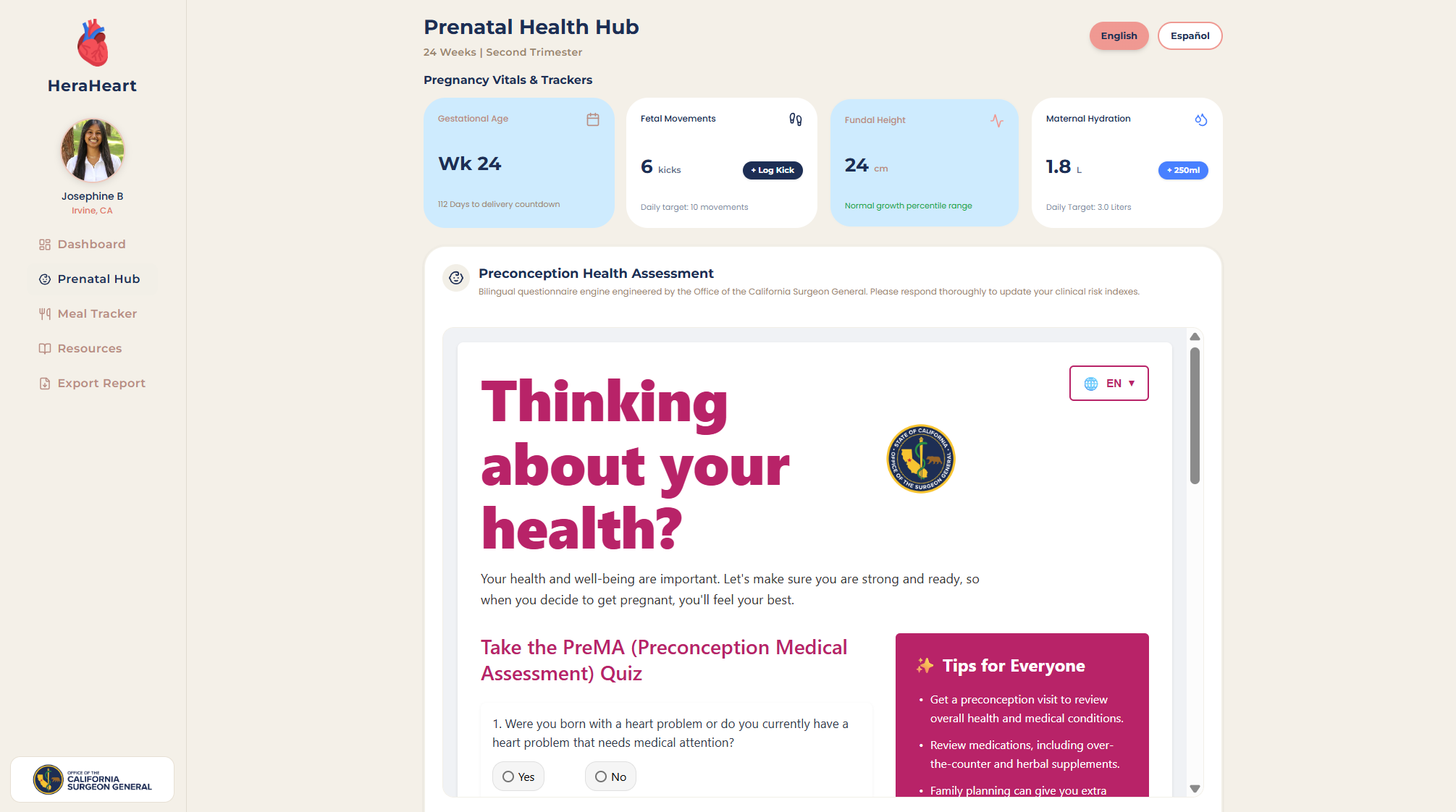
Prenatal Hub that embeds a Preconception Health Assessment provided by the Office of the California Surgeon General.
-
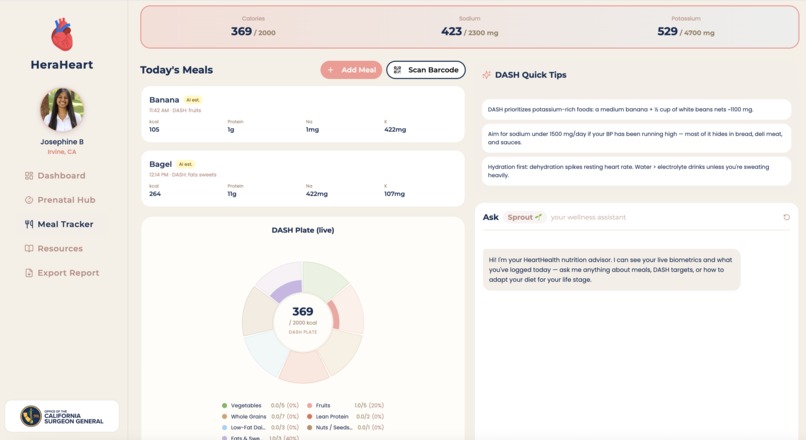
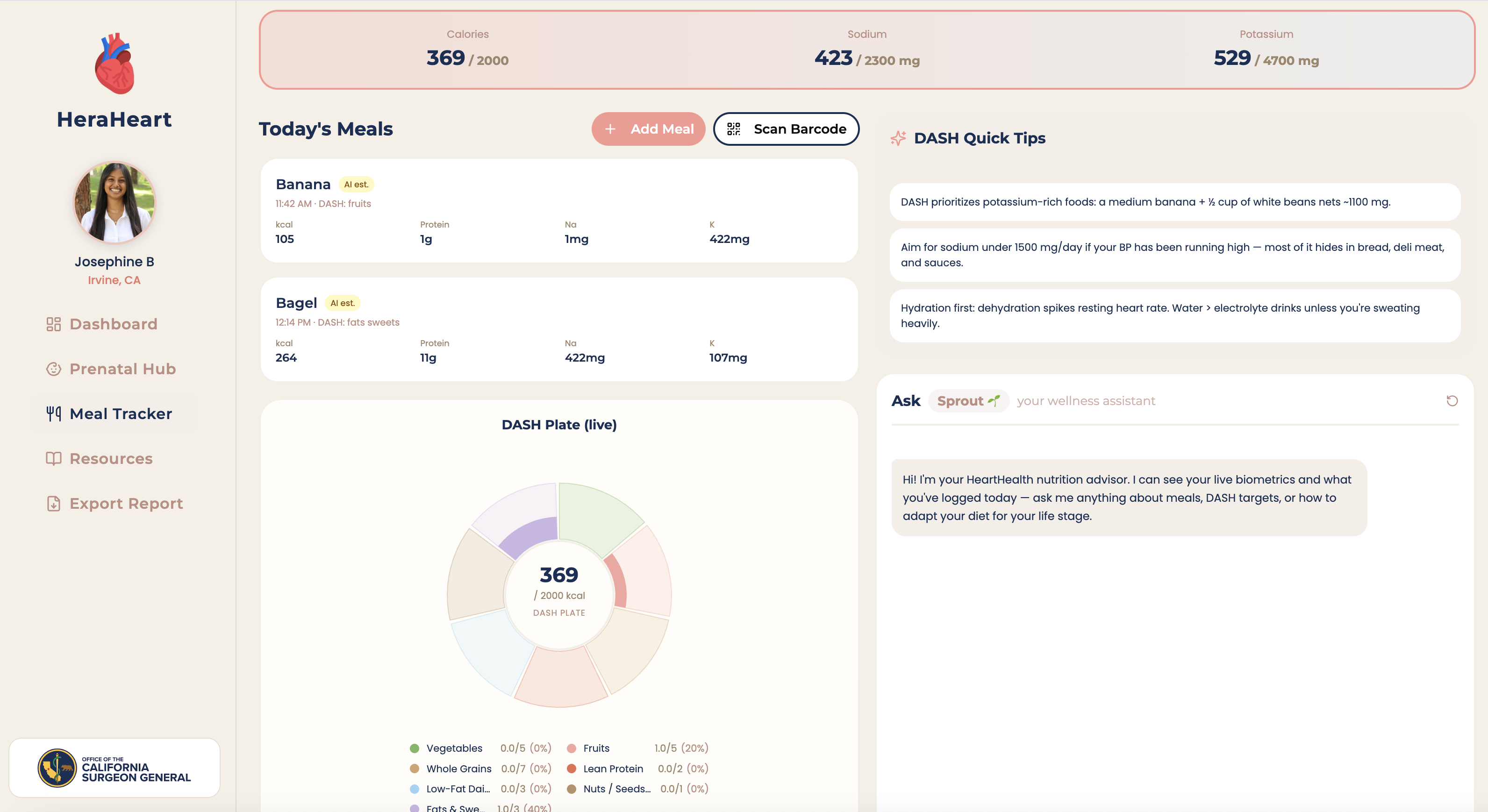
Nutrition Hub that allows user to document their diet that supports barcode scanning and a chatbot for questions.
-
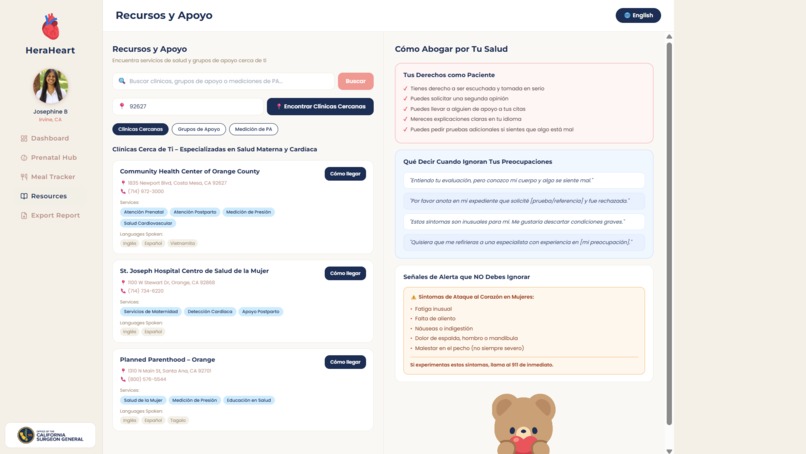
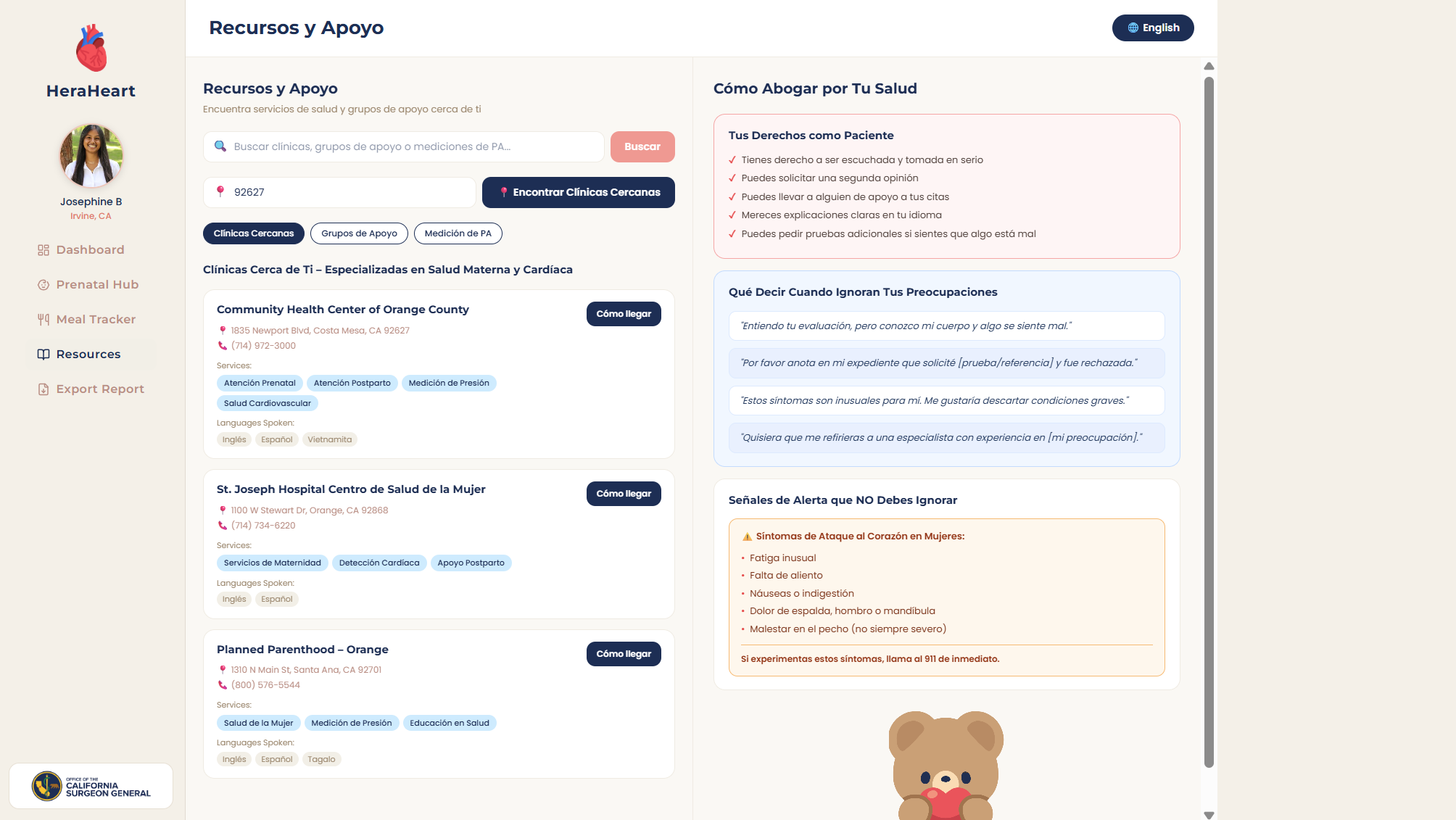
Local community resource search bar and a template for women to advocate for themselves during appointments (Shown in Spanish).
-
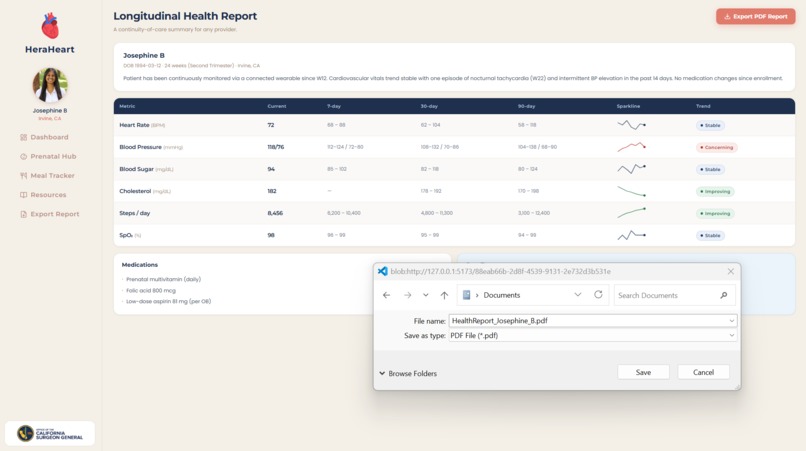
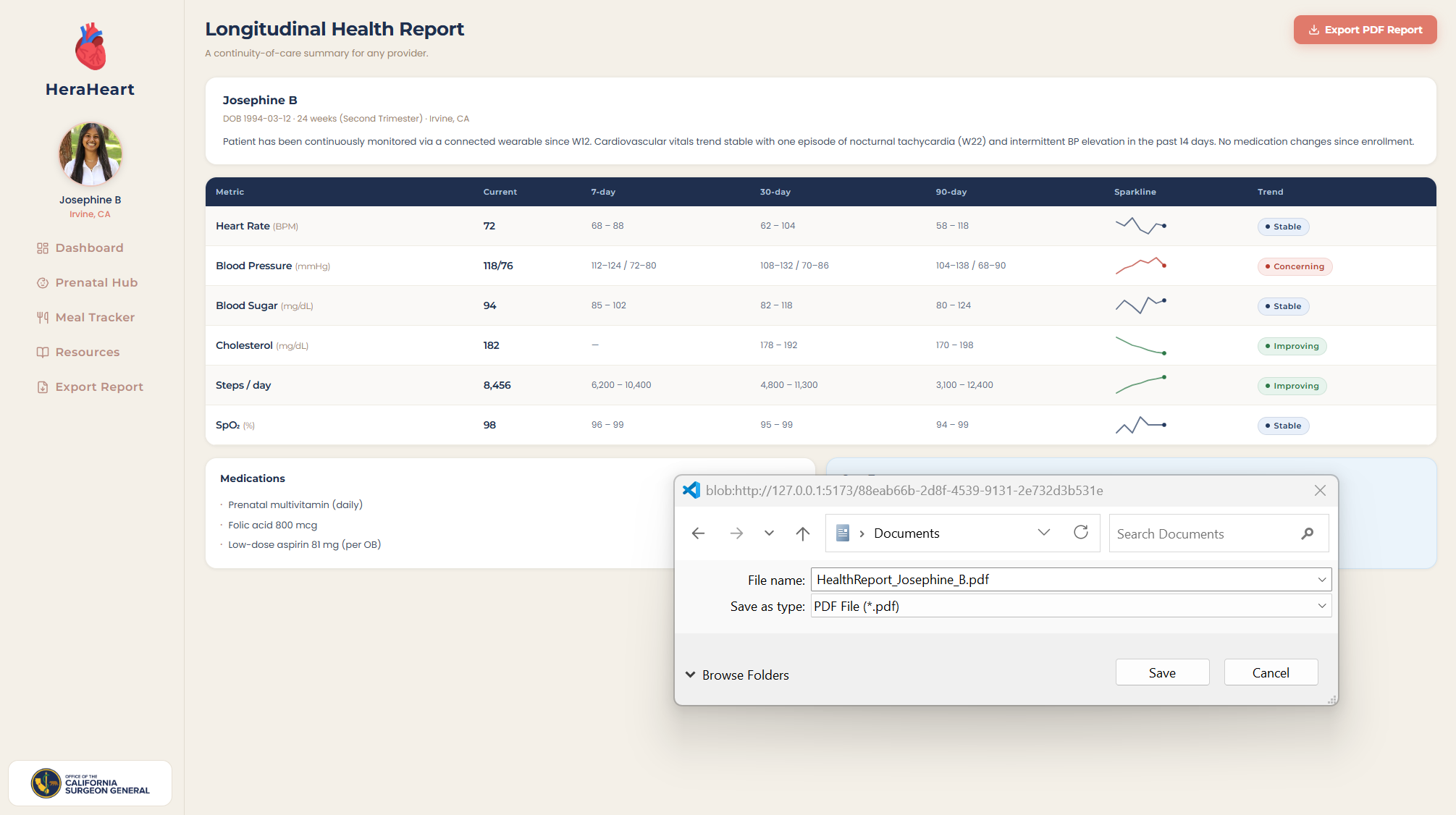
Users can export their vital reports in a formatted pdf.

Inspiration
Cardiovascular disease in women is influenced by many interconnected factors, including access to care, nutrition, health literacy, and continuity of medical records.
Our platform consolidates maternal heart health monitoring, education, resources, and self-advocacy tools into one accessible toolkit that empowers women of all backgrounds to better understand, track, and advocate for their health!
What it does
HeraHeart is a unified maternal cardiovascular health platform that helps patients track key health metrics, monitor symptoms, access education, and prepare for care visits in one place. It combines wearable data, self-reported information, nutrition support, clinic navigation, and advocacy tools to turn scattered health inputs into clear, actionable insights. By organizing trends and risk signals over time, HeraHeart helps patients stay informed, share better context with providers, and support earlier preventative care.
Key features include:
- Universal rPPG scanning using only a camera to estimate vitals without requiring expensive wearables
- Unified dashboard for heart rate, blood pressure, blood sugar, sleep, cholesterol, exercise
- Symptom monitoring for warning signs related to preeclampsia and maternal cardiovascular complications
- AI-powered nutrition assistance with meal suggestions and DASH-aligned macro monitoring
- Barcode nutrition scanning with fallback systems to reduce manual data entry frustration
- Longitudinal health report generation for OB/GYN visits and smoother provider transitions through centralized health history access
- Nearby clinic discovery with language and specialty filtering
- Patient rights education and self-advocacy guidance
- English and Spanish bilingual accessibility
Our goal is to shift maternal health management from reactive emergency response toward proactive preventative care.
How we built it
We conducted extensive research into maternal cardiovascular health, healthcare accessibility barriers, posted OSG resources, podcasts, public health frameworks, and wearable health technologies.
We also explored:
- Maternal mortality and cardiovascular risk factors
- Healthcare equity and accessibility challenges
- rPPG research papers and implementations
- Nutrition and DASH diet guidelines
- Patient self-advocacy and continuity-of-care issues
On the technical side, we built:
- A full-stack health monitoring platform
- Centralized health dashboards
- Smartwatch incorporation
- AI-assisted nutrition tools
- Barcode nutrition lookup systems
- Bilingual interfaces
- Longitudinal reporting systems
- Trend analysis visualizations
Our stack included technologies such as:
- Python
- React
- Vite
Challenges we ran into
- We originally planned real-time smartwatch streaming integration, but required APIs to connect to our watch were hidden behind expensive enterprise/paywall pricing.
- rPPG implementation and reliability required extensive experimentation and research.
- Maternal cardiovascular health is highly interdisciplinary, requiring us to balance medical accuracy, accessibility, usability, and technical feasibility.
- Consolidating many different health metrics into a clean, understandable interface without overwhelming users was challenging.
- Designing for inclusivity meant accounting for financial, geographic, language, and healthcare-access barriers simultaneously.
- Nutrition APIs and barcode databases were inconsistent, so we developed fallback systems to minimize user friction.
Accomplishments that we're proud of
- Conducting extensive interdisciplinary research across maternal health, cardiovascular disease, and preventative care
- Building an accessibility-focused maternal health platform that considers financial, geographic, and language barriers
- Consolidating fragmented maternal health workflows into one centralized experience
- Creating bilingual English/Spanish support to improve accessibility Implementing rPPG-based vitals estimation to reduce reliance on expensive wearables
- Designing proactive health trend visualizations instead of only displaying raw numbers
- Building self-advocacy and patient-rights tools alongside traditional health tracking
- Creating a polished and approachable UI experience, including custom mascot artwork created by one of our team members
What we learned
- Maternal cardiovascular health is deeply connected to social, financial, and systemic healthcare barriers — not just medical metrics alone.
- Many health APIs and wearable ecosystems are surprisingly restrictive for student developers and small teams.
- Users engage more consistently with health tracking when information is centralized, visualized clearly, and actionable.
- rPPG has strong potential as a low-cost preventative healthcare technology, especially for underserved populations.
- Building healthcare-adjacent tools requires balancing innovation with trust, clarity, and equity
What's next for HeraHealth
Future development plans for HeraHeart include:
- Expanding supported smartwatch and wearable integrations
- Integrating additional health metrics as rPPG research and reliability continue improving
- Adding FHIR healthcare data standards to improve interoperability and provider-to-provider record transfer
- Expanding multilingual accessibility support
- Integrating more advanced nutrition and lifestyle tracking
- Developing stronger provider-facing tools and care coordination features
As research in accessible digital health and rPPG continues advancing, we hope HeraHeart can help make preventative maternal cardiovascular monitoring more affordable, proactive, and universally accessible.

Log in or sign up for Devpost to join the conversation.