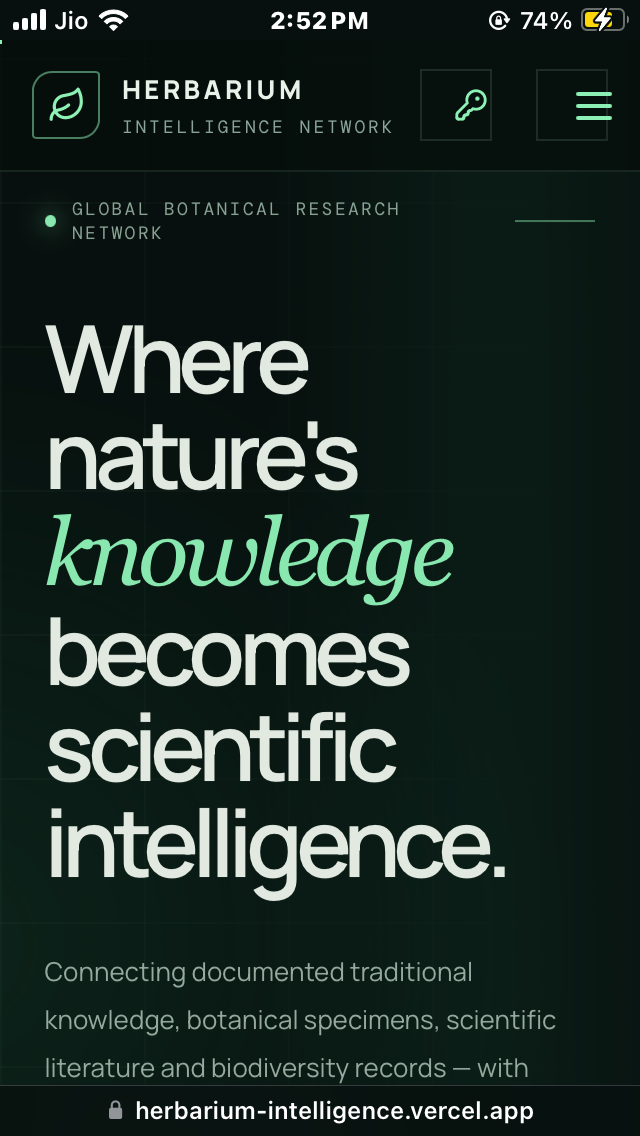
HERABRIUM was inspired by India’s rich medicinal plant heritage and the need to preserve biodiversity. Its mission is to unite AI, botanical science, and traditional knowledge to explore plant intelligence, understand molecular properties, and promote sustainable conservation through interactive scientific technology.
- Inspiration
HERABRIUM was inspired by the extraordinary medicinal potential of plants and the gap between traditional botanical knowledge and modern scientific research.
For centuries, communities have relied on medicinal plants, yet botanical knowledge, scientific publications, phytochemical records, and biodiversity information remain scattered across different sources.
We envisioned a platform that could bring these worlds together through artificial intelligence, scientific databases, interactive visualizations, and molecular exploration.
Our inspiration was simple: What if we could transform the way humanity discovers, understands, researches, and protects medicinal plants?
- What It Does
HERABRIUM is an interactive AI-powered botanical intelligence ecosystem that combines:
- Botanical research and species intelligence.
- Traditional medicinal knowledge exploration.
- Phytochemical and molecular discovery.
- Biodiversity monitoring and exploration.
- Scientific literature and evidence analysis.
- AI-powered botanical intelligence.
- Interactive 3D-inspired scientific environments.
It provides researchers and curious explorers with a unified environment to investigate medicinal plants, understand their biological relationships, explore their chemical compounds, and examine conservation-related information.
- The Problem
Botanical and ethnopharmacological research faces several challenges:
- Scientific information is scattered across different databases and publications.
- Traditional medicinal knowledge is difficult to connect with modern scientific evidence.
- Exploring phytochemicals and molecular relationships requires specialized research tools.
- Biodiversity information can be difficult to visualize and interpret.
- Researchers need better ways to connect species, compounds, literature, and conservation evidence.
HERABRIUM addresses these challenges through a unified research ecosystem.
- Our Solution
HERABRIUM brings botanical intelligence, scientific evidence, biodiversity information, and AI-assisted exploration together in one platform.
Instead of navigating disconnected research resources, users can explore interconnected scientific information through specialized environments.
The platform is designed to make complex botanical research more accessible, interactive, and understandable.
- Key Features
Phase 1 – Scientific Intelligence
- Botanical intelligence.
- Scientific research exploration.
- Species information.
- Biological data investigation.
- Scientific relationship discovery.
Phase 2 – EthnoKnowledge
- Traditional knowledge exploration.
- Ethnobotanical information.
- Connections between traditional uses and scientific literature.
- AI-assisted knowledge discovery.
Phase 3 – Specimen Intelligence
- Botanical specimen exploration.
- Phytochemical investigation.
- Molecular and compound exploration.
- Scientific relationship visualization.
Phase 4 – Biodiversity Explorer
- Seven interactive biodiversity environments.
- GBIF-based taxonomy and occurrence information.
- Geographic biodiversity exploration.
- Maps, timelines, and filters.
- Biodiversity data exports.
Phase 5 – PhytoEvidence
- Scientific literature exploration.
- Research evidence organization.
- Species and compound comparisons.
- Saved research collections.
- Research notes and provenance.
- Evidence review and quality tracking.
Phase 6 – Herabrium Nexus
- Unified five-domain search.
- AI-powered botanical research assistance.
- Scientific intelligence matrix.
- Research dossier vault.
- Evidence-grounded answers.
- JSON and Markdown exports.
- How We Built It
HERABRIUM combines modern web technologies, scientific data integration, AI-assisted research, and interactive visualization.
Its architecture incorporates:
- Frontend: Interactive web interface with cinematic animations and 3D-inspired environments.
- Backend: FastAPI-based research and AI integration.
- Artificial Intelligence: OpenRouter-powered AI integration for botanical research assistance.
- Biodiversity Data: GBIF.
- Knowledge Data: Wikidata.
- Scientific Literature: Crossref and OpenAlex.
- Visualization: Interactive scientific diagrams, maps, timelines, and molecular exploration.
- Storage: Browser-based local storage for selected settings and API configuration.
The system connects multiple scientific information sources and organizes their information into specialized research environments.
- Challenges We Faced
Developing HERABRIUM involved several significant challenges:
- Integrating multiple scientific data sources into one ecosystem.
- Maintaining meaningful connections between botanical, biological, chemical, and biodiversity information.
- Making scientific information accessible through an interactive interface.
- Improving AI-generated answers with evidence-based information.
- Avoiding repetitive or misleading scientific results.
- Maintaining performance across complex animated and interactive environments.
- Designing a unified architecture across six development phases.
One of our biggest challenges was ensuring that different research environments delivered relevant information instead of simply displaying disconnected datasets.
- Accomplishments We’re Proud Of
We are proud to have developed a six-phase botanical intelligence ecosystem rather than another conventional plant-information website.
Our accomplishments include:
- Six interconnected development phases.
- Seven biodiversity exploration environments.
- Unified five-domain research search.
- AI-assisted botanical intelligence.
- Scientific literature integration.
- Phytochemical and molecular exploration.
- Biodiversity mapping and timelines.
- Research evidence organization.
- Interactive cinematic scientific interface.
- Research dossier management and export functionality.
Most importantly, HERABRIUM brings several traditionally disconnected research disciplines into one interactive environment.
- What We Learned
Throughout development, we learned:
- How AI can support scientific knowledge exploration.
- How to integrate multiple external scientific datasets.
- How biodiversity information can be transformed into interactive visualizations.
- Why scientific provenance and evidence quality matter.
- How to design interconnected research environments.
- How to balance complex functionality with accessibility and usability.
We also learned that AI-assisted scientific exploration must communicate uncertainty and distinguish reported evidence from unverified predictions.
- What’s Next?
HERABRIUM is envisioned as an evolving scientific research ecosystem.
Our future plans include:
- Advanced Molecular Intelligence: Expand molecular and phytochemical exploration.
- Deeper AI Research: Improve evidence-grounded botanical reasoning.
- Global Botanical Knowledge: Expand species and ethnobotanical information.
- Conservation Intelligence: Develop more advanced biodiversity monitoring.
- Scientific Knowledge Graphs: Connect species, compounds, biological activities, and publications.
- Advanced 3D Laboratories: Introduce more immersive molecular and botanical research environments.
- Research Collaboration: Enable researchers to organize and share scientific discoveries.
- Improved Evidence Validation: Strengthen source verification, provenance, and scientific reliability.
Built With
- claude
- code
- coding
- css
- github
- gpt
- html
- javascript
