-
-
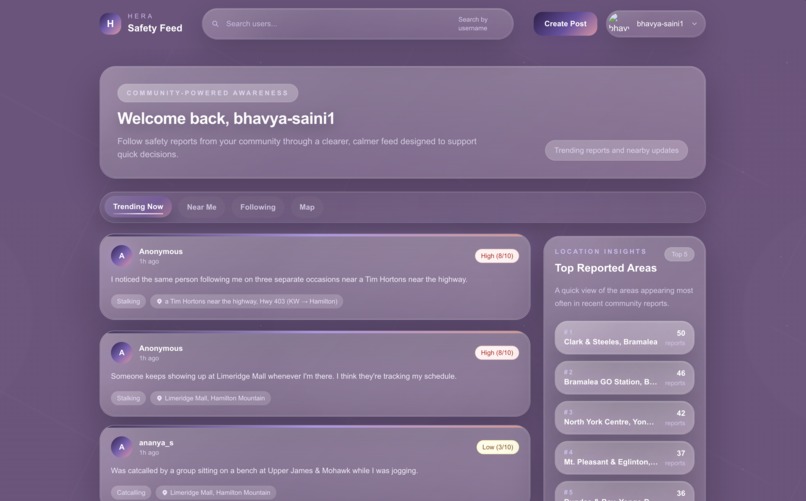
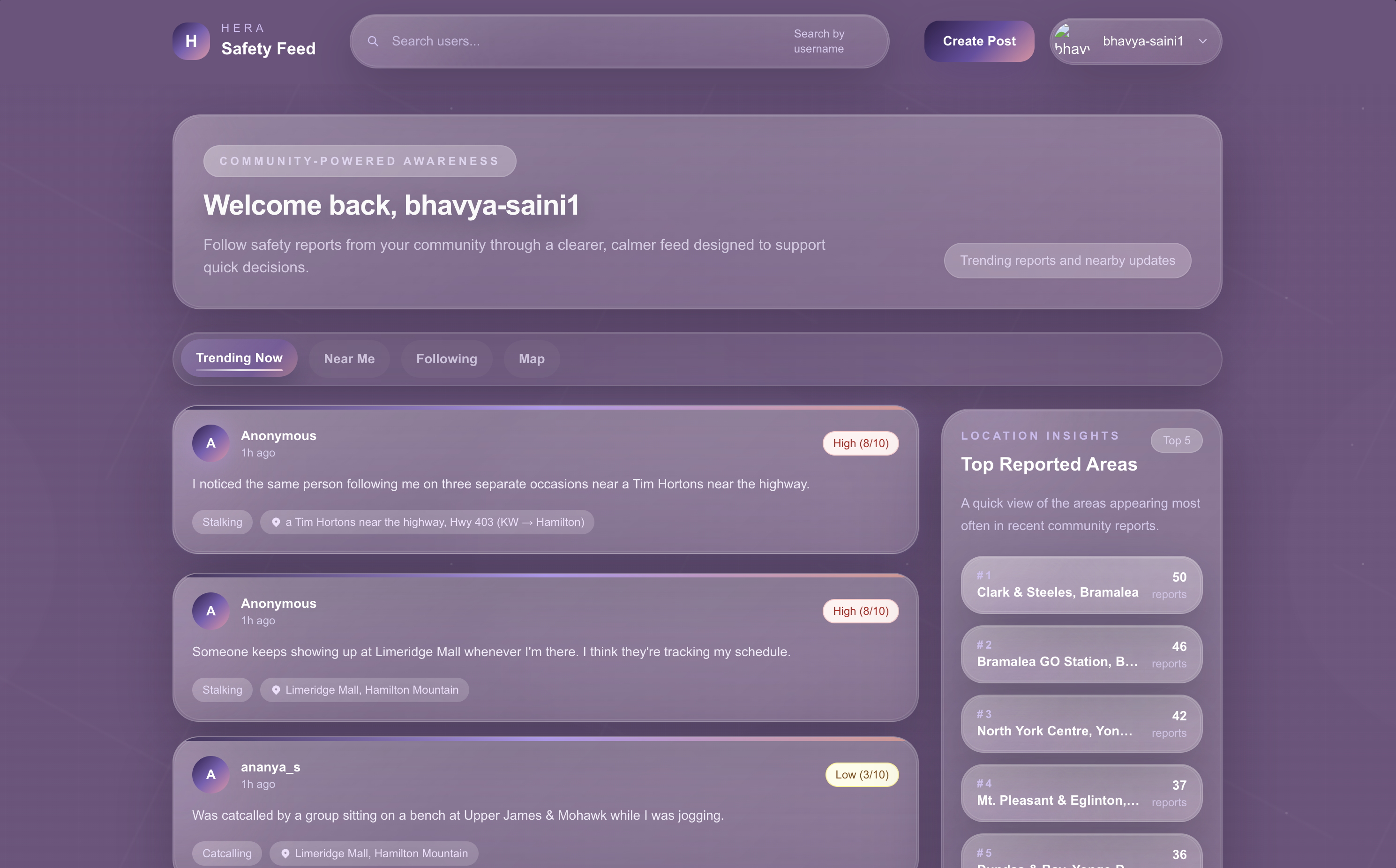
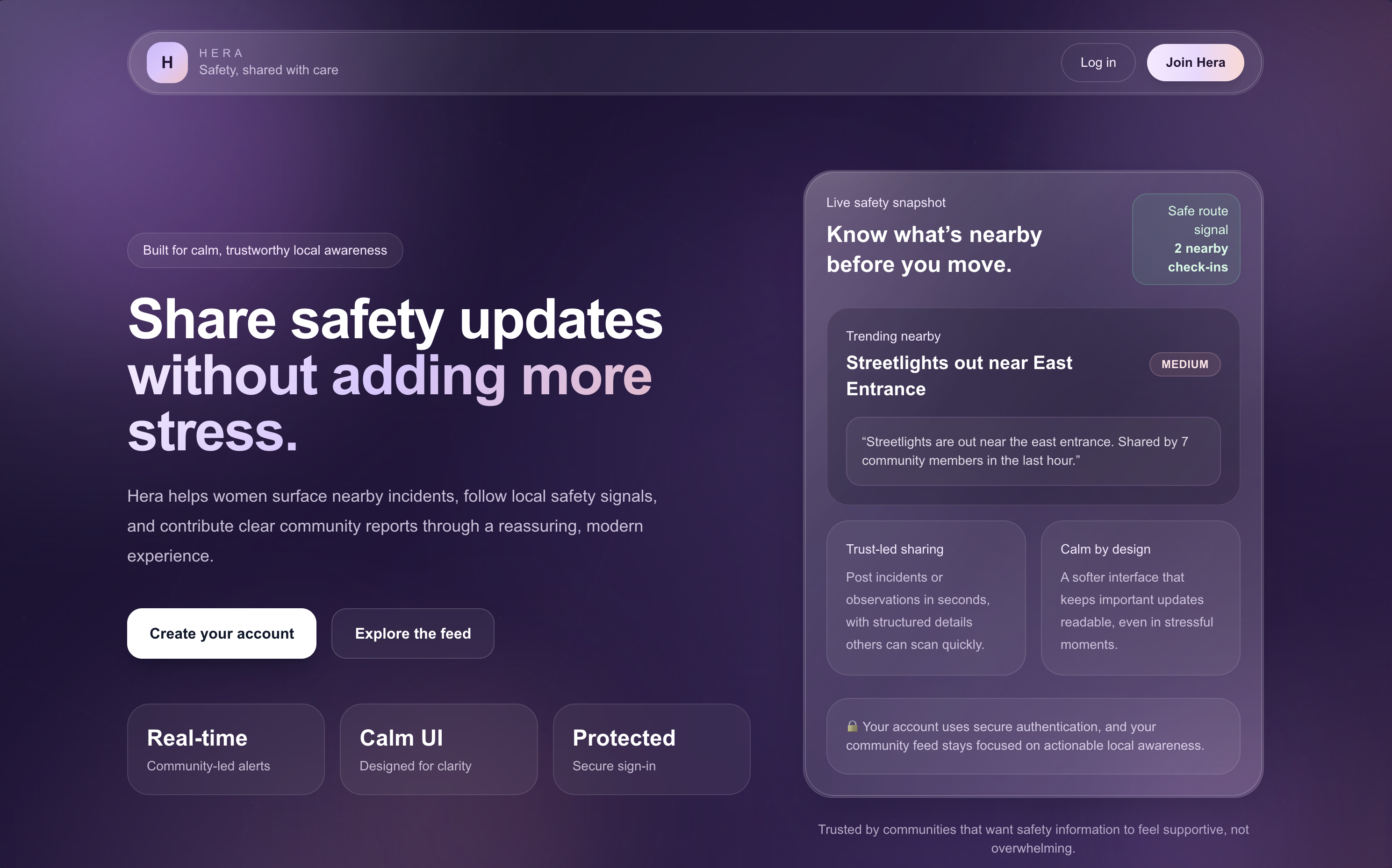
Home Page
-
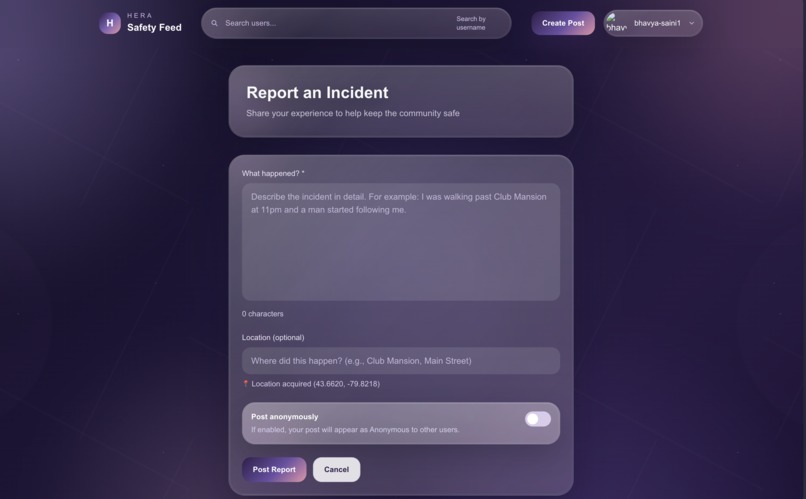
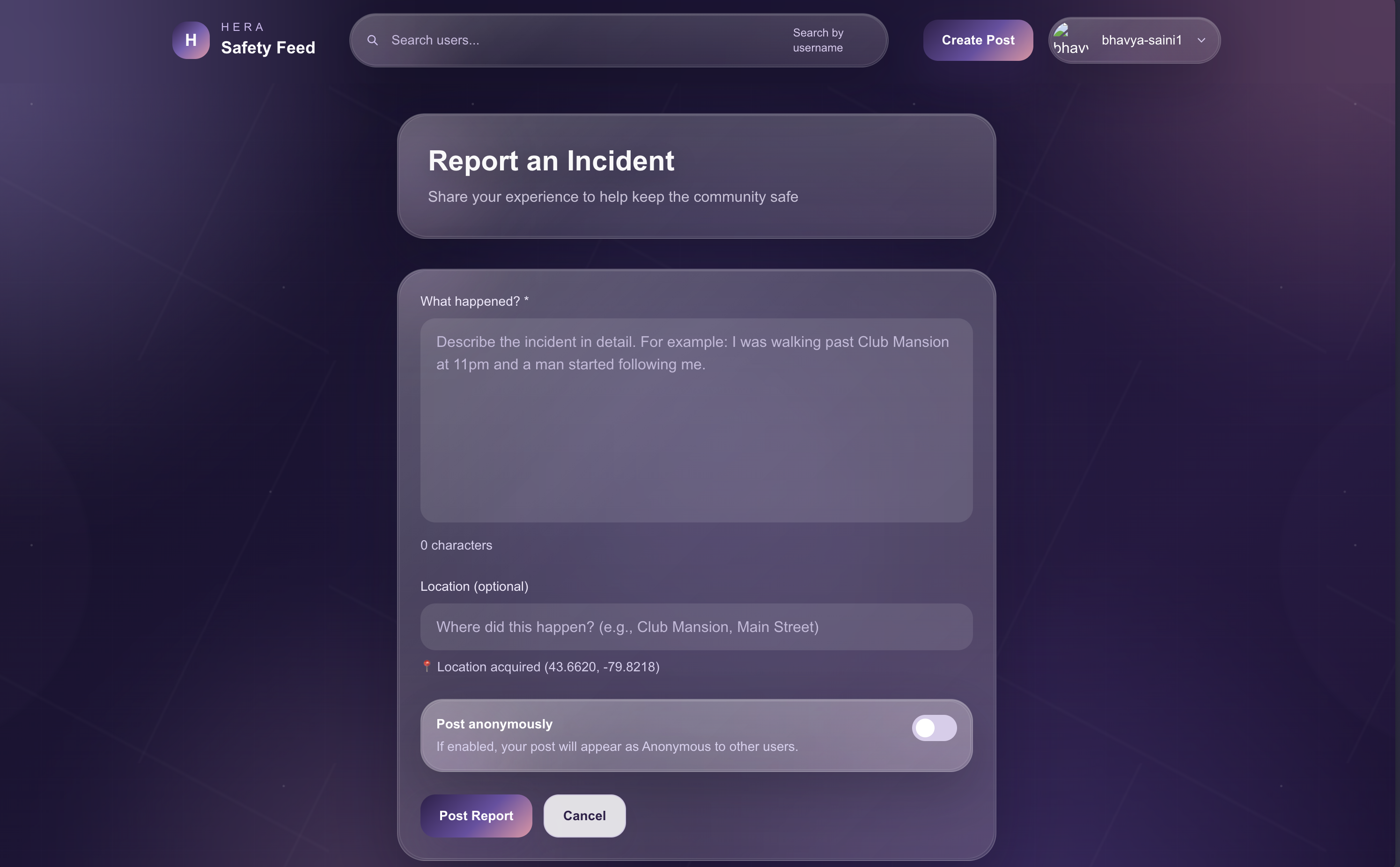
Post Creation
-
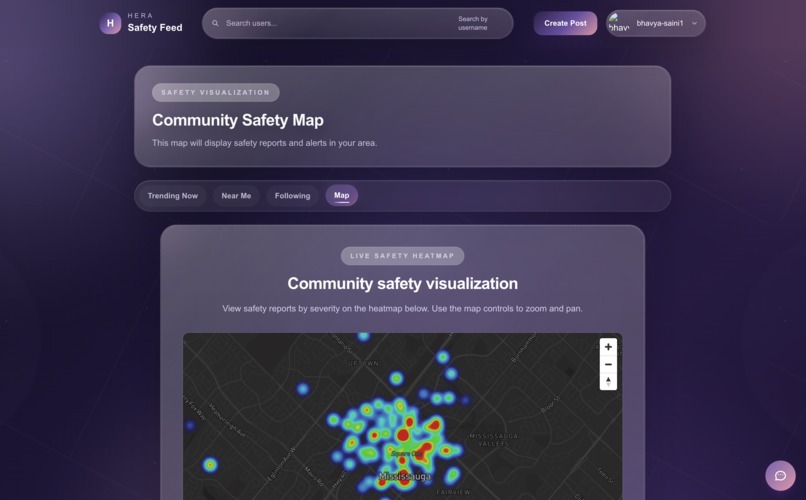
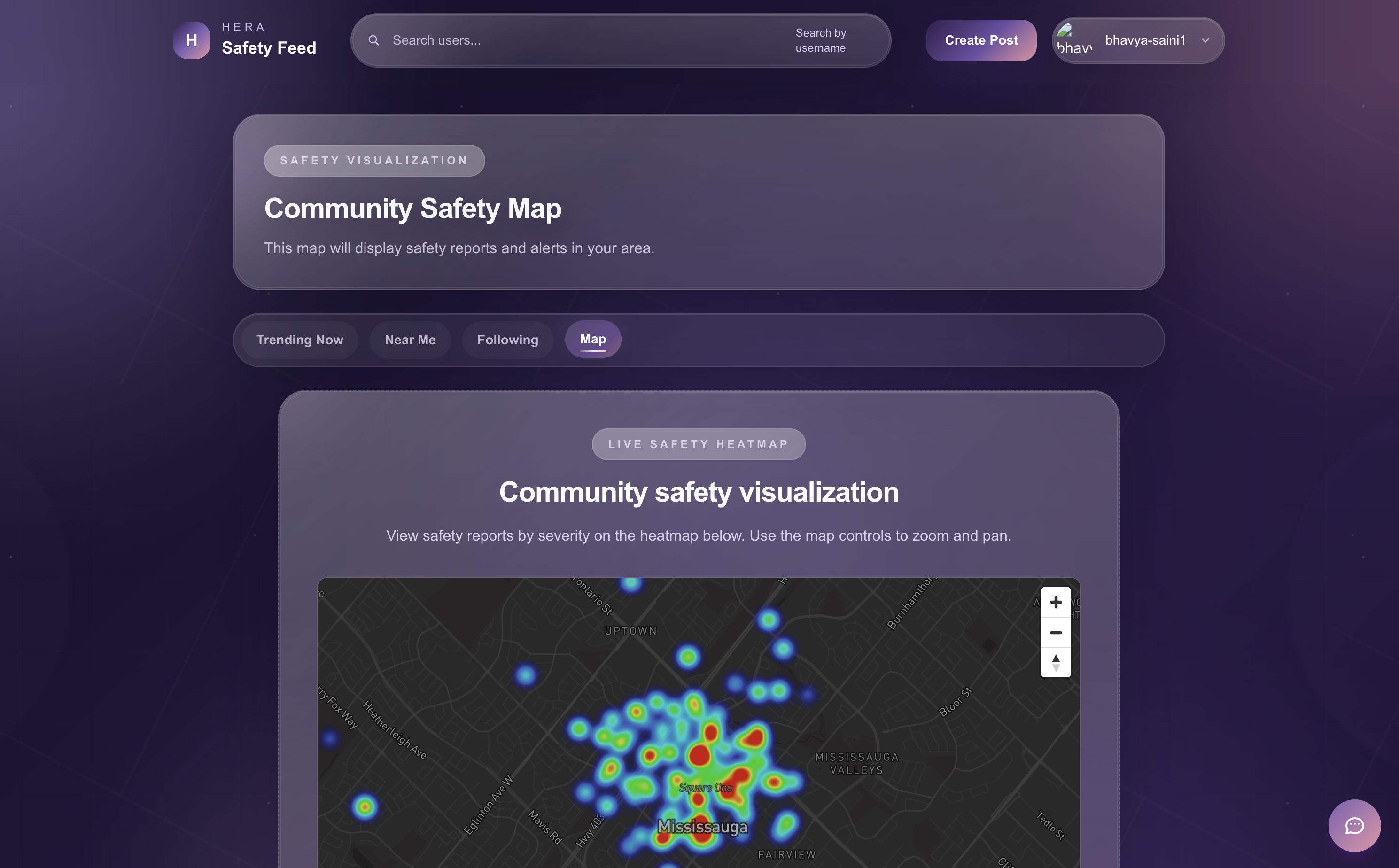
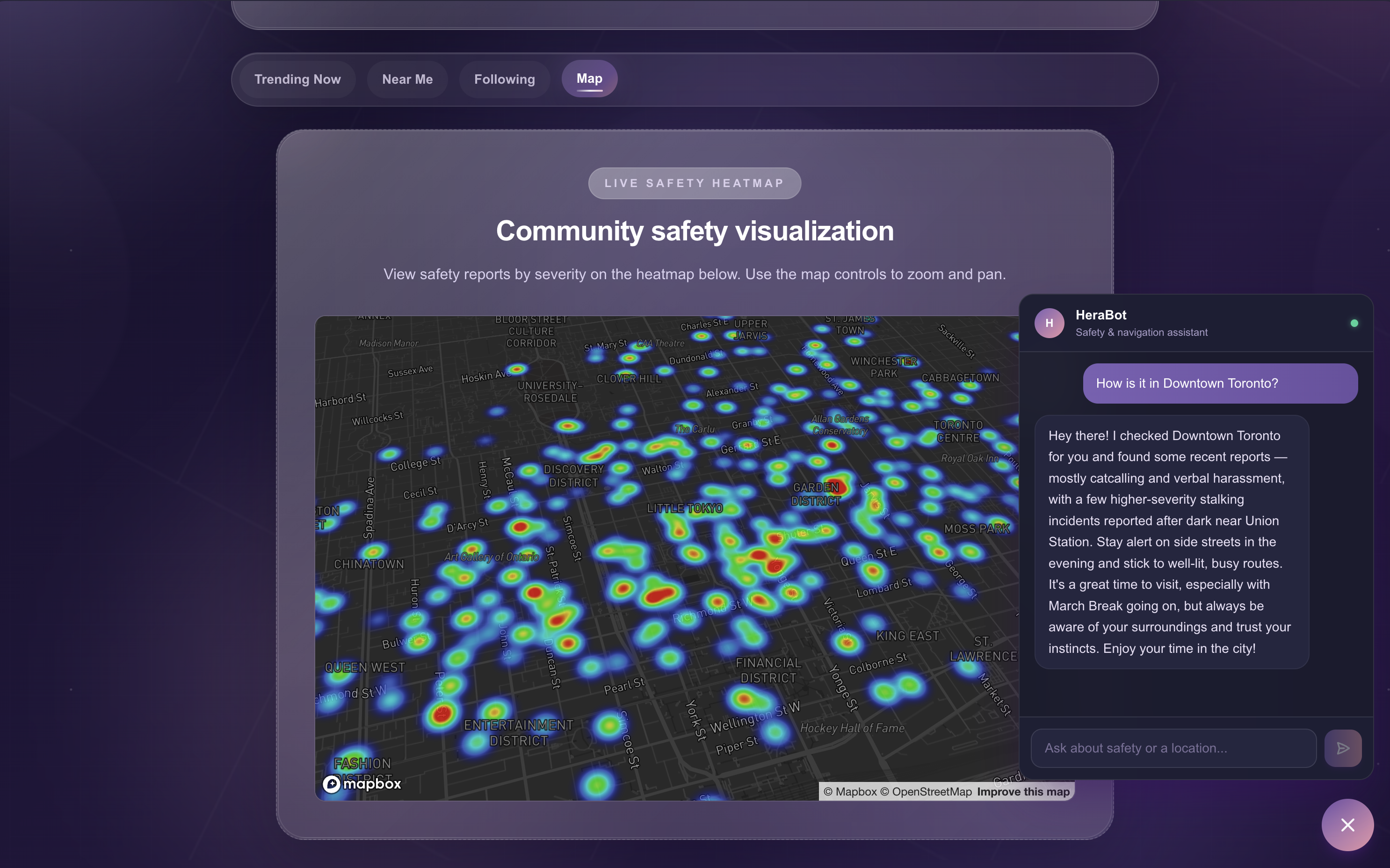
Incident Heatmap
-
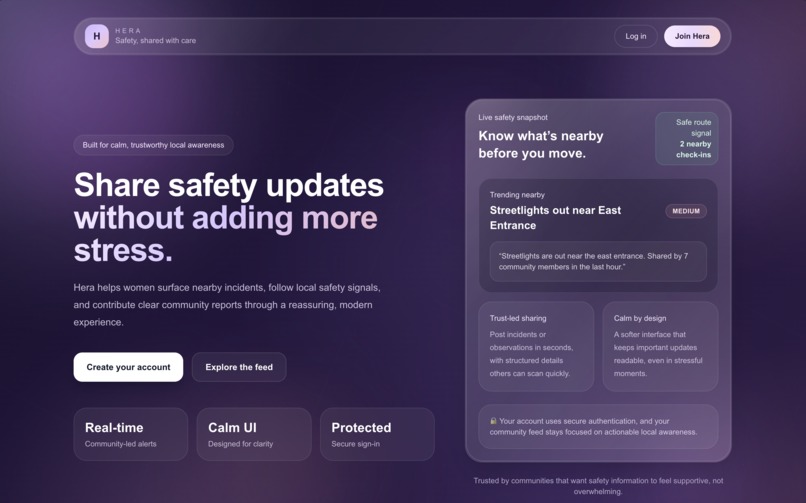
Sign Up Page
-
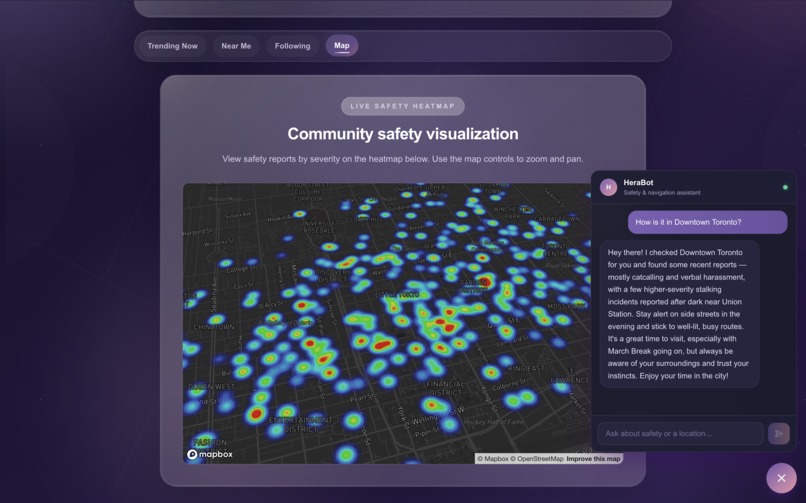
Nova Analysis of Heatmap
Inspiration
Traditional safety apps are stressful to use and rely on scattered, isolated reports. We wanted to build something that doesn't just show pins on a map, but actually understands the environment. We were inspired to create a proactive, data-driven safety companion for Southern Ontario that uses machine learning to synthesize community data into actionable insights.
What it does
Hera is an AI-driven safety intelligence platform.
- Geospatial Heatmap: Visualizes over 2,000 community reports across the GTA, mathematically mapped to avoid bodies of water and highlight real transit corridors.
- Nova AI Agent: Users can chat with our safety companion. Instead of giving generic advice, the agent uses MongoDB
$nearSpherequeries to fetch live incident data within a 5km radius and synthesizes a highly specific safety report. - Smart Ingestion Pipeline: When a user submits a report, we auto-grab their GPS coordinates. The text is instantly sent to our custom PyTorch machine learning regression model to calculate a 1-10 severity score before hitting the database.
How we built it
- Frontend: Next.js and TailwindCSS, integrated with Mapbox for the heatmaps and Auth0 for user sessions.
- Backend: Serverless Next.js API routes connected to a MongoDB database utilizing
2dsphereindexes for rapid proximity searches. - The ML Brain: We built a custom Python regression model for severity scoring and hosted it as an independent microservice API on Hugging Face Spaces using Gradio.
- The Agent: Powered by Amazon Nova, utilizing tool-calling to bridge the LLM with our MongoDB database.
Challenges we ran into
- The "Dependency Hell" Microservice: Hosting our PyTorch model on Hugging Face led to brutal version conflicts between
uvicorn,fastapi, and the Python runtime. We had to rewrite the configuration to force a stable Python 3.10 build environment. - Next.js Dynamic Server Usage: Our Auth0 cookies clashed with Next.js's attempt to statically generate our map pages for production, throwing 500 errors right before deployment. We had to forcefully opt the route into dynamic rendering.
- Geospatial Math: Seeding 2,000 realistic data points without dropping them in Lake Ontario required us to write a custom piecewise linear equation to mathematically trace the diagonal coastline of the GTA.
Accomplishments that we're proud of
- Bulletproof Ingestion Architecture: We engineered a graceful degradation pipeline. If our Hugging Face ML microservice times out or sleeps, the backend seamlessly falls back to a custom Keyword Regex scanner and a default severity score, guaranteeing the app never crashes during an emergency.
- Data-Grounded Agent: Orchestrating an LLM agent that actually reads a live database instead of hallucinating "vibes."
What we learned
We leveled up our skills in orchestrating multi-agent systems, managing Python microservices in a TypeScript monorepo environment, and utilizing advanced MongoDB geospatial indexing.
What's next for Hera
- Hera Command: A B2B institutional dashboard for campus security and city planners to predictively route patrols based on our ML severity heat-maps.
- Decentralized Trust: Implementing a "Community Verified" feature to prevent spam and ensure data integrity.
Built With
- amazon-nova
- auth0
- huggingface
- mapbox
- mongodb
- next.js
- python
- pytorch
- tailwind
- typescript


Log in or sign up for Devpost to join the conversation.