-
-
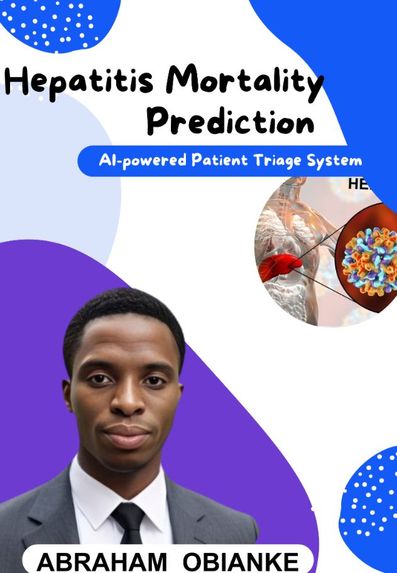
Hepatitis Mortality Prediction using Machine Learning
Inspiration
Hepatitis remains a significant global health challenge, with high mortality rates due to late diagnosis and disease progression. Inspired by the need for early risk assessment, we aimed to leverage AI to predict mortality outcomes, enabling proactive healthcare interventions.
What it does
The project predicts the likelihood of mortality in hepatitis patients using machine learning models. It takes patient data as input and provides a risk score, helping healthcare professionals make informed decisions about patient management.
How we built it
- Data Collection: We used publicly available hepatitis datasets for training.
- Preprocessing: Data cleaning, handling missing values, and feature engineering.
- Model Development: Trained multiple machine learning models, including logistic regression, decision trees, and neural networks, to compare performance.
- Web Deployment: Built a Flask-based web app for user interaction, allowing healthcare providers to input patient data and get predictions.
Challenges we ran into
- Data Limitations: Limited availability of large, high-quality hepatitis datasets.
- Feature Selection: Identifying the most relevant clinical parameters for accurate predictions.
- Model Performance: Balancing model accuracy and interpretability for practical medical use.
- Deployment Issues: Ensuring smooth integration of the model into a user-friendly web interface.
Accomplishments that we're proud of
- Successfully developed and deployed a working predictive model.
- Achieved competitive accuracy in mortality prediction.
- Built an intuitive web interface for ease of use in a clinical setting.
What we learned
- The importance of feature selection and medical relevance in AI models.
- The challenges of deploying machine learning models for real-world applications.
- How to integrate AI models into web applications using Flask.
What's next for Hepatitis Mortality Prediction
- Improving model accuracy with more diverse datasets.
- Enhancing interpretability with explainable AI techniques.
- Expanding the model to predict disease progression and treatment outcomes.
- Collaborating with healthcare professionals for real-world validation.
Built With
- css3
- html5
- javascript
- lime
- matplotlib
- numpy
- pandas
- python
- scikit-learn


Log in or sign up for Devpost to join the conversation.