-
-
-
-
-
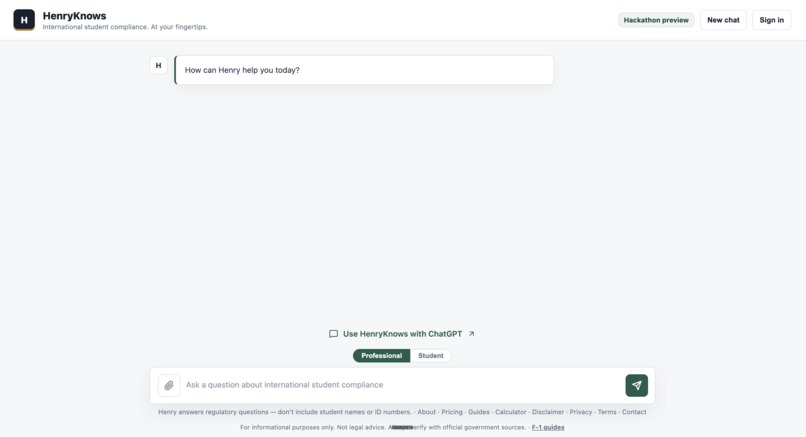
App with clickable WebMCP
Problem
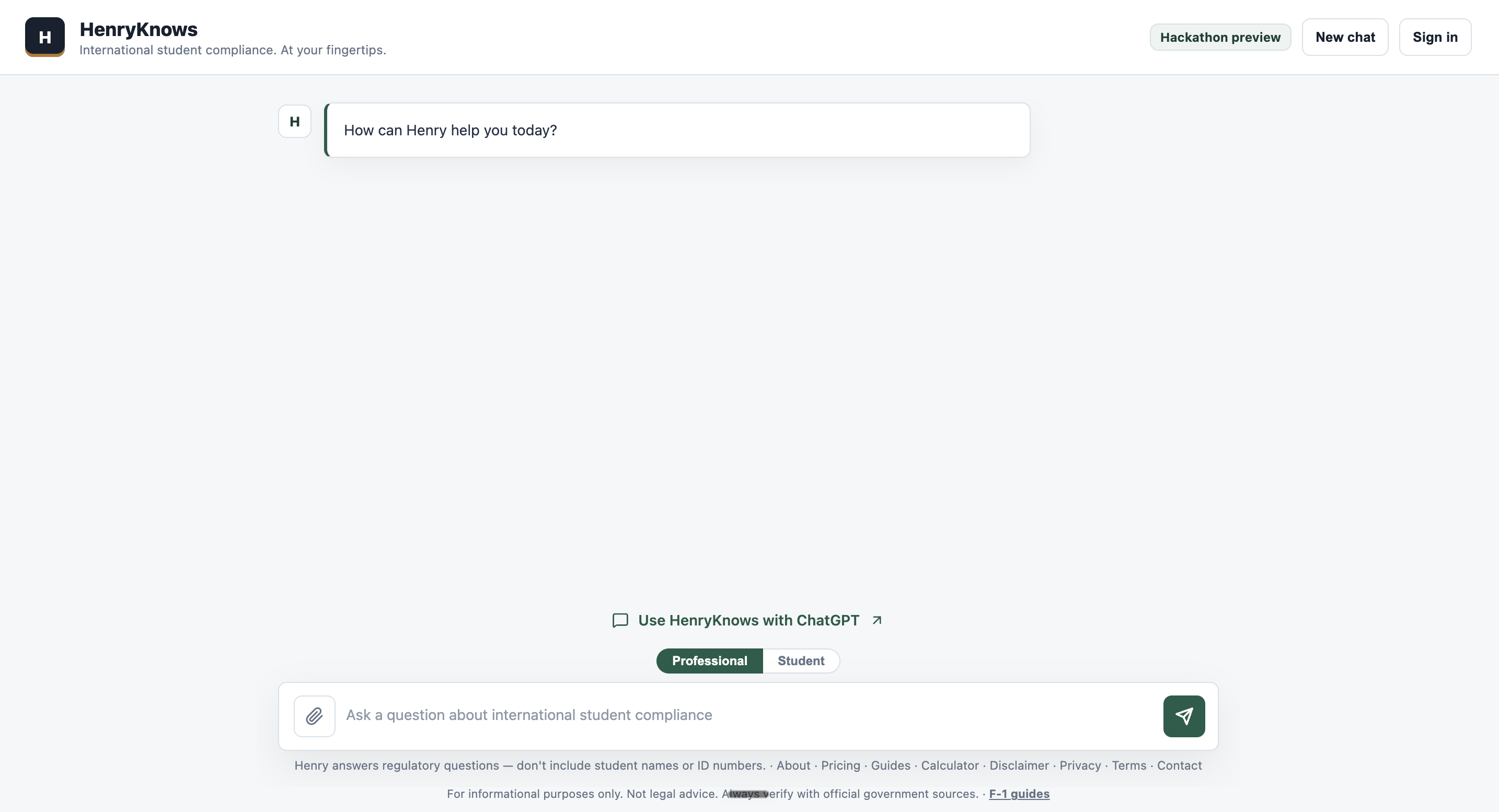
International students must make decisions about study, employment, travel, and immigration compliance while complex rules around them are changing weekly. They also do a LOT of filling out forms and submitting their information to get things done. A personal AI assistant may know the student's goals and prior plans, but off-the-shelf AI does not have HenryKnows' specialized F-1 reference system or a deterministic implementation of brand new duration-of-status rules. HenryKnows has that regulatory capability, but starts each visit needing to essentially do an intake
This can mean just another place already beleaguered students are having to reexplain themselves. Or they skip it altogether and arrive at advising appointments without a clear account of what matters or which questions remain unresolved -- and then having to reexplain themselves anyway.
Solution
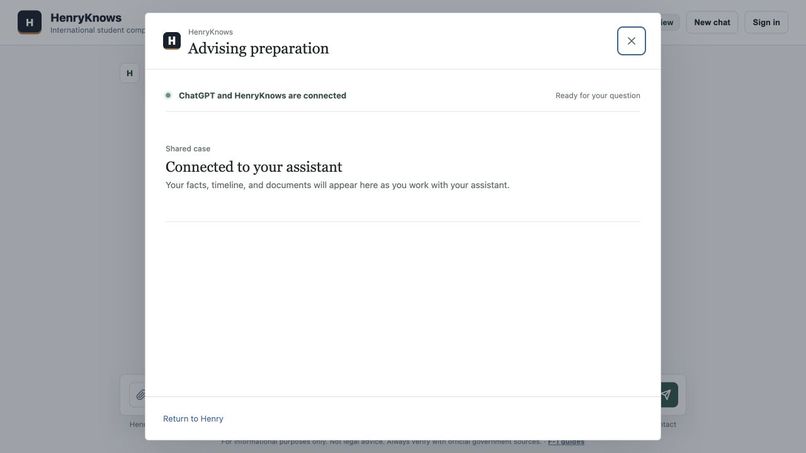
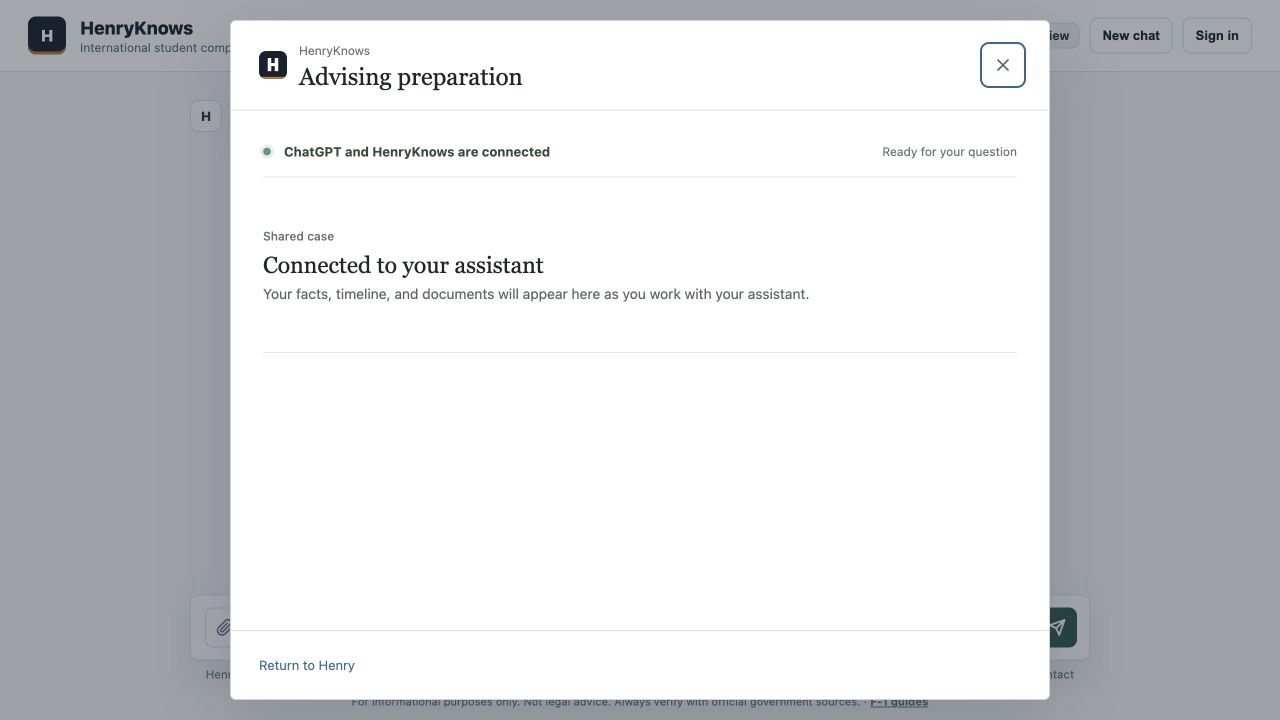
HenryKnows now exposes a bounded set of WebMCP tools to an external browser agent. With the student's permission, the agent can propose relevant facts already present in their memory, ask only for consequential gaps or corrections, consult HenryKnows repeatedly throughout, and run the specialized Duration of Status Mapper once the calculation inputs are settled.
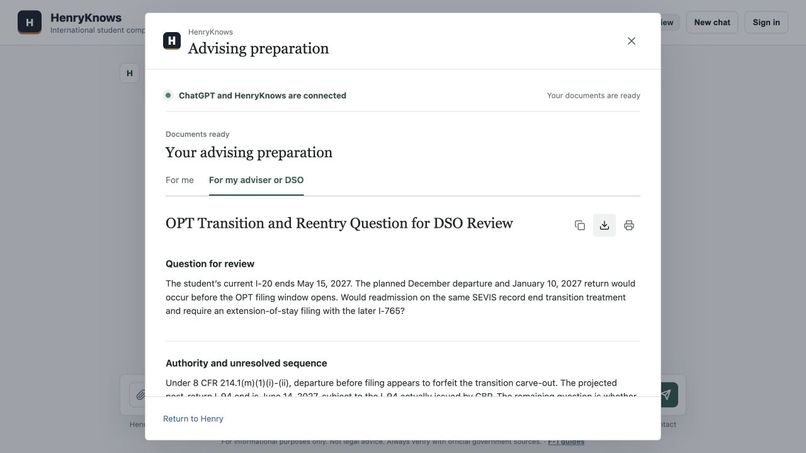
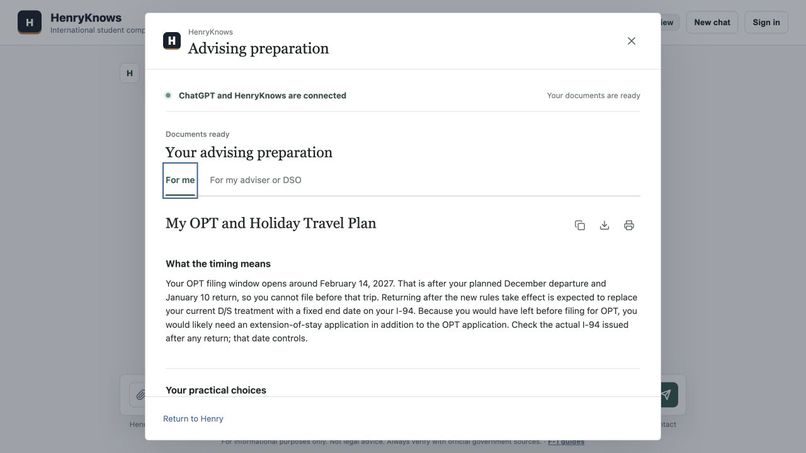
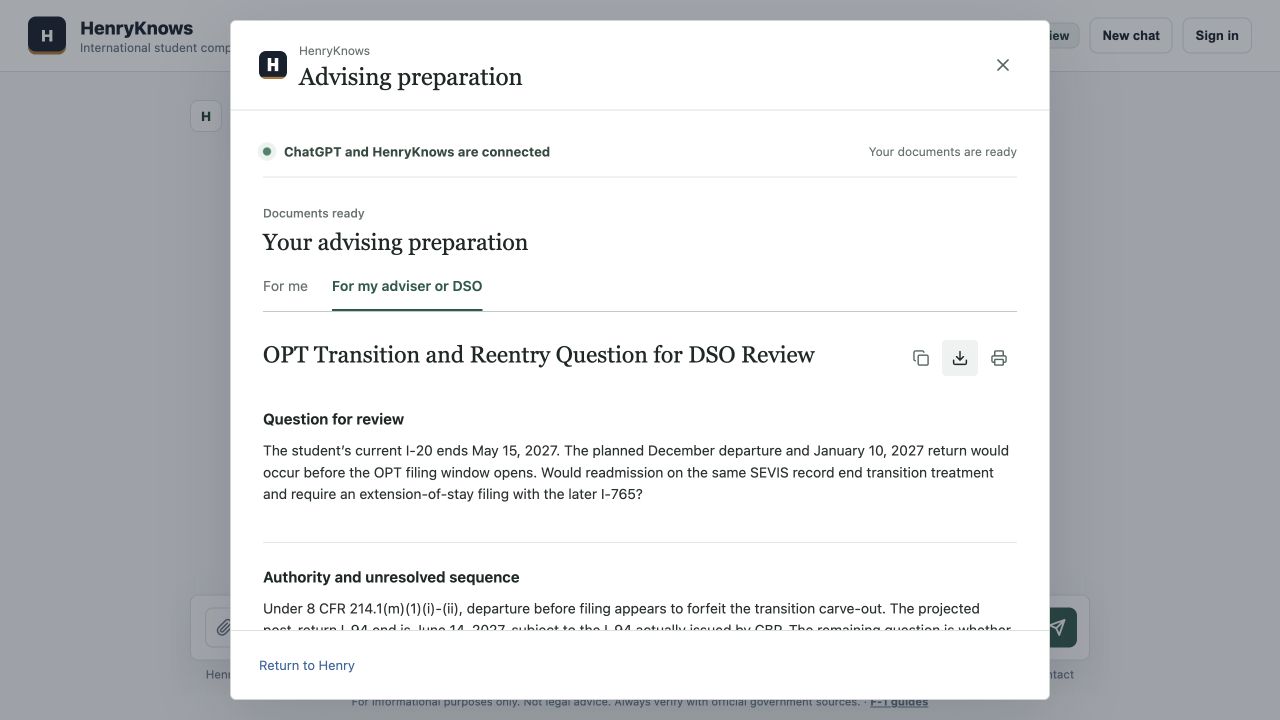
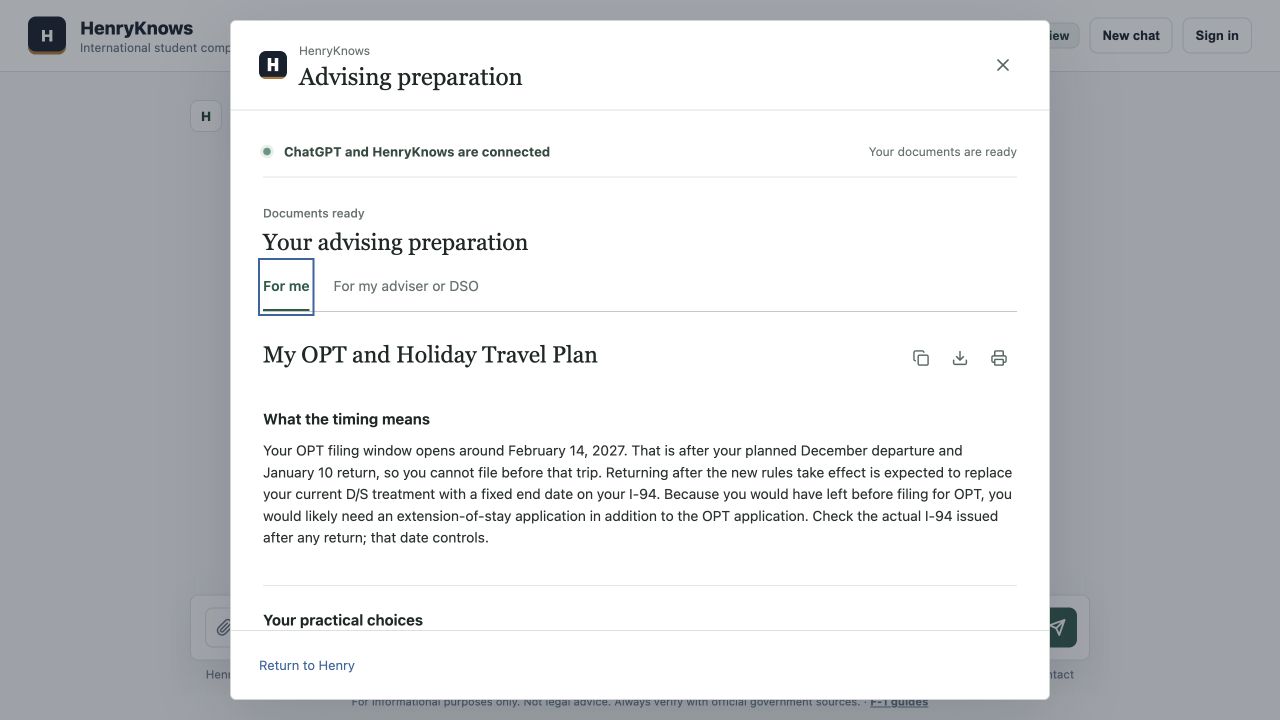
The student confirms the situation before case-specific calculations. Deterministic code, not the language model, calculates the new-rule classification, dates, and timeline. The agent evaluates HenryKnows' student and professional answers against that evidence and authors two coordinated documents: a plain-language student preparation brief and a concise, source-linked DSO brief. Both can be downloaded as polished PDFs.
Why This Matters
The collaboration gives each participant the job it is suited for:
- The student owns the facts, choices, and final sharing decision.
- The personal agent contributes context, conducts the conversation, and handles the procedural work.
- HenryKnows supplies broad F-1 analysis grounded in primary authority.
- The mapper performs its narrower deterministic job: showing how the September 15, 2026 duration-of-status rules affect the confirmed timeline.
- The DSO receives a short case-specific briefing, not routine professional instruction or an AI demand for a decision.
This is especially valuable where the sources do not resolve a new transition issue. The workflow preserves uncertainty, explains its practical significance, and directs human attention to the question that actually needs professional review.
Why WebMCP
This experience depends on capabilities that neither side has alone. A conventional website cannot access the context a student has already shared with their chosen agent. A personal agent cannot reliably reconstruct HenryKnows' curated regulatory retrieval or the mapper's deterministic rules. WebMCP allows the agent and student to work with the same live page and confirmed case while the website keeps specialized calculations, sources, validation, and visible state under its control.
The agent can consult HenryKnows repeatedly, refine the student’s confirmed case, determine whether the new-rules timeline applies, compare one or two plans, and save both final briefs together. If an important fact changes, earlier results are marked outdated rather than reused.
How We Used AI
The external agent acts as an expeditor. It interprets the student's goal, reuses relevant conversational context with permission, asks focused follow-ups, decides when another HenryKnows consultation would resolve ambiguity, translates technical findings into practical choices, and writes the two audience-specific briefs.
HenryKnows uses a model-backed answer engine over a curated index of primary F-1 sources. The model does not calculate legal deadlines or decide which duration-of-status branch applies. Those results come from the tested deterministic mapper and are supplied to the agent and HenryKnows as inspectable evidence.
How We Used Codex
Codex helped turn the initial idea into the implemented WebMCP workflow: inspecting the existing HenryKnows and mapper codebases, defining the shared case and tool contracts, implementing the native site tools, connecting the existing answer and calculation systems, and building the retained two-audience document surface.
The UX was developed through repeated real ChatGPT Work walkthroughs. Codex traced failures found during those sessions, including blank comparisons, repetitive confirmation loops, stale evidence, false completion claims, buried outputs, tool-language leakage, and Markdown downloads that opened in unrelated applications. Those failures became implementation changes and regression tests. The current suite contains 242 passing tests across 19 files, plus TypeScript and production-build verification.
Additionally, the Duration Mapper tool was originally built with Codex for another OpenAI hackathon.
Key Features
- Native WebMCP tools with visible shared-page state.
- Immediate connected status and restrained live activity pulse.
- Relevant conversational context proposed by the student's agent.
- Cumulative fact collection with one settled confirmation.
- Repeated HenryKnows consultation before or after clarification.
- Deterministic screening, plan calculation, timeline, and source references.
- Honest handling of unsupported or unresolved regulatory questions.
- Agent-authored student and professional briefs tied to the same case revision.
- Atomic document completion and stale-output protection.
- Polished student and adviser PDF exports with clickable professional sources.
- Server-controlled free judging access without changing the commercial HenryKnows product.
Architecture
- Static HenryKnows interface hosted on Netlify.
- Eleven bounded site-tool contracts registered through
document.modelContext.registerTool. - Versioned in-browser preparation case with confirmation and dependency invalidation.
- Existing TypeScript duration-of-status engine for deterministic rule calculations.
- HenryKnows retrieval and model-backed answer endpoint for broader F-1 guidance.
- Netlify Functions and Blobs for bounded continuation, long-running work, and short-lived transfer state.
- Client-side PDF generation loaded only when the user requests a download.
Existing Project And New Work
HenryKnows and the integrated Duration of Status Mapper existed before the challenge. The mapper was originally created for an earlier hackathon and was subsequently updated inside HenryKnows. They are not presented as new work for this challenge.
Work added during the WebMCP Challenge includes the native site-tool layer, external-agent expeditor contract, versioned shared case, conversational confirmation boundary, cumulative connected interface, mapper/Henry orchestration, iterative consultations, revision and stale-work protection, atomic paired-document retention, audience-specific document validation, and client-generated PDF handoffs. The dated commit history and build log distinguish this extension from the prior products.
Built With
- anthropic-claude
- chatgpt
- codex
- jspdf
- netlify
- netlify-blobs
- netlify-functions
- react
- typescript
- vite
- vitest
- webmcp

Log in or sign up for Devpost to join the conversation.