Inspiration
Crimean-Congo Hemorrhagic Fever (CCHF) is a high-mortality viral disease with fatality rates up to 40% in endemic regions. Early symptoms often resemble common infections, making timely recognition and triage difficult — especially in rural or resource-limited healthcare settings. We were inspired by the gap between early symptom presentation and lifesaving intervention. HemoSense was created to transform complex epidemiological and clinical patterns into actionable decision support for frontline healthcare workers.
What it does
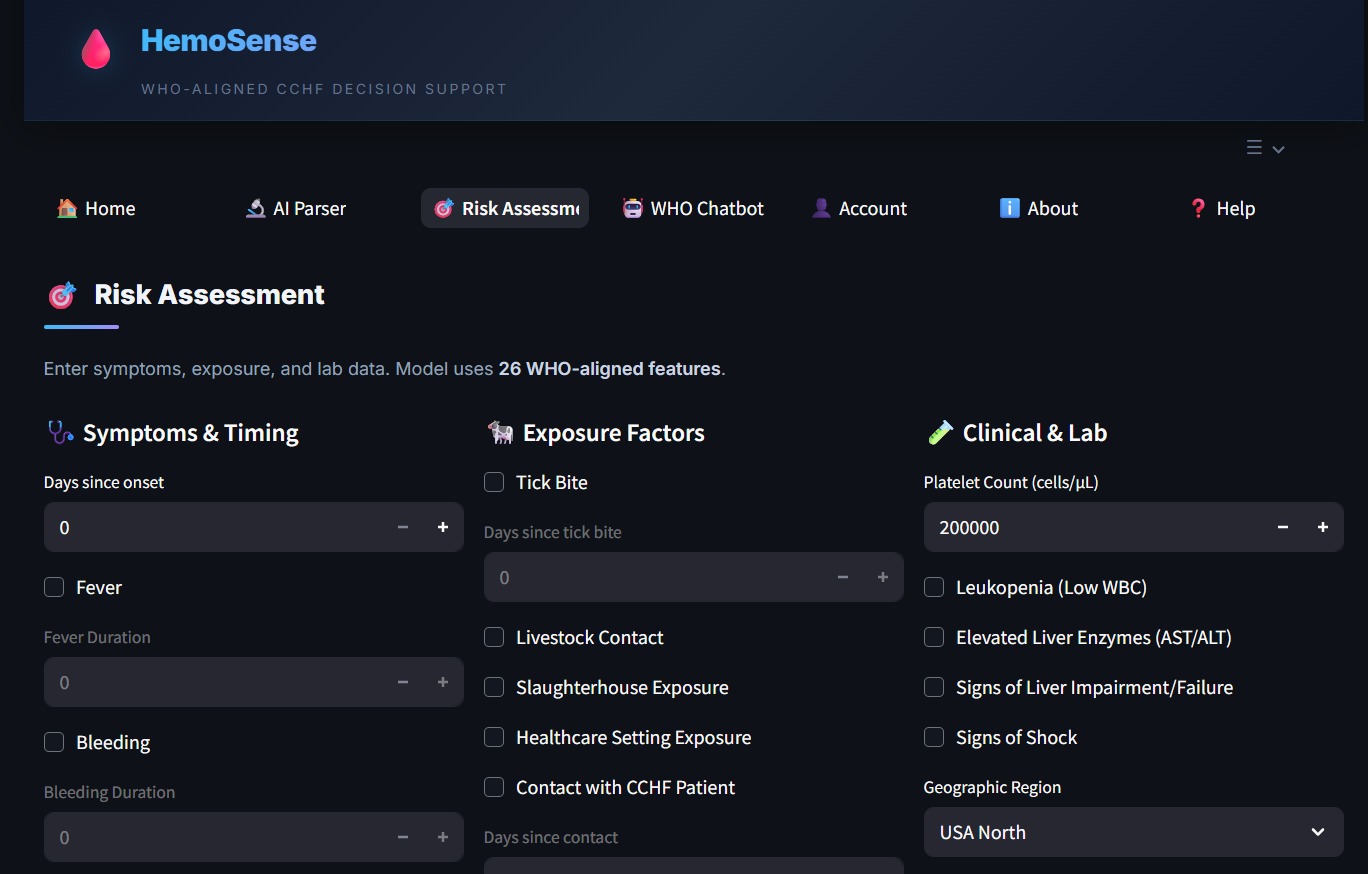
HemoSense is an explainable AI clinical decision-support system for early CCHF risk assessment and triage guidance. It analyzes WHO-aligned symptoms, exposure factors, laboratory indicators, geographic risk, and seasonal patterns to predict both disease risk and stage. Unlike typical prediction tools, HemoSense translates AI outputs into interpretable risk factors, recommended precautions, and medical escalation guidance. It generates a structured clinical report that can be exported as a PDF for referral or documentation. The system also includes outbreak simulation and epidemiological insights.
How we built it
We designed a synthetic dataset grounded in WHO CCHF epidemiology and engineered 28 clinical and contextual features, including seasonal and regional risk encoding. Multiple machine-learning models were trained and validated using cross-validation and ROC/F1 evaluation, with explainable feature importance extraction. The application was implemented as a modular Streamlit platform with AI symptom parsing, WHO knowledge integration, and a clinical report generator that converts model predictions into actionable guidance.
Challenges we ran into
Limited availability of real CCHF datasets required careful design of a realistic synthetic dataset. Ensuring predictions remained clinically interpretable — not just statistical — was also challenging. Mapping explainable model features to meaningful precautions while avoiding heuristic bias required iterative refinement.
Accomplishments that we're proud of
We built a WHO-aligned, explainable ML system that not only predicts CCHF risk but converts it into actionable clinical guidance. The structured AI-generated precaution report and epidemiological simulation make HemoSense a practical decision-support prototype rather than just a predictive model.
What we learned
We learned that healthcare AI must prioritize interpretability and clinical usability alongside accuracy. Designing explainable models and translating predictions into trusted decision support requires combining machine learning with domain knowledge and human-centered design.
What's next for HemoSense
Future work includes validation with real clinical data, expansion to other hemorrhagic fevers, mobile deployment for rural healthcare workers, and integration with outbreak surveillance systems.
Built With
- cross-validation
- gradient-boosting
- llm
- logistic
- natural-language-processing
- numpy
- pandas
- plotly
- python
- rag
- random-forest
- regression
- reportlab
- roc/f1
- scikit-learn
- streamlit


Log in or sign up for Devpost to join the conversation.