Inspiration
Imagine this: It’s 2026. We are literally landing reusable rockets on drone ships, AI is passing the bar exam, and yet, if I want to know how hard my heart is pumping, I have to strap a tiny, stressful inflatable bounce-house to my arm and let it squeeze the absolute life out of me.
It’s absurd, right? It causes "white coat syndrome" (where your anxiety about the test artificially spikes the results), and you have to buy extra, clunky hardware.
One night, while staring blindly at my smartphone flashlight, a question hit me with the force of a pure dopamine rush: Wait... what if the camera could just 'see' my pulse? Every time my heart beats, the capillary bed in my finger changes color by a microscopic amount. What if, instead of just counting the beats, we used heavy-duty physics to reverse-engineer the entire vascular system using nothing but light and code? That "aha!" moment birthed Hemody.io.
What it does
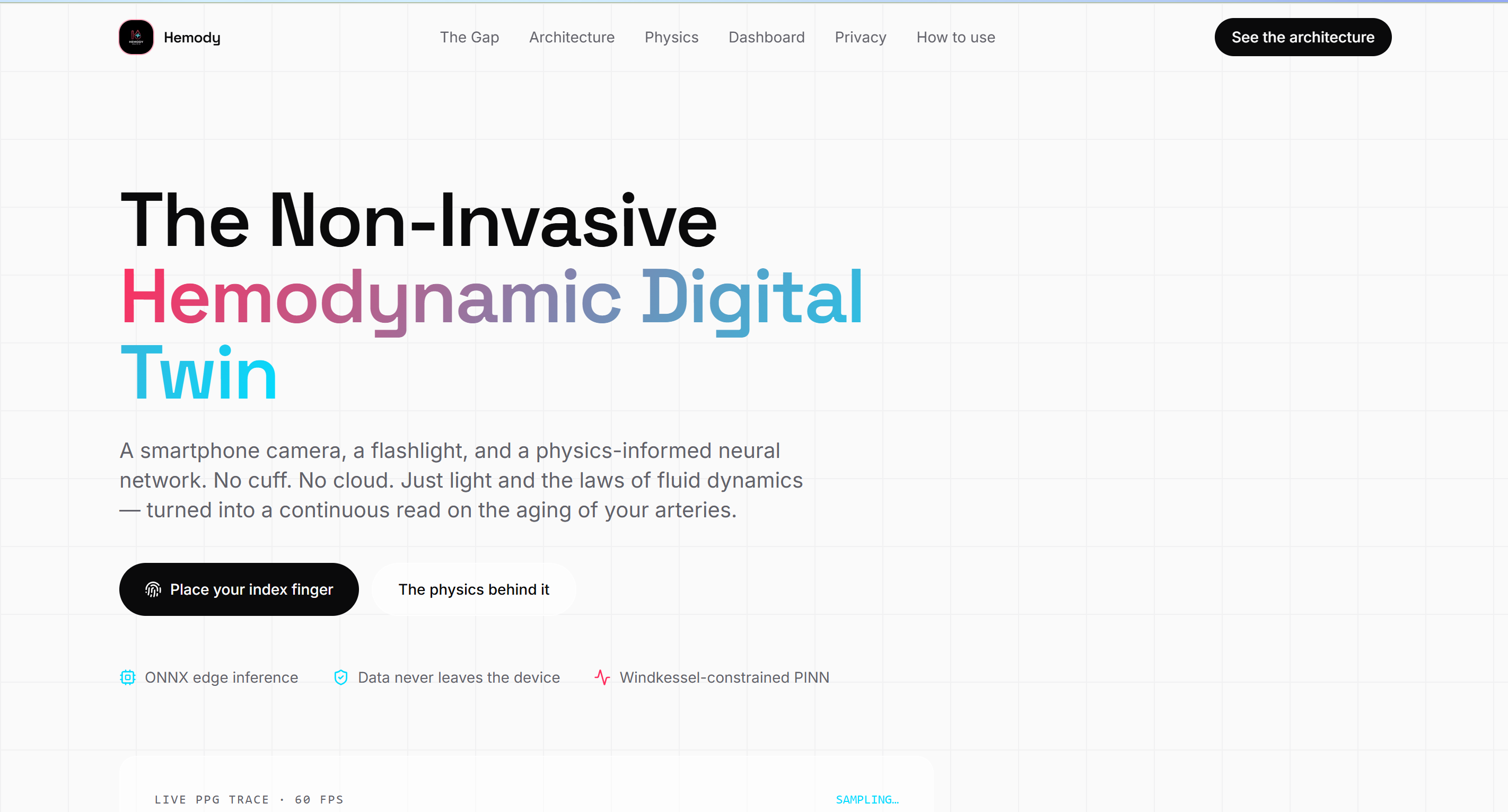
Hemody.io is a frictionless, non-invasive Hemodynamic Digital Twin. You place your index finger over your phone's camera and flash. The app records a 60 FPS video of your capillary bed, tracking the micro-fluctuations in your skin color to extract a live Photoplethysmography (PPG) waveform.
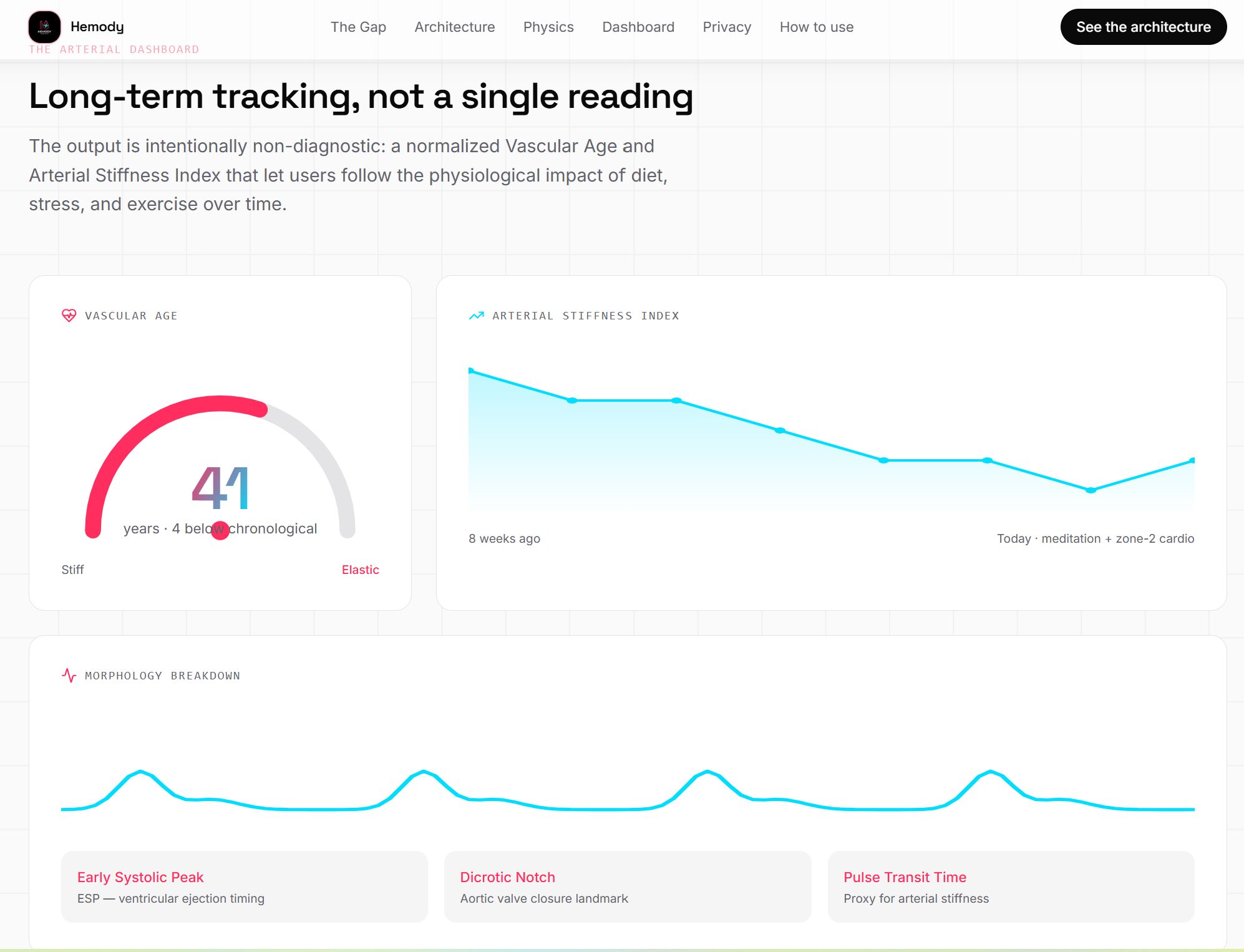
But here is where we get incredibly frank about what it is and isn't: If we output a clinical "120/80 mmHg" reading, the FDA would kick down our door, classify us as a diagnostic medical device, and lock us in clinical trials for five years. So, we designed a brilliant regulatory hack. Hemody.io doesn't diagnose disease. It analyzes the morphology of your pulse wave to output an Arterial Stiffness Index and a Vascular Age. It is purely a consumer wellness instrument to track how your late-night coding sessions and diet impact your vascular elasticity over time.
How we built it
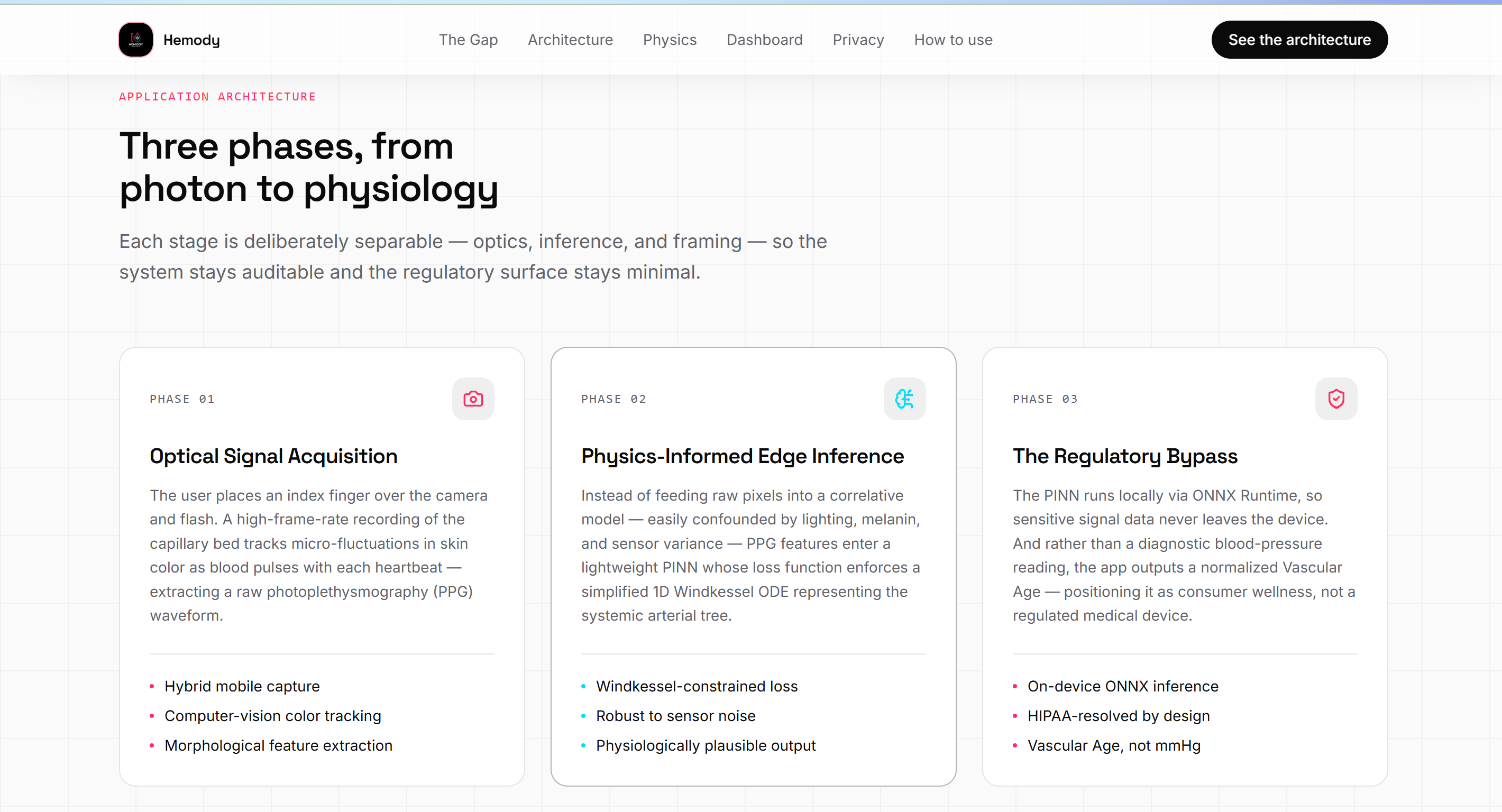
We built this as a three-stage pipeline to bridge the gap between photon and physiology:
- The Optics (Next.js & Capacitor.js): We tap directly into the mobile camera hardware to extract the raw red-channel video data and map the peaks.
- The Brains (Physics-Informed Neural Network - PINN): Standard AI is awful at this. It gets confused by melanin content or room lighting, creating biased data. We fixed this by mathematically forcing our neural network to obey the fluid dynamics of human blood using a 1D Windkessel model. It doesn't just guess pixels; it calculates physics!
- The Ghost Protocol (ONNX Runtime): Sending 60 FPS biometric video to a cloud server is a privacy nightmare. So, we execute the PINN locally, entirely on the edge in your browser. No data ever leaves the device.
Challenges we ran into
Let’s be brutally honest—physics is unforgiving, and this was incredibly hard to get right. Here are the very real limitations we faced:
- The User Error Problem: If you press your finger too hard against the lens, you squeeze all the blood out of your capillaries (blanching). The signal just flatlines. Poof, no pulse.
- The Ambient Light Sabotage: If your finger doesn't perfectly seal the flash and lens, room lighting sneaks in and ruins the waveform.
- The Compute Bottleneck: Running 60 FPS computer vision extraction and complex PINN inference on a mobile browser makes older phones sweat. If the phone drops frames, the algorithm misses the exact microsecond of the systolic peak, and the whole output gets skewed.
Accomplishments that we're proud of
We successfully crammed supercomputer-level fluid dynamics into a smartphone browser! Seeing that cyan dot perfectly sync up with my actual heartbeat for the first time, knowing the data wasn't being sent to some creepy data broker, felt like absolute magic. We bypassed racial bias in optical sensors by relying on the universal laws of physics, and we solved HIPAA compliance by never uploading a single byte of biometric data.
What we learned
We learned that the biggest hurdles in healthcare innovation aren't always technical; they are regulatory. Framing a product as "wellness" versus "diagnostic" completely changes the software architecture. We also learned that edge-AI (running models directly on the user's silicon) is the absolute gold standard for the future of health-tech privacy.
What's next for Hemody.io
We aren't stopping here. The next phases include:
- Motion-Cancellation: Right now, you have to hold perfectly still for 12 seconds. We want to integrate the phone's accelerometer data to actively cancel out motion artifacts, so you can get a clean reading even if your hand is shaking.
- Federated Learning: We want to train the model across thousands of phones without ever collecting user data, making the physics engine smarter while preserving absolute privacy.
- Acoustic Biomarkers: We plan to tap into the microphone to listen to respiratory stress in the user's voice, evolving Hemody.io from a vascular tracker into a full-blown cardiopulmonary digital twin.
Built With
- ai
- biometrics
- biotech
- cardiovascular
- computer
- edge
- health
- healthtech
- learning
- machine
- networks
- neural
- next.js
- onnx
- physics-informed
- pinn
- react
- vision
- wellness


Log in or sign up for Devpost to join the conversation.