-
-
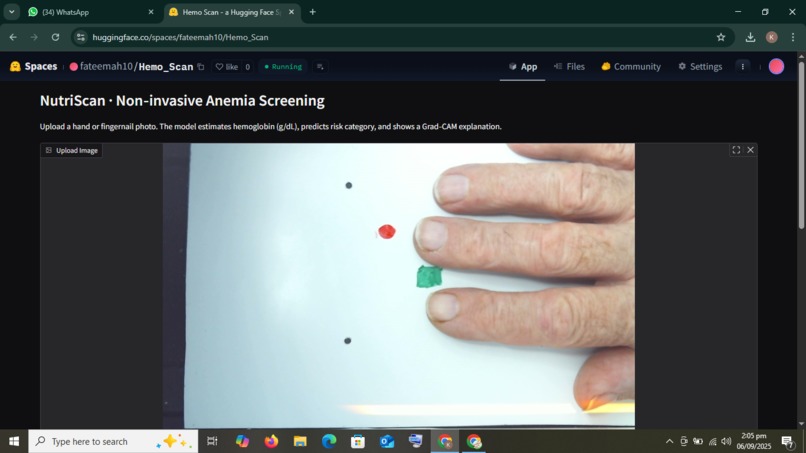
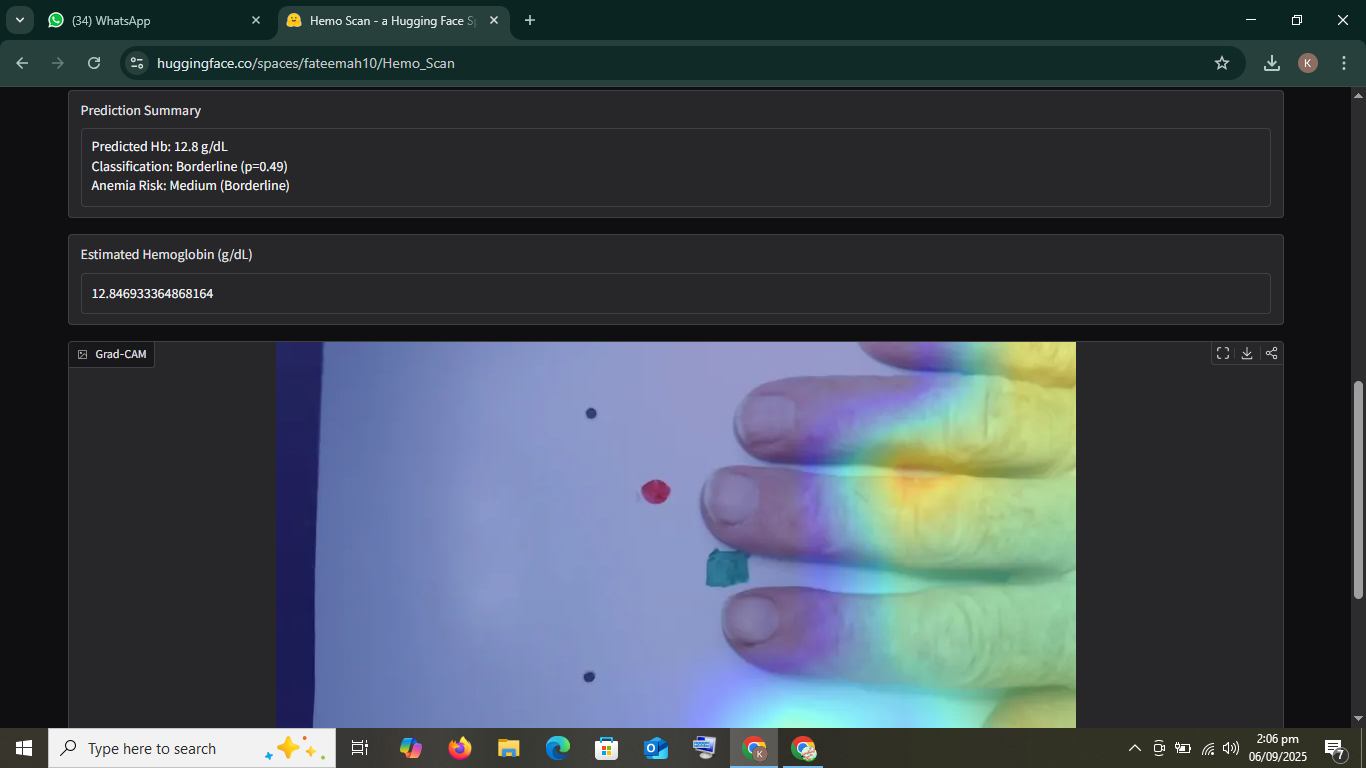
Picture for testing
-
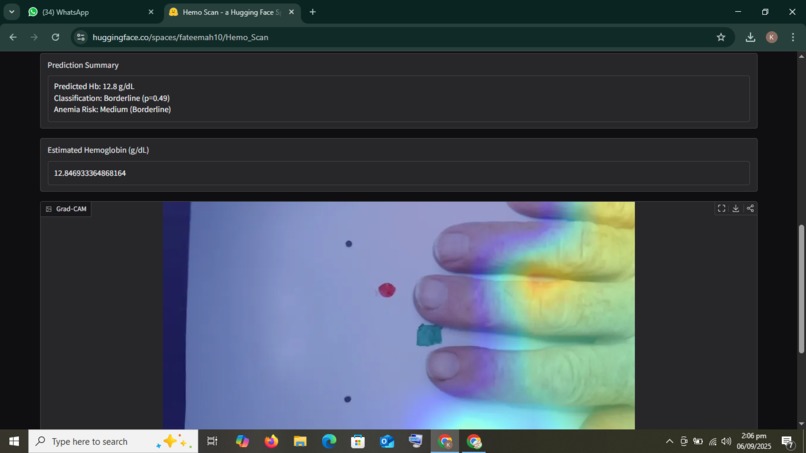
Grad-CAM visualization showing the nail regions the AI model focused on while predicting anemia risk.
-
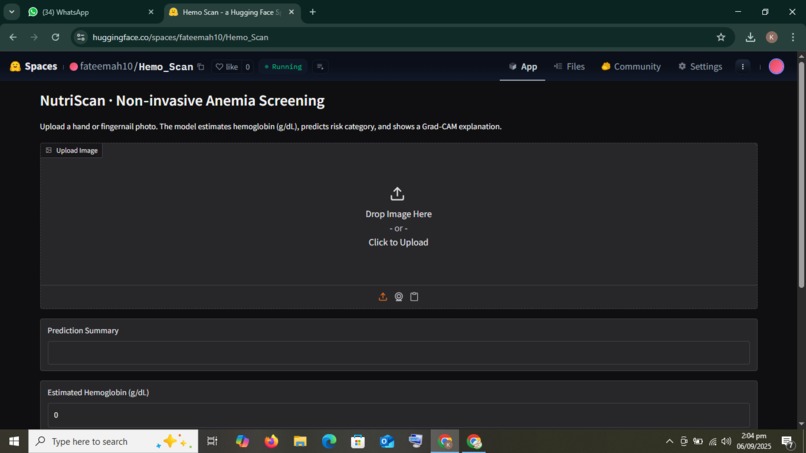
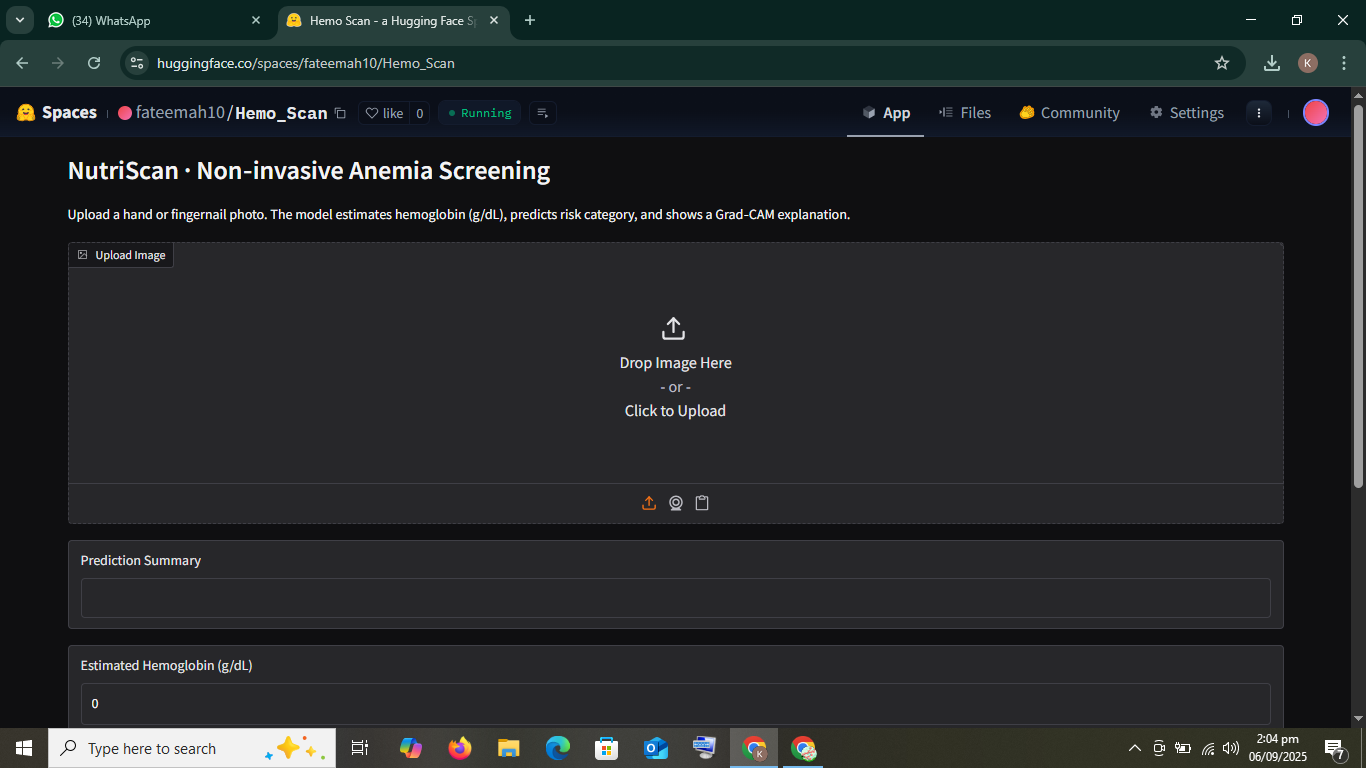
Basic App interface
Inspiration
Anemia affects millions of people worldwide, but it often goes undiagnosed because testing usually requires blood work, labs, or hospital visits that many people avoid due to cost or lack of awareness. We wanted to create a solution that is simple, non-invasive, and accessible to anyone with just a smartphone camera. Fingernails are a visible health indicator, so we explored using AI to analyze nail images and provide quick anemia risk screening.
What it does
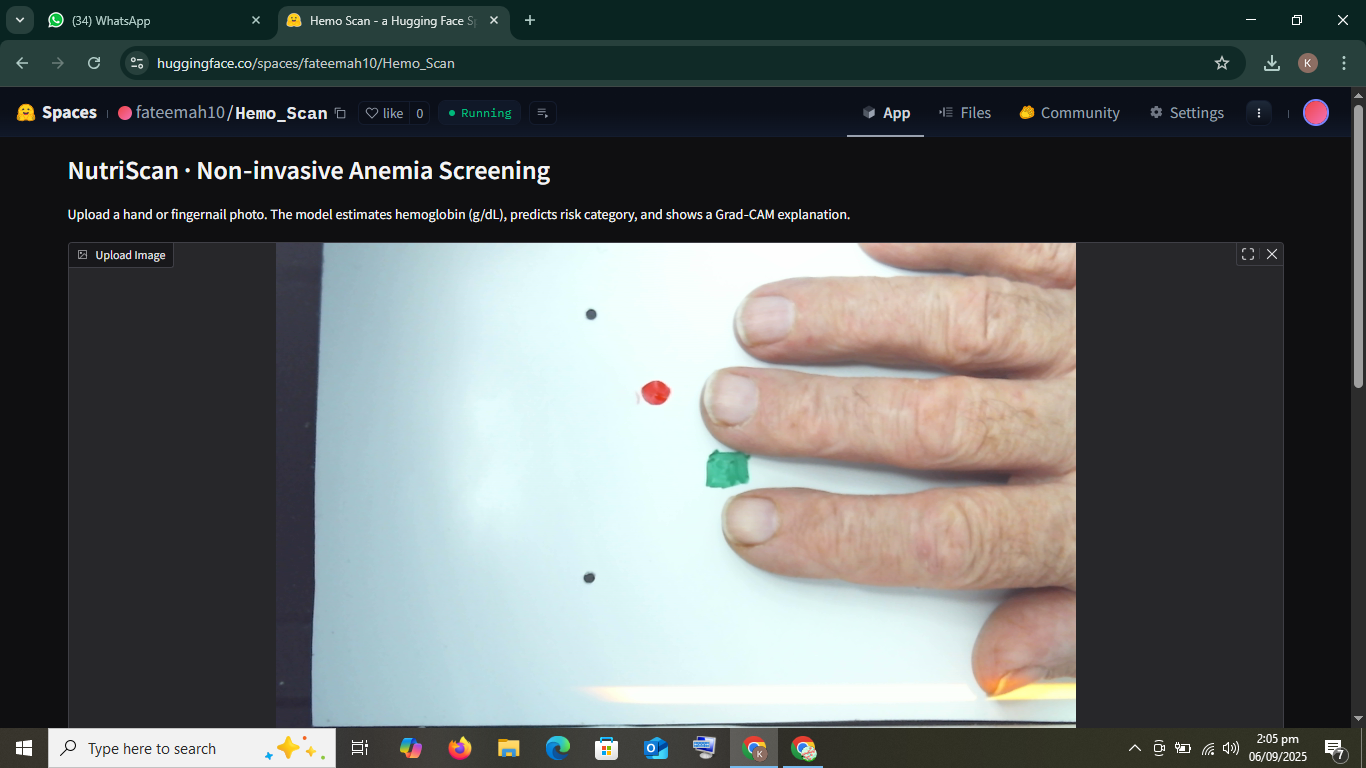
Hemo_Scan is an AI-powered tool that uses nail images to predict anemia risk. A user can upload a photo of their fingernails, and the system provides:
A predicted risk category (Anemic, Borderline, Normal)
An estimated hemoglobin level
A risk interpretation (High, Medium, Low)
It’s designed to give people an early warning and encourage them to seek medical advice if needed, not to replace lab tests, but to make anemia detection more accessible.
How we built it
-We prepared a dataset of fingernail images with metadata and hemoglobin values.
-Preprocessed the data and applied bounding boxes for nail regions.
-Built a deep learning model (MobileNet-based) with two outputs:
-Classification (Anemia vs. Borderline vs. Normal)
-Regression (Hemoglobin prediction)
-Used Grad-CAM visualizations to highlight which nail regions the model focused on.
-Trained and evaluated the model in Colab, saving best checkpoints for testing.
Challenges we ran into
-Limited dataset size made training harder and reduced accuracy.
-Class imbalance (more images in some categories than others).
-Ensuring the model focused on nails rather than background.
-Balancing classification (labels) and regression (hemoglobin) tasks together.
Accomplishments that we're proud of
-Successfully built a working pipeline that can take a nail image and give an anemia risk prediction.
-Integrated both classification and hemoglobin estimation into a single model.
-Generated clear Grad-CAM overlays to improve explainability.
-Created a foundation for a low-cost, non-invasive anemia screening tool.
What we learned
-How to handle imbalanced datasets with weighted sampling and augmentation.
-The importance of combining accuracy with usability and explainability.
-How AI can be applied to real health problems, but also the need for medical validation before real-world use.
What's next for Hemo_Scan
-Increase dataset size with more diverse nail images across ages, genders, and lighting conditions.
-Improve accuracy with advanced architectures (e.g., Vision Transformers, ensemble models).
-Build a user-friendly mobile/web app so people can try it easily.
-Collaborate with healthcare professionals for validation.
-Expand the idea to detect other conditions visible from nails (like deficiencies or circulation issues).


Log in or sign up for Devpost to join the conversation.