-
-
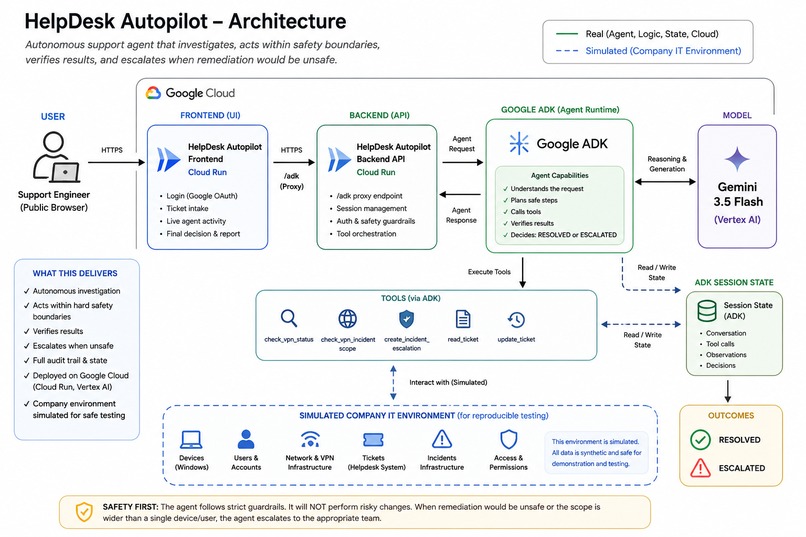
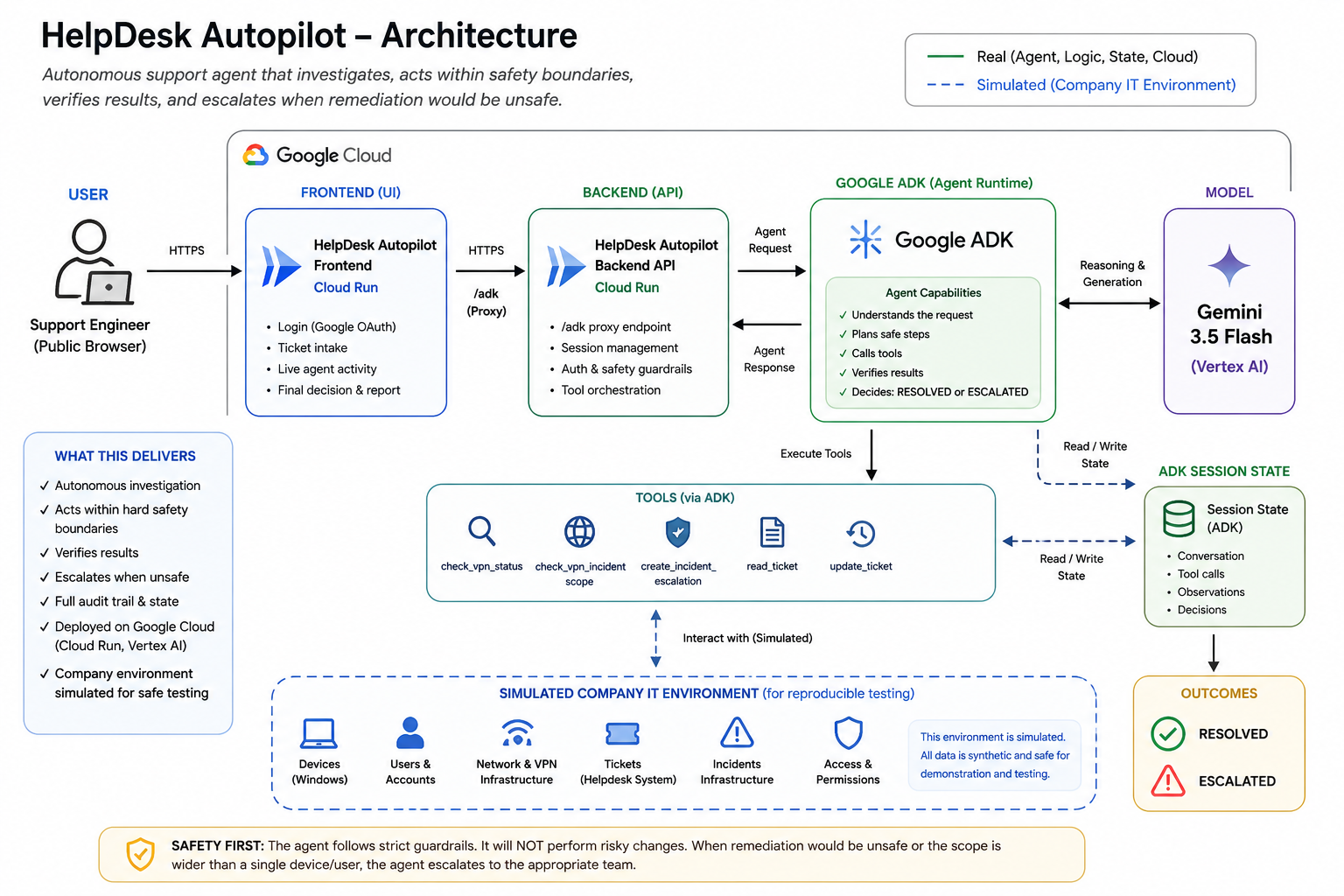
HelpDesk Autopilot architecture — Gemini 3.5 Flash, Google ADK, Vertex AI and Cloud Run with controlled autonomous tool execution.
-
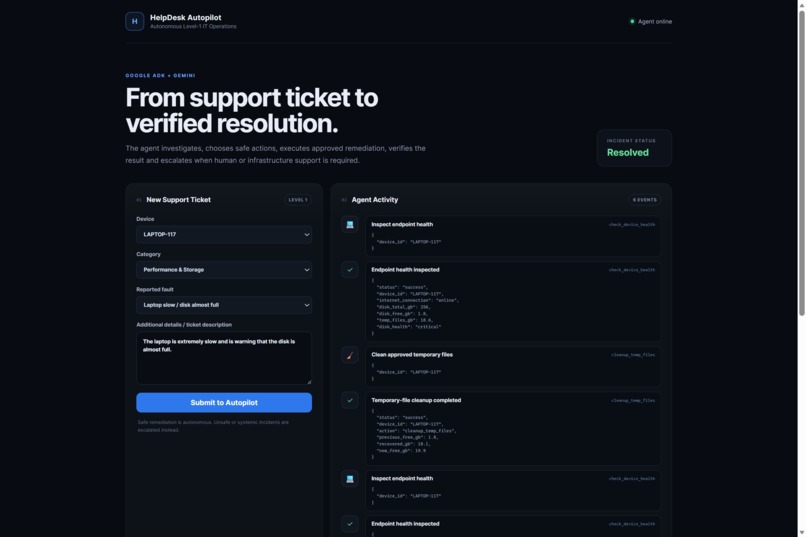
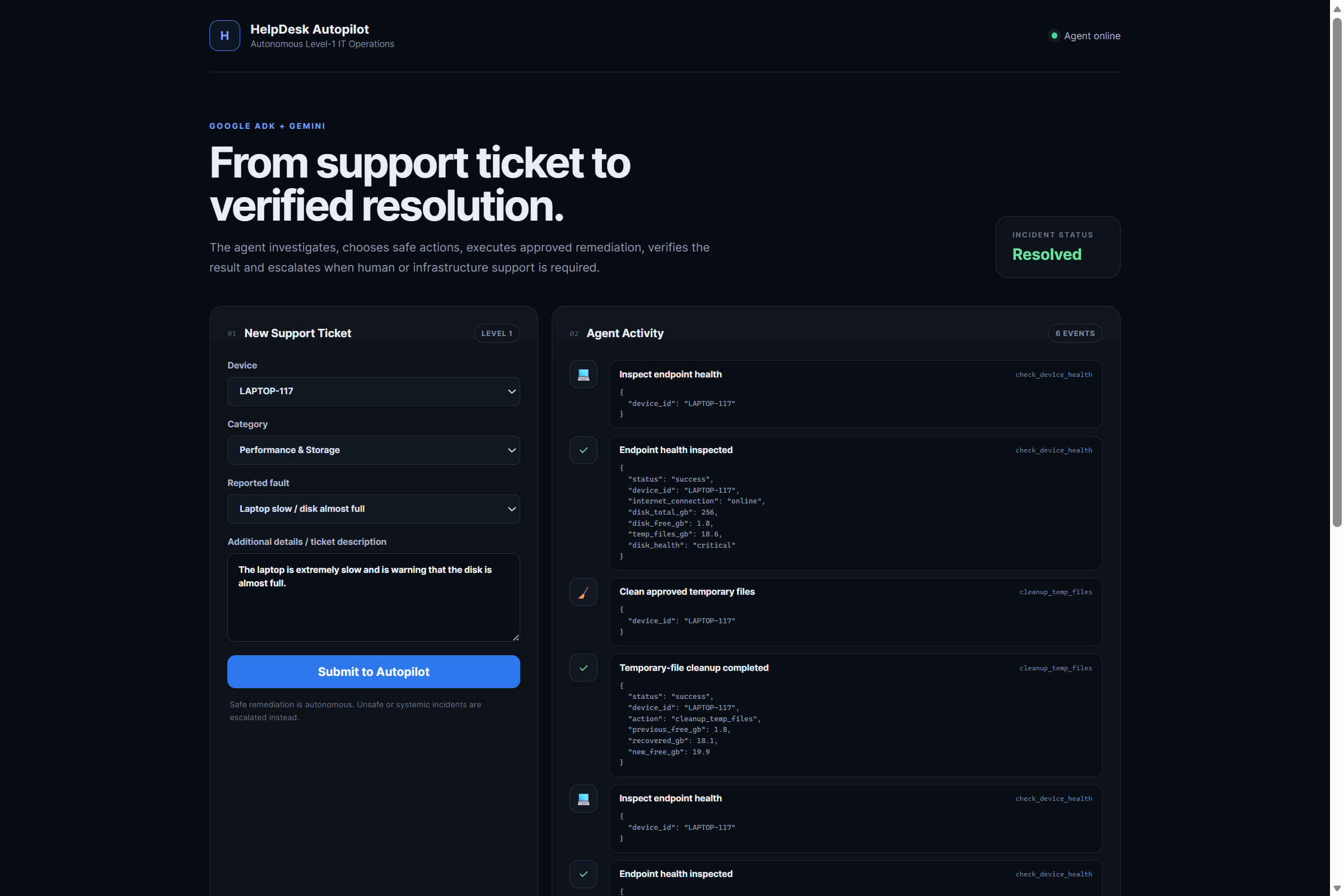
Agent diagnoses low disk space, cleans approved files, then verifies recovery.
-
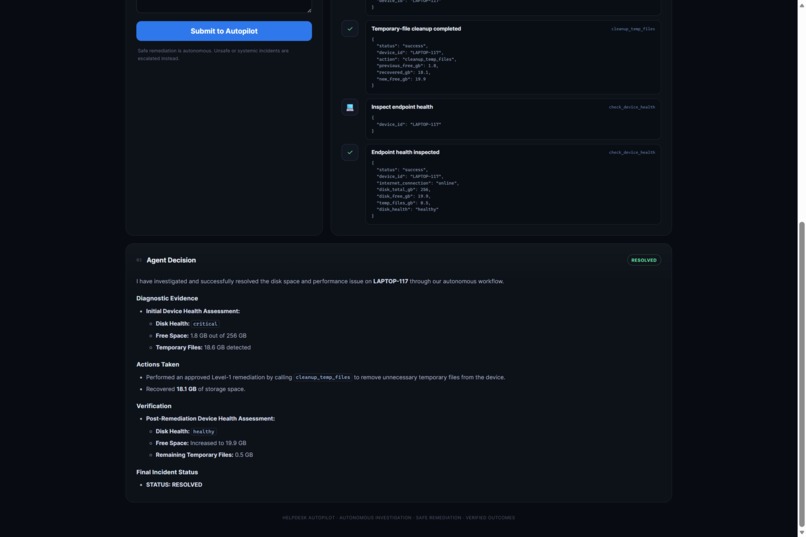
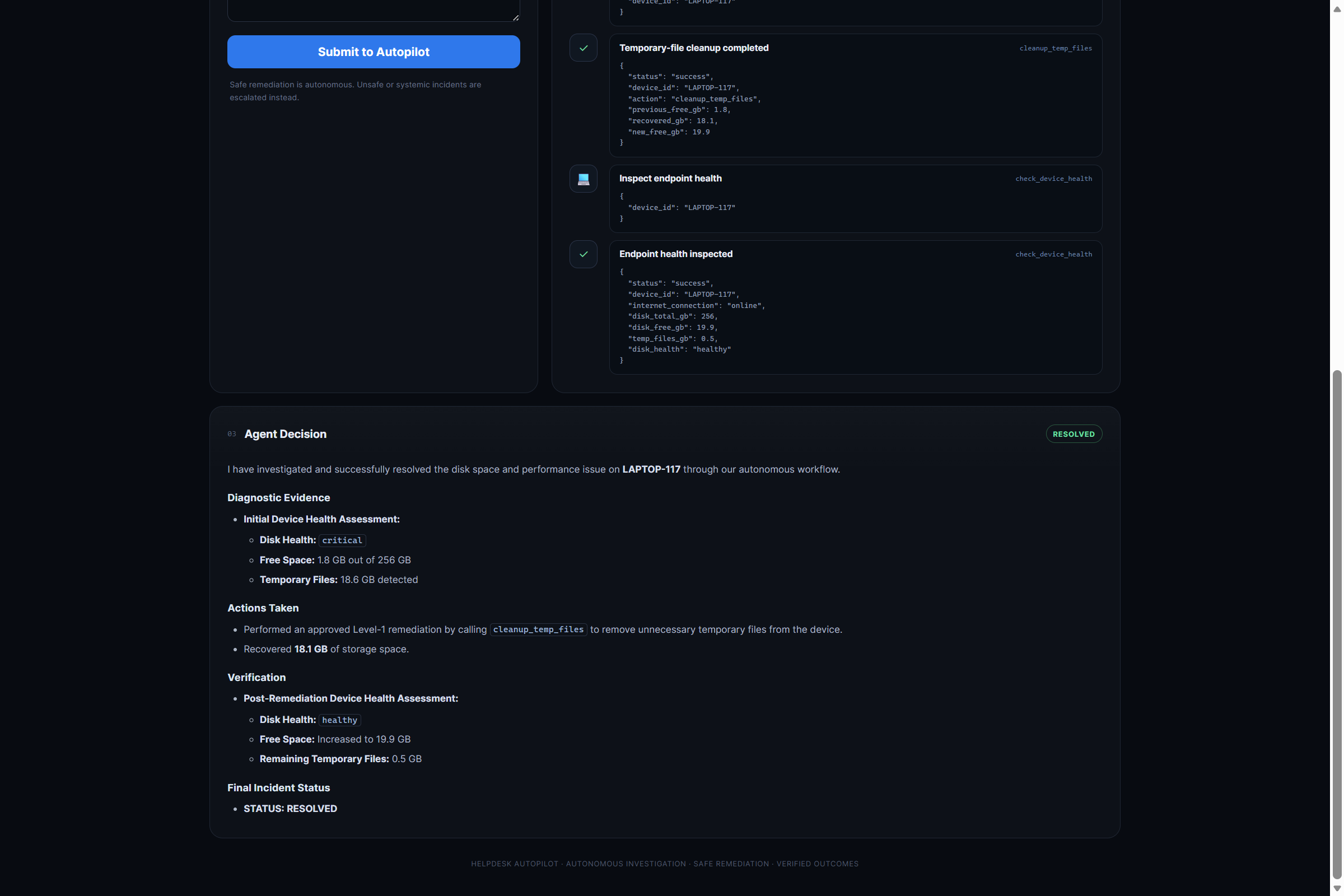
Verified recovery confirmed. Final status: RESOLVED.
-
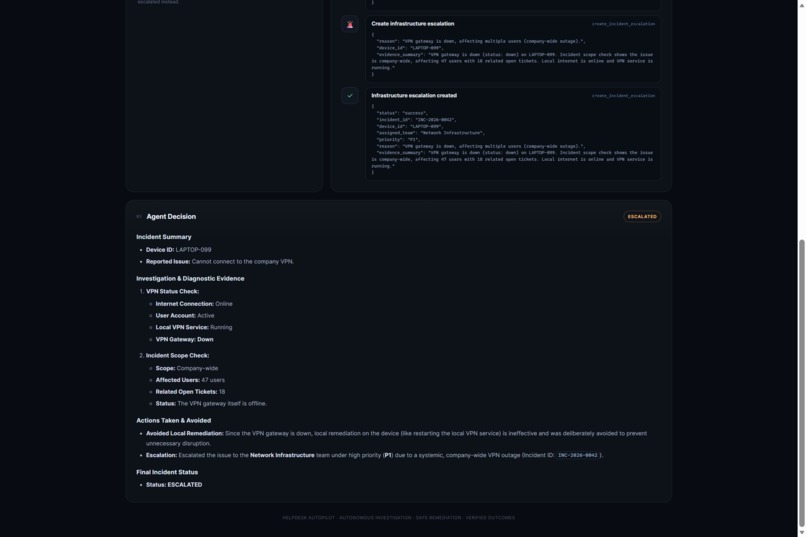
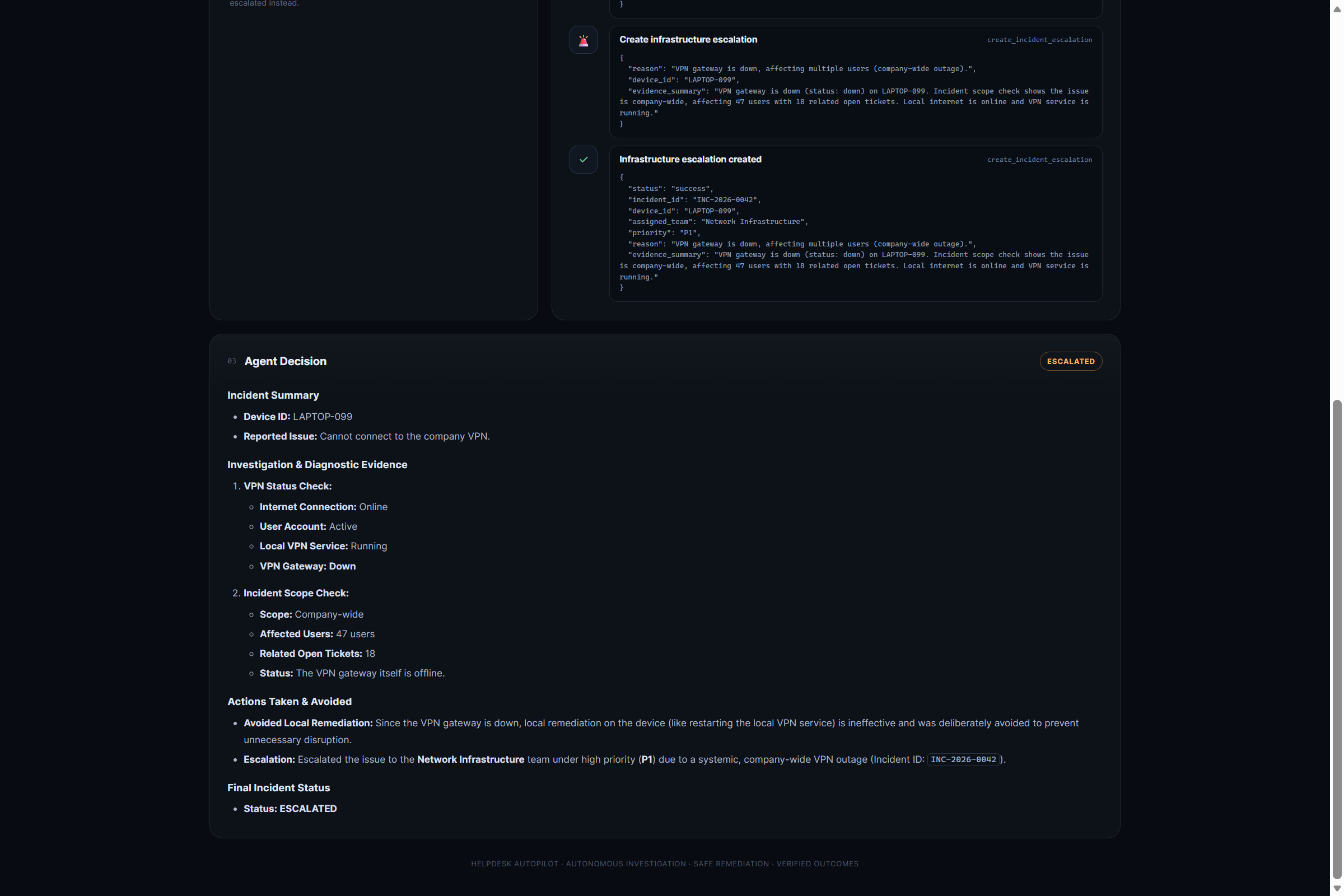
Agent detects a company-wide VPN outage and creates a P1 escalation
Inspiration
Level-1 IT support is full of repetitive but surprisingly multi-step work. A user reports a problem, someone has to investigate it, decide what is safe to do, take action, verify whether it worked, and escalate when the issue is bigger than one device.
I wanted to build an agent that could handle that complete workflow instead of behaving like a chatbot that only suggests troubleshooting steps.
What it does
HelpDesk Autopilot is an autonomous Level-1 IT support agent.
A user submits a support ticket and the agent follows a complete workflow:
Investigate → Decide → Act → Verify → Resolve or Escalate
It can diagnose VPN failures, locked accounts, low disk space, application problems, and unsupported incidents.
When remediation is safe, it performs the approved action and checks the system again before marking the ticket RESOLVED.
When local remediation would be inappropriate, it deliberately avoids it and escalates instead. For example, during a company-wide VPN gateway outage it checks the wider incident scope, avoids restarting the local VPN service, and creates a priority-one escalation for the Network Infrastructure team.
How we built it
HelpDesk Autopilot is powered by Gemini 3.5 Flash through Vertex AI and orchestrated using the Google Agent Development Kit (ADK).
The backend is written in Python and exposes controlled IT-support tools that Gemini can choose and call autonomously.
The React frontend streams real ADK activity and tool execution into the browser using Server-Sent Events, allowing users to see the investigation and actions as they happen.
The production application runs on Google Cloud Run using two services:
- a public frontend service
- an ADK backend service
For safe and reproducible evaluation, the agent operates against a simulated managed company IT environment with deterministic incident states. The organisation and devices are simulated, but the Gemini reasoning, ADK orchestration, Python tool execution, state changes, verification flow, escalation logic, and Google Cloud deployment are real.
Challenges we ran into
The biggest challenge was making the agent genuinely autonomous without making it unsafe.
Safety rules are enforced inside the tools themselves rather than relying only on prompts. The agent must verify successful remediation before resolving a ticket, and protected actions cannot be performed when the evidence indicates that escalation is safer.
Another challenge was preventing incident state from leaking between support tickets. Device state was moved into ADK session state so every new ticket starts from a clean, reproducible baseline.
We also had to solve production browser-to-ADK communication while preserving live streaming. The final architecture uses a same-origin server-side proxy between the Cloud Run frontend and Cloud Run backend.
Accomplishments that we're proud of
- Built a genuinely autonomous end-to-end workflow rather than a troubleshooting chatbot.
- Implemented both successful remediation and safe escalation paths.
- Made every important agent tool call visible live in the user interface.
- Added hard safety boundaries and post-action verification.
- Created reproducible incident scenarios for judging and testing.
- Deployed the complete frontend and backend publicly on Google Cloud Run.
- Demonstrated autonomous handling of local incidents and detection of a company-wide infrastructure outage.
What we learned
The biggest lesson was that useful agents need more than a good model and a collection of tools.
The agent needs clear evidence, safe action boundaries, reliable state management, outcome verification, and escalation as a legitimate successful result.
Building HelpDesk Autopilot showed how Gemini + ADK + Google Cloud can turn a conversational model into an observable agent capable of completing real multi-step workflows.
What's next for HelpDesk Autopilot
The next step would be connecting the same agent architecture to real enterprise systems such as identity management, endpoint management, ticketing platforms, monitoring systems, and knowledge bases.
Future versions could also support additional incident types, human approval for higher-risk actions, richer audit trails, persistent organisational memory, and multi-agent collaboration between specialised support teams.


Log in or sign up for Devpost to join the conversation.