-
-
Helpa frontend
-
metadata.json
Inspiration
Most preventable deaths after an accident happen before the patient reaches a hospital. A crash on an expressway, a pot of hot oil in a kitchen, a child convulsing at 2am, a snake bite on a farm — the outcome is often decided in the ten minutes before anyone medical is involved.
In that window, the wrong action is worse than none. Butter on a burn. Tilting a bleeding nose backwards. Forcing a spoon into the mouth of someone having a seizure. Sucking venom from a snake bite. These are common, taught by word of mouth, and they cause harm.
The people standing in that window are rarely clinicians, and across much of Nigeria they are not operating in English.
We tested that failure before writing a line of training code. Asked in Yorùbá what to do for a feverish, shivering child, base Gemma 4 E2B produced fluent nonsense — rendering doctor as ìwé ìròyìn, which means newspaper. The identical question in English returned a clean, sensible answer that correctly directed the user to a clinician.
That gap is the project. An emergency assistant that only works in English, and only with signal, is not an emergency assistant for the people most likely to need one.
What it does
Helpa gives step-by-step first-aid and triage guidance in Yorùbá or English, whichever language the question was asked in — for the presentations that actually show up in Nigeria: malaria, typhoid, kwashiorkor, snake bite, burns, choking, seizure.
It leads with what not to do, because in this domain the harmful actions are the common ones, and every answer is anchored to a hospital referral — Helpa triages and stabilizes, it does not diagnose.
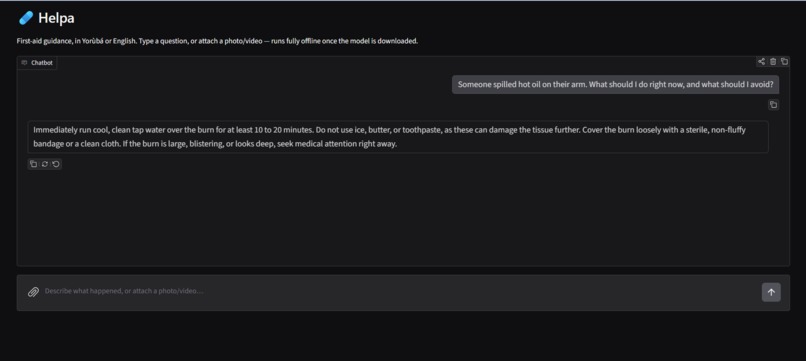
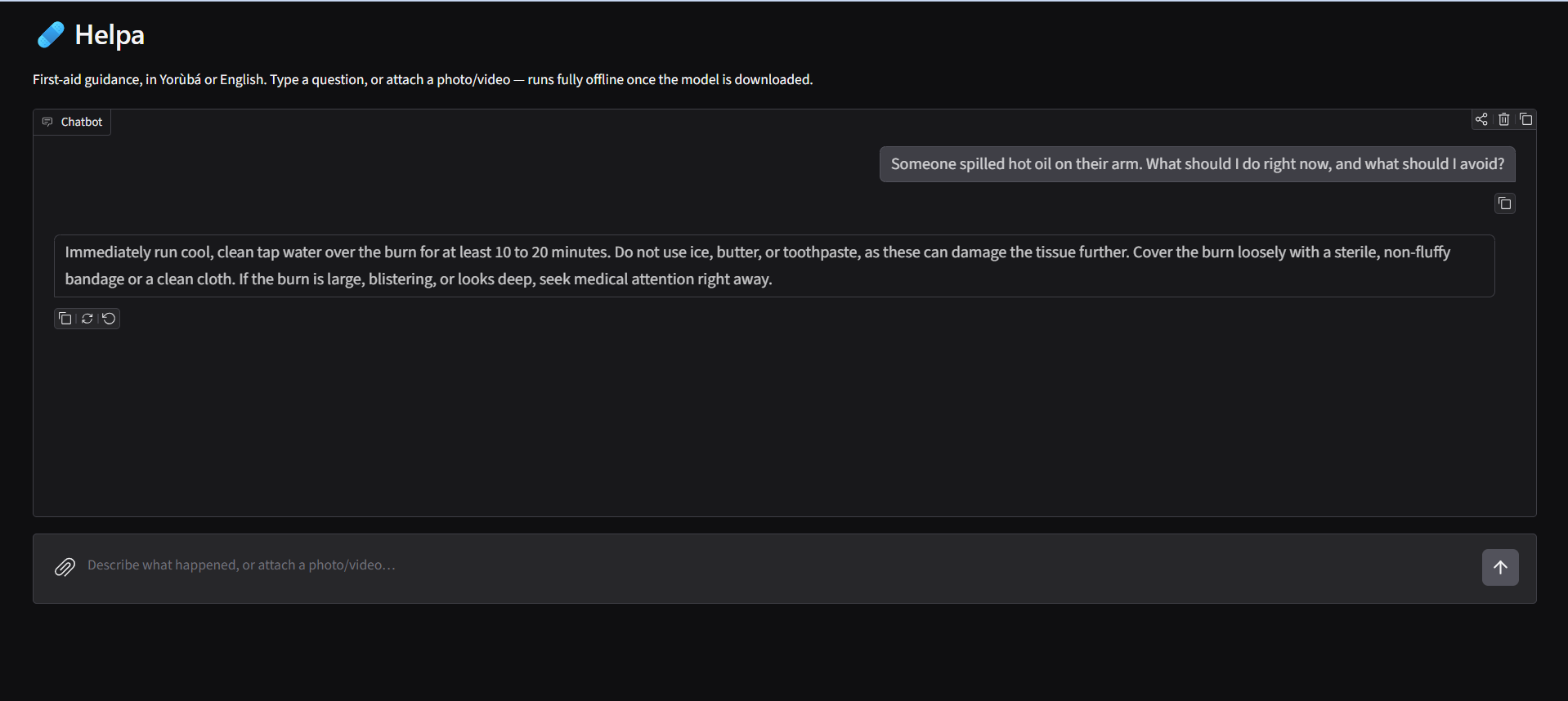
Ask it "Ejò bu ẹnìkan jẹ ní ẹsẹ̀. Kí ni àwọn ìgbésẹ̀ tí mo gbọdọ̀ ṣe?" — a snake bit someone on the leg, what do I do — and it answers in Yorùbá with the same procedural precision that "someone spilled hot oil on their arm, what should I avoid" gets in English.
The whole thing runs on the CPU of an 8 GB laptop with no internet connection — because emergencies happen exactly where signal does not reach.
How we built it
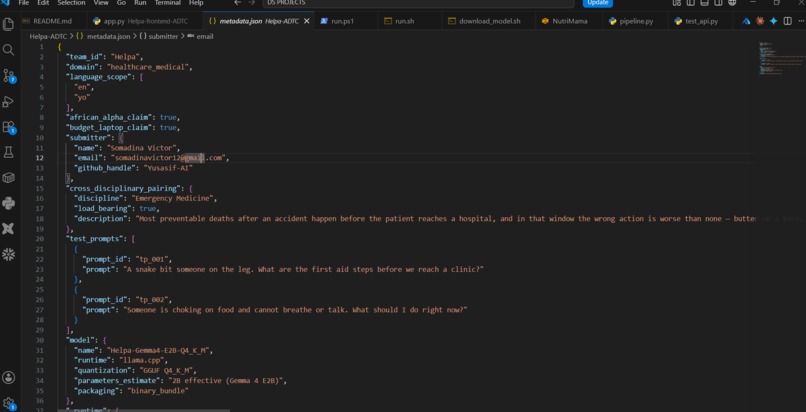
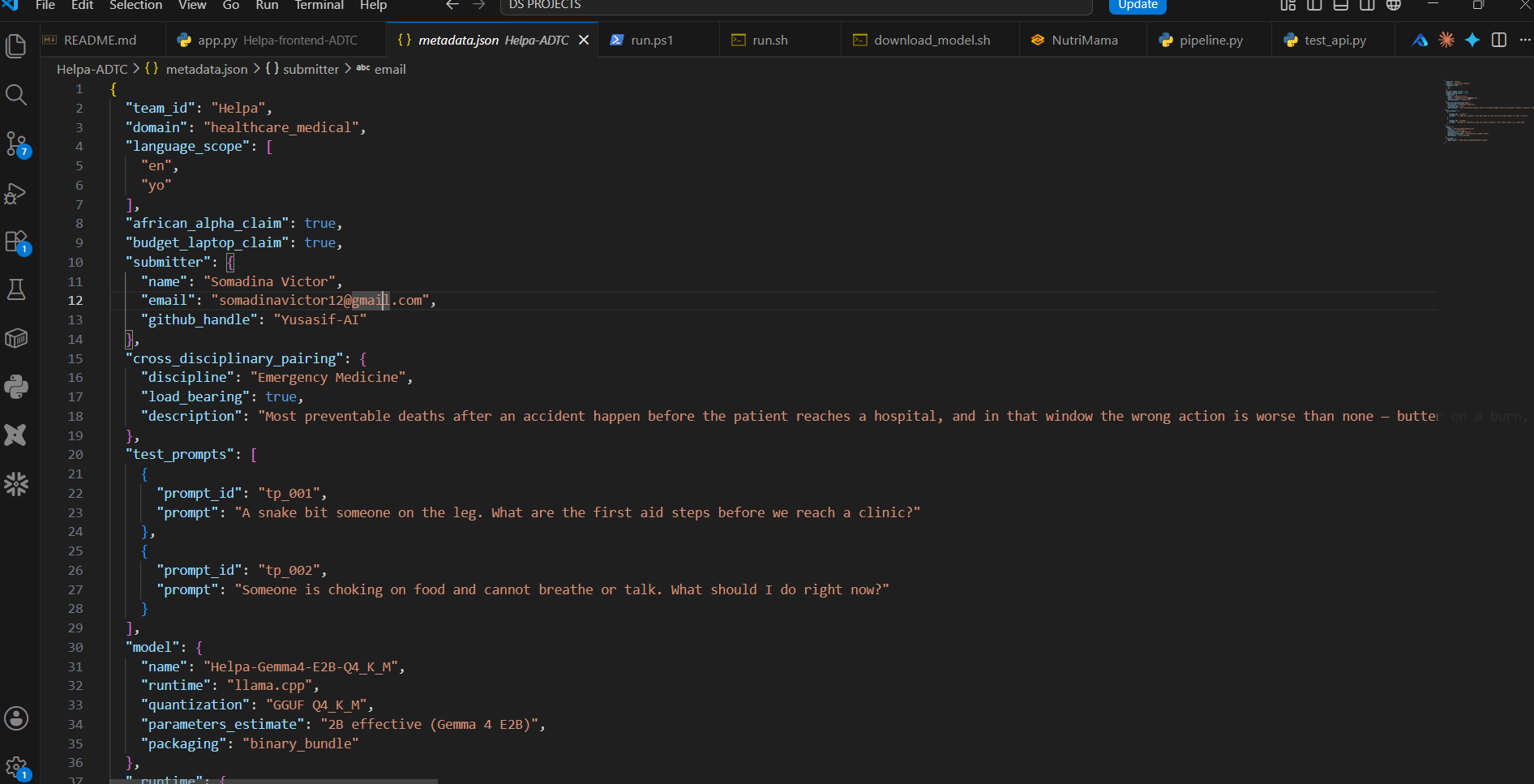
Base model: Gemma 4 E2B — natively multilingual, so Yorùbá is adaptation rather than a cold start; effective-2B fits the 8 GB laptop profile with headroom; supported by llama.cpp, which the track requires.
Training: text-only LoRA via FastLanguageModel — r=32, α=64, lr=1e-4, 3 epochs — with embed_tokens and lm_head frozen. This model takes no image input in training, so no vision layers are touched; the adapter is smaller and training faster than a multimodal run.
1,412 unique pairs — 773 Yorùbá / 639 English — plus a fluency slice:
slice n job Yorùbá health Q&A 760 70 triage topics, ~10 paraphrases each English health & first aid 614 step-by-step emergency procedure Yorùbá procedures, written for this work 13 procedural Yorùbá the source lacked Yorùbá fluency (en→yo rendering) 2,000 closes the generation gap Every Yorùbá token was verified before training against a 68,665-token attested vocabulary built from a human-reviewed Yorùbá corpus and human-written reference answers. Out-of-vocabulary rate: 0.00%. The gate caught real authoring errors at source — including ìdodo (navel) mistakenly used for toothpaste in a burns instruction.
Deployment: merged, converted to GGUF, quantized to Q4_K_M — ~3 GB, running under llama.cpp with zero network calls.
Challenges we ran into
The two languages were teaching different skills. The Yorùbá data was almost entirely triage — "what does this symptom mean" → "go to hospital." The English data was procedure — numbered emergency steps. Mixed unchanged, the model would learn English = steps, Yorùbá = hospital referral, exactly the inequality this project exists to remove. We authored 13 Yorùbá step-by-step procedures — choking, CPR, severe bleeding, fracture, burns, poisoning, seizure, heat collapse — to close it.
7,075 rows were really 785. The Yorùbá source contained 7,075 entries; deduplication showed 785 unique question/answer pairs and only 95 unique answers — the rest exact repeats. Training on the raw file would have produced memorization, not capability.
The tokenizer shreds Yorùbá. English runs 1.16 tokens per word; Yorùbá runs 2.75. 'Ṣàlàyé àwọn èròjà' tokenizes into twelve near-character fragments. At 2.4× the token cost, tone placement has to be learned token by token — repetition-loop degeneration is the known signature of that weakness, and it's exactly what base Gemma showed us before training.
Fine-tuning hard on a life-or-death domain risks losing general reasoning. We measured arc_easy before and after: 70.0% base → 68.3% fine-tuned (n=300) — inside sampling noise. The Yorùbá and procedural work cost nothing in general reasoning.
Accomplishments that we're proud of
It leads with what not to do. Every procedure states the harmful action before the correct one, because in this domain those harmful actions are the common ones — that ordering is a deliberate safety choice, not a stylistic one.
We closed a capability gap, and proved it. Base Gemma answered a Yorùbá triage question with fluent nonsense — doctor rendered as newspaper. The fine-tuned model gives correct, actionable guidance in the same language, for the presentations that actually happen in Nigeria.
Every answer routes to a hospital. Helpa doesn't try to replace a clinician — it exists for the space before one is reachable, and it says so.
It works with the network unplugged, on hardware people already own — no data bundle, no signal, an 8 GB laptop is enough.
0.00% out-of-vocabulary across the Yorùbá corpus — and a caught error worth naming: ìdodo (navel) used for toothpaste in an early burns instruction. That's exactly the class of mistake that reads as fluent and would otherwise have shipped into a first-aid procedure.
We did it without breaking anything else. 68.3% vs 70.0% on arc_easy — within sampling noise. Emergency Yorùbá guidance cost nothing in general reasoning.
What we learned
Measure before you build. Probing base Gemma in Yorùbá told us the real problem was generation quality, not language routing — it already knew to reply in Yorùbá, it just had nothing correct to say.
In a domain where the wrong answer causes harm, verify at the token level. A mistranslated ingredient is embarrassing in a nutrition app. A mistranslated instruction in a burns procedure is dangerous — ìdodo/toothpaste is the reason the vocabulary gate exists, not a hypothetical.
The two languages needed different content, not just different words. This project's whole premise is that Yorùbá speakers deserve the same concrete, procedural guidance English speakers get — so we authored the missing Yorùbá procedures by hand rather than accept the gap.
Count unique examples, not rows. 7,075 rows holding 785 real pairs would have quietly trained a much weaker model if we hadn't deduplicated first.
Small and clean beats large and noisy. 1,412 unique pairs, verified end to end, moved eval loss from 0.548 to 0.324 with a monotone curve — no overfitting signature despite the small dataset.
What's next for Helpa
1: Voice input and output — hands are busy in an emergency, and Gemma 4 supports audio natively. 2: Image and video input in production — the model is natively multimodal; a bystander photographing an injury is sometimes faster than describing it. 3: Hausa, Igbo and Pidgin, using the same token-level verification method. 4: Deepening the procedural half of the dataset — this is where the life-saving minutes are. 5: Clinician review of every procedure, and alignment with Nigerian Red Cross and WHO first-aid guidance, ahead of field deployment.
Built With
- gamma
- llama.cpp
- model
- natural-language-processing
- python
- q4-km
- quantization
- transformers
