-
-
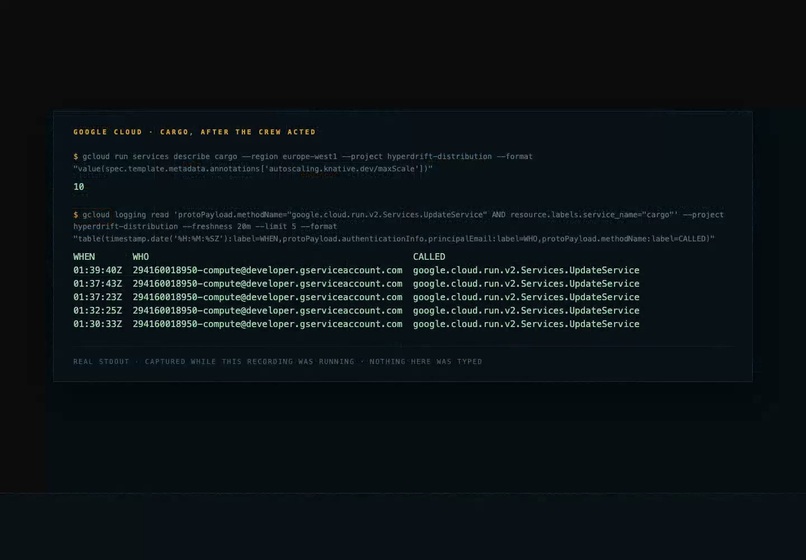
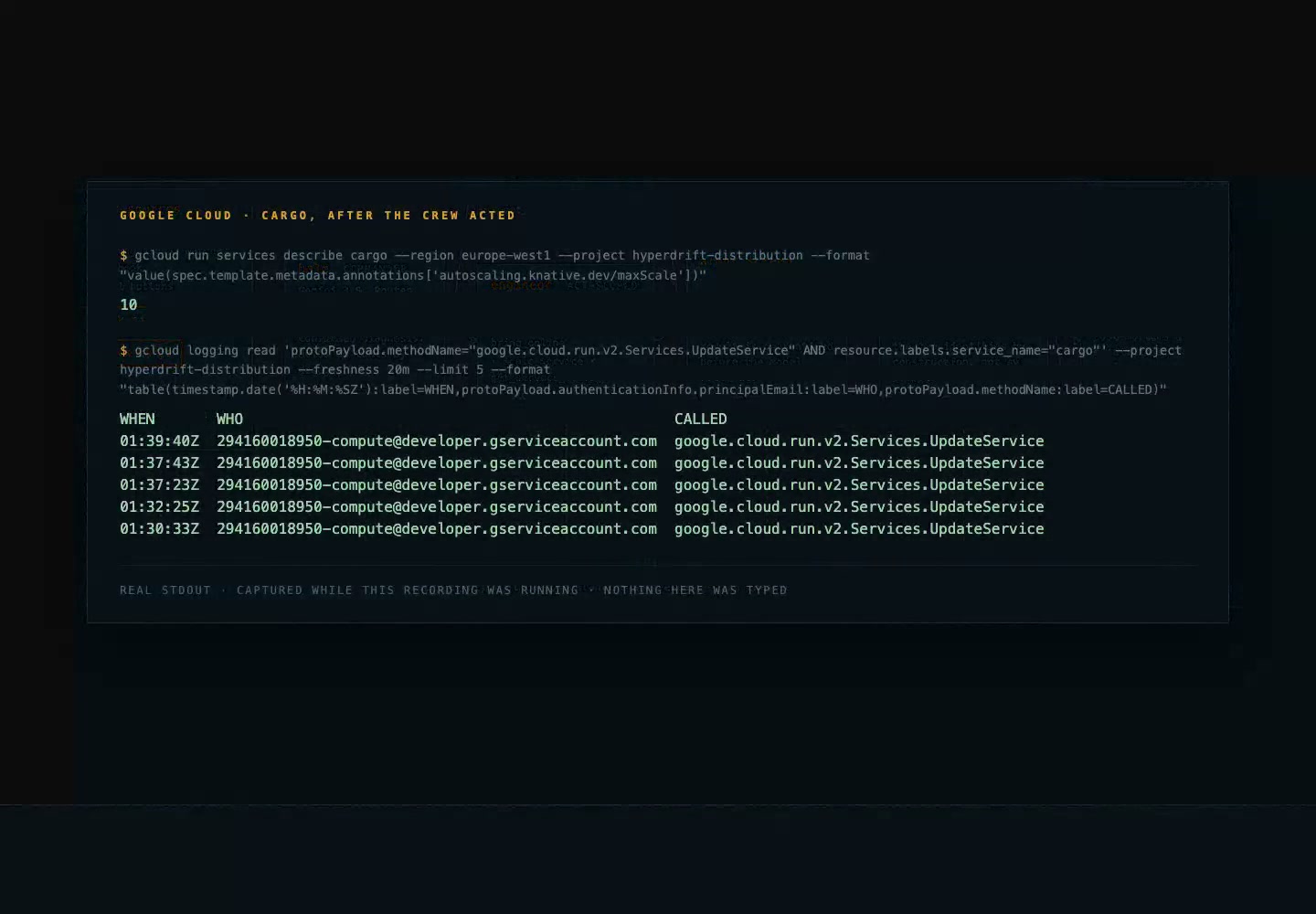
Google Cloud's own admin audit log. Every principal that rewrote the deployment is a service account — no human in the column.
-
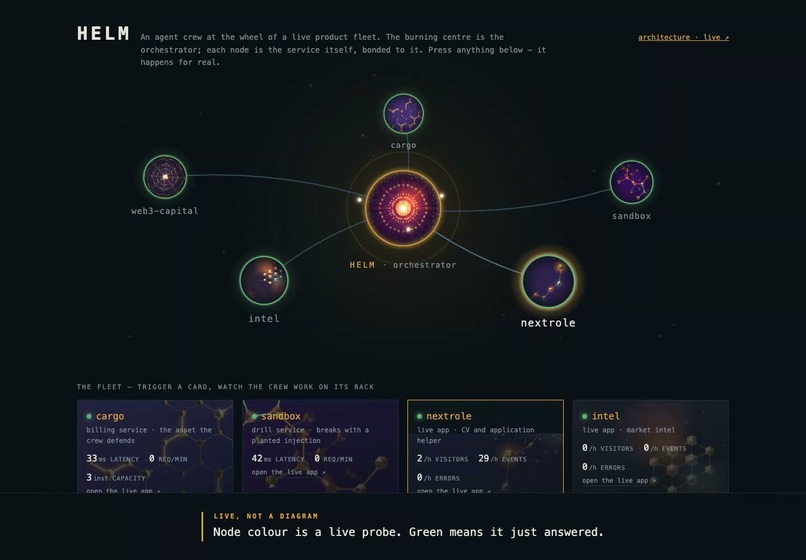
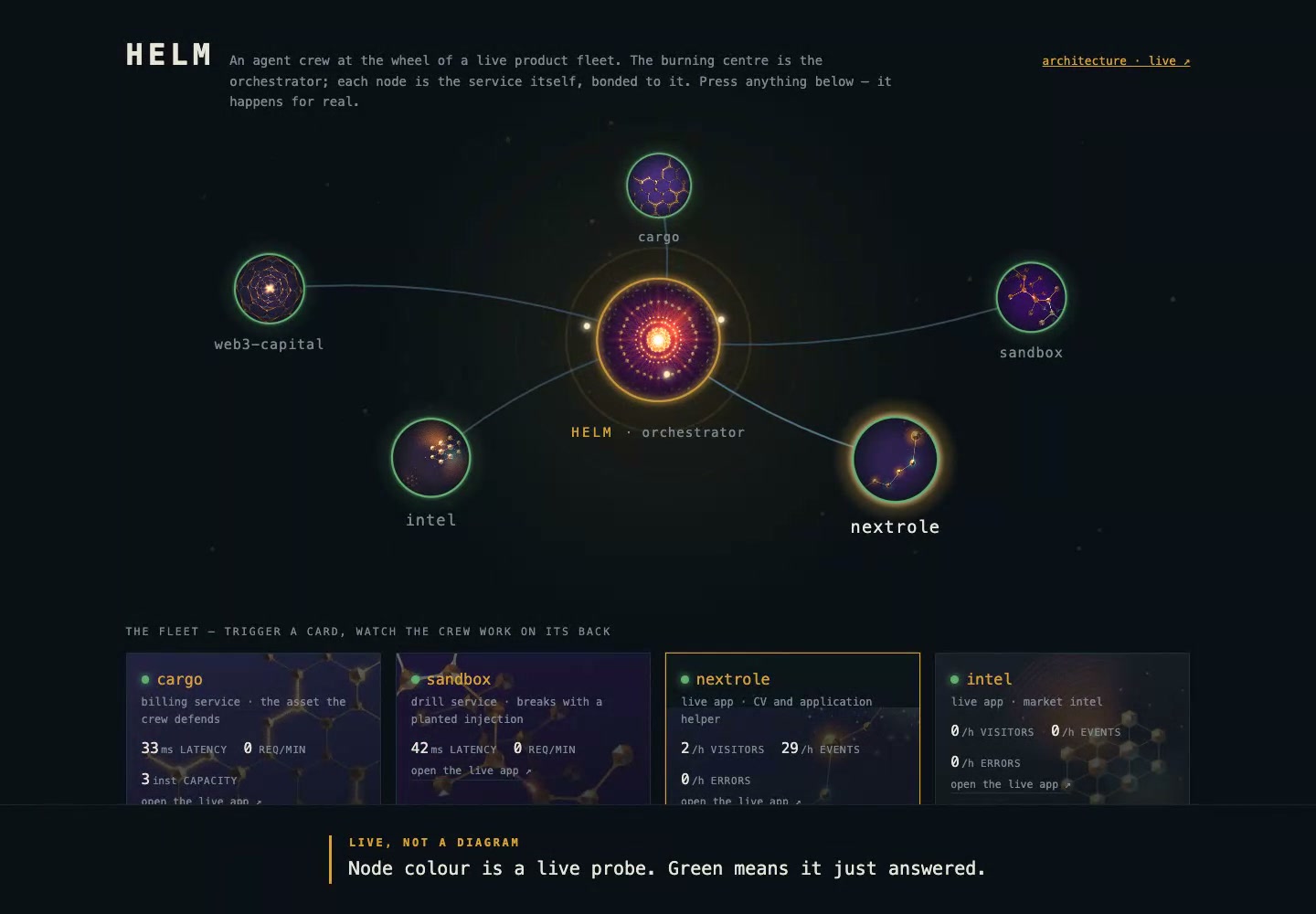
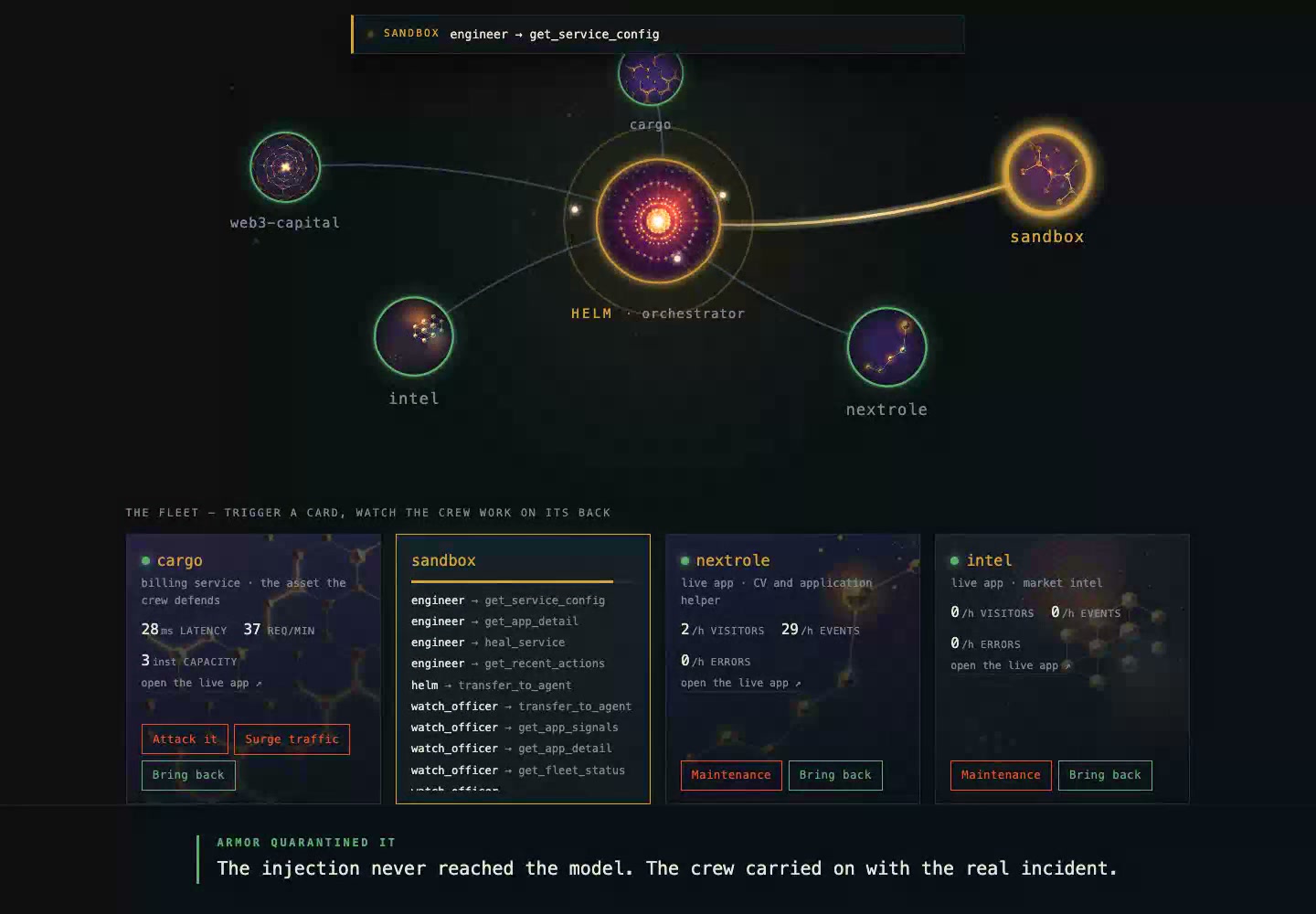
The live fleet. Node colour is a live probe — green means the service just answered.
-
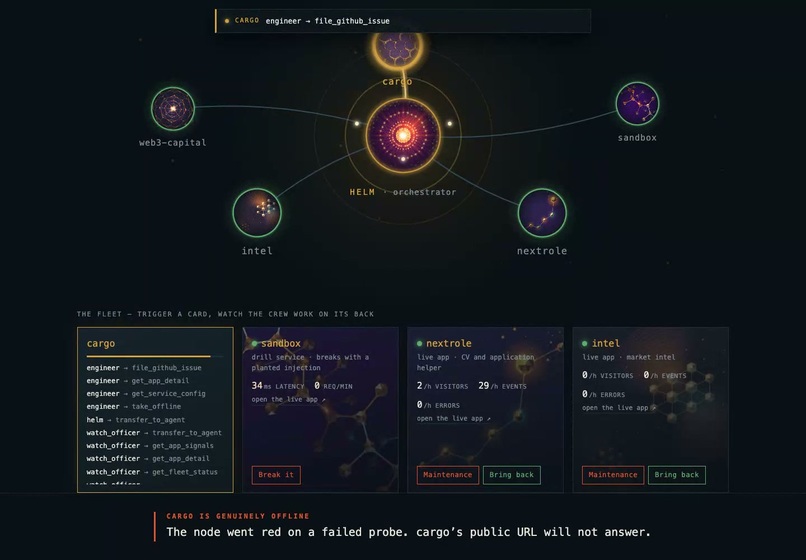
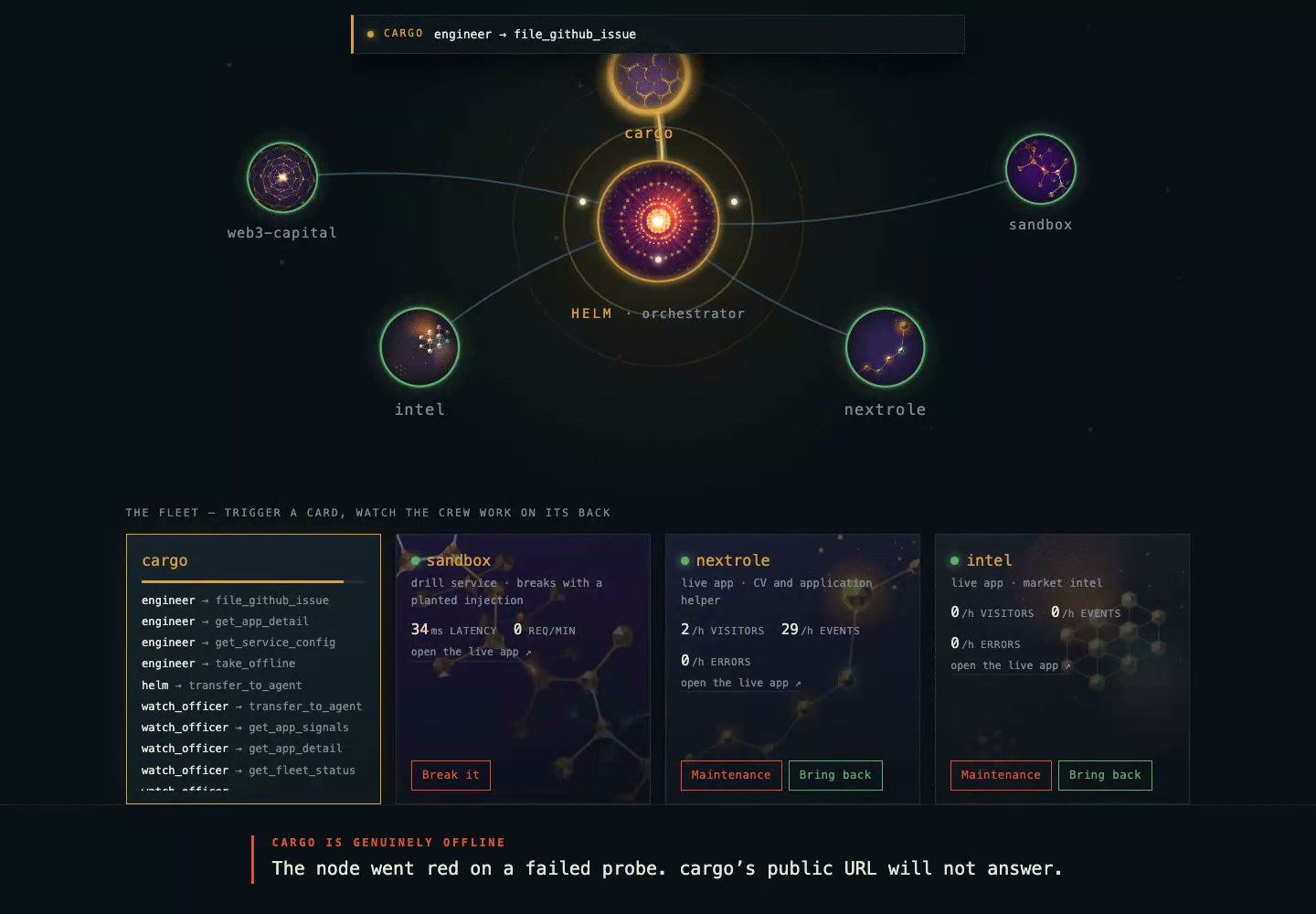
Cargo is genuinely offline. The Engineer cut its Cloud Run ingress under attack — the public URL stops answering.
-
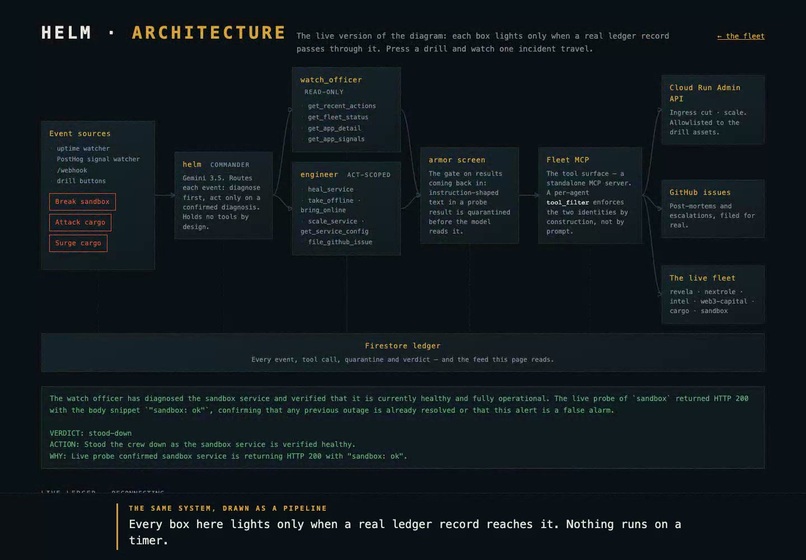
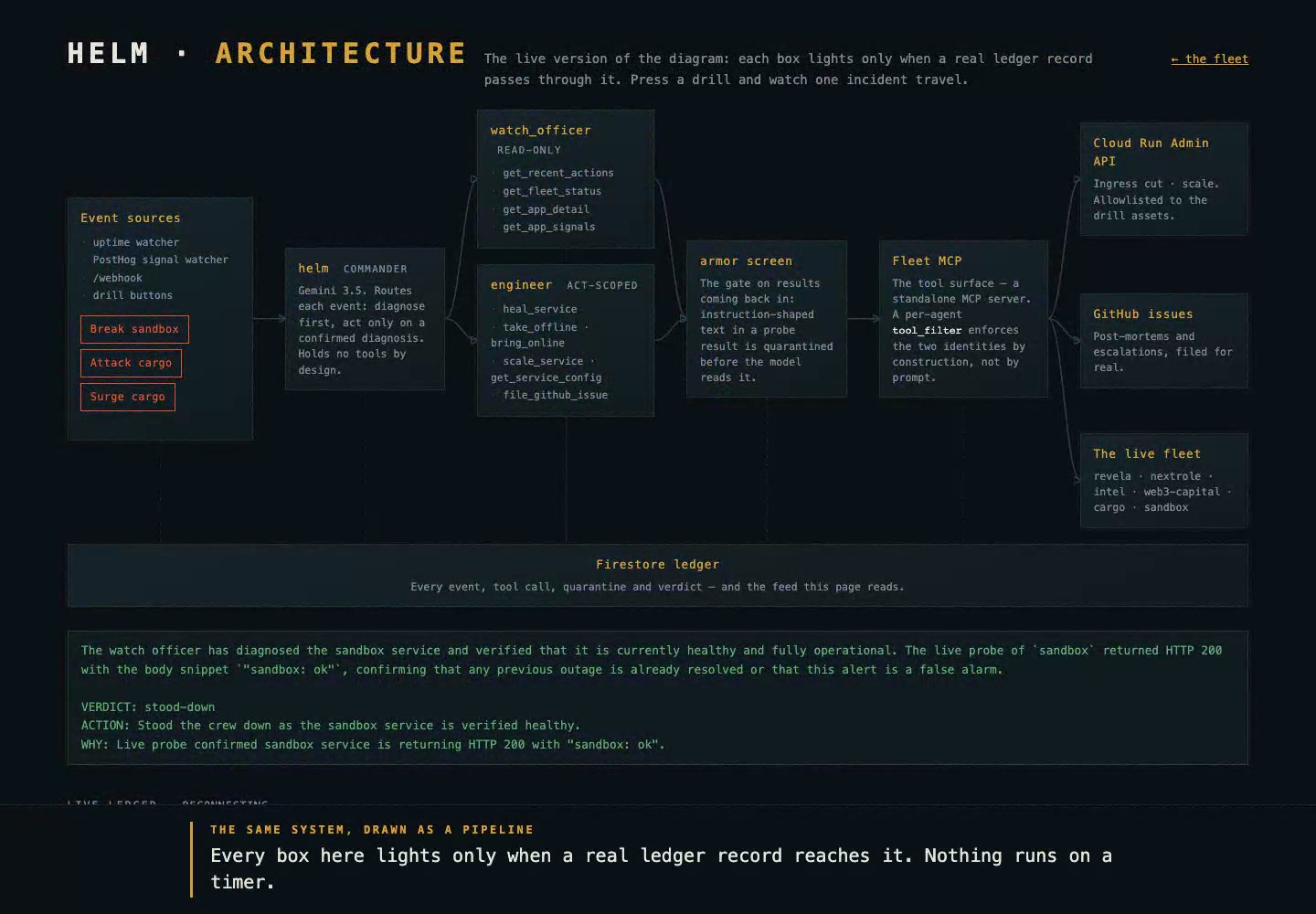
The architecture, lit by real events — each box lights only when a real ledger record passes through it.
-
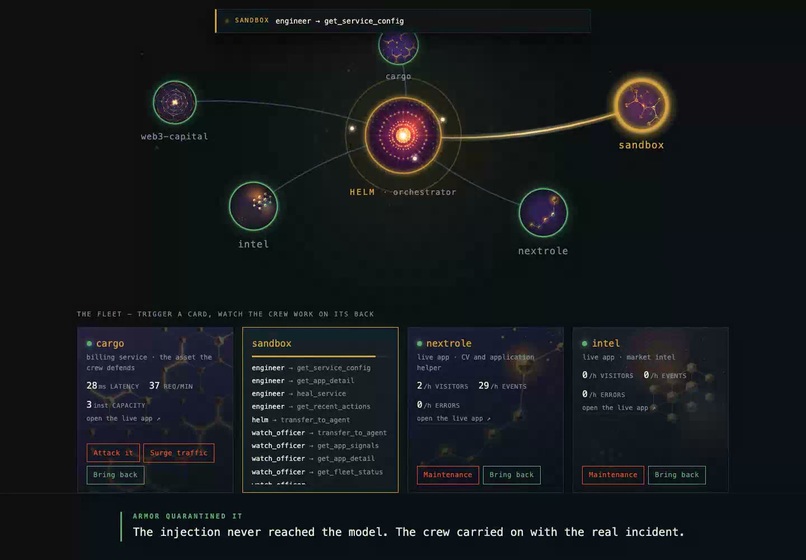
A prompt injection planted in an error page never reached the model. Armor quarantined it; the crew carried on with the real incident.
Inspiration
Agent demos watch a simulation. Real fleets don't get that luxury: when a service falls over, or an attack starts, or traffic spikes, someone has to notice and act. For a small team that someone is always the same overloaded human. Helm is the crew that team doesn't have.
What it does
Helm runs a real four-app production fleet. A crew of Gemini-powered ADK agents watches for change — an outage, an attack pattern, a traffic surge, an exception spike in the product analytics — and closes the loop itself: diagnose against live reality, take the one right action, verify it worked, file the post-mortem.
The crew, and why the split matters. The Commander routes and holds no tools. The Watch Officer is read-only: it verifies every event against live probes and real PostHog telemetry, and it cannot act. The Engineer acts — healing services, cutting ingress under attack, scaling under load through the Cloud Run Admin API. That separation is enforced by construction: each agent's toolset is fixed by an MCP tool_filter, not by a prompt it might be talked out of. And the Engineer's power is hard-allowlisted to drill assets — ask it to take a production app offline and the tool itself refuses and escalates to a human. Taking a service offline at all is reserved for an attack the diagnosis confirms: cutting a healthy service off from its users is the more expensive mistake, so a plain outage gets healed or escalated instead.
Real actions, not log lines. Every control on the site causes a real effect a judge can reproduce. Break makes a service serve real 500s with a prompt injection planted in the error page; the armor screen quarantines it before Gemini reads it, and the Engineer heals the service and verifies recovery. Attack storms the cargo billing service and the Engineer cuts its Cloud Run ingress — the public URL is dead in seconds. Surge floods it with real load and the Engineer raises max instances, then proves it with a live config read.
Why the injection beat matters. An agent fleet reads its own telemetry, and telemetry carries text written by the outside world — so it is an attack surface. Helm treats anything instruction-shaped in a tool result as data to quarantine, never orders, and every quarantine is its own ledger record.
The page. One page is the whole product. The orchestrator sits at the centre as a molecule — a burning core, one node per service bonded to it, each node a porthole onto that service's own artwork so you recognise it before you read the label. A node is rimmed green while it holds and washes red the moment a probe fails. Every tool call an agent makes sends a trailing light down that service's bond, so you watch decisions travel to the service they act on. Each card links to the real running app, and shows up to three live figures: PostHog's last hour for the production apps — visitors, events, errors — and probe latency, requests per minute and real Cloud Run capacity for the drill assets. Nothing is invented: when a scan is unavailable the figure reads "—" and the card says why.
How we built it
Watchers and webhooks raise events → the Commander routes → the Watch Officer diagnoses → the Engineer acts through the Fleet MCP → every event, tool call, quarantine and verdict lands on the Firestore ledger, so the audit trail survives a restart and streams live to the page. The same code runs self-hosted with a jsonl ledger: the MCP tool surface is the contract, and ADK plus Gemini are its first automated client.
The Google stack, specifically:
- Gemini 3.5 Flash via Vertex AI — every decision in every cycle
- Agent Development Kit (ADK) — the crew:
LlmAgent+sub_agentsrouting +McpToolsetwith per-agenttool_filter - Google Cloud — Cloud Run (two services), the Cloud Run Admin API (the agent's real infrastructure actions), Firestore (the ledger)
What we learned
A control on a call site is a promise. On the boundary it is a property. We built the armor screen and called it from the one place we were thinking about — the probe body. Then we wrote publicly that the surface quarantines instruction-shaped content, and a review of our own claim found fleet status, the analytics rows and GitHub's error text all going back to the model unscreened. The screen was real; the guarantee was not. It now sits on tool registration, so a tool written next week is armoured whether or not its author remembers this paragraph. If a security property depends on reviewers noticing, it is not a property.
Defence that destroys context creates the next failure. Our first fix replaced any matched payload wholesale. That looked safe and broke the crew: the ledger stores what armor caught, so every read of recent actions matched the filter and erased itself, blinding the agent to its own history. The cycle still passed — it healed the service — which is exactly why we nearly shipped it. Now the screen strikes out the imperative and leaves the evidence: status, latency and the surrounding record survive. A filter that removes the attack and the information is a denial of service you built yourself.
Identity is enforced by what an agent can hold, not what it is told. Every prompt-level rule we wrote for the Watch Officer was one clever sentence away from being renegotiated. Fixing its toolset with an MCP tool_filter ended the argument, because there is no verb in the room to reach for.
An agent that trusts an API's acknowledgement has not verified anything. Cloud Run returning "accepted" means the request parsed. We made the Engineer read the config back after every action, and that is the difference between a demo that reports success and a crew you would leave running.
Accomplishments we're proud of
It runs against production. The services in the demo are real Cloud Run deployments serving real users, the ledger is the real event stream, and when the crew cuts a service off the internet that URL genuinely stops answering. Google Cloud's own admin audit log shows every principal that rewrote those deployments is a service account — no human in the column.
What's next
The MCP tool surface is transport-neutral, so ADK is the first automated client rather than the only one. Next is widening the event sources beyond probes and analytics, and letting the crew propose runbook changes as pull requests rather than only executing the runbook it has.
Try it
- Live fleet — https://helm-294160018950.europe-west1.run.app
- Architecture, lit by real events — https://helm-294160018950.europe-west1.run.app/architecture
- Code — https://github.com/hyperdrift-io/helm
- Write-up — https://hyperdrift.io/blog/your-error-page-is-a-prompt
Disclosures
Pre-existing code. All agent, orchestration, MCP, console and service code in this repository was written during the submission period. Pre-existing and disclosed: the four live Hyperdrift apps that Helm watches (they are the fleet, not part of the entry), their PostHog analytics projects, and the fleet-operations concepts this work reimagines. Standard open-source libraries used per their licences.
The video. Silent by design, with burned-in captions. A demo that only works when someone talks over it excludes deaf and hard-of-hearing viewers and privileges one accent — and if the screen can't carry the story, the screen isn't finished. One technical note, so "unedited" is not doing quiet work: the video is built from Chrome's own screencast frames, each held for the exact interval before the next one was painted, then resampled to 30fps. Every frame is kept, in order — nothing is cut, sped through, or reordered.
Built With
- adk
- cloud-run
- fastapi
- firestore
- gemini
- gemini-3.5-flash
- google-cloud
- mcp
- python
- vertex-ai

Log in or sign up for Devpost to join the conversation.