-
-
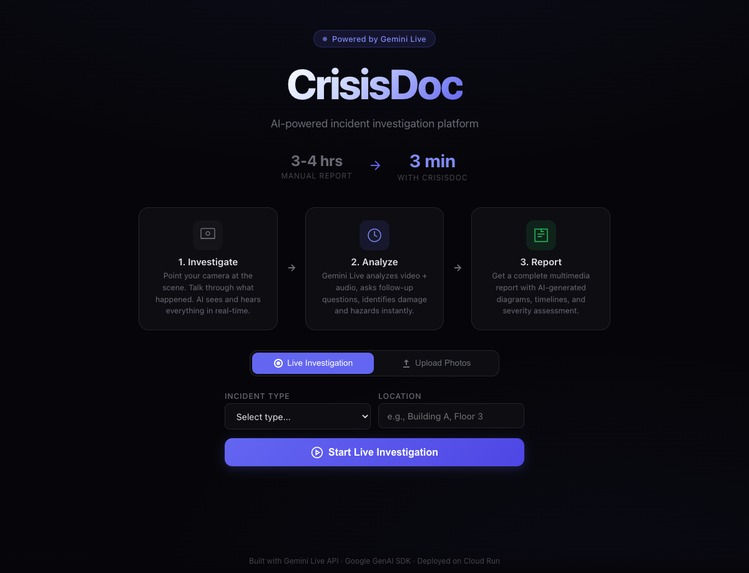
Landing Page

Inspiration
Incident reports take 3-4 hours to write and are often incomplete. Workplace injuries alone cost businesses $170 billion/year in the US. We asked: what if you could just describe what happened and get a complete multimedia documentary back?
## What it does
CrisisDoc takes a simple incident description (or a live camera investigation) and produces a narrated multimedia documentary with:
- Text — Engaging, storytelling-style narrative (not a dry report)
- Images — AI-generated scene reconstruction diagrams, damage assessments, and visual timelines
- Audio — Documentary-style TTS voiceover for every section, with a "Play Story" button
- Video — A Veo-generated CCTV-style incident reconstruction
All four modalities are woven together in one interleaved output stream.
It also features a Live Investigation Mode — point your camera at a scene, talk through what happened, and Gemini Live responds in real-time with voice, asking follow-up questions like a senior investigator.
## How we built it
4 Gemini models, 1 pipeline:
| Model | Role |
|-------|------|
| gemini-2.5-flash-native-audio | Live bidirectional video + audio investigation |
| gemini-2.5-flash-image | Interleaved text + image report via response_modalities=['TEXT', 'IMAGE'] |
| gemini-2.5-flash-preview-tts | Documentary narration voiceover |
| veo-3.1-fast-generate-preview | Incident reconstruction video |
Stack: FastAPI + WebSocket backend, vanilla JS frontend with WebRTC for camera/mic, Google GenAI SDK, deployed on Cloud Run with Terraform IaC.
TTS narration and video reconstruction run in parallel via asyncio.gather() to minimize wait time.
## Challenges we ran into
- The Gemini image generation model name changed —
gemini-2.0-flash-preview-image-generationno longer exists. We had to queryclient.models.list()to discovergemini-2.5-flash-imagesupports interleaved output. - The Live API only works with
bidiGenerateContent-capable models — only thenative-audiovariants support it. - Veo video generation is async (returns an operation to poll), unlike the synchronous content generation APIs.
- Browser audio handling required an AudioWorklet for PCM capture and manual WAV blob construction for playback.
- The
Part.from_text()API requires keyword arguments (text=...), not positional — cost us a debugging session.
## What we learned
- Gemini's interleaved output (
response_modalities=['TEXT', 'IMAGE']) is genuinely powerful — the AI decides where to place diagrams within the narrative - Combining multiple Gemini models in a pipeline (Live → Image → TTS → Veo) creates experiences no single model can deliver
- The Google GenAI SDK is the fastest path for hackathons — ADK adds complexity without solving the core problem
## What's next
- Real-time streaming of the report (currently waits for full generation)
- Multi-language support for international incident reporting
- Integration with insurance claim systems
- Mobile-first PWA for field investigators
Built With
- cloud-storage
- css
- fastapi
- firestore
- gemini-2.5-flash
- gemini-live-api
- google-cloud-run
- google-genai-sdk
- html
- javascript
- python
- terraform
- veo-3.1
- webrtc
- websocket

Log in or sign up for Devpost to join the conversation.