Inspiration
Most online learning platforms deliver the exact same static, one-size-fits-all curriculum to every student. Whether a learner has strong fundamentals in programming or is a complete novice, traditional bootcamps and course platforms force them through an identical linear sequence.
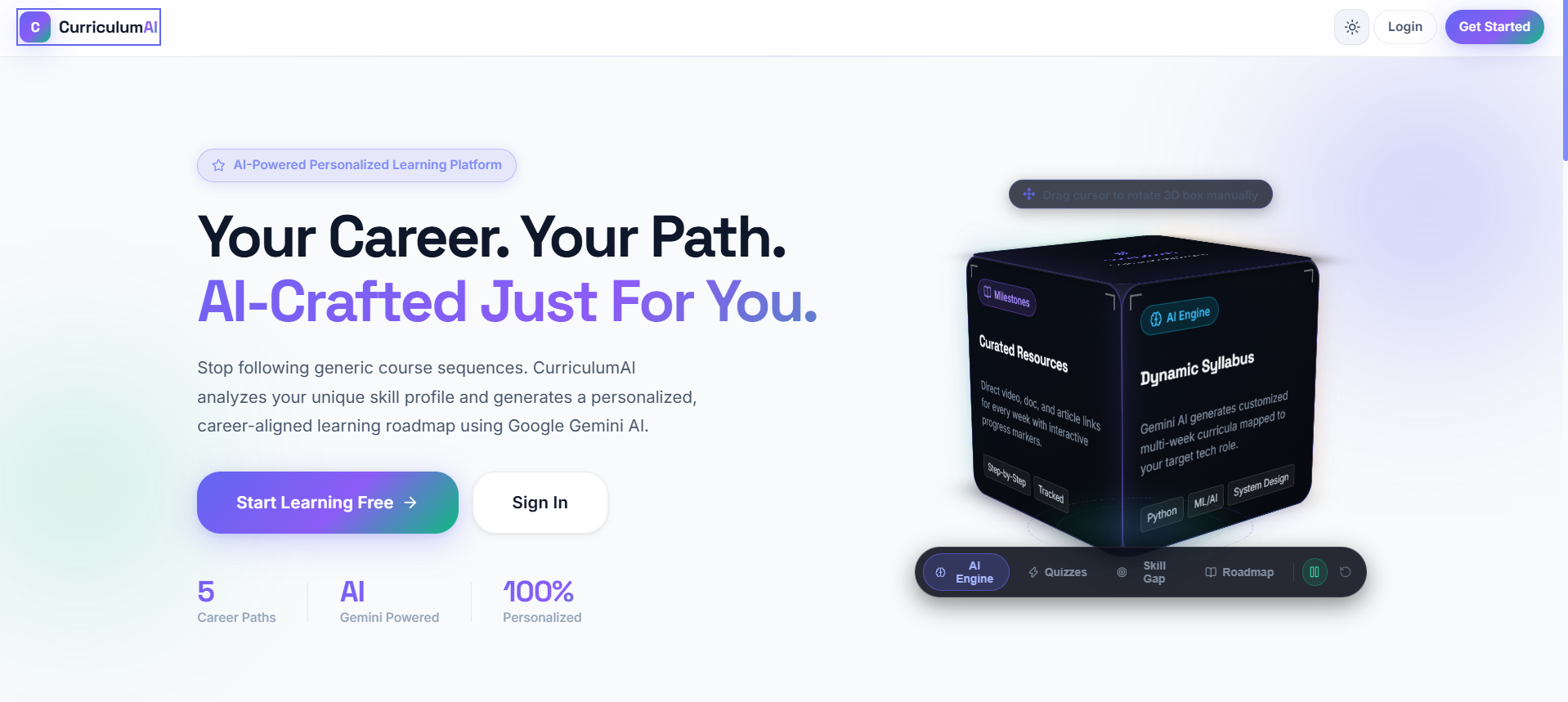
This causes two major issues: experienced students waste valuable time reviewing concepts they have already mastered, while beginners encounter steep knowledge cliffs without the necessary prerequisite support. We were inspired to build the AI-Driven Dynamic Curriculum Recommendation Engine to invert this paradigm: rather than forcing the student to adapt to a fixed syllabus, our system diagnoses an individual's specific skill gaps and uses Generative AI to construct a personalized, career-oriented learning roadmap.
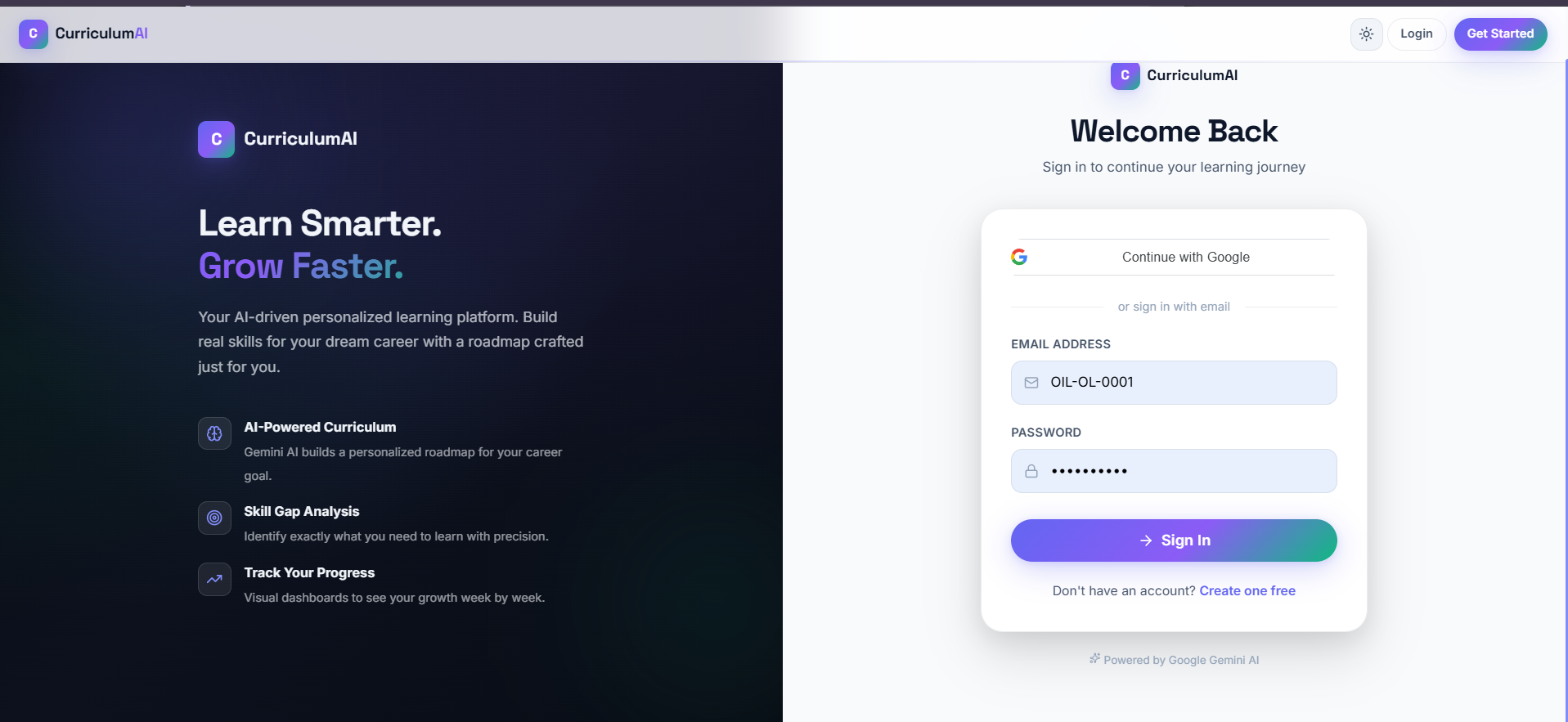
What it does
Our platform transforms a student's career aspirations into an individualized, milestone-driven curriculum:
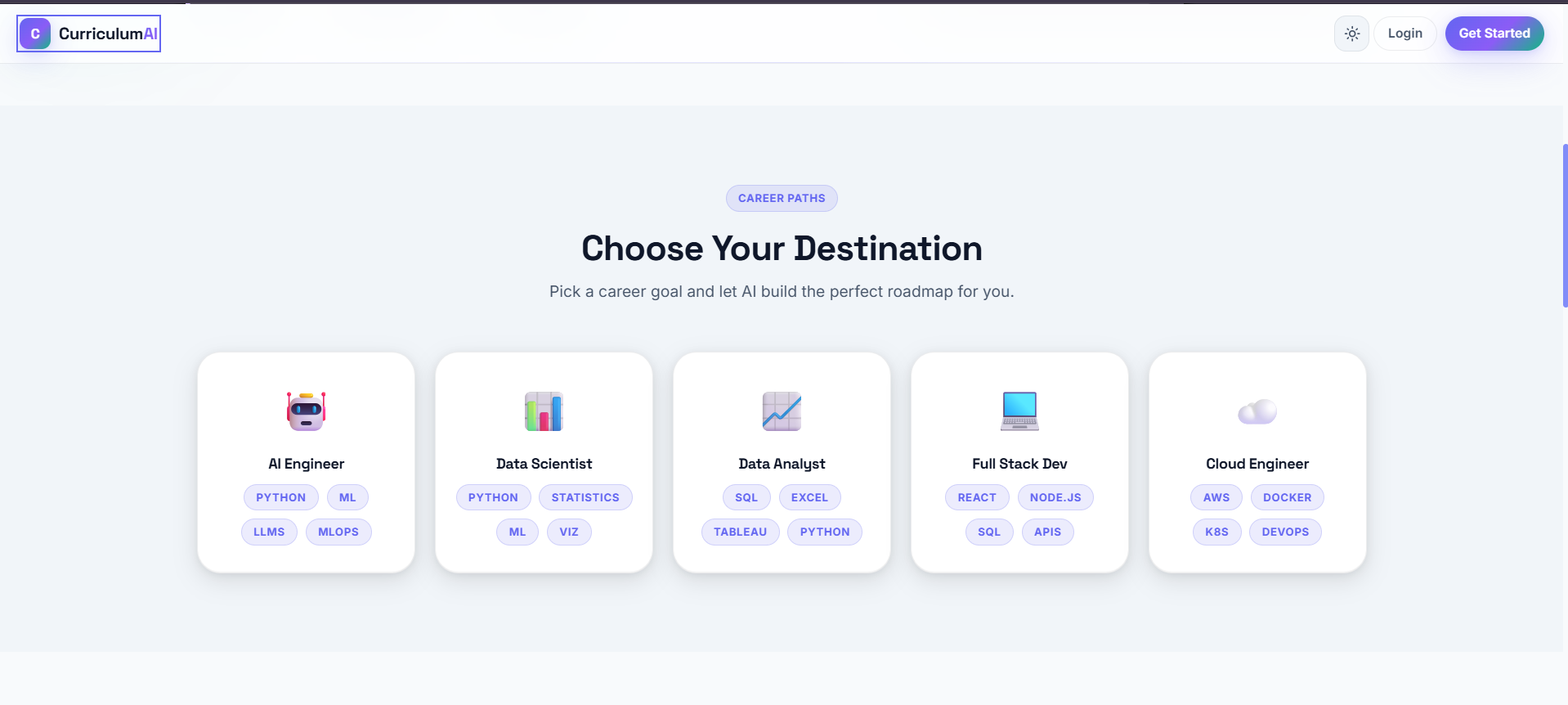
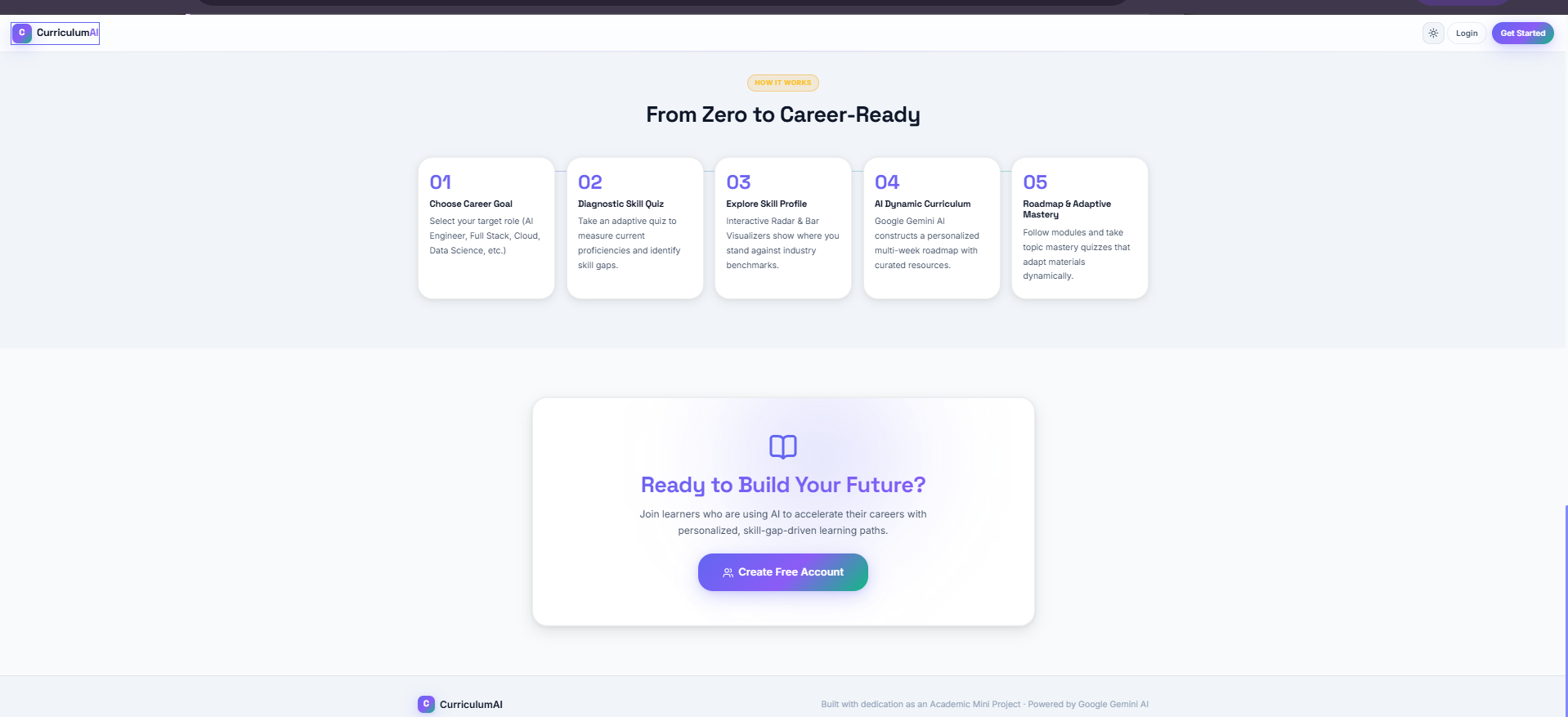
- Career Goal Selection: Students select from 5 major career paths: AI Engineer, Data Scientist, Data Analyst, Full Stack Developer, or Cloud Engineer.
- Diagnostic Skill Assessment & Profiling: Collects learner background, self-ratings, and learning style preferences ($video$, $text$, $projects$, or $mixed$) alongside diagnostic quiz scores.
- Algorithmic Skill-Gap Analysis: Categorizes each target career skill into:
- Strong Skills: Proficiency $\ge 75\%$ (bypassed or accelerated).
- Weak Skills: Proficiency between $1\%$ and $74\%$ (scheduled for reinforcement).
- Missing Skills: Proficiency of $0\%$ (prioritized as foundational prerequisites).
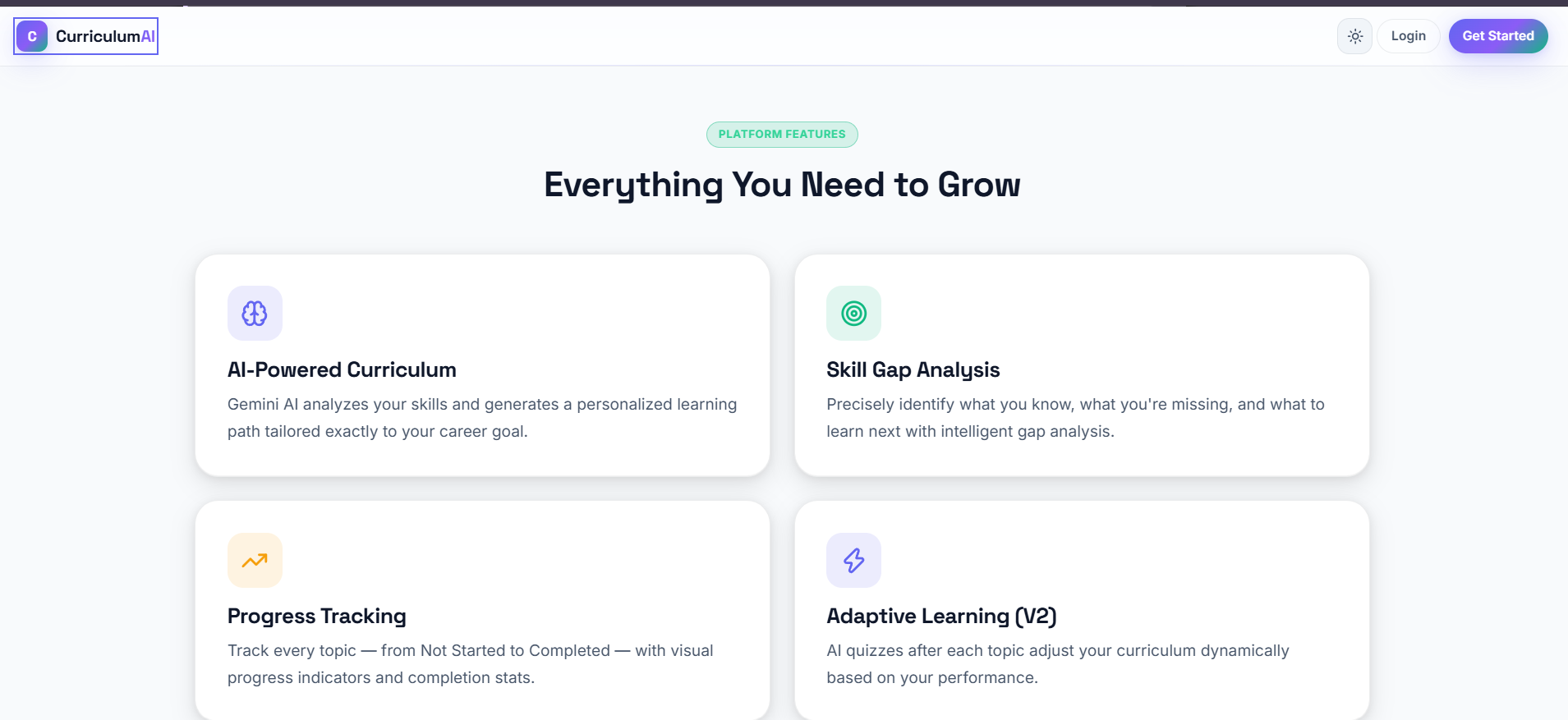
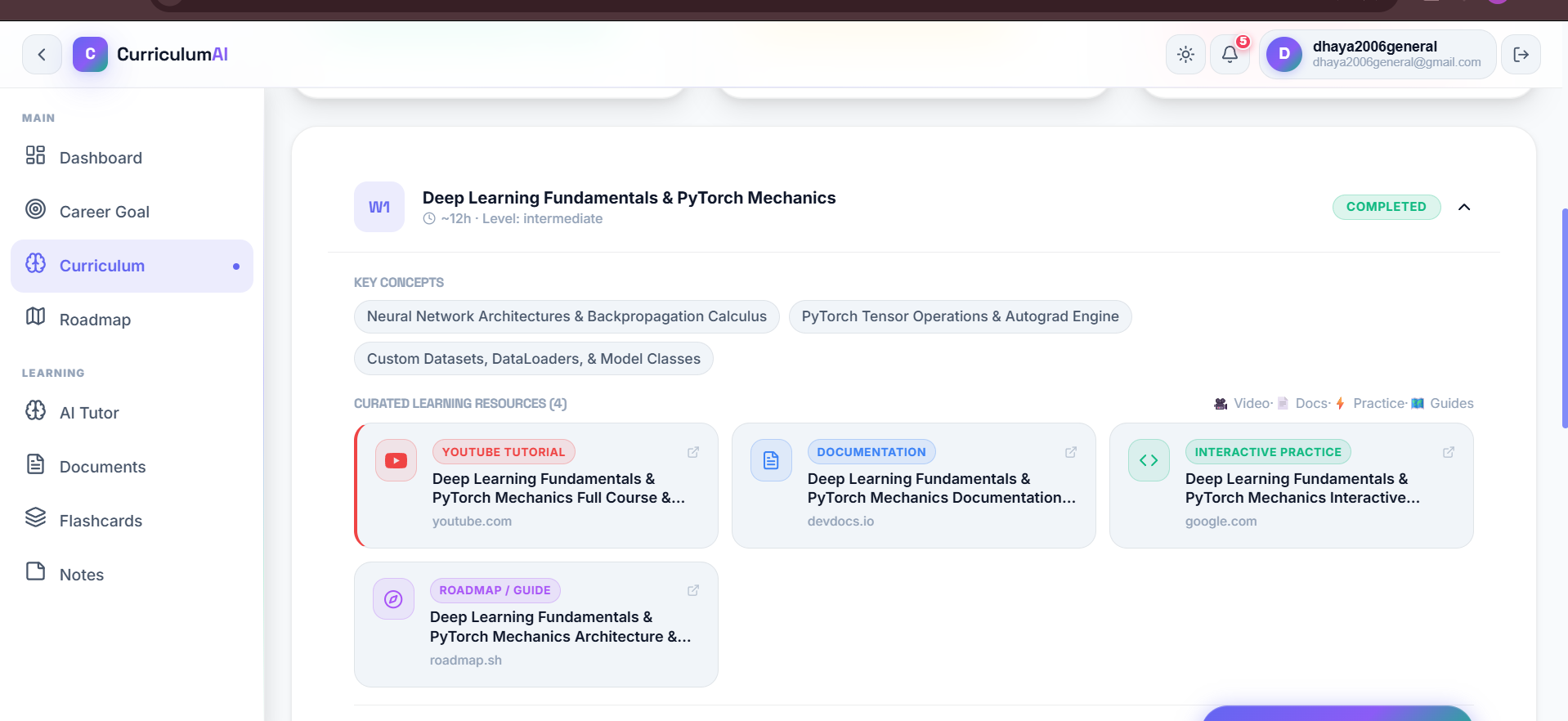
- AI Curriculum Generation: Uses the Google Gemini API to produce an adaptive multi-week curriculum complete with topics, prerequisites, time budgets, and curated resource links.
- Zero-Downtime Fallback Engine: Features an internal algorithmic synthesizer that builds a structured syllabus if the LLM API is unavailable or rate-limited.
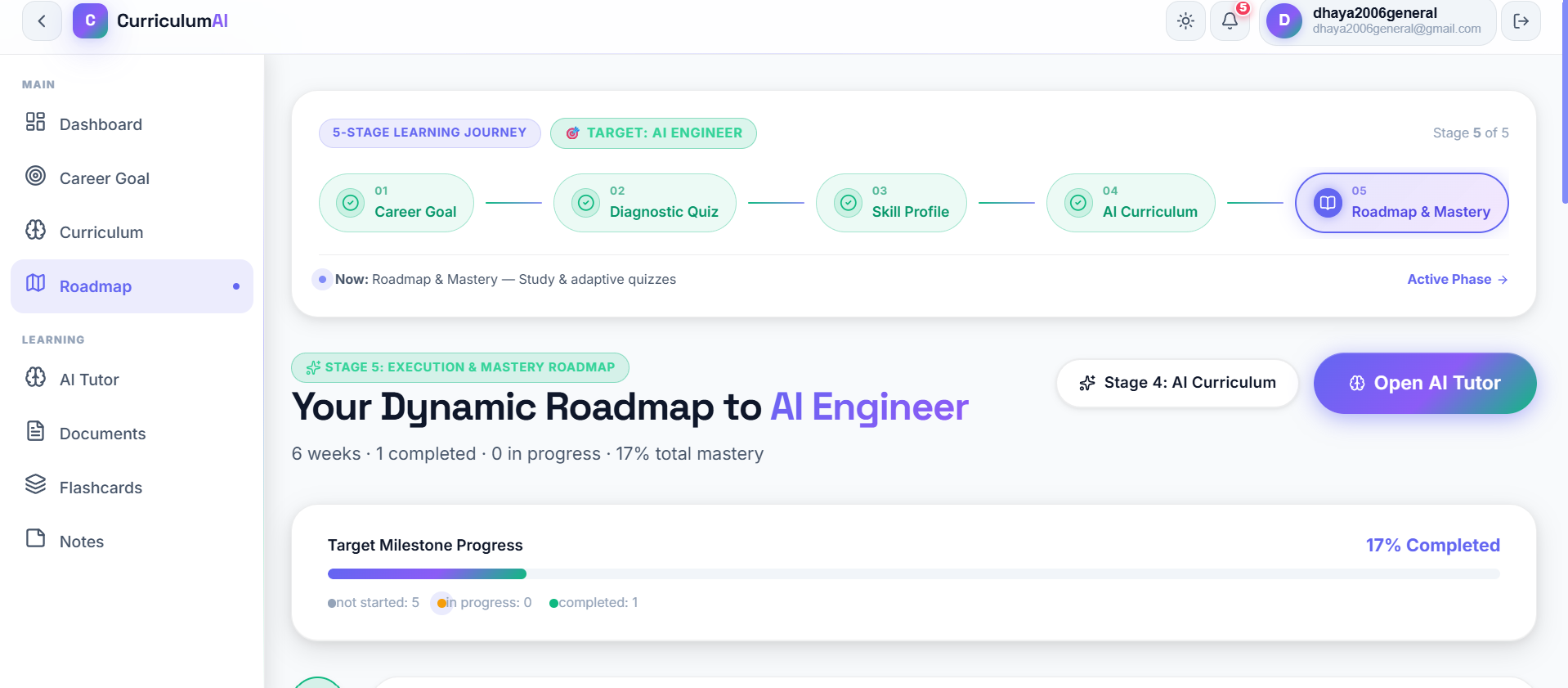
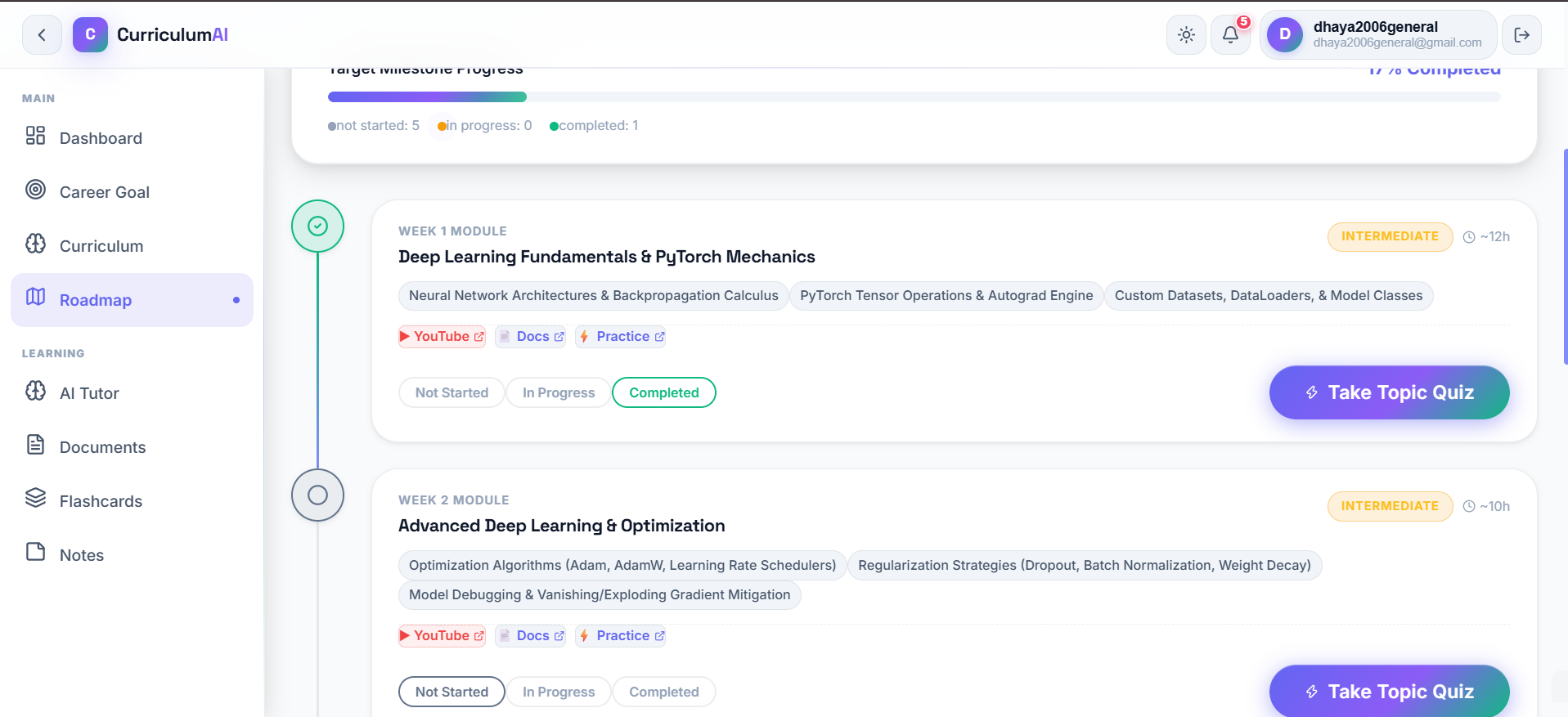
- Interactive Roadmap & Progress Tracking: Visual roadmap with milestone nodes where students mark topics as Not Started, In Progress, or Completed.
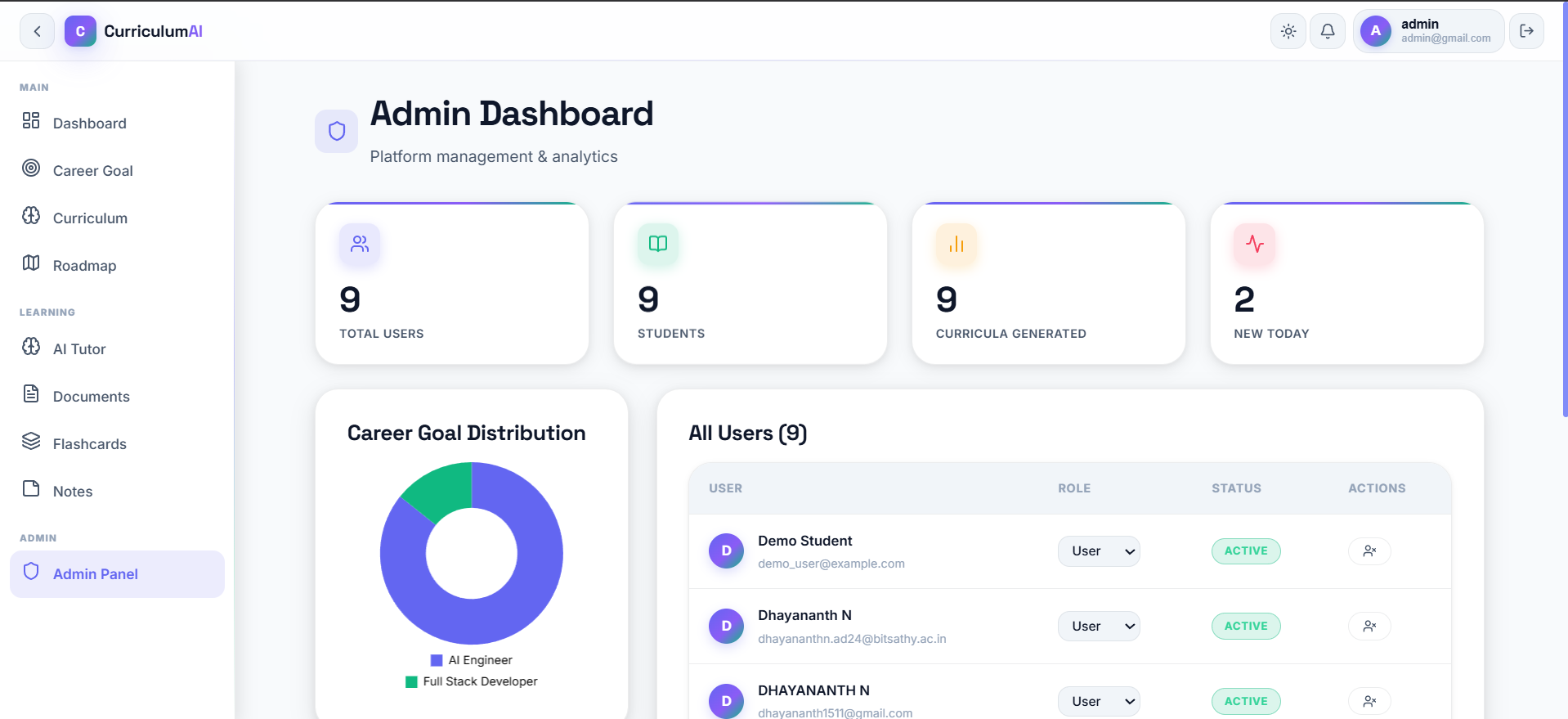
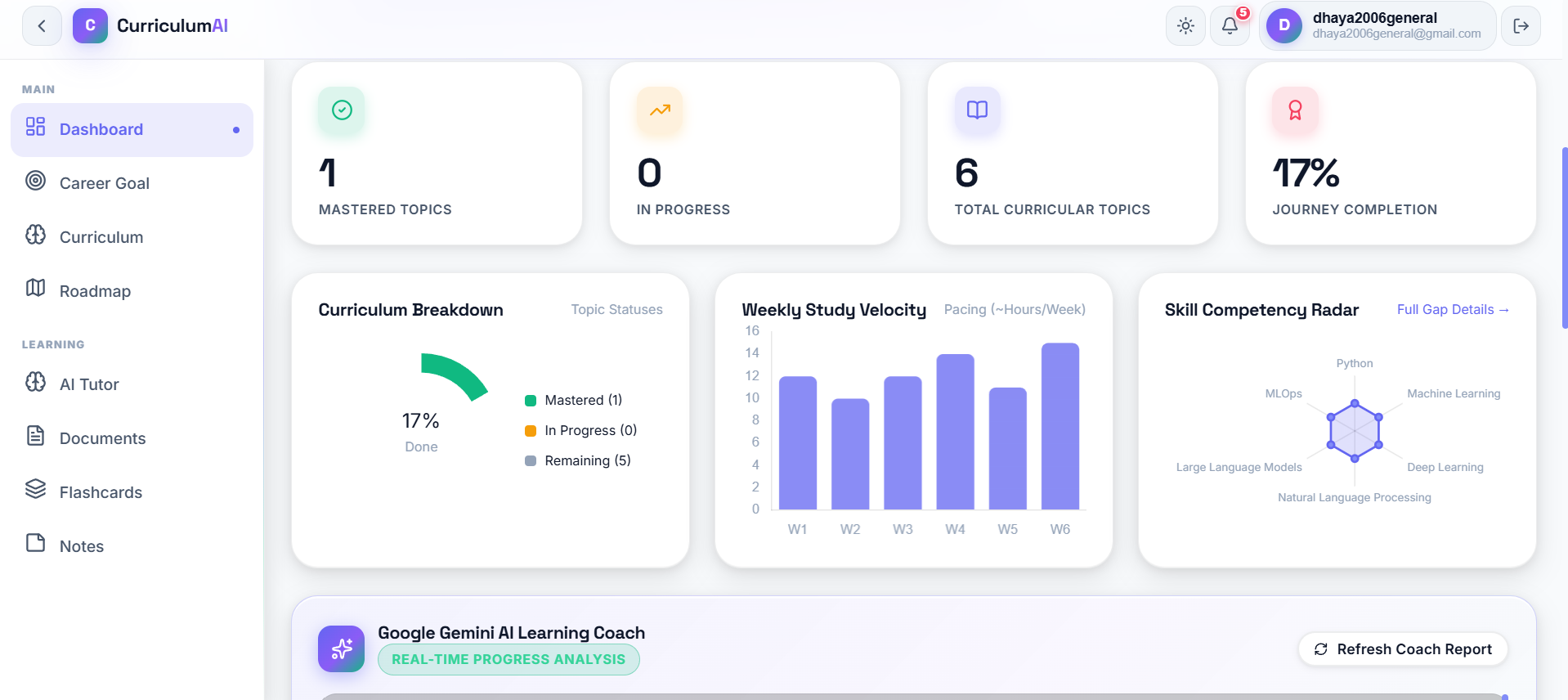
- Student & Admin Dashboards: Dedicated analytics views to monitor topic completion rates and career readiness scores.
How we built it
We designed the application with a decoupled, modular architecture featuring a React frontend, a FastAPI backend, and an intelligent gap analysis engine.
1. Mathematical Formulation for Skill-Gap & Prioritization
To ground the AI recommendations in deterministic metrics, we modeled skill evaluation mathematically:
Let $S = {s_1, s_2, \dots, s_n}$ represent the required skills for a chosen career path. Each skill has an industry benchmark target level $L_{\text{target}}(s_i) \in [0, 100]$ and an evaluated student score $P(s_i) \in [0, 100]$.
The individual skill gap $\Delta_{\text{gap}}(s_i)$ is defined as:
$$\Delta_{\text{gap}}(s_i) = \max\left(0, L_{\text{target}}(s_i) - P(s_i)\right)$$
To ensure missing foundational skills are prioritized before minor weaknesses, we assign an optimization priority weight $W(s_i)$:
$$W(s_i) = \begin{cases} 2 \cdot L_{\text{target}}(s_i), & \text{if } P(s_i) = 0 \quad (\text{Missing Skill}) \ L_{\text{target}}(s_i) - P(s_i), & \text{if } 0 < P(s_i) < 75 \quad (\text{Weak Skill}) \ 0, & \text{if } P(s_i) \ge 75 \quad (\text{Mastered Skill}) \end{cases}$$
The overall Career Readiness Index ($\mathcal{R}$) is computed as the normalized aggregate of closed gaps across all benchmark requirements:
$$\mathcal{R} = \left( 1 - \frac{\sum_{i=1}^{n} \Delta_{\text{gap}}(s_i)}{\sum_{i=1}^{n} L_{\text{target}}(s_i)} \right) \times 100\%$$
Topics are sequenced across a multi-week horizon $T$ by maximizing the marginal reduction in skill gap per estimated study hour:
$$\max \sum_{t=1}^{T} \sum_{s \in \text{Week}t} \frac{\Delta{\text{gap}}(s)}{\text{Hours}(s)}$$
2. Technical Stack
- Frontend: React 18, TypeScript, Vite, React Router, custom CSS design system.
- Backend: FastAPI (Python 3.11), SQLAlchemy ORM, SQLite / PostgreSQL, JWT security (
passlib,python-jose). - AI Orchestration: Google Gemini API (
google-generativeai) with structured JSON schema outputs and prompt engineering. - DevOps: Docker and Docker Compose containerization for both frontend and backend services.
Challenges we ran into
- Enforcing Deterministic JSON from LLMs: Generative models can vary their JSON formatting or drop nested lists like weekly resource links. We solved this by using strict Pydantic schemas and structured prompt instructions that validate the generated response before persisting it to the database.
- Offline Resilience & Fault Tolerance: Relying solely on third-party cloud APIs poses a single point of failure. We resolved this by building an algorithmic fallback generator that constructs a gap-prioritized curriculum using local heuristics if API limits are reached.
- Harmonizing Self-Reported vs. Assessed Data: Students often over- or under-estimate their abilities. We addressed this by giving objective diagnostic quiz scores precedence over self-reported ratings during gap scoring.
Accomplishments that we're proud of
- True Personalization: Two students selecting the same target career (e.g., AI Engineer) receive completely distinct curricula based on their specific diagnostic evaluation.
- Fail-Safe Generation: Implemented a resilient fallback system that guarantees curriculum generation under any network or API condition.
- Full-Stack Implementation: Built and integrated 10 distinct React pages with a production-ready, JWT-authenticated FastAPI backend.
What we learned
- Combining Deterministic Math with GenAI: Using mathematical formulas for gap detection and ranking, while utilizing Generative AI for pedagogical sequencing, resource curation, and syllabus explanations.
- Structured Prompt Engineering: Techniques for constraining LLM outputs to strict JSON schemas suitable for direct database storage.
- State Management Across Multi-Stage User Flows: Synchronizing state between onboarding, diagnostic assessments, curriculum generation, and roadmap progress tracking.
What's next for AI-dynamic-curriculum-recommendation-Engine
- Version 2 (Adaptive Quizzing): Weekly diagnostic checkpoint quizzes that dynamically recalculate $\Delta_{\text{gap}}(s_i)$ and re-balance upcoming weeks.
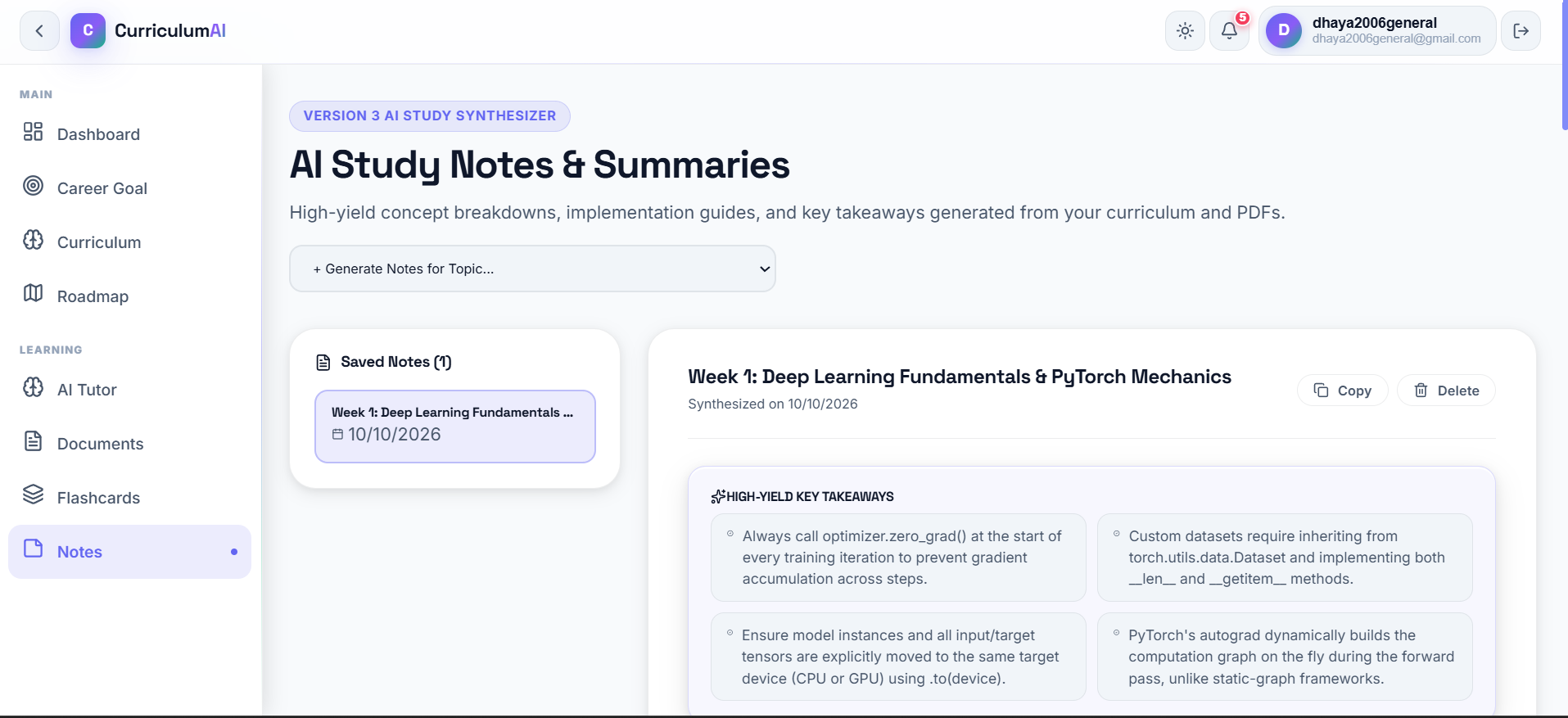
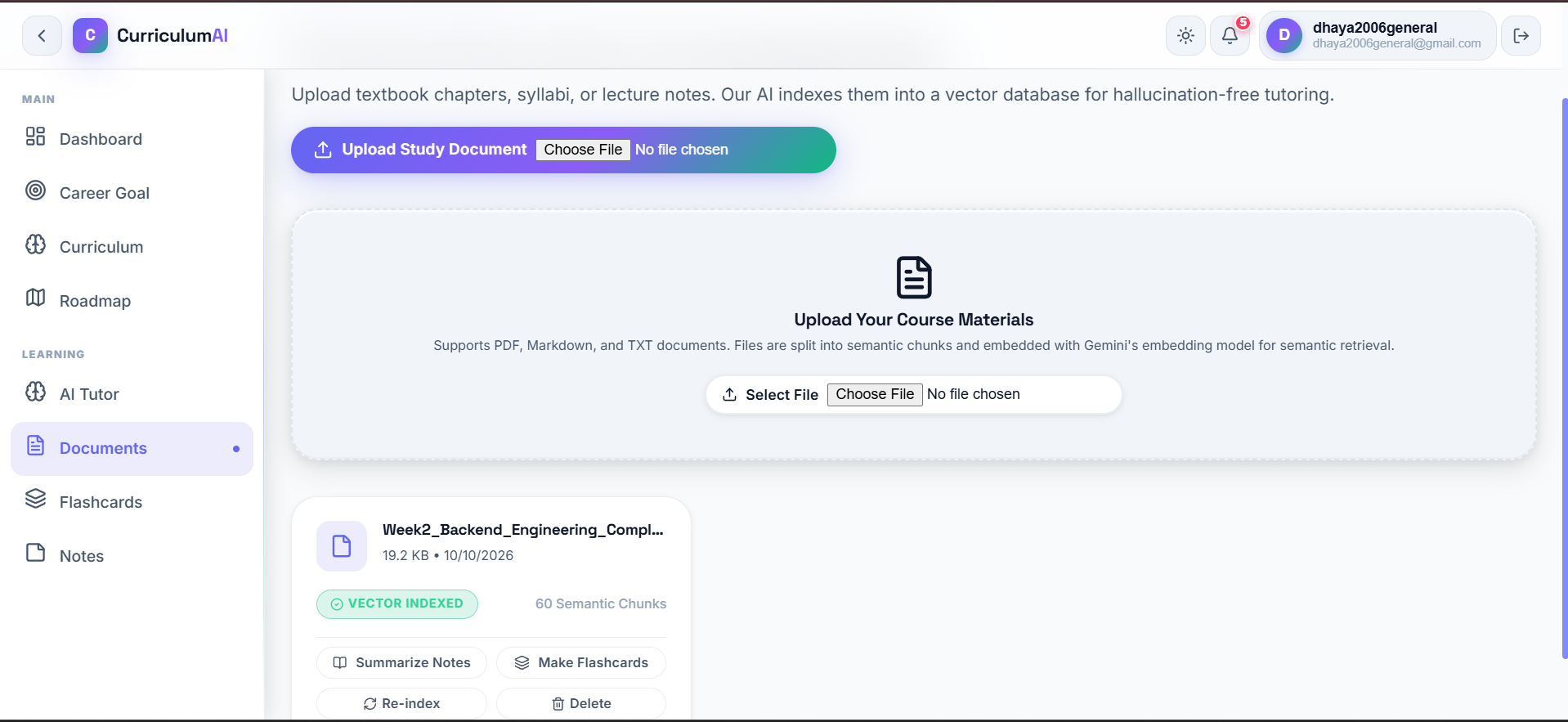
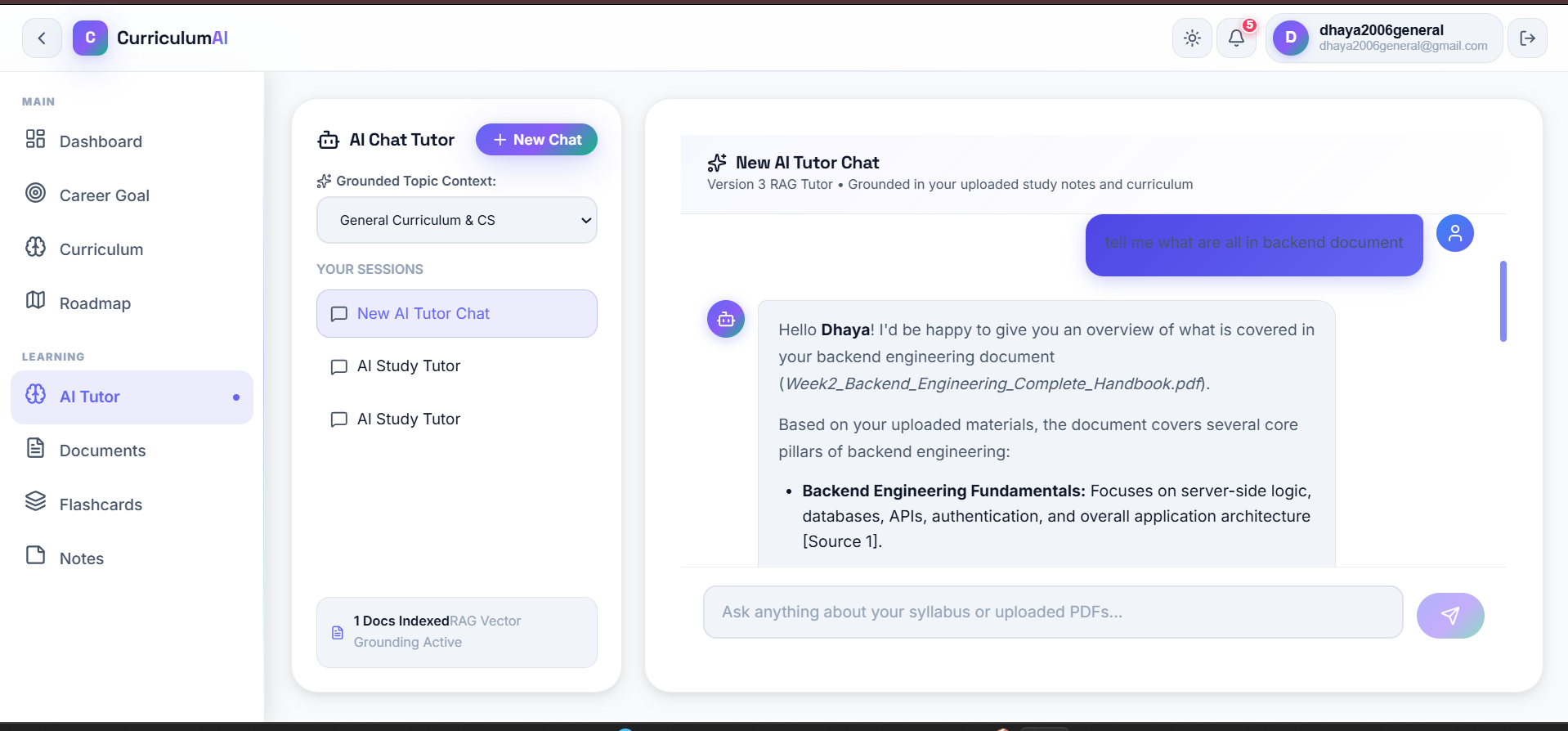
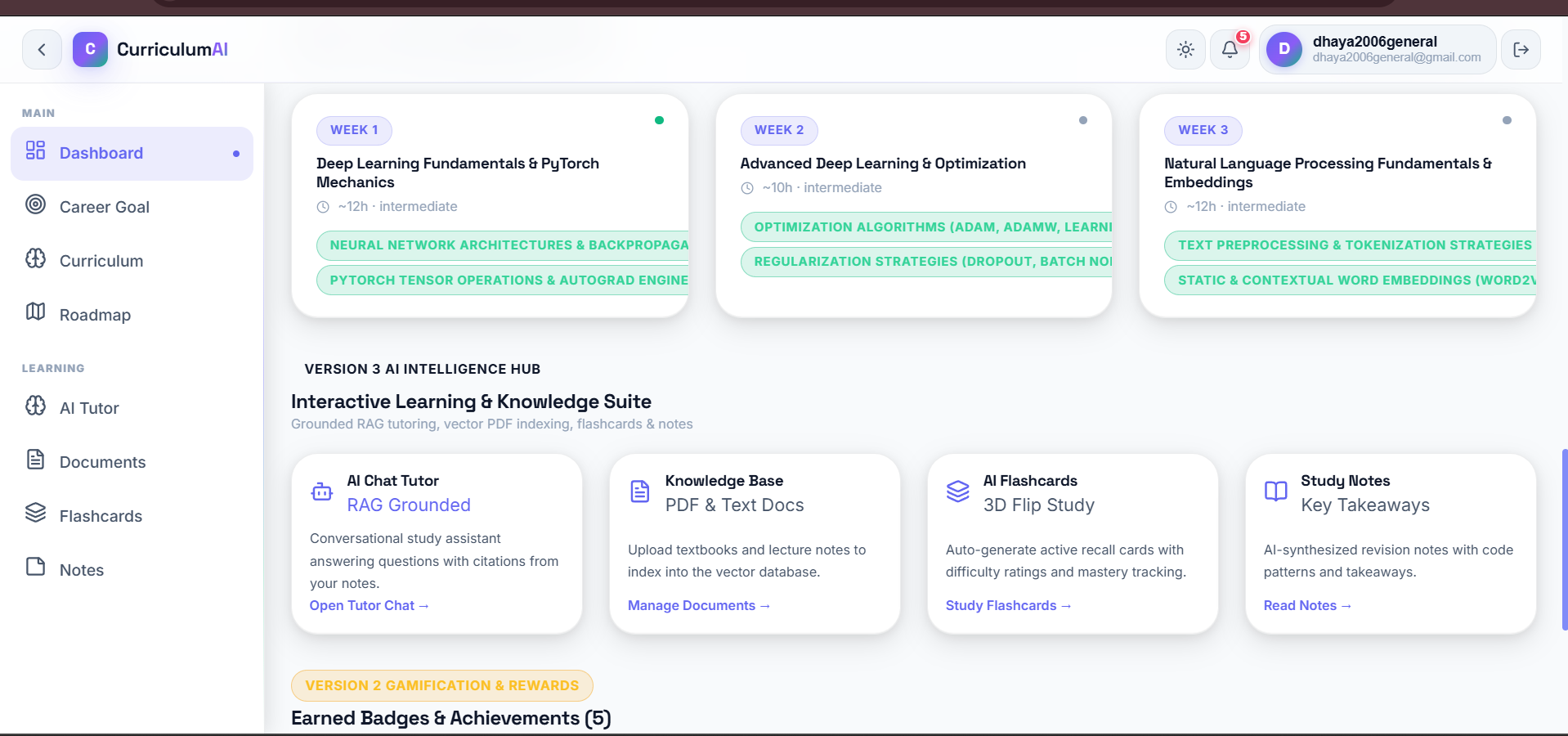
- Version 3 (AI Tutor & RAG): In-platform conversational AI assistant powered by Retrieval-Augmented Generation (RAG) to allow learners to query course notes and uploaded PDFs.
- Version 4 (AI Career Coach): Automated resume parsing against target skill benchmarks and AI-driven mock technical interviews.
- Version 5 (Multi-Agent Ecosystem): Autonomous agents coordinating study schedules, assignment reminders, and placement readiness tracking.
Built With
- chartjs
- css3
- docker
- docker-compose
- fastapi
- generative-ai
- google-gemini-api
- html5
- jwt
- postgresql
- pydantic
- python
- react
- rest-api
- sqlalchemy
- sqlite
- typescript
- uvicorn
- vite
- zustand


Log in or sign up for Devpost to join the conversation.