-
-
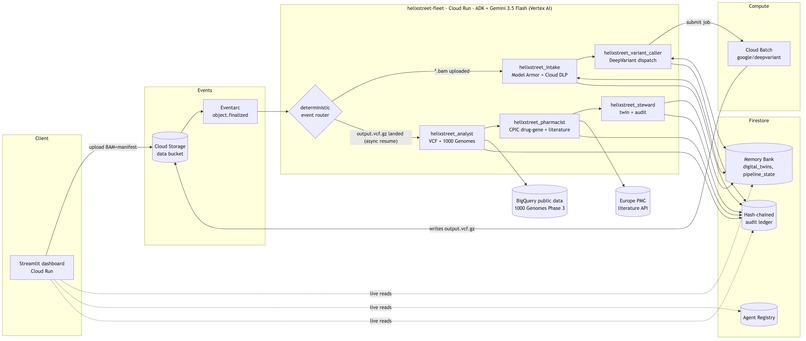
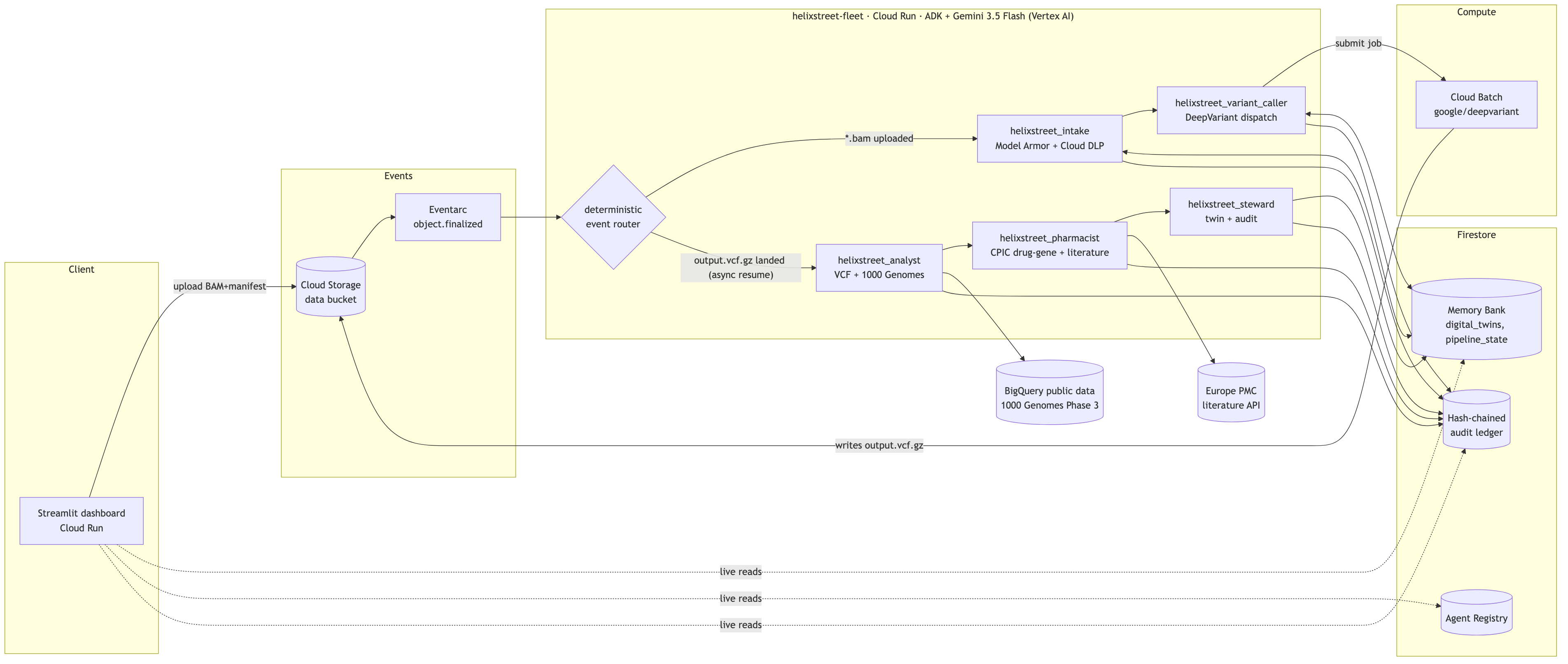
Architecture
-
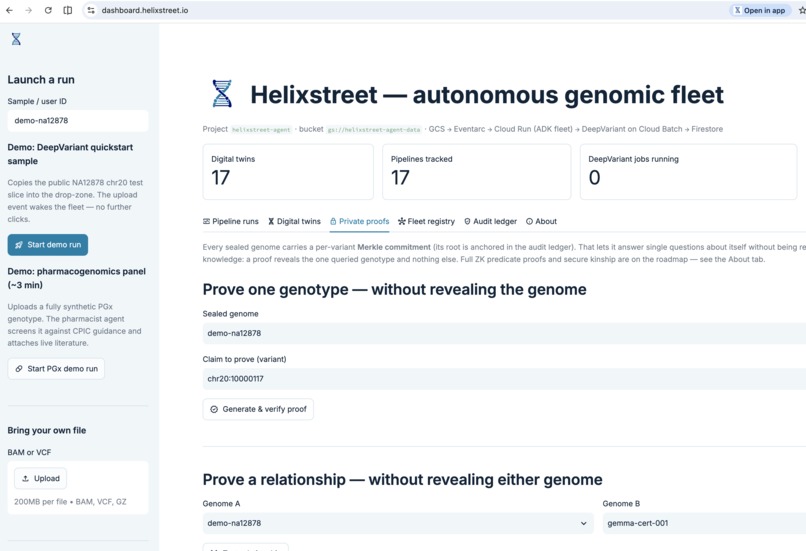
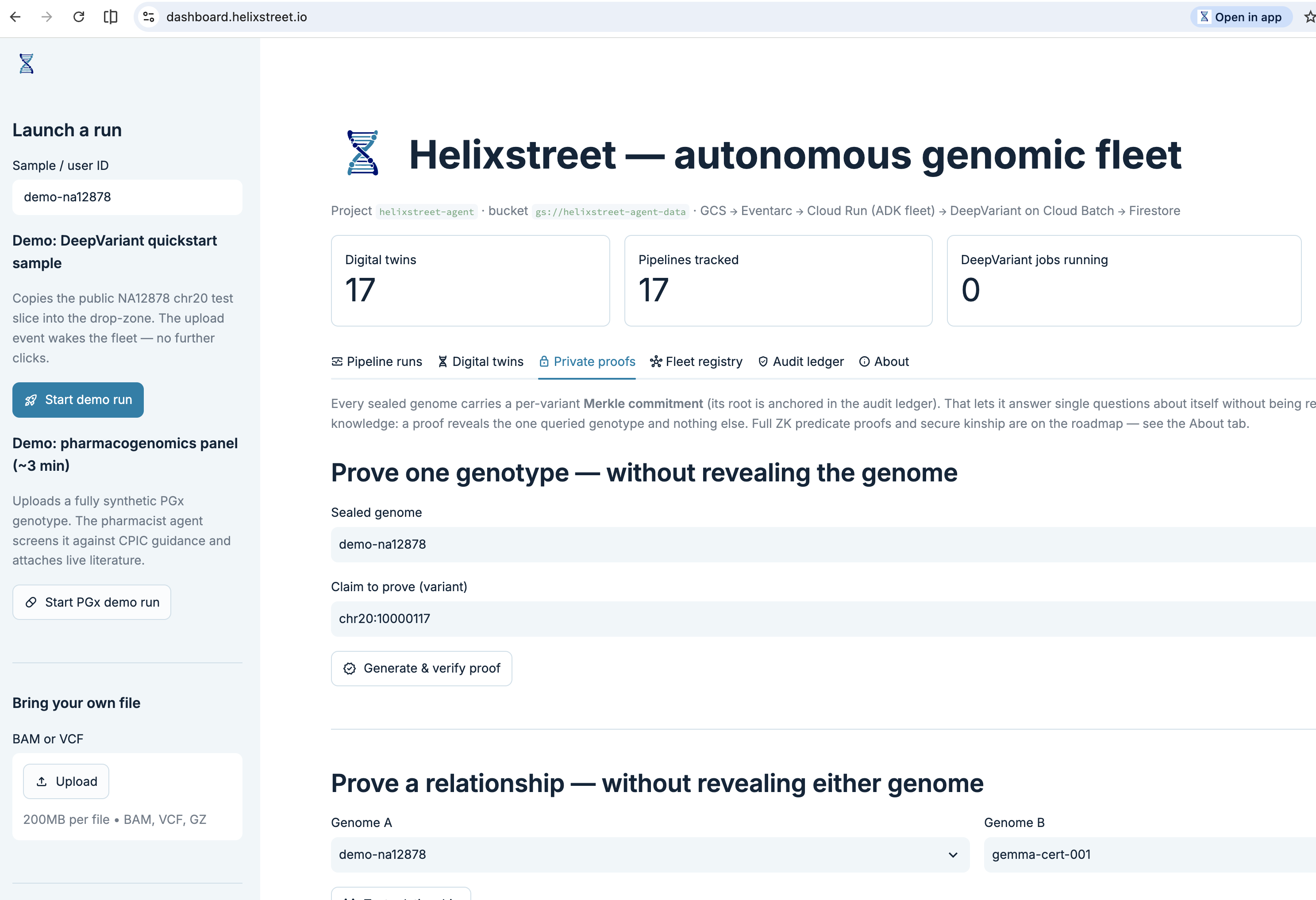
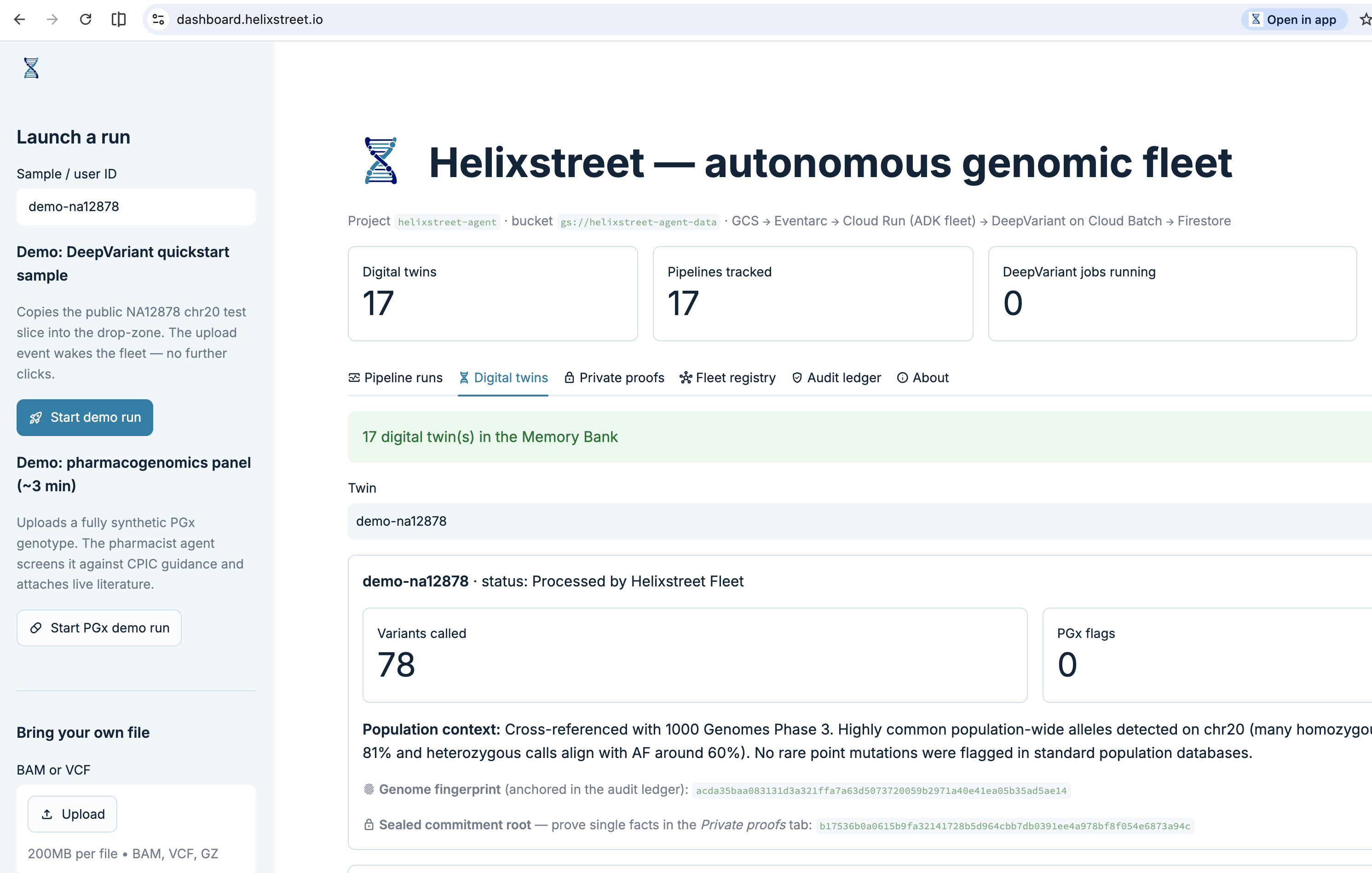
Dashboard Helixstreet 3 - Private Proofs
-
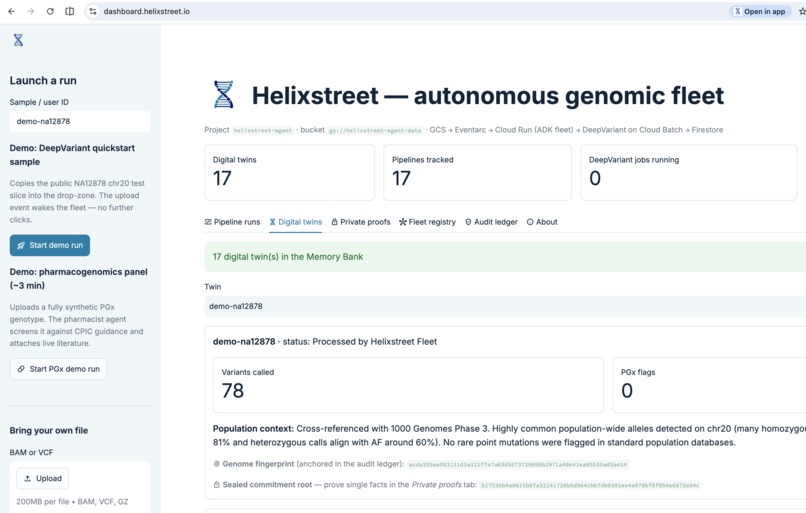
Dashboard Helixstreet 4 - Digital Twins
-
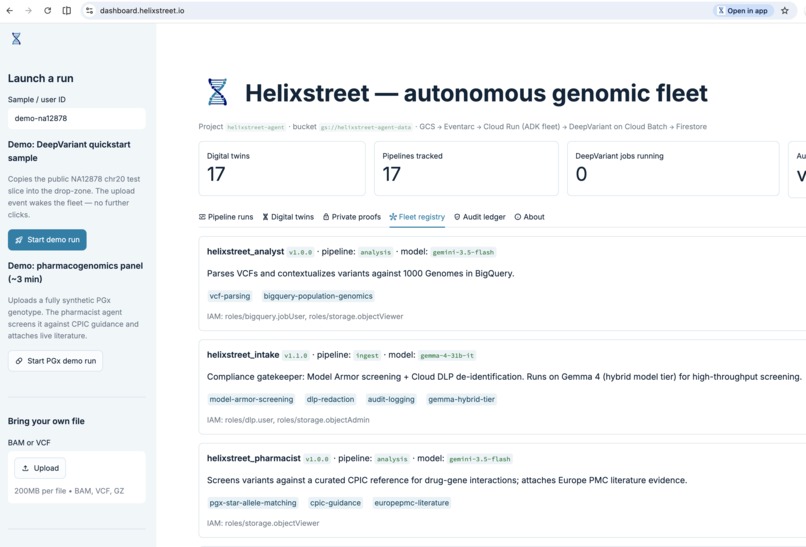
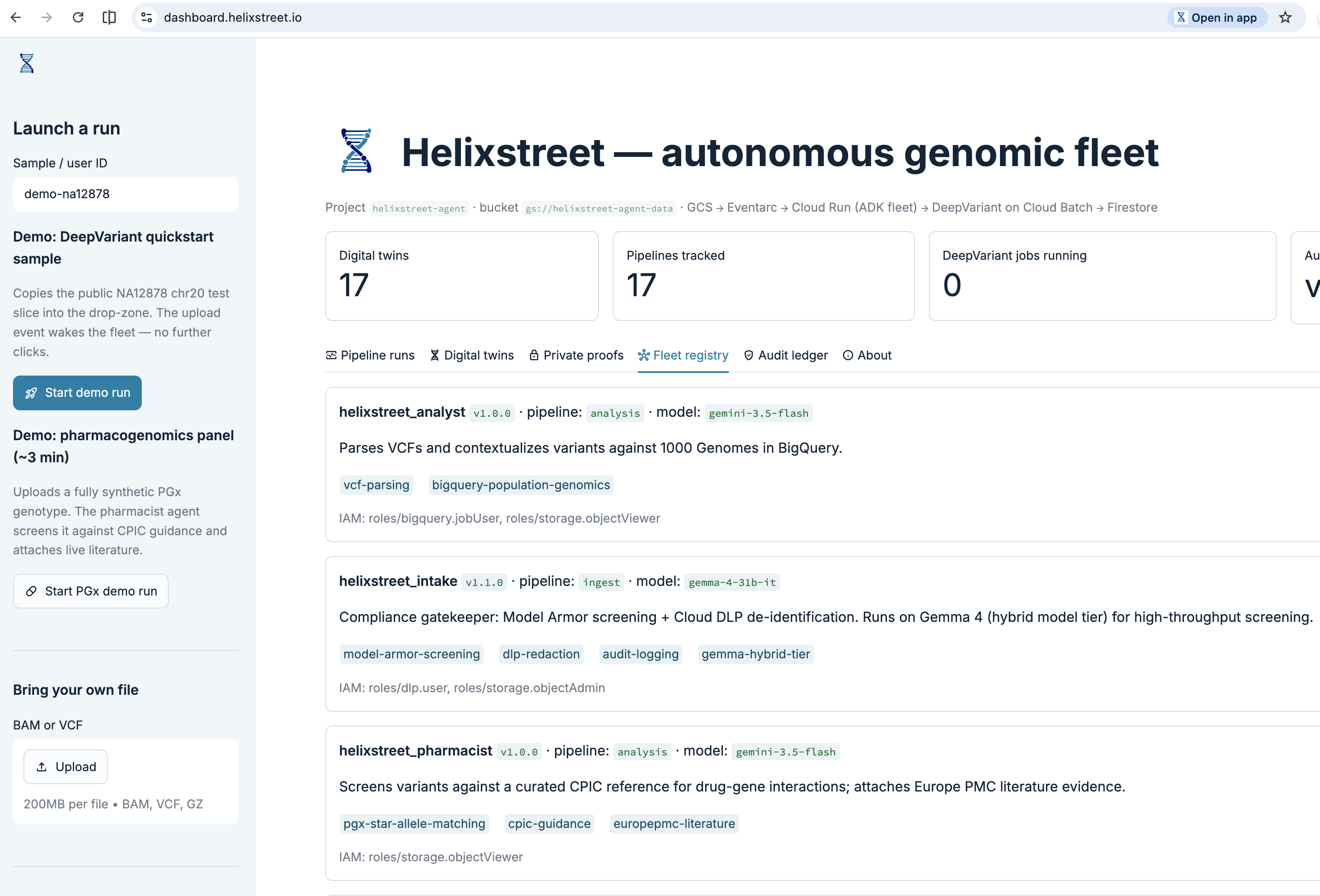
Dashboard Helixstreet 2 - Agent Fleet
-
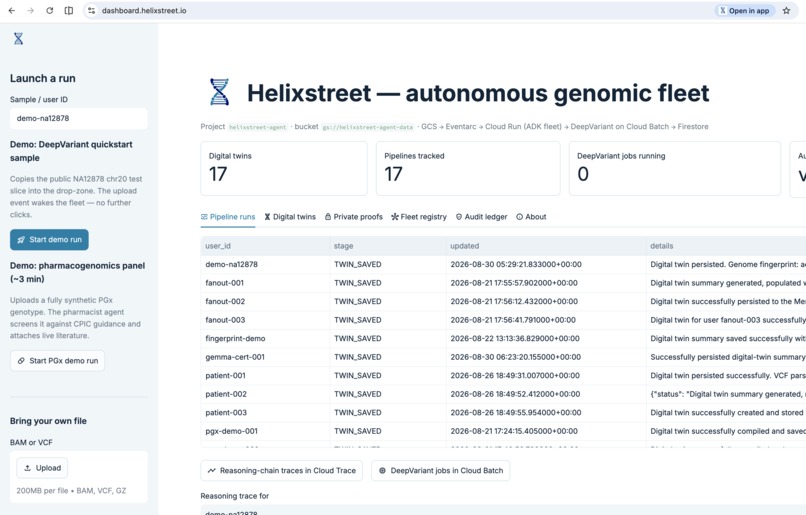
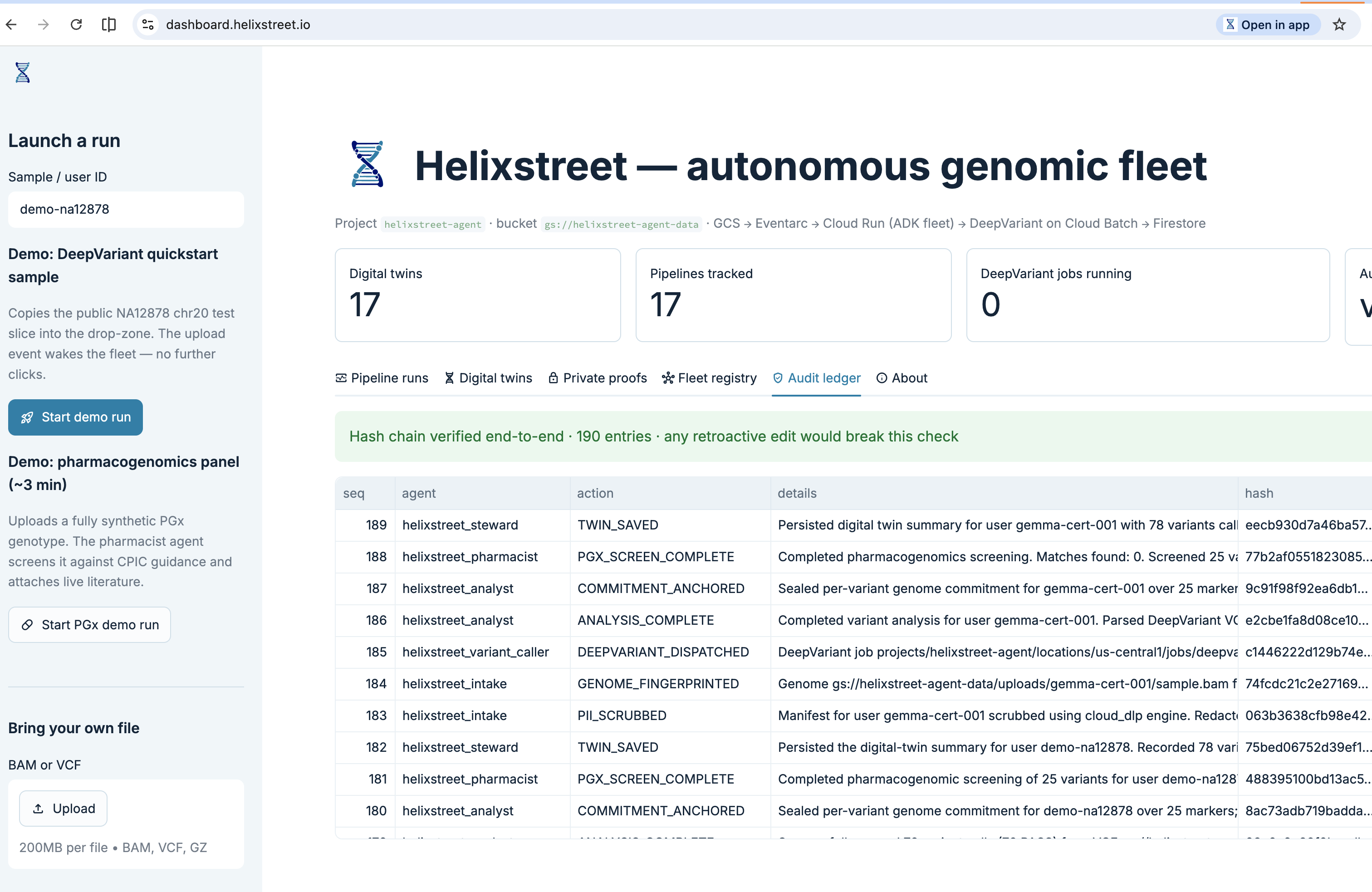
Dashboard Helixstreet 4 - Audit
-
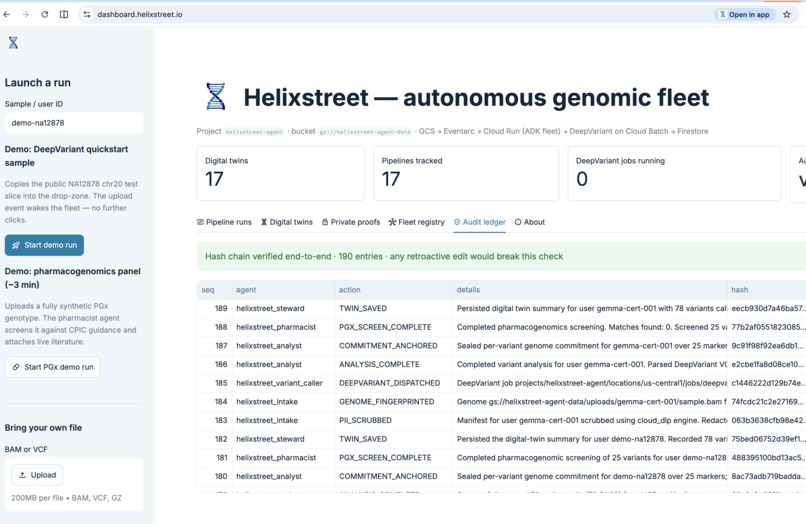
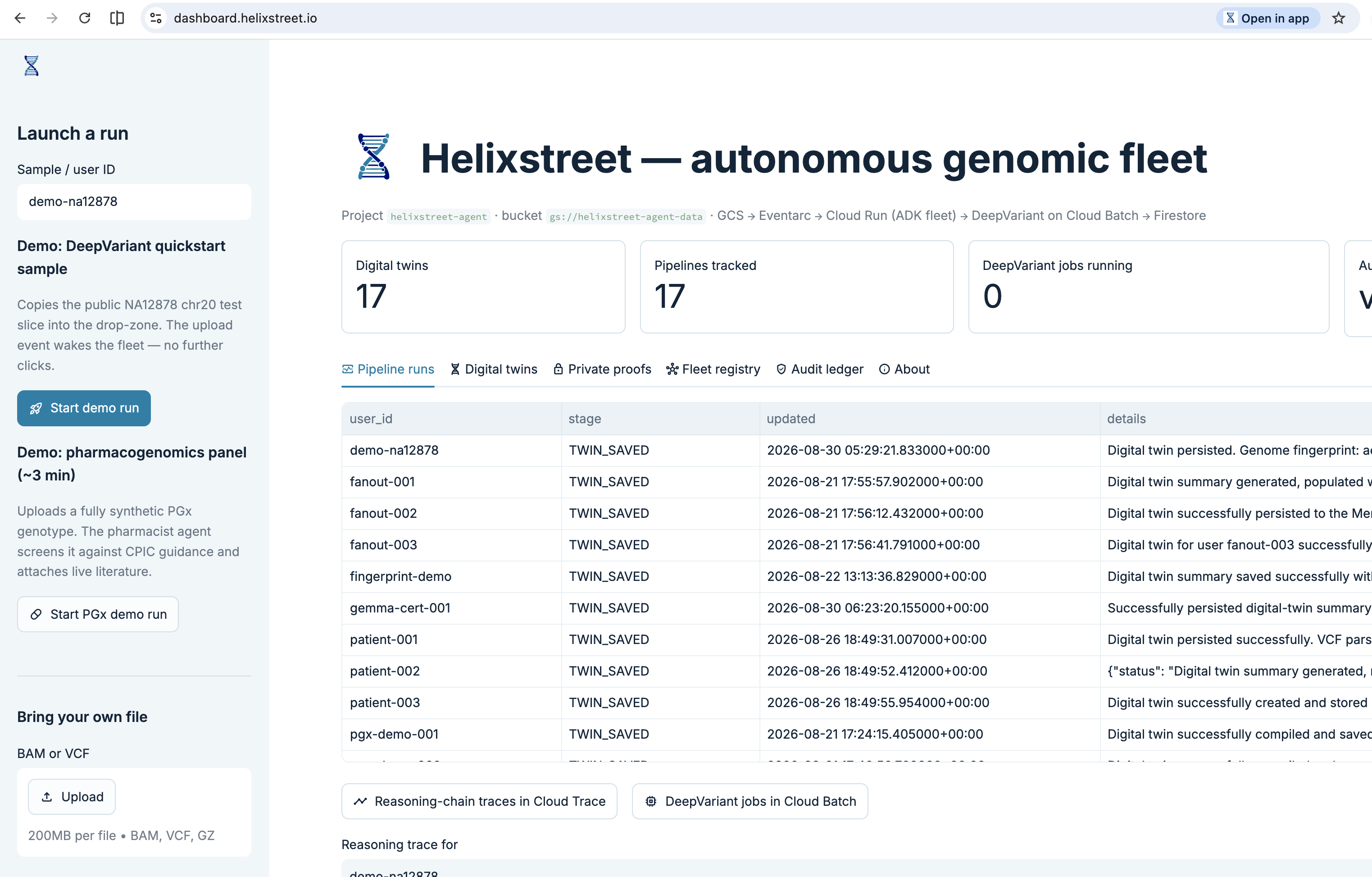
Dashboard Helixstreet - Start Page
Inspiration
Every genomic sample that reaches a lab starts a relay of humans: compliance review, PII scrubbing, pipeline babysitting, annotation lookups, record-keeping — days of coordination per file. We wanted to know what it looks like when the relay is replaced by a governed fleet of agents that the file itself wakes up. Not a chatbot with tools — a system with no chat loop anywhere.
What it does
Drop a raw sequencing file (BAM) into a Cloud Storage bucket and walk away:
- Intake agent screens the patient manifest with Model Armor (prompt-injection, malicious-URI, PII filters) and de-identifies it with Cloud DLP.
- Variant-calling agent dispatches Google DeepVariant as an asynchronous Cloud Batch job, checkpoints state to a Firestore Memory Bank — and the fleet goes dormant.
- Minutes later the VCF lands; Eventarc wakes the fleet again. The analyst agent parses the real calls and cross-references 1000 Genomes in BigQuery.
- The pharmacist agent screens variants against a curated CPIC drug-gene reference (e.g. "CYP2C19 poor metabolizer — clopidogrel may not activate") and attaches peer-reviewed papers it fetches live from Europe PMC.
- The steward agent persists a digital twin behind a hash-chained audit ledger whose integrity the dashboard re-verifies on every refresh.
Measured result: raw reads to fully-annotated twin in ~9 minutes, zero human touches — and three samples processed concurrently by the same fleet. Every reasoning step is an OpenTelemetry trace in Cloud Trace.
How we built it
Four principles shaped the architecture:
- Right-sized hybrid model tier. The high-throughput intake gatekeeper runs on Gemma 4 31B (Gemini API backend, native function calling; graceful fallback to Gemini if the key is absent), while the four reasoning agents run on Gemini 3.5 Flash. At population scale, screening every sample with a frontier model is waste; a small open model is the production answer.
- Events decide when, the model decides how. Routing between pipelines is
deterministic (Eventarc + a regex router); behavior inside each stage is agentic —
Gemini 3.5 Flash (Vertex AI, global endpoint) driving tools through Google's Agent
Development Kit (
Agent,SequentialAgent,Runner). - Dormancy over polling. The async gap while DeepVariant runs is bridged by Firestore state, not a waiting process. The same mechanism would carry a multi-week job.
- Identity at the platform layer. Three least-privilege service accounts: the analyst can read BigQuery but cannot launch compute; the dashboard reads state but cannot invoke agents; the fleet endpoint accepts exactly one identity — Eventarc's. Zero API keys in the codebase — the single key (Gemma's Gemini-API key) lives in Secret Manager.
- Governance as data. Agent registry in Firestore, audit entries written by the agent that did the work, hash-chained so tampering breaks the chain.
Stack: Gemini 3.5 Flash · ADK · DeepVariant · Cloud Run · Cloud Batch · Eventarc · Cloud Storage · Firestore · BigQuery · Cloud DLP · Model Armor · Cloud Trace · FastAPI · Streamlit.
Challenges we ran into
Five production incidents, each of which hardened the system:
- Model placement —
gemini-3.5-flashserves only from Vertex's global endpoint, while Batch jobs are regional; one env var was doing two jobs. - The idempotency trap — we claimed events as processed before success, so a failed run swallowed its own Eventarc retry. Claims now release on failure: exactly-once on success, self-healing on error (later proven live when a quota-exhausted run failed, was redelivered, and completed untouched).
- GCS-FUSE's vanishing directories — empty directories have no backing object and evaporate when the kernel cache expires, killing DeepVariant's final write minutes into the job. We back the output prefix with a placeholder object before dispatch.
- Quota-aware agents — concurrent pipelines cannibalized a thin per-minute model budget; model-level 429 backoff (15s→120s) plus right-sized concurrency fixed it.
- Unpinned dependencies — an upstream release broke Cloud Build mid-hackathon; all dependencies are now pinned from a verified environment.
Accomplishments that we're proud of
- A genuinely autonomous multi-agent system: upload in, governed digital twin out.
- Real heavy compute (DeepVariant on Batch), real enterprise guardrails (Model Armor + DLP), real population genomics (1000 Genomes), real clinical references (CPIC).
- The analyst agent noticed — unprompted — that VCF and BigQuery coordinates disagree by exactly one base pair (1-based vs 0-based) and reasoned through it. A join-by-position ETL would have silently returned zero matches.
- 3 concurrent patients → 3/3 twins, 6/6 pharmacogenomic findings each, zero errors.
What we learned
Autonomy is an infrastructure property before it is a model property: exactly-once event handling, claim release on failure, durable state across dormancy, and platform-level identity are what let an agent be trusted to act alone. The model supplies judgment inside stages; the architecture supplies the right to act.
What's next for Helixstreet — autonomous genomic fleet
Whole-genome scale on larger Batch shapes, per-department registries with A2A hand-offs, dbSNP joins in BigQuery to assign rsIDs to called variants, and managed Vertex AI Memory Bank for cross-session personalization.
Built With
- bigquery
- cloud-batch
- cloud-dlp
- cloud-run
- cloud-storage
- cloud-trace
- deepvariant
- docker
- europe-pmc
- eventarc
- fastapi
- firestore
- gemini
- gemma
- genomics
- google-adk
- google-cloud
- model-armor
- opentelemetry
- pharmacogenomics
- python
- secret-manager
- streamlit
- vertex-ai


Log in or sign up for Devpost to join the conversation.