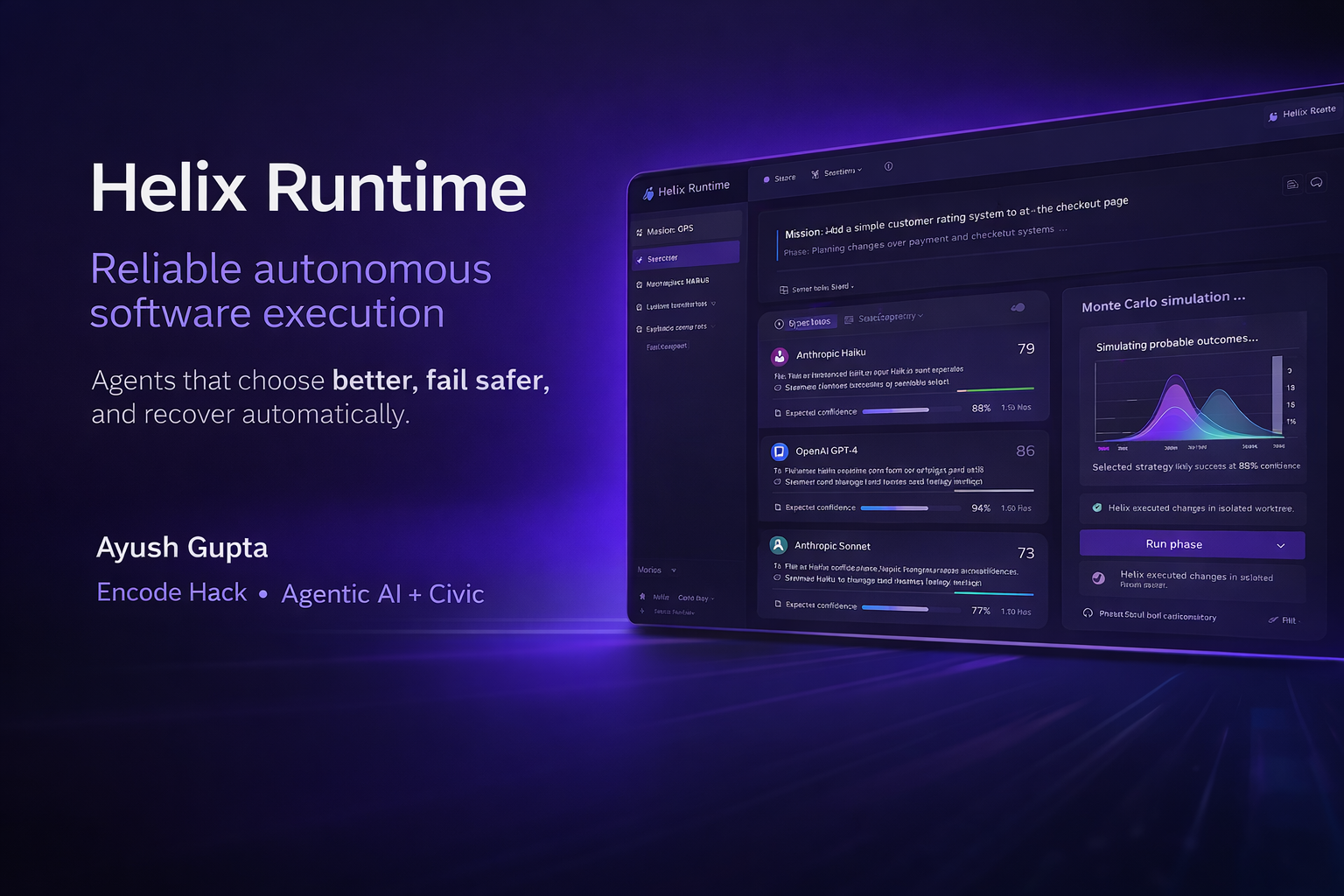
Helix Runtime is a local-first autonomous software execution runtime designed to make AI agents more reliable before they act and safer while they act. Instead of relying on a single plan and executing it blindly, it generates multiple competing strategies for each phase of a task, evaluates them using Monte Carlo simulation, and selects the most reliable option before execution. This allows the system to make decisions, adapt across steps, and recover from failure without requiring constant human intervention. The strategies are produced using lightweight forks of base models (Anthropic and OpenAI in this prototype) to minimize token usage while still exploring diverse approaches. Execution is performed in isolated git worktrees and validated against the repository baseline, with built-in failover mechanisms such as rollback, standby promotion, and rebidding to enable autonomous recovery. Civic is deeply integrated as a guardrail and governance layer throughout the runtime. It governs higher-trust actions such as external data access, GitHub context, and pull request publishing, while also preflighting capabilities and enforcing safe tool usage. This ensures that as the agent becomes more autonomous, its actions remain controlled, auditable, and aligned with defined safety boundaries.
Process
I initially set out to build a fully autonomous execution agent end-to-end, but quickly realized that was way too ambitious. I then decided to build something similar to civic, with civic. An autonomous agent brain that sits between the human and the agent. I initially was going to call it “arbiter” but that sounded too boring so I later settled on helix runtime. A key challenge was making the Monte Carlo evaluation meaningful while keeping it lightweight, as well as ensuring that recovery and multi-phase execution behaved consistently across the system.
Context
I came into the hackathon wanting to explore ways to reduce wasted token computation, after noticing inefficiencies in previous projects using AI APIs. That led to the idea of evaluating multiple strategies before execution rather than committing to one. I set myself a very ambitious goal, and while the final system is still a prototype, I was able to build a full working runtime with bidding, simulation, execution, recovery, and Civic integration. I’m genuinely happy with how much I was able to build and learned a lot along the way.

Log in or sign up for Devpost to join the conversation.