Inspiration
As a Biotechnology student and AI Engineer, I’ve seen how researchers drown in fragmented data—PDFs, microscope images, and sequences that don't talk to each other. I built Helix Mind to be the "Digital Lab Partner" that remembers every experiment and reasons through complex biological puzzles using Gemini 3.
What it does
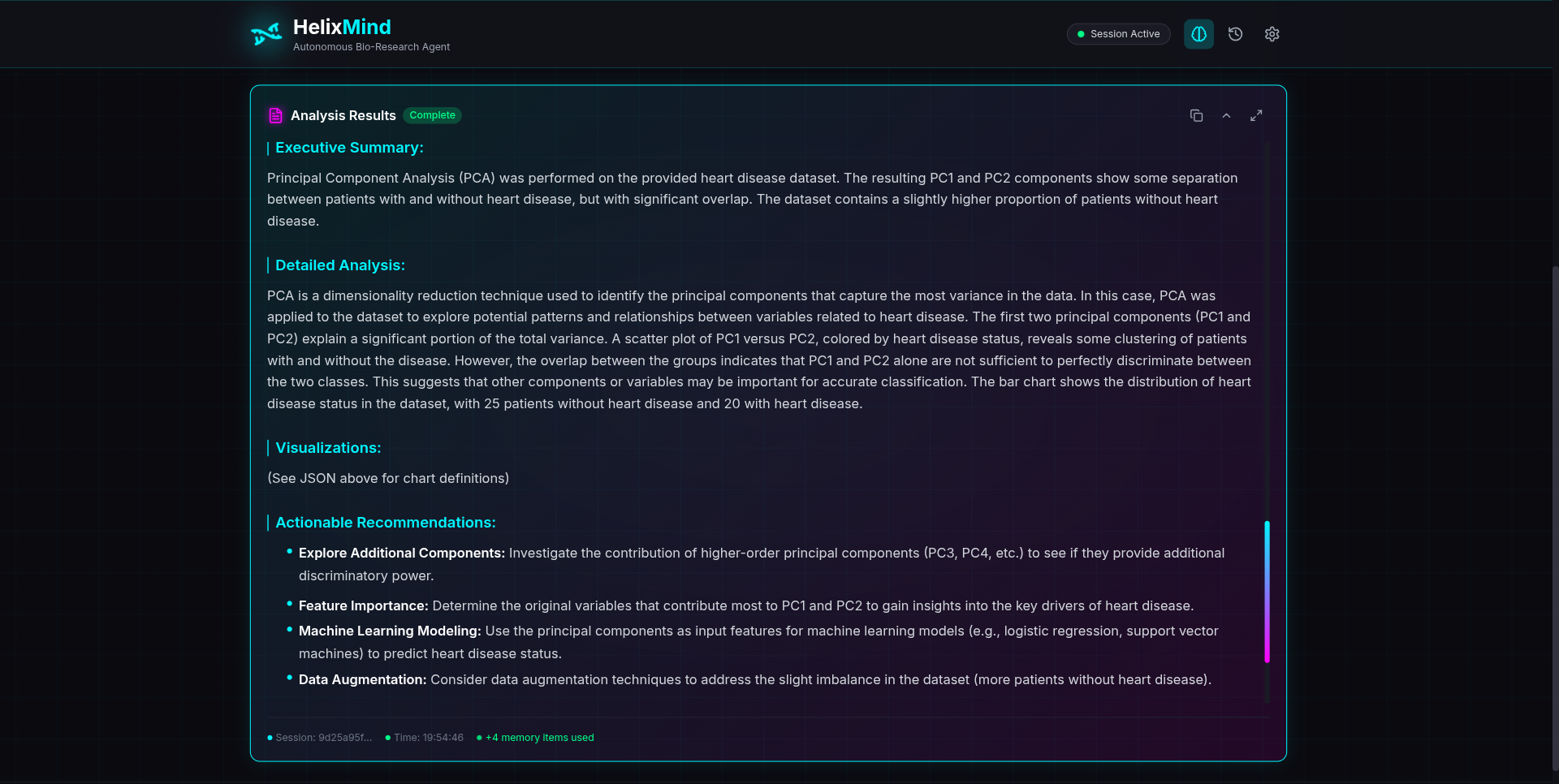
Helix Mind is a futuristic research terminal. You upload a protein sequence, a research paper, and a lab image; it uses Gemini 3’s high-level reasoning to find contradictions or breakthroughs. It doesn't just give an answer; it shows its "Thought Signature" (internal logic) and automatically writes Python code to render interactive Plotly charts of the data.
How I built it
I utilized an agentic workflow exclusively on Antigravity, spawning parallel sub-agents to build the FastAPI backend and Next.js frontend. The "brain" is fine-tuned in Google AI Studio using Gemini 3 Pro.
Challenges I faced
Implementing Session Resumption (Memorization) for large biological datasets was a challenge. I solved this by leveraging Gemini 3’s persistent context caching, allowing the agent to "remember" a scientist's specific research focus across multiple days without re-uploading files.
Accomplishments that I'm proud of
Successfully bridging the gap between raw biological data and generative interactivity. Seeing the AI "think" through a gene-disease association and then immediately plot a expression chart was a "eureka" moment.
What I learned
Agentic development is the future. Using Antigravity allowed me to build a complex, full-stack scientific tool in under 24 hours—a task that would usually take weeks.


Log in or sign up for Devpost to join the conversation.