-
-
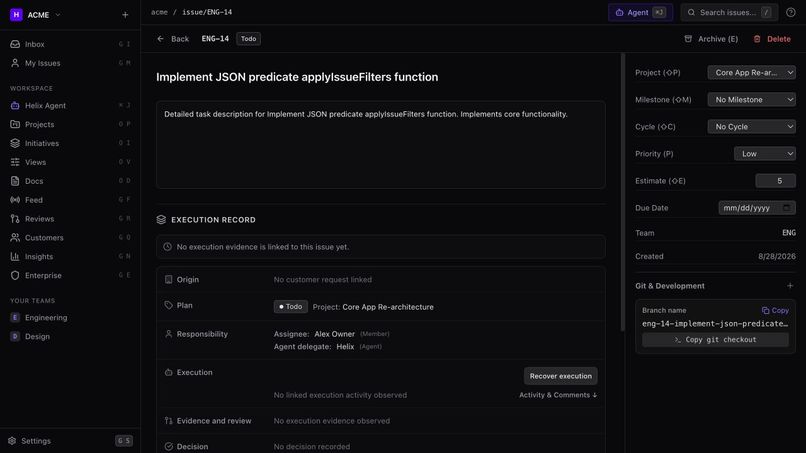
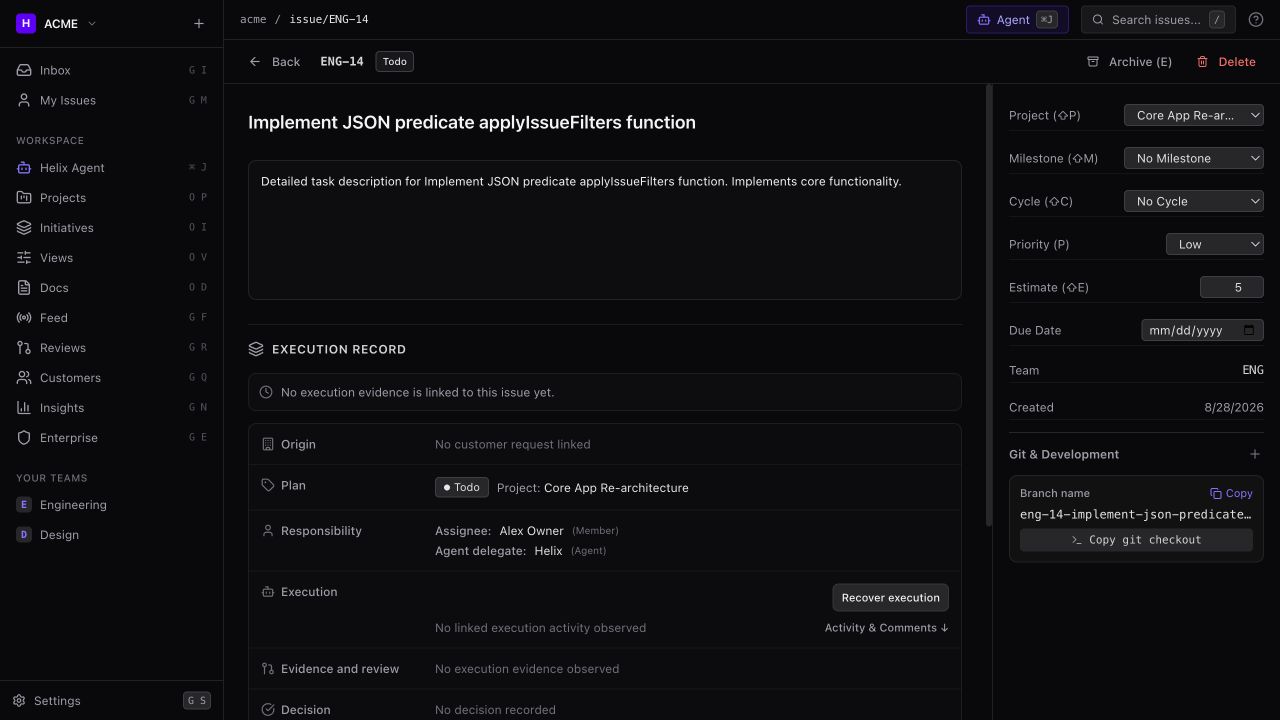
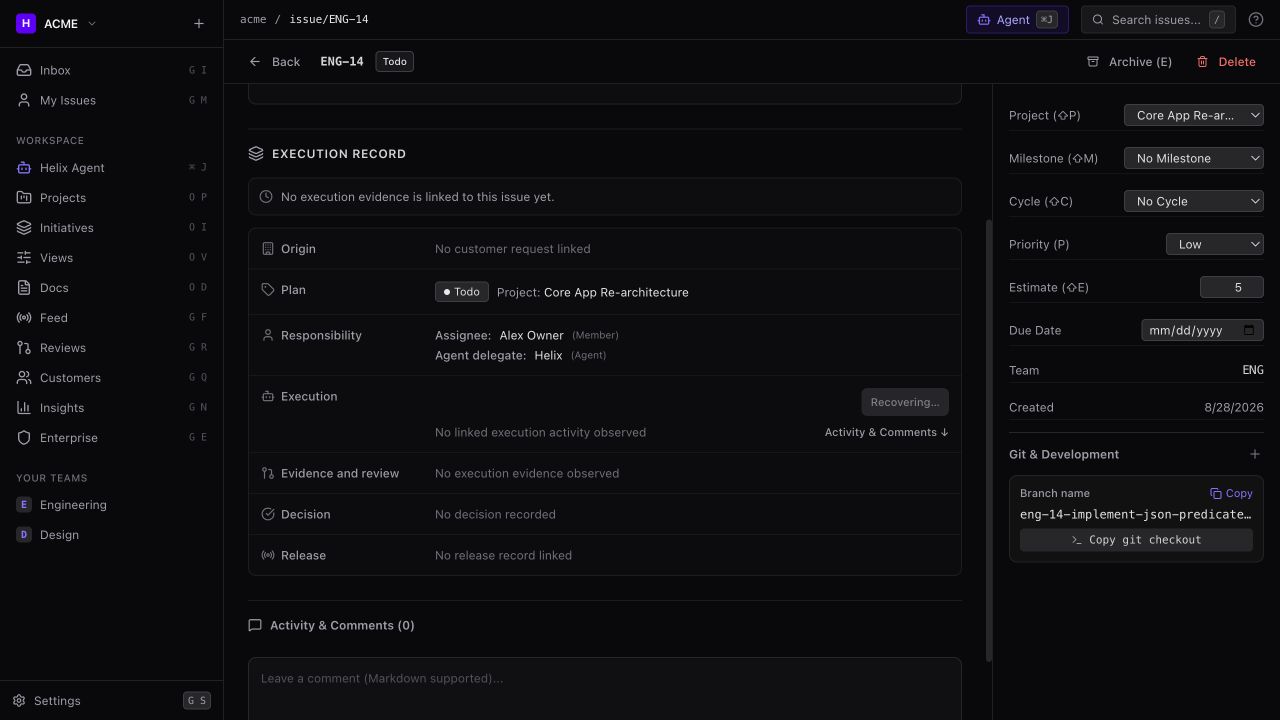
Execution Record: origin through release evidence in one issue-scoped view.
-
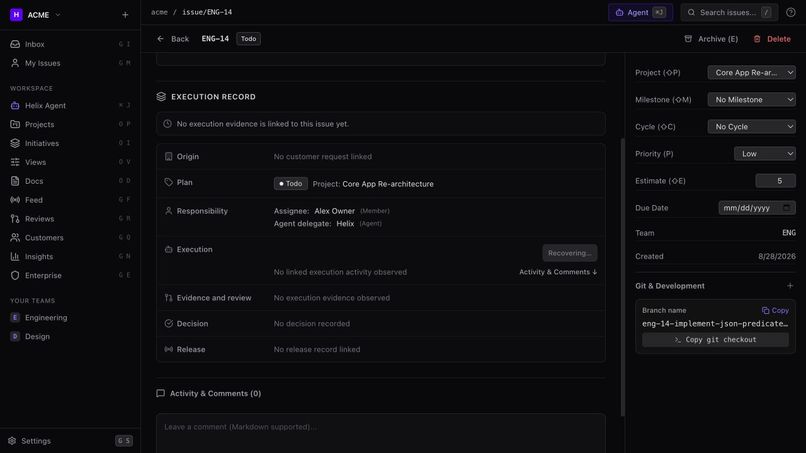
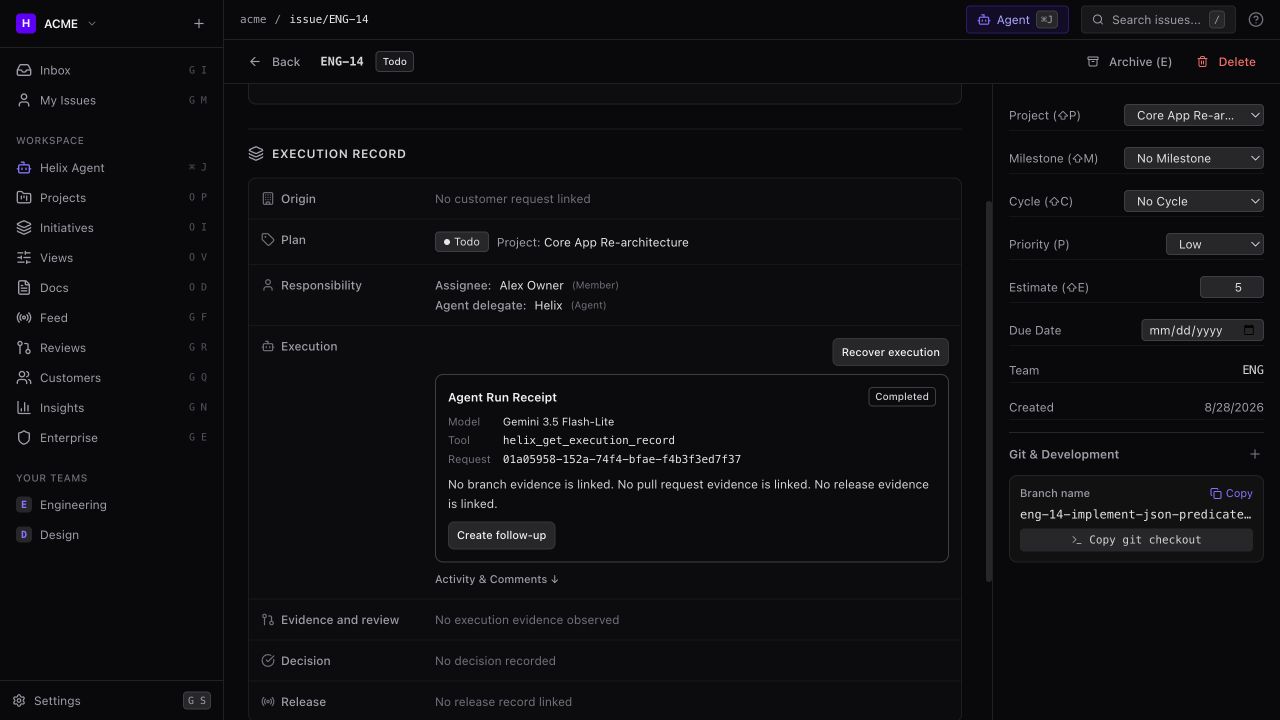
Recover execution: Gemini receives a minimized, tenant-scoped record—not arbitrary tool access.
-
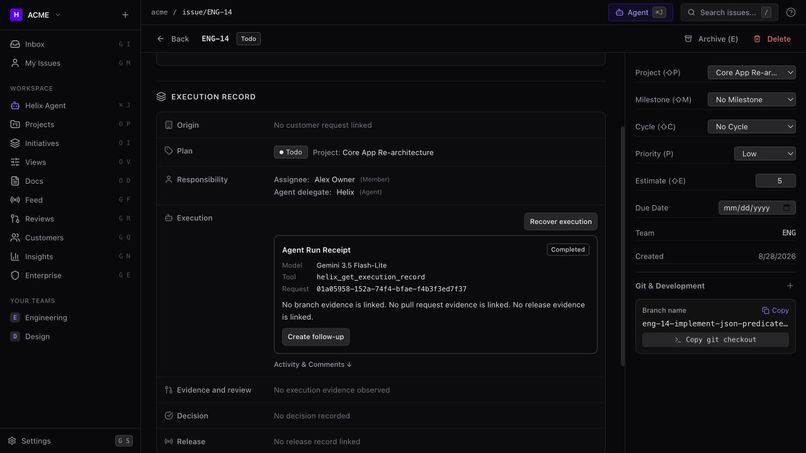
Human approval: the recovery follow-up becomes real only after an explicit approval.
-
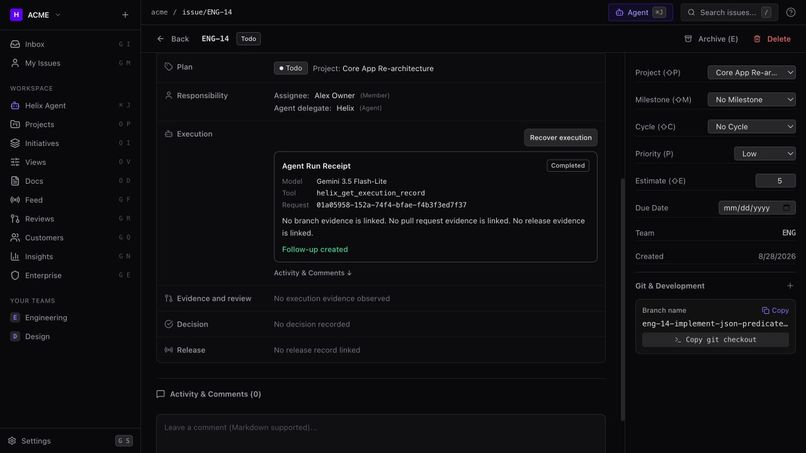
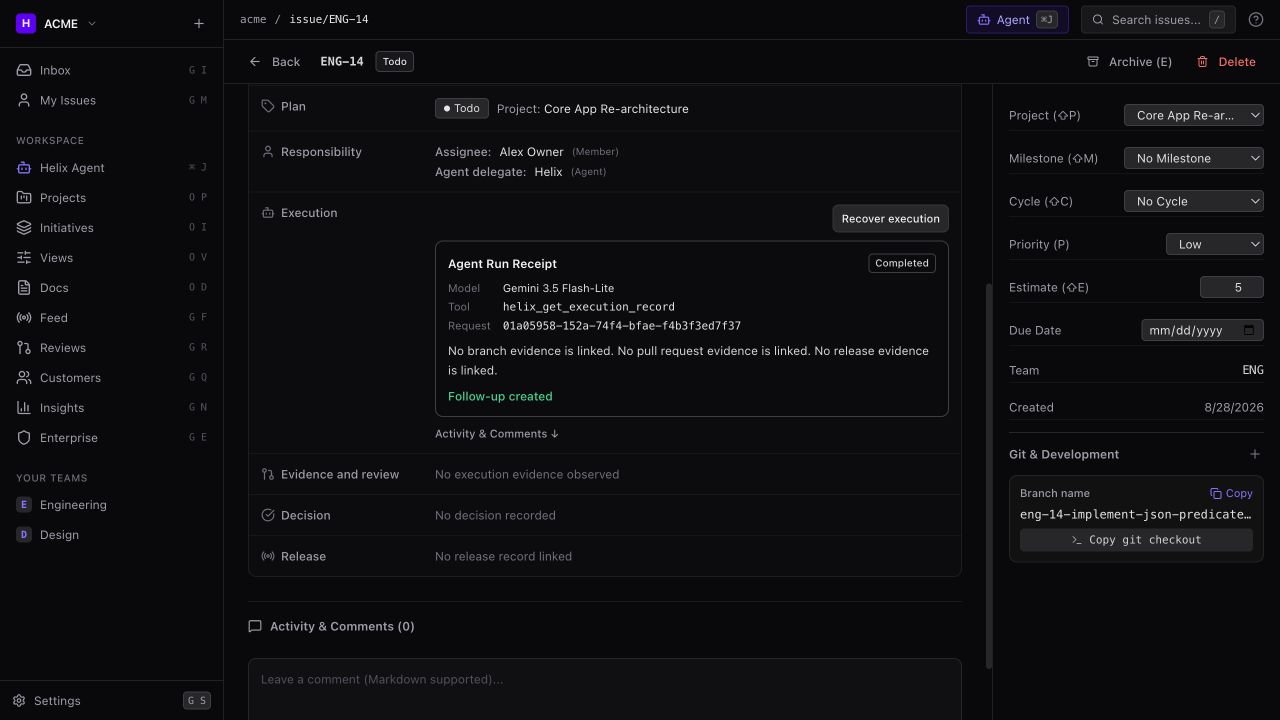
Grounded receipt: Gemini 3.5 Flash-Lite called helix_get_execution_record and selected server-allowed gaps.
-
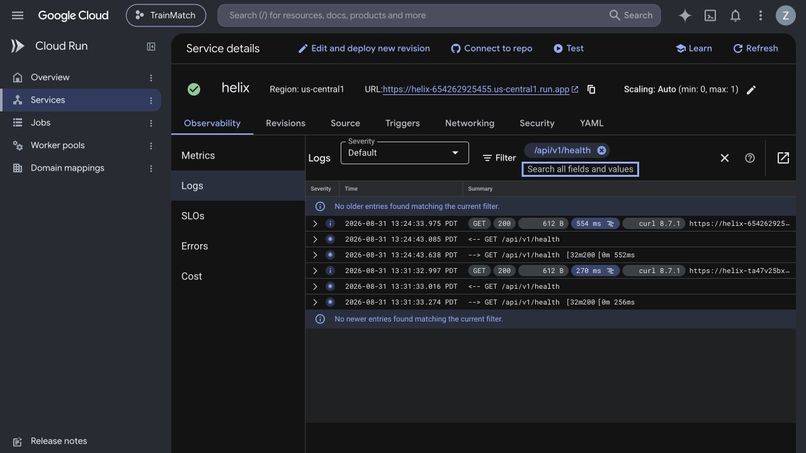
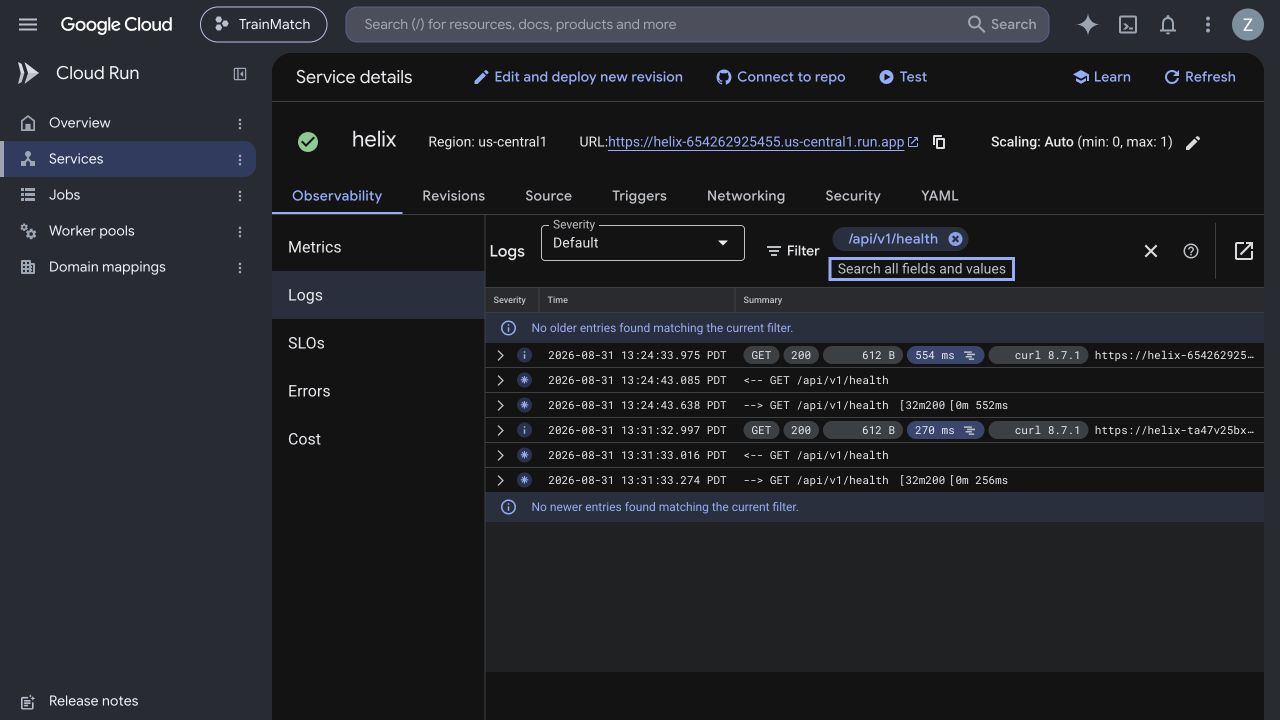
Live operational proof: Cloud Run health requests return HTTP 200 in service logs.
-
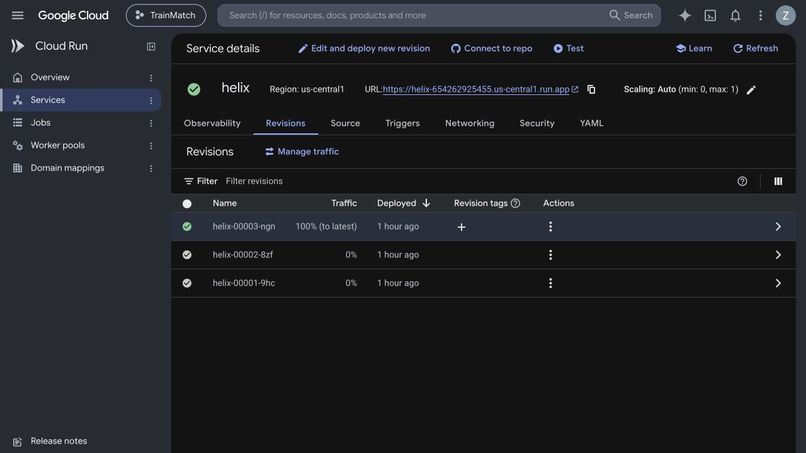
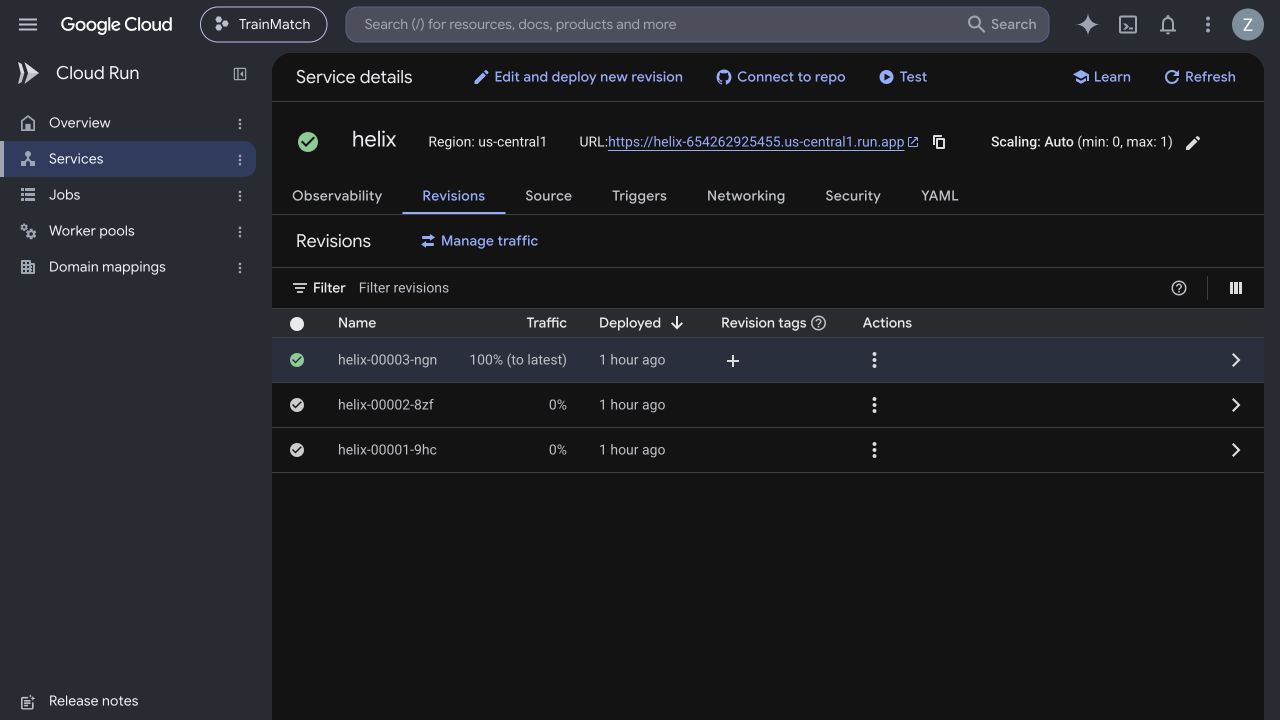
Running in Google Cloud: Helix Cloud Run service with the active revision.
-
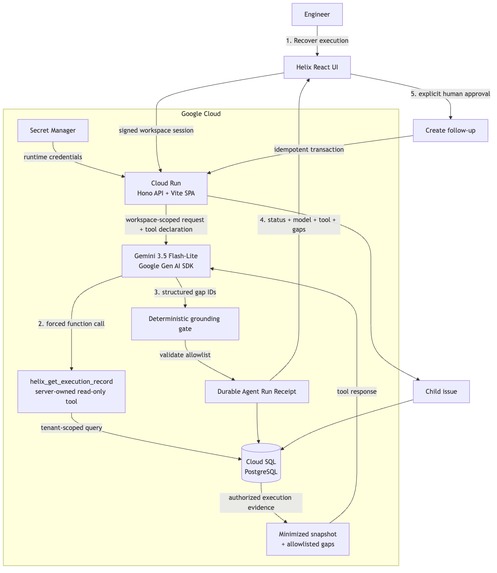
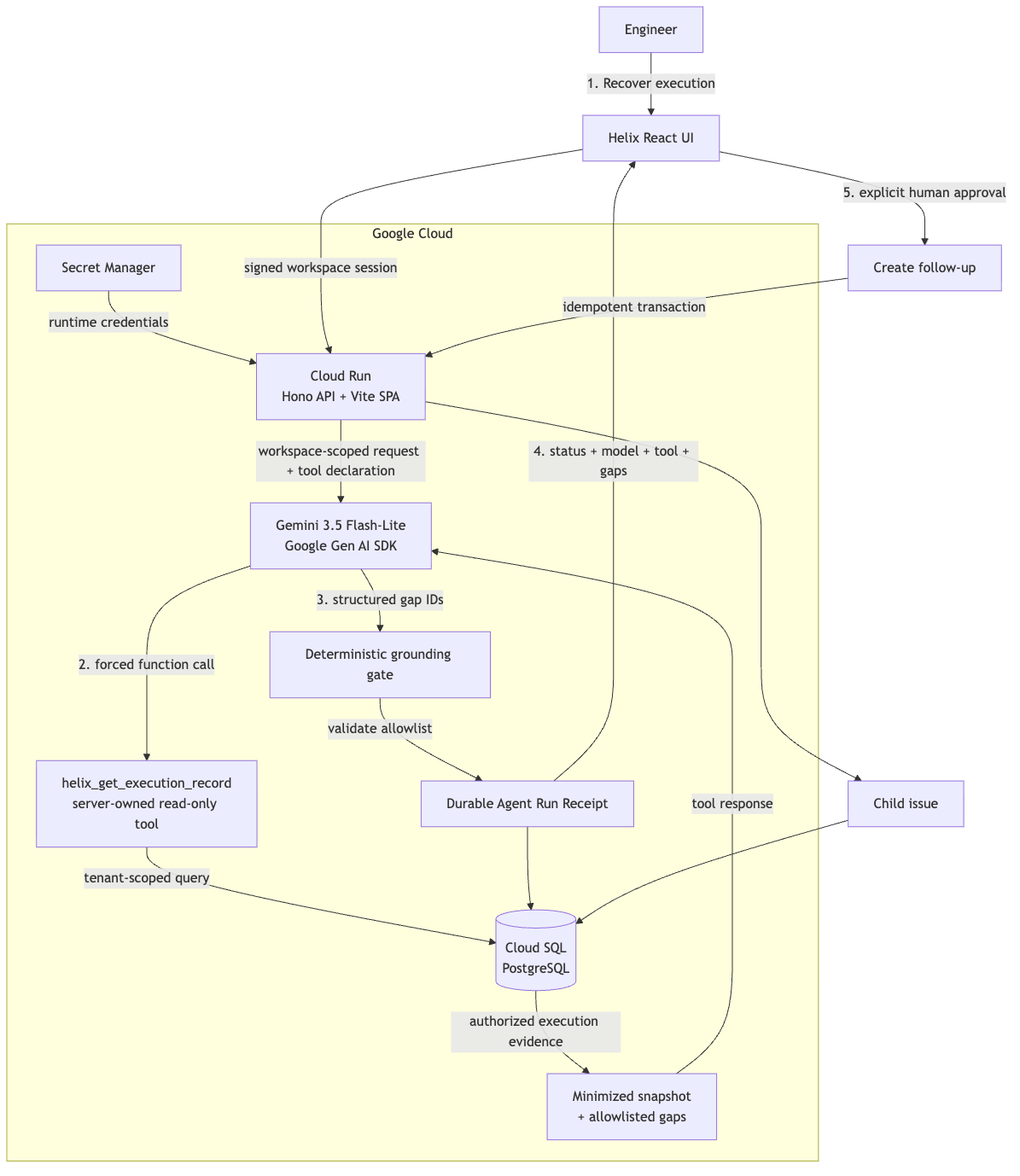
Architecture: grounded recovery across React, Hono, Gemini, Cloud Run, Cloud SQL, and Secret Manager.
Inspiration
Engineering work now moves between people, coding agents, issue trackers, pull requests, reviews, and release systems. A task can look complete in one surface while still lacking ownership, review, release proof, or a link to the customer need that started it. Teams waste time reconstructing what happened, while model-written status summaries can sound certain without proving anything.
What it does
Helix gives every issue a seven-stage Execution Record: origin, plan, responsibility, execution, evidence, decision, and release.
When work stalls, Recover execution asks Gemini 3.5 Flash-Lite to call one server-owned, read-only tool. That tool returns a tenant-scoped, minimized snapshot and an allowlist of valid delivery gaps. Gemini selects up to three gap IDs; Helix validates those IDs deterministically, stores a durable Agent Run Receipt, and prepares a recovery follow-up. A person approves the consequential write, and Helix applies it idempotently.
The result is one evidence-backed answer to three questions: what is blocked, what proves it, and what should happen next.
How we built it
- React 19 web UI and Hono/Node API
- PostgreSQL with Drizzle for product data and durable receipts
- Google GenAI SDK (
@google/genai) - Gemini 3.5 Flash-Lite function calling plus structured output
- Cloud Run container packaging and Cloud SQL integration
- Better Auth with optional Google OAuth and workspace-bound sessions
- Vitest and Playwright coverage
The model is deliberately constrained. It can call only helix_get_execution_record, which performs authorized issue reads and returns server-derived gap IDs. A deterministic boundary rejects unknown, duplicate, empty, or over-limit selections before anything is persisted. The model never chooses a tenant, queries arbitrary data, invents proof, or performs the final write.
Challenges we ran into
Our first paid Gemini proof call exposed a real API-contract failure: forced function calling and JSON response MIME type cannot be combined in the same model turn. We reproduced it with a regression test, separated the required tool-call turn from the structured-response turn, disabled tools for the follow-up, and reran the real Gemini path successfully.
We also kept release evidence honest: local build, paid model proof, cloud deployment, public repository, and Devpost status are tracked as separate states rather than collapsed into “done.”
Accomplishments that we're proud of
- A real Gemini tool call grounded in a tenant-scoped Execution Record
- Durable success and failure receipts that survive refresh
- Human approval separated from model judgment
- Idempotent recovery application
- Visible fail-closed behavior instead of mock fallback
- A sanitized public repository with reproducible setup, Apache-2.0 licensing, tests, and an architecture artifact
What we learned
Agentic reliability is less about giving a model more power and more about designing the evidence and authorization boundaries around it. Gemini is strongest here as a constrained diagnostic reasoner: the application owns identity, retrieval, validation, persistence, and writes.
What's next for Helix
The current boundary is an issue-scoped, single-workspace demo. Next steps are background recovery triggers, richer cross-system evidence connectors, and production-grade multi-tenant authorization—without weakening the receipt and human-approval model.
Known limitations
- Recovery is user-triggered rather than scheduled in the background.
- Gemini diagnoses and drafts recovery, but a human approves the consequential write.
- Google OAuth support is implemented but a live OAuth round trip is not part of this submission claim.
- Broader Helix surfaces remain preview-grade; this entry claims the Execution Record and grounded recovery loop.
Built With
- gemini-3.5-flash-lite
- google-cloud-run
- google-cloud-sql
- google-genai-sdk
- hono
- postgresql
- react
- typescript

Log in or sign up for Devpost to join the conversation.