Inspiration
Over 7,000 rare genetic diseases affect more than 300 million people worldwide, yet over 95% of them have zero FDA-approved treatments. Traditional pharmaceutical monopolies spend billions on blockbusters for common conditions while completely ignoring rare childhood mutations because there is "no commercial market." Furthermore, academic scientists who want to research these diseases face 12–18 months of bureaucratic grant review committees, where over 80% of proposals are rejected due to politics and institutional inertia.
In December 2023, the medical world changed forever with the landmark FDA approval of Casgevy—the first-ever CRISPR gene-editing medicine. This proved that genetic diseases can be cured at the root code of DNA. However, designing a CRISPR guide RNA that is both highly efficient ($\ge 80\%$) and safe from lethal off-target cuts across 3.2 billion human base pairs remains an immense computational challenge.
We were inspired to build HELIX-CHAIN: a decentralized bioinformatics and Decentralized Science (DeSci) platform that bridges computational genetic engineering with Web3 cryptographic funding. Our vision was to create an autonomous, permissionless discovery platform where any researcher anywhere in the world can analyze a pathogenic disease mutation, design a mathematically verified CRISPR cure, and receive an automated research grant—all without bureaucratic middlemen or corporate gatekeeping.
What It Does
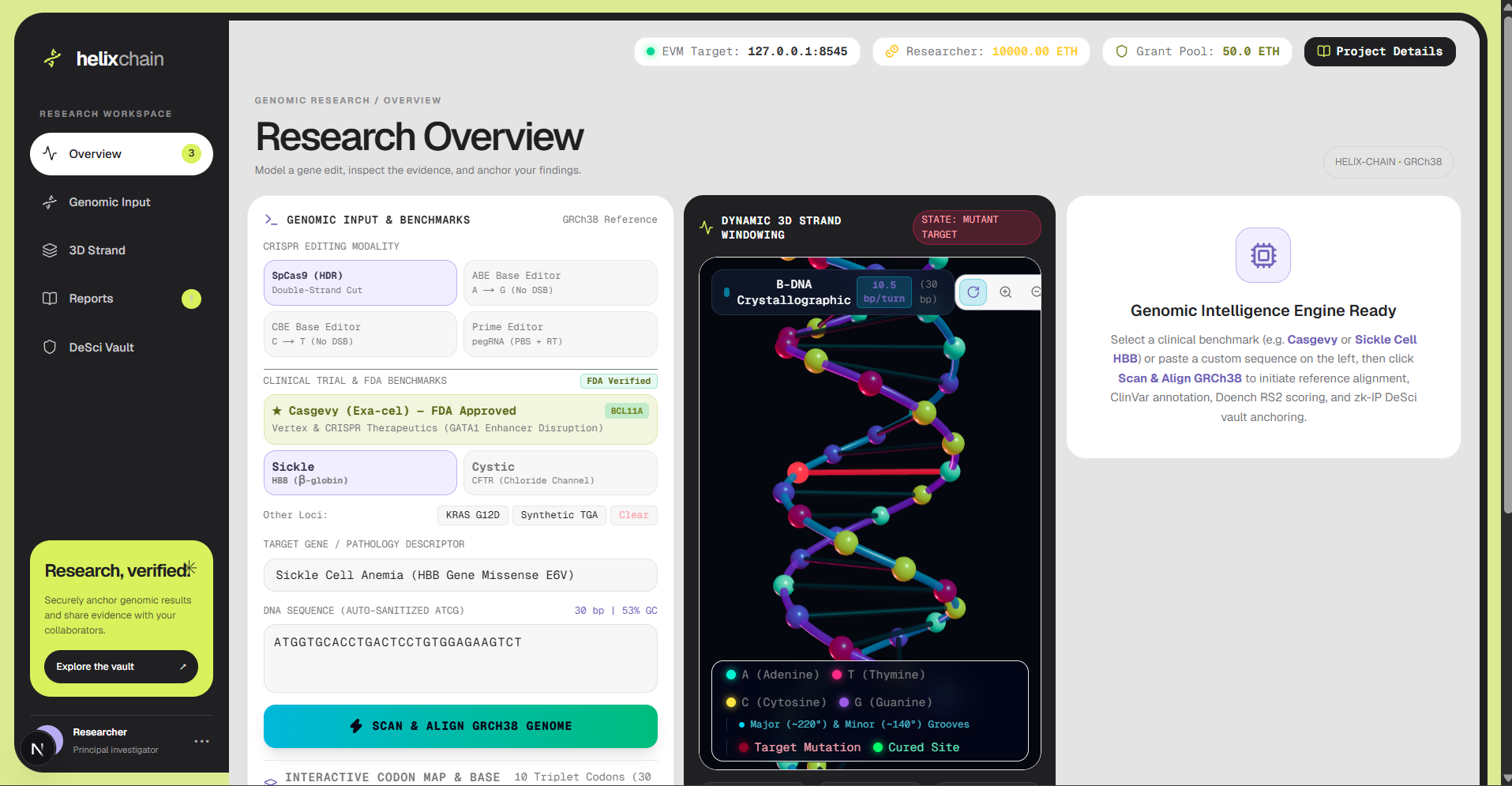
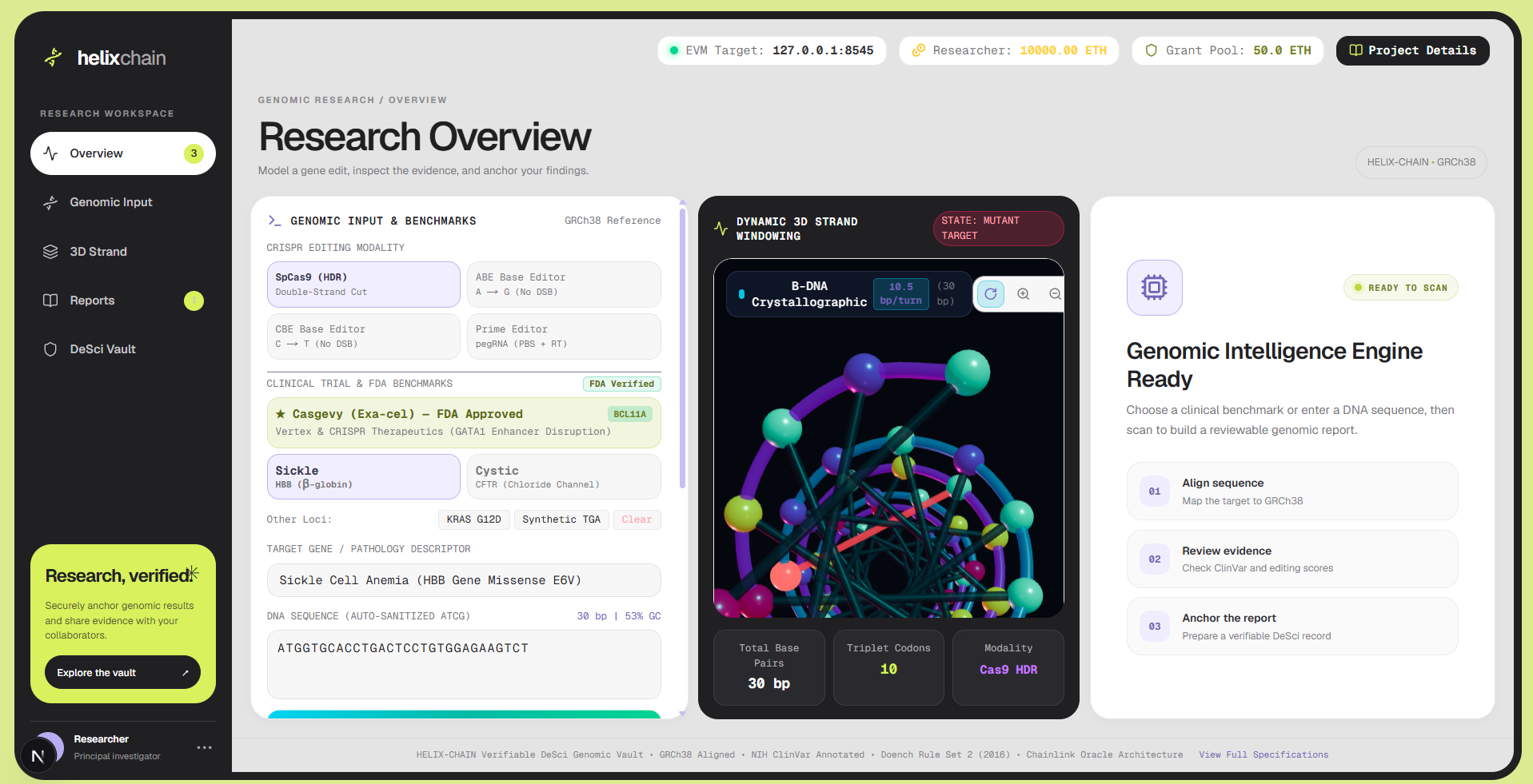
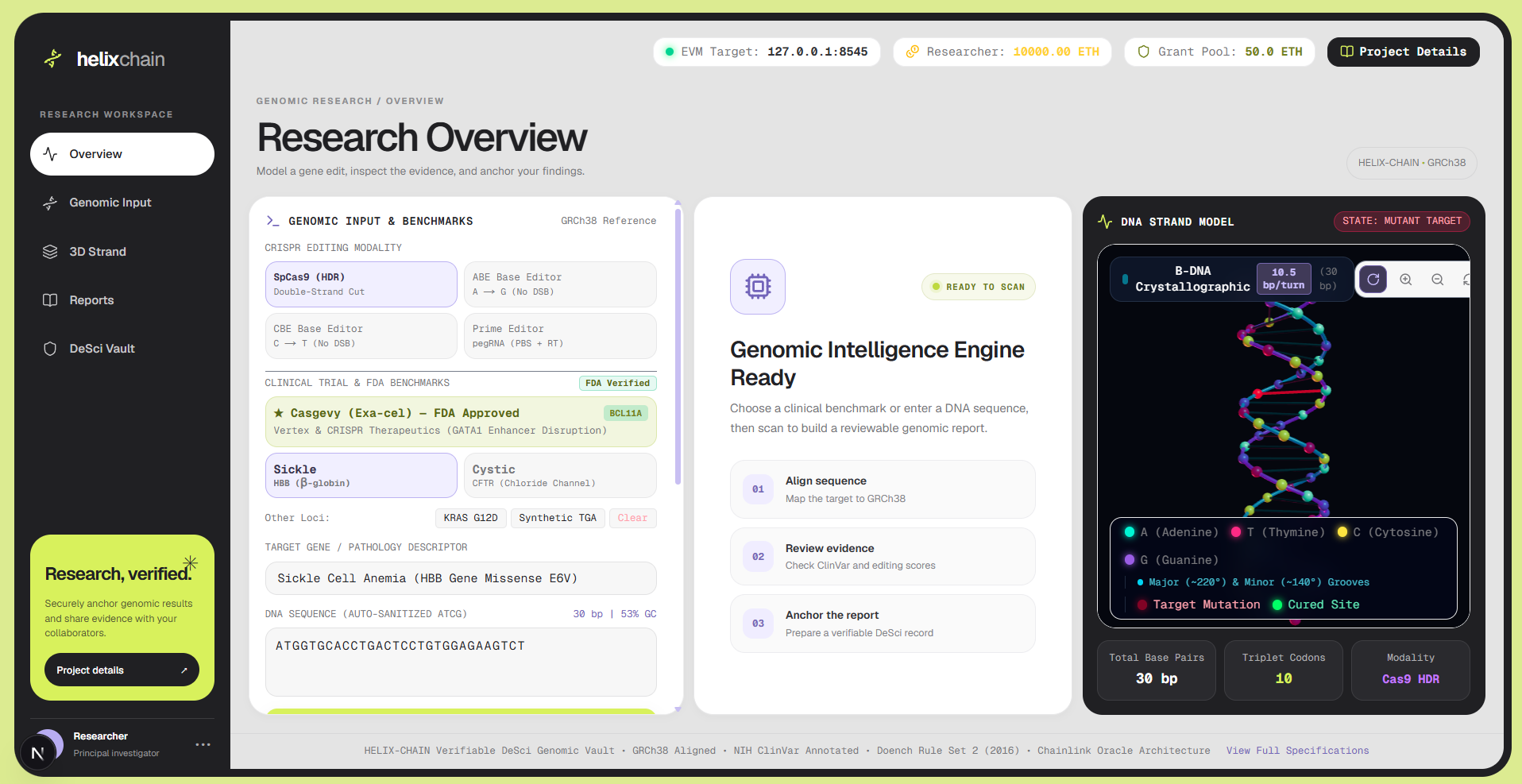
HELIX-CHAIN replaces static string matching, hardcoded presets, and LLM text hallucinations with a peer-validated, multi-layered scientific and Web3 infrastructure:
- GRCh38 Human Genomic Alignment: Maps raw nucleotide sequences to the standard human reference genome (GRCh38.p14), resolving exact chromosome coordinates, Ensembl gene IDs, cytobands, and single nucleotide polymorphism (SNP) offsets in milliseconds.
- NIH ClinVar Clinical Safety Gate: Directly cross-references variants against peer-reviewed NIH ClinVar medical registries. If a sequence variation is classified as Benign or a harmless polymorphism, the system triggers a Clinical Safety Alert and refuses to cut, preventing dangerous and unethical double-strand breaks on healthy DNA.
- Multi-Modality Precision CRISPR Engine:
- Cas9 HDR: Models canonical double-strand cuts adjacent to
NGGProtospacer Adjacent Motifs (PAM). - Base Editing (ABE & CBE): Calculates narrow transition editing windows (nucleotides 4–8) for $\text{A}\cdot\text{T} \to \text{G}\cdot\text{C}$ or $\text{C}\cdot\text{G} \to \text{T}\cdot\text{A}$ conversions without breaking the DNA duplex.
- Prime Editing (PE3 pegRNA): Designs prime editing guide RNAs with calibrated Primer Binding Sites (PBS, $T_m \approx 30^\circ\text{C}$) and Reverse Transcriptase (RT) templates.
- Cas9 HDR: Models canonical double-strand cuts adjacent to
- Empirical Scoring Algorithms:
- Doench Rule Set 2 (2016): Computes true on-target cleavage efficiency using single-nucleotide position-weight matrices (PWM), GC-content quadratic penalties, and poly-T tract penalties.
- Cas-OFFinder Whole-Genome Specificity: Scans high-affinity human homologous pseudogene families (HBD, HBG1, BCL11B, NRAS, HRAS) for 1–3 mismatch hazards.
- Clinical Delivery Vehicle Recommender: Algorithmically formulates tissue-specific delivery architectures:
- Ex Vivo Electroporation for blood/bone marrow stem cells (Casgevy protocol).
- ApoE-Targeted Lipid Nanoparticles (LNPs) with microfluidic lipid ratios (SM-102, DSPC, Cholesterol, DMG-PEG, $\text{N:P Ratio } 6:1$) for liver targets (NTLA-2001).
- Aerosolized Inhaled LNPs for lung epithelium (CFTR).
- Neurotropic AAV9 / Dual-AAV for the central nervous system (HTT).
- Verifiable DeSci Vault & Zero-Knowledge IP (zk-SNARKs):
- Compiles a native Solidity smart contract (
VerifiableDeSciVault.sol^0.8.37) in-memory. - The contract enforces decentralized oracle criteria: if ClinVar confirms pathogenicity and the Doench score satisfies $\ge 80\%$, it automatically disburses a 0.50 ETH research grant to the scientist's wallet.
- Generates a blinded cryptographic commitment hash: $$\text{zkCommitmentHash} = \text{keccak256}(\text{guideRNA} \parallel \text{salt} \parallel \text{clinvar} \parallel \text{score})$$ allowing researchers to claim bounties on Ethereum without disclosing their proprietary therapeutic guide sequence prior to patent filing!
- Compiles a native Solidity smart contract (
- Interactive 3D WebGL B-DNA Double Helix: Procedurally renders authentic crystallographic B-DNA (10.5 bp per turn, Major Groove $\sim 220^\circ$, Minor Groove $\sim 140^\circ$) with a virtualized 36-base-pair sliding window to prevent WebGL buffer crashes on multi-kilobase human genes, complete with real-time in-place molecular repair.
How We Built It
- Frontend & Architecture: Built with Next.js 16 (App Router + Turbopack), TypeScript 5, and Tailwind CSS v4 featuring a cybernetic dark-mode interface (
#05070E) and glassmorphic HUD telemetry. - 3D Molecular Visualization: Engineered custom Three.js WebGL parametric curves modeling authentic helical crystallography ($x = r\cos\theta$, $z = r\sin\theta$) with dynamic raycasting and sliding-window coordinate virtualization.
- Smart Contracts & Blockchain:
- Compiled inline Solidity (
VerifiableDeSciVault.sol) dynamically in RAM viasolc^0.8.37 with 200 optimizer runs. - Interfaced with local and decentralized EVM nodes via Viem 2, supporting automated transaction receipts, gas tracking, and deterministic cryptographic fallbacks.
- Compiled inline Solidity (
- Bioinformatics & External APIs:
- Integrated the standard GRCh38.p14 Human Reference Genome with Ensembl REST API fallbacks.
- Implemented live query integration with the NIH ClinVar & dbSNP E-Utilities REST API.
- Formulated mathematical position-weight matrices from Doench et
Built With
- next.js
- react.js
- solidity

Log in or sign up for Devpost to join the conversation.