

🧠 Helix AI — Decision Intelligence for Teams
Inspiration
Every day, developers, students, founders, and teams face important decisions—choosing technologies, planning products, prioritizing features, or evaluating trade-offs. While AI chatbots can answer questions, they rarely provide structured decision analysis or remember previous decisions.
We wanted to build an AI assistant that doesn't just answer questions, but helps people make better decisions. This led to the idea of Helix AI, a Slack-native Decision Intelligence Assistant that analyzes decisions, presents structured recommendations, and keeps a history of previous analyses for future reference.
What it does
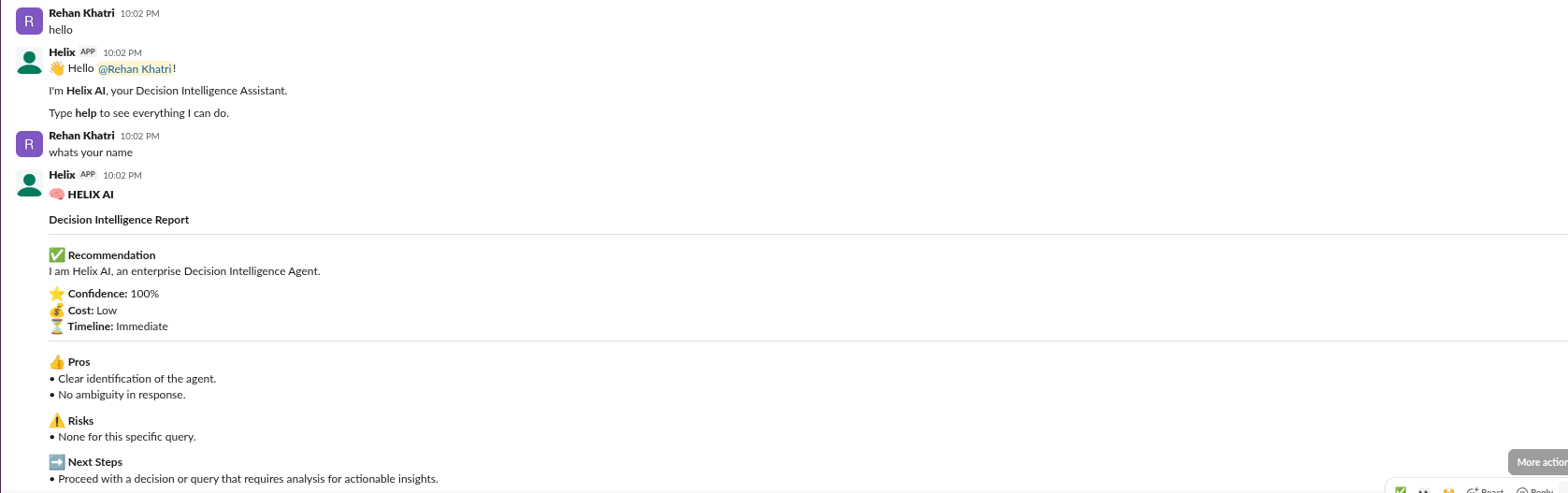
Helix AI is a Slack application that provides structured AI-powered decision analysis directly inside Slack.
Users can ask questions such as:
- Should I build a mobile app first?
- Should I use PostgreSQL or MongoDB?
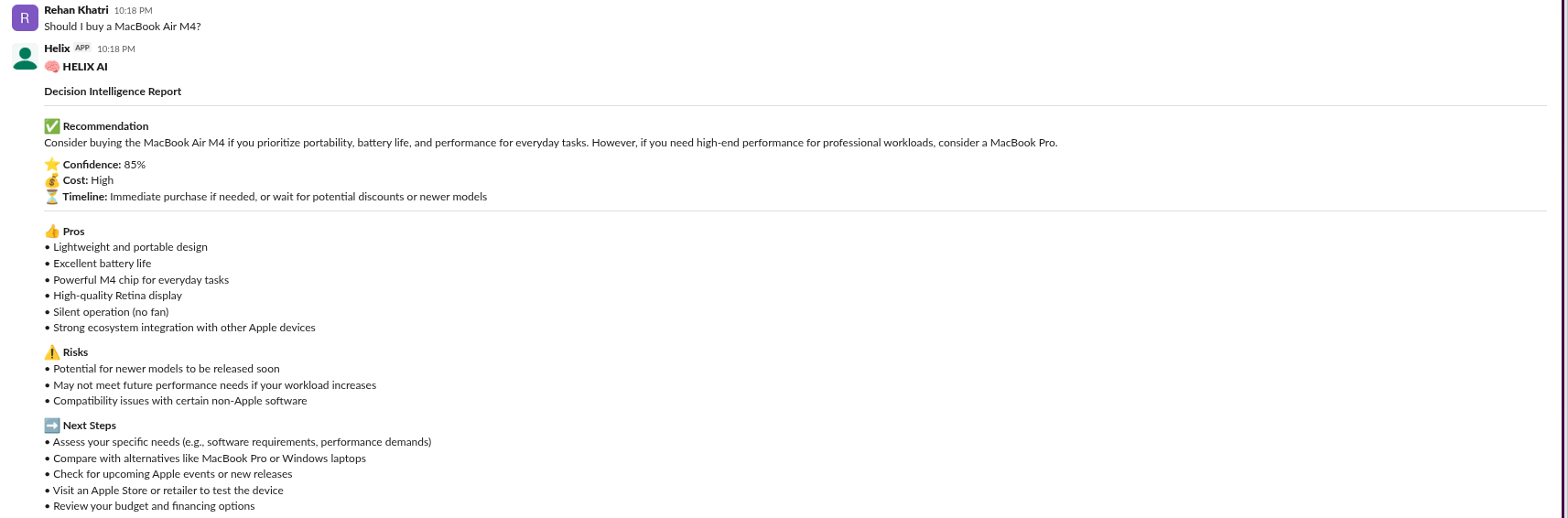
- Should I buy a MacBook Air M4?
Helix responds with a structured decision report containing:
- ✅ Recommendation
- ⭐ Confidence Score
- 👍 Pros
- 👎 Cons
- ⚠ Risks
- 💰 Estimated Cost
- ⏳ Estimated Timeline
- ➡ Actionable Next Steps
Every analysis is automatically stored, allowing users to review previous decisions using the history command.
How we built it
Helix AI was built using a modular Node.js architecture with Slack Bolt for Slack integration.
The application consists of:
- Slack Bolt for event handling
- OpenRouter API for AI-powered decision analysis
- Prompt engineering to enforce structured JSON responses
- A modular decision engine for processing AI output
- Slack Block Kit for rich, user-friendly responses
- Local JSON storage for persistent decision memory
- Environment-based configuration using dotenv
The project follows a modular architecture by separating commands, services, prompts, utilities, and storage into dedicated modules, making the application easier to maintain and extend.
Challenges we ran into
One of the biggest challenges was ensuring reliable AI responses.
Initially, responses were inconsistent, making them difficult to parse programmatically. We improved prompt engineering, added response validation, and built fallback logic to handle malformed AI output gracefully.
Another challenge was selecting an AI provider. During development we migrated from Google's Gemini API to OpenRouter, which provided greater flexibility in model selection and simplified integration.
We also focused on improving the Slack user experience by replacing plain text responses with structured Slack Block Kit cards.
Accomplishments that we're proud of
We're proud that Helix evolved from a simple Slack bot into a complete Decision Intelligence Assistant.
Key accomplishments include:
- Slack-native AI experience
- Structured decision analysis
- Persistent decision history
- Modular project architecture
- Professional Slack Block Kit interface
- Robust AI response validation
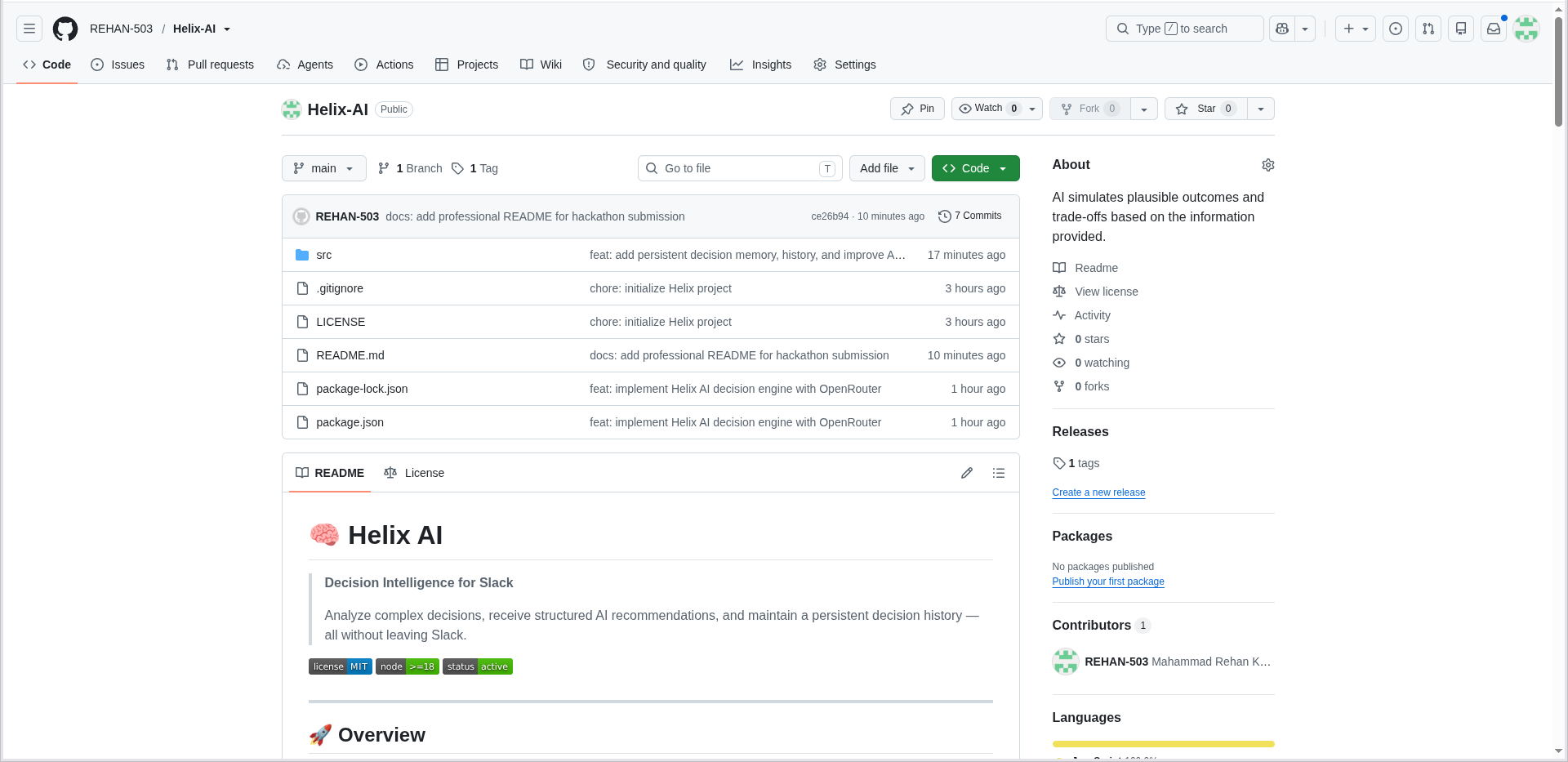
- Clean GitHub documentation and project structure
What we learned
Building Helix reinforced the importance of designing AI applications around reliability rather than simply generating text.
We learned how prompt engineering directly impacts application stability, how to build resilient parsing pipelines, and how modular software architecture makes AI-powered applications easier to extend and maintain.
We also gained valuable experience integrating Slack applications with external AI services while designing a user experience that feels native to the Slack ecosystem.
What's next for Helix AI — Decision Intelligence for Teams
Future improvements include:
- Decision comparison between multiple options
- Searchable decision history
- Team-wide shared decision memory
- Analytics dashboard for decision trends
- Exporting reports as PDF
- Database-backed persistence
- Multi-workspace deployment
- Role-based collaboration features
- Enterprise authentication and deployment
Built With
- ai
- api
- artificial
- assistant
- block
- bolt
- dotenv
- github
- intelligence
- javascript
- json
- kit
- llm
- node.js
- openrouter
- rest
- slack


Log in or sign up for Devpost to join the conversation.