Helix
The cure might already exist. It just hasn't been tested for your disease yet.
Inspiration
It started with metformin.
Metformin is a diabetes drug. It costs about $4 a month. It's been sitting in medicine cabinets since 1994. And somewhere along the way, researchers noticed something strange: diabetic patients taking metformin were getting cancer less often. And when they did get cancer, they were surviving longer.
It wasn't designed for cancer. Nobody planned it. It was discovered by accident, through observational data, decades after the drug was approved.
That stuck with us. If one drug slipped through like that, if a $4 diabetes pill turned out to have anti-cancer properties that took 30 years to notice, how many others are hiding in plain sight? There are roughly 9,000 FDA-approved drugs out there. Most were designed for one condition and never seriously tested for anything else. The biology doesn't care about the original indication. A drug that blocks a receptor in a diabetic patient's cells might block the same receptor in a tumor.
Nobody has been systematically checking, because it takes too long and costs too much, and the tools to do it at scale didn't really exist.
We built Helix to change that. The metformin story shouldn't be the exception. It should be the starting point.
The Problem, In Numbers
Drug discovery has a cost problem. Not because scientists aren't smart (they are) but because the process itself is extraordinarily expensive and slow, and it keeps getting worse every decade.
R&D COST PER APPROVED DRUG RISING EVERY DECADE
═══════════════════════════════════════════════════════════════════
  1975  │▎ $100M
  1980  │▍ $175M
  1985  │▋ $280M
  1990  │█ $400M
  1995  │█▌ $600M
  2000  │██ $800M
  2005  │███ $1.2B
  2010  │████▌ $1.8B
  2013  │██████▎ $2.56B  ← Tufts CSDD peak estimate
  2019  │█████▊ $2.30B
  2022  │█████▍ $2.12B
  2024  │█████▌ $2.23B   ← Deloitte Big Pharma avg
═══════════════════════════════════════════════════════════════════
This is Eroom's Law. More spend. Fewer breakthroughs. Every decade.
Source: Deloitte 2024, Tufts CSDD, PhRMA
This phenomenon has a name. Eroom's Law (Moore's Law backwards) describes how drug discovery has gotten slower and more expensive every decade, even as computing power has exploded.
The numbers tell the story:
$$\text{Traditional Discovery} \approx \$2.23\text{B} \times 12\text{–}15 \text{ years}$$
$$\text{Repurposing (avg)} \approx \$300\text{M} \times 6.5 \text{ years}$$
$$\text{Helix candidate identification} \approx \$0.04 \times 4 \text{ minutes}$$
CLINICAL ATTRITION OUT OF EVERY 5,000 COMPOUNDS
═══════════════════════════════════════════════════════════════════
  Preclinical entry    ████████████████████████████████  5,000
  Enter Phase I        █▋                                  250
  Enter Phase II       ▋                                   100
  Enter Phase III      ▎                                    40
  FDA approved         ▏                                     1
═══════════════════════════════════════════════════════════════════
Less than 1 in 5,000 makes it. The cost of every failure
is baked into the price of the one drug that does.
Source: FDA, DiMasi et al., GreenField Chemical 2023
Repurposed drugs skip early safety trials because we already know they're safe in humans. The bottleneck isn't biology. It's the systematic search, and that's exactly what Helix automates.
Repurposing Works. We Just Haven't Done It Systematically.
DE NOVO DISCOVERY vs. DRUG REPURPOSING
═══════════════════════════════════════════════════════════════════
                        De Novo          Repurposing
───────────────────────────────────────────────────────────────────
  Avg Cost              $2.23B      →    ~$300M        (87% less)
  Avg Timeline          12–15 yrs   →    ~6.5 yrs      (57% less)
  Safety Data           Unknown     →    Established
  Phase I Burden        Required    →    Often skipped
───────────────────────────────────────────────────────────────────
Source: Deloitte 2024, honcology.com, DiMasi et al.
The evidence for repurposing is real and growing. These aren't hypothetical:
PROVEN DRUG REPURPOSING SUCCESSES
═══════════════════════════════════════════════════════════════════════════════
  Drug            Original Use           Repurposed For           Status
───────────────────────────────────────────────────────────────────────────────
  Metformin       Type 2 Diabetes        Multiple Cancers         100+ trials
                  ↳ Nearly doubled overall survival in lung adenocarcinoma
                    Phase II, n=139 patients (PMC7929227)

  Thalidomide     Sedative / Psoriasis   Multiple Myeloma         ✓ FDA approved
                  ↳ Now a standard-of-care blood cancer treatment

  Sildenafil      Angina                 Erectile Dysfunction     ✓ FDA approved
                  ↳ Discovered accidentally during cardiovascular trials

  Arsenic         Toxic compound         Acute Promyelocytic      ✓ FDA approved
  Trioxide                               Leukemia                 ~90% remission

  Propranolol     Hypertension           Breast Cancer, Myeloma   Active trials
                  ↳ Reduces tumor angiogenesis and chemo resistance

  Aspirin         Pain / Inflammation    Colorectal Cancer        Active trials
                  ↳ Targets TP53 and MMP9, both linked to metastasis
═══════════════════════════════════════════════════════════════════════════════
Sources: PMC5694537, PMC7929227, British Journal of Cancer 2023
Metformin alone is active in 100+ Phase II and III clinical trials as a cancer therapeutic. In a Phase II trial of 139 lung adenocarcinoma patients, adding standard-dose metformin to targeted therapy nearly doubled overall survival. A drug that costs $4 a month, found by accident.
METFORMIN CANCER TRIAL BREAKDOWN (~100+ active trials)
═══════════════════════════════════════════════════════════════════
  Phase II   ████████████████████████████████████████████  ~58%
  Phase III  █████████████████████████                     ~28%
  Phase I    ███████                                        ~10%
  Phase IV   ███                                             ~4%
═══════════════════════════════════════════════════════════════════
Source: PMC5694537, ClinicalTrials.gov
These discoveries happened through observation, accident, and intuition. Helix does it through systematic search.
What Helix Does
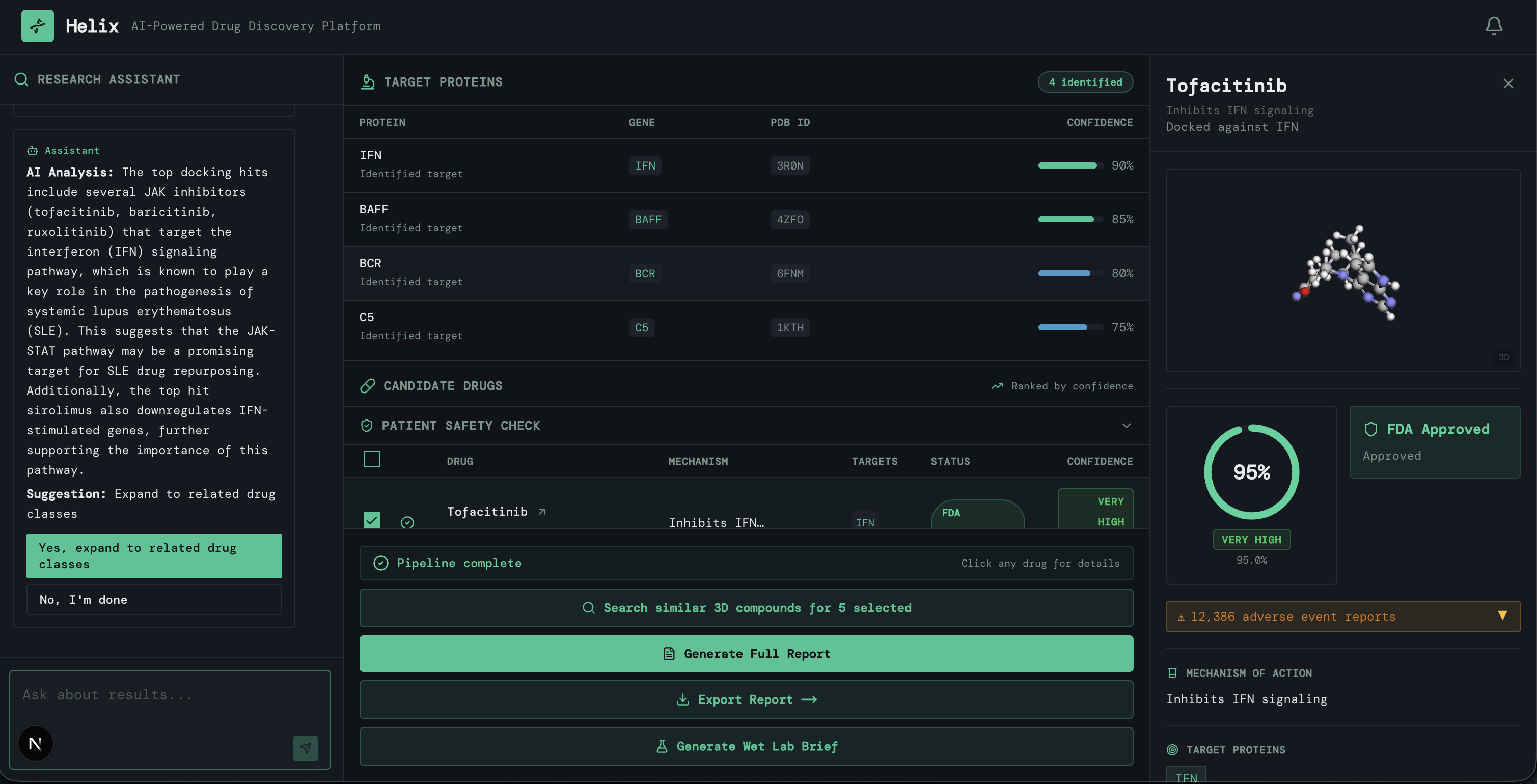
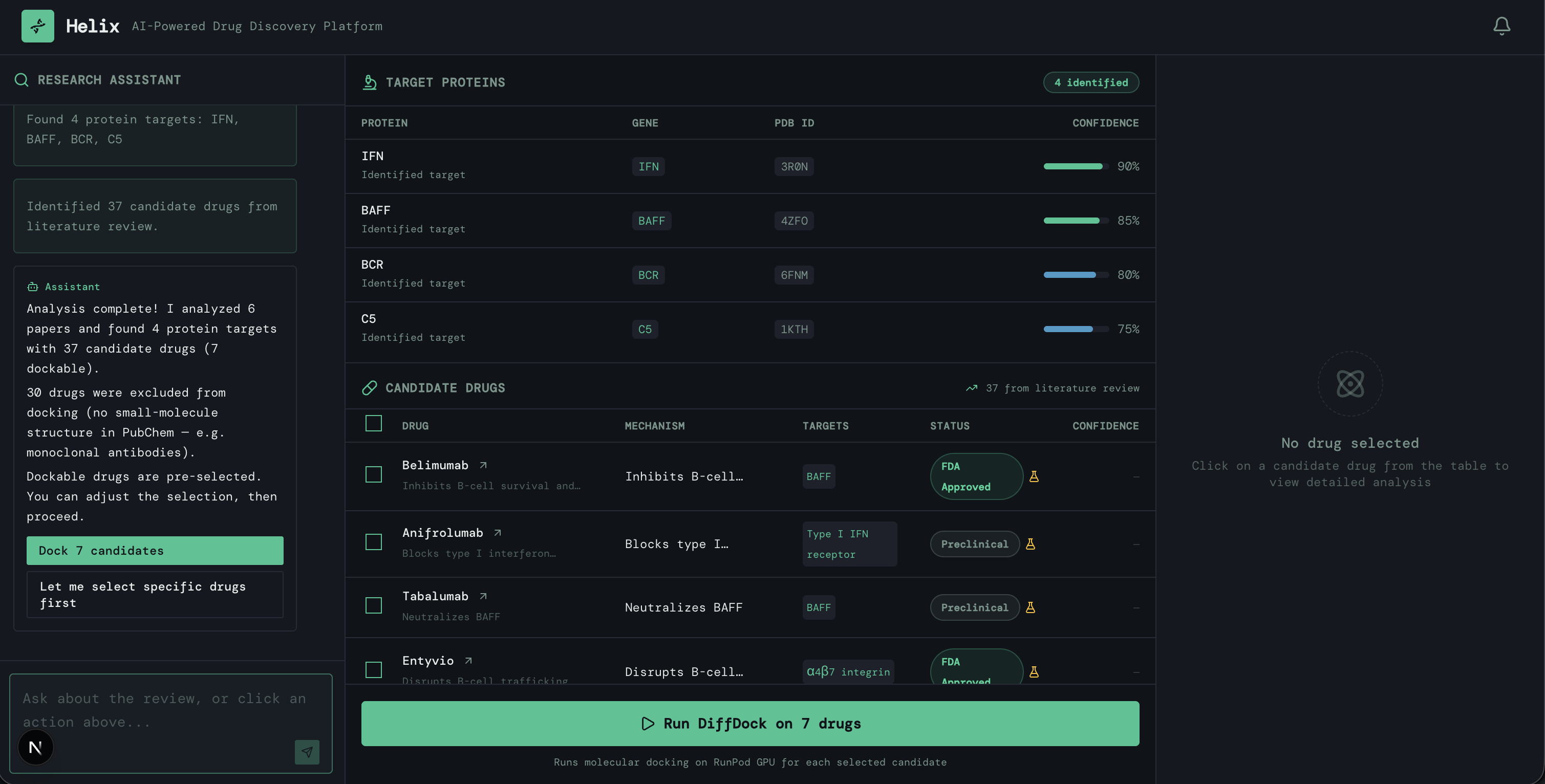
You type a disease. In under 4 minutes, Helix runs a complete autonomous research pipeline and hands you a ranked list of FDA-approved drug leads worth investigating, with confidence scores, safety flags, and a wet lab brief your team can act on immediately.
Here's what's happening under the hood during those 4 minutes:
Step 1: Literature Synthesis Queries 35 million peer-reviewed papers from arXiv and PubMed, synthesizing current research into a live structured knowledge base specific to your disease.
Step 2: Target Identification Extracts the highest-impact proteins (EGFR, KRAS, TP53, HER2, and others) along with known mechanisms of action and existing drug relationships.
Step 3: Structure Retrieval Pulls high-resolution 3D protein structures from the RCSB Protein Data Bank. Queries PubChem for candidate compounds. RDKit canonicalizes every SMILES string for docking compatibility.
Step 4: GPU Molecular Docking The core of Helix. DiffDock, a physics-informed diffusion model, runs on NVIDIA Blackwell GPUs via RunPod serverless. It generates multiple binding poses per drug-protein pair and assigns a real confidence score from 0 to 1. Actual computational chemistry, not a lookup table.
Step 5: Safety Validation Every candidate gets cross-checked against real FDA adverse event data from OpenFDA. Google Cloud Healthcare API then checks contraindications against the specific patient's age, conditions, and medications using real DrugBank interaction data. Candidates are re-ranked by risk for that patient.
Step 6: Molecular Similarity Search Vertex AI Vector Search scans 2.4 million compounds from ChEMBL for structurally similar drugs. If the best lead is one molecular step away from what we found, Helix finds it.
Step 7: Wet Lab Brief The output isn't a table of numbers. It's a complete research brief with ranked candidates, binding scores, safety profiles, mechanism summaries, and a prioritized experimental plan your team can act on immediately.
How We Built It
Early on we made one decision that shaped everything else: the pipeline had to run on real data. No mocked results, no fake APIs, no hardcoded demo paths. If someone asked us to run it live on a disease we'd never tested, it needed to work.
That made things harder. But it also made the output worth trusting.
The frontend is Next.js and Tailwind on Vercel, fully animated, bioluminescent green on deep black. Confidence score cards translate raw DiffDock outputs into human-readable labels, because a 0.74 binding score means nothing to a clinician, but "HIGH: strong predicted binding affinity, mechanism consistent with KRAS inhibition" does.
The backend is a TypeScript multi-agent pipeline. Each agent is independently scoped and communicates via structured JSON, which made it possible to debug and improve individual stages without touching the rest of the system.
Google Cloud Infrastructure
| GCP Service | What It Powers |
|---|---|
| Cloud Healthcare API (FHIR R4) | Patient contraindication filtering |
| Vertex AI Vector Search | Molecular similarity across 2.4M compounds |
| Vertex AI text-embedding-004 | Drug compound embeddings |
| BigQuery (PubMed public dataset) | 35M peer-reviewed papers |
| Cloud Pub/Sub | Real-time research alert backbone |
| Cloud Scheduler | Daily literature monitoring |
| Cloud Functions | Alert processing and email dispatch |
Helix is also registered on Fetch.ai AgentVerse, making every agent in the pipeline discoverable and composable within the broader decentralized AI ecosystem.
Challenges We Ran Into
Keeping everything real under time pressure was the hardest part. At a hackathon, the temptation to hardcode a demo path is overwhelming. We didn't. Every result you see came from a live pipeline run. That meant debugging at 2am when DiffDock returned unexpected confidence distributions and we couldn't tell if it was our batching logic, a malformed SMILES string, or something in the GPU runtime.
SMILES canonicalization took more time than it should have. Drug compound strings from PubChem, ChEMBL, and DrugBank don't always arrive in compatible formats. RDKit handles it, but only after you've caught every edge case. We found three.
Embedding molecules for similarity search required rethinking what a molecule embedding even means. A SMILES string captures structure. A mechanism-of-action description captures biology. We needed both in one vector, and getting text-embedding-004 to weight both appropriately took longer than expected.
FHIR data modeling, specifically turning real DrugBank interaction data into FHIR MedicationKnowledge resources the Cloud Healthcare API could query, involved schema design that wasn't obviously documented anywhere useful.
GPU cold starts. RunPod serverless is fast once it's warm, but getting it consistently warm before a live demo without burning through compute budget required some careful pre-warming logic that took a while to get right.
Accomplishments We're Proud Of
The thing we're most proud of is that it actually works. You can point Helix at a disease, run the full pipeline, and get a scientifically grounded output in under 4 minutes backed by real GPU simulations, real FDA data, and 35 million real papers. That was the goal from day one and we didn't cut corners to get there.
The metformin story is exactly the kind of thing Helix is built to surface before decades pass. That felt like a worthwhile thing to spend a weekend on.
What We Learned
The bottleneck in drug repurposing isn't knowledge. The papers exist. The molecular data exists. The protein structures exist. What's been missing is the infrastructure to query all of it systematically, at once, with enough scientific rigor that a researcher can trust the output. That's what we spent the weekend building.
We also came away with a lot of respect for Google Cloud Healthcare API. FHIR R4 as a real clinical data standard, the same format used in hospital systems, opens up patient-specific personalization in a way that generic databases simply can't match.
And working with DiffDock was a reminder of how fast this field is moving. A physics-informed diffusion model producing chemically meaningful binding poses, running on commodity GPU hardware, accessible via API. That didn't exist a few years ago. We're building on top of a genuinely exciting moment in computational chemistry.
What's Next for Helix
Broader disease coverage: autoimmune diseases, rare diseases, and neglected tropical diseases, where the repurposing opportunity is largest and pharmaceutical investment is most scarce.
Researcher collaboration layer: shared workspaces where teams can annotate candidates, track experimental results, and feed wet lab outcomes back into the ranking model over time.
Clinical trial matching: integrating ClinicalTrials.gov to cross-reference every Helix lead against active human trials in real time.
Academic partnerships: Helix's value is highest when computational leads get validated in real labs. The next step is getting it into the hands of researchers who can close the loop.
Every simulation runs on real hardware. Every data point comes from real sources. Every safety flag comes from real FDA filings. We set out to build something researchers could actually trust, and we think we got there.
Built With
- 3dmol.js
- arxiv-api
- claude
- clsx
- cmdk
- crypto-js
- eslint
- gc
- google-cloud
- html2pdf.js
- jsx
- lucide
- next.js
- node.js
- postcss
- pubchem-pug-rest-api
- radix-ui
- react-markdown
- react-pdf
- recharts
- runpod
- server-sent-events
- sonner
- tailwind
- tsx
- typescript
- vaul
- vercel
- zod


Log in or sign up for Devpost to join the conversation.