Inspiration
was born with melanin deficiency i frequently used to get sun burns whenver i went out. but some days it was more some days it was less. then i came to find out it was because of the solar flares which shoot out more ultraviolet light which is bad for us.. so i made a tool which analysis the sun and make live time solar flare predictions
What it does
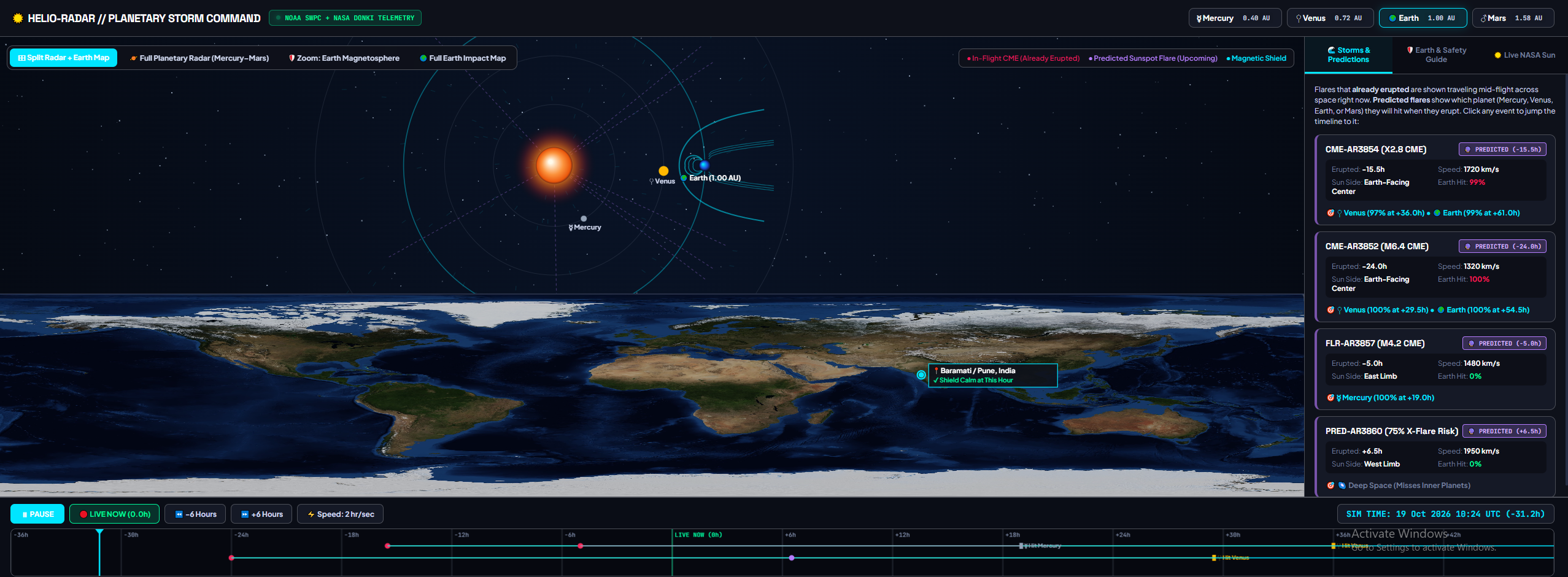
The Sun regularly shoots out massive clouds of magnetic plasma called Coronal Mass Ejections. If a large one hits Earth, it can knock out power grids, fry satellites. Most space weather tools only show static charts or alert you after a storm has already arrived. We wanted to fix that. HeliosShield lets you track these storms in real-time while they are flying through space so we know exactly when and where they will hit
also judges my bad the video is gliched out.. the menus clip out.. you can test out the website. from the link. and i also had no mic to voiceover with.... im sorry..
How we built it
HTML5 Canvas Rendering Engine: Built with Vanilla JavaScript and HTML5 Canvas. It uses dual 2D contexts to render the orbital mechanics radar and the global ionospheric projection,
Telemetry Pipeline: NASA DONKI API - Fetches live data on confirmed solar storms, including their initial launch speed, angle, and coordinates. NOAA SWPC - Pulls real-time solar wind speeds from the DSCOVR satellite to monitor the active activities of sun
Math Engine:
Calculates the exact real-time orbital positions of Mercury, Venus, Earth, and Mars using true Keplerian orbital mechanics.
Uses the Drag-Based Model to calculate how solar wind creates physical drag on the solar ejections, giving us a highly accurate arrival time instead of just assuming a constant speed.
Challenges we ran into
Non-Linear Space Physics: CMEs don't move at a constant speed implementing the Drag-Based Model to calculate how solar wind slows down or speeds up the plasma wave in real time Tight Time Constraint: Initially explored building in a 3D game engine, but concluded to move to vanilla HTML5 Canvas to ensure a lightweight, 60 FPS build before the deadline.
Accomplishments that we're proud of
Zero-Dependency 60 FPS Engine - Built the entire interactive solar radar and telemetry HUD using JavaScript and HTML5 Canvas with no heavy external frameworks.
What's next for HeliosShield
Upgrade the 2D canvas visualizer into a full 3D interactive celestial sphere using Add automated webhook/SMS notifications for satellite operators and drone pilots when a solar flare occurs
Built With
- data-visualization
- html5
- javascript
- nasa-api
- noaa-swpc
- physics-simulation
- space-weather


Log in or sign up for Devpost to join the conversation.