-
-
logo
-
Helios Protocol - Evidence First. Certificates Second.
Inspiration
The transition to renewable energy is accelerating, but we kept coming back to a fundamental question:
How can someone trust that a renewable energy certificate is actually backed by renewable electricity generation?
Renewable Energy Certificates (RECs) represent the environmental attributes associated with renewable electricity. However, generation evidence, certificate ownership, trading, and retirement can be managed across disconnected systems.
This fragmentation makes provenance harder to trace, increases reconciliation complexity, and creates risks around inaccurate or duplicate claims.
We realized that simply tokenizing a certificate doesn't solve the underlying trust problem. A blockchain can make records tamper-evident, but it cannot independently verify that electricity was physically generated.
That insight became the foundation of Helios Protocol:
Evidence first. Certificates second.
We wanted to explore whether blockchain infrastructure, combined with an integrity-focused evidence pipeline, could make the certificate lifecycle more transparent, auditable, and accessible.
What It Does
Helios Protocol is a Solana-based renewable energy certificate infrastructure prototype that connects generation evidence, certificate issuance, marketplace transactions, and retirement.
Rather than treating certificates as standalone digital assets, Helios links issuance to eligible generation recorded through an evidence-validation process.
The system follows five stages:
- Generation: Solar generation readings are submitted to the platform.
- Integrity: Our Climate Integrity Engine validates timestamps, checks for duplicate submissions, and evaluates generation eligibility.
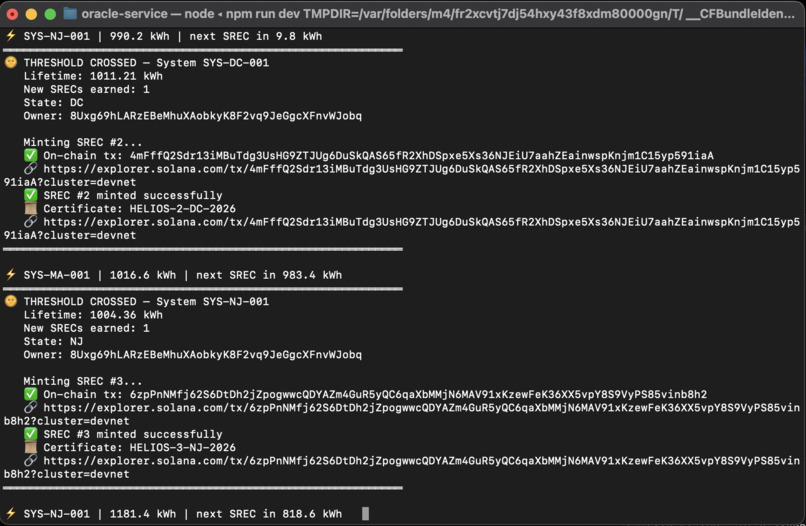
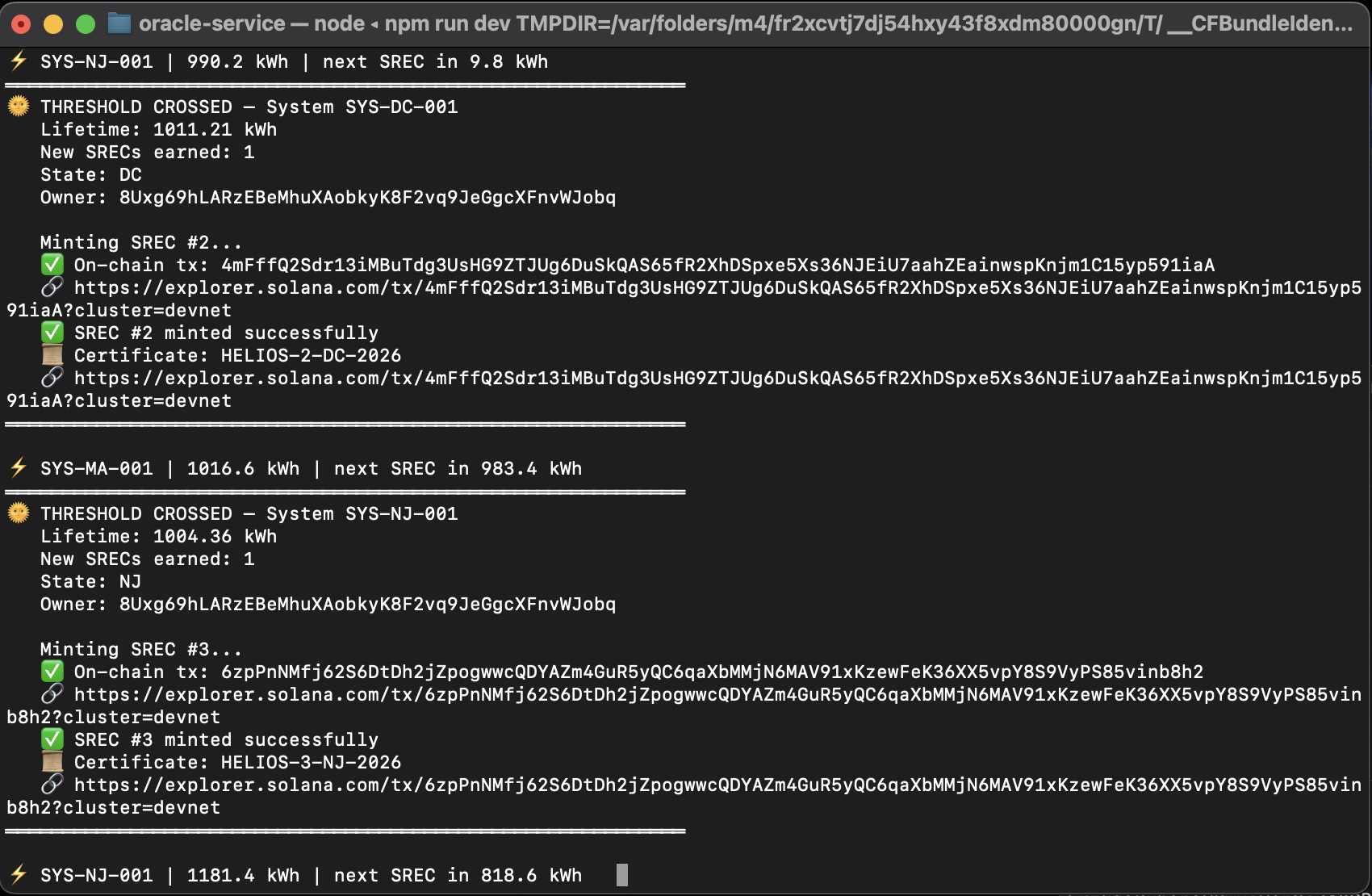
- Issuance: Eligible generation evidence is committed to Solana, where smart contracts enforce certificate issuance limits.
- Marketplace: Issued certificates can be listed and purchased using USDC-based settlement.
- Retirement: Certificates can be permanently retired within the protocol, creating a traceable record and preventing further trading.
In our prototype, one certificate represents one megawatt-hour (MWh) of eligible generation.
The core issuance constraint is:
[ N_{\text{issued}} \leq \left\lfloor \frac{E_{\text{eligible}}}{1000\text{ kWh}} \right\rfloor ]
This means the number of certificates issued cannot exceed the eligible generation committed to the protocol.
The result is an auditable lifecycle connecting submitted generation evidence to the final retirement record.
How We Built It
We developed Helios as a full-stack application combining an interactive frontend, an off-chain evidence-processing system, and on-chain smart contracts.
Frontend and User Experience
We designed an interactive solar-system-inspired interface to make renewable energy infrastructure more approachable.
The application introduces the roles of producers and buyers and provides entry points into the certificate lifecycle.
We wanted the interface to communicate more than a conventional trading dashboard: it should help users understand where certificates originate and what happens to them.
Climate Integrity Engine
One of our most important engineering contributions is the Climate Integrity Engine, developed using TypeScript.
It processes incoming generation readings and applies validation rules, including timestamp checks, duplicate detection, and eligibility evaluation.
The backend maintains evidence records using PostgreSQL.
Instead of writing every raw meter reading directly to the blockchain, the system uses an authorized oracle to commit evidence information to Solana.
This separates data-intensive evidence processing from on-chain certificate enforcement.
Solana Smart Contracts
We implemented the on-chain protocol using Rust, Anchor, and Solana.
The smart contracts enforce issuance constraints based on committed eligible generation.
This prevents the protocol from minting certificates beyond the eligible generation recorded through its authorized evidence pipeline.
We also implemented certificate lifecycle operations, including issuance, transfer through marketplace transactions, and retirement.
Marketplace and Settlement
The marketplace supports certificate listing and purchasing with USDC-based settlement.
We designed the lifecycle so that a certificate's ownership and retirement status can be traced through protocol records.
Retirement is especially important because it marks the point at which a certificate's environmental attribute is claimed and the asset should no longer circulate.
Testing and Validation
We tested the prototype using simulated solar generation readings and a local Solana environment.
Our reference workflow processed 721 simulated meter readings, recorded approximately 1,375.099 kWh of eligible generation, and demonstrated the issuance of one certificate.
The workflow also demonstrated a marketplace purchase using 190 test USDC, followed by certificate retirement.
These are prototype test results, not commercial transactions or independently verified renewable generation.
Challenges We Faced
1. Connecting Off-Chain Evidence to On-Chain Rules
Our biggest technical challenge was determining how to connect generation data to blockchain issuance without assuming that the blockchain could verify physical-world events.
We addressed this by separating the architecture into an off-chain integrity engine, evidence storage, an authorized oracle, and on-chain enforcement.
This made the trust boundaries more explicit.
2. Preventing Over-Issuance
We needed to ensure that certificate issuance could not exceed eligible generation recorded by the protocol.
Designing the issuance logic required careful handling of generation quantities, certificate thresholds, and state changes.
Rather than allowing unrestricted token creation, we implemented constraints within the smart contracts.
3. Building a Complete Certificate Lifecycle
Issuing a certificate was only one part of the problem.
We also needed to handle marketplace purchases, settlement, and retirement while maintaining consistent certificate state.
The challenge was ensuring that the lifecycle remained coherent across multiple operations rather than treating each transaction as an isolated feature.
4. Balancing Transparency, Performance, and Cost
Storing every generation reading directly on-chain would introduce unnecessary storage and transaction overhead.
We chose an architecture where detailed evidence is processed and maintained off-chain, while blockchain commitments and contract state support auditability and enforcement.
5. Making a Complex System Understandable
Renewable energy certificates combine energy-market concepts, data integrity, blockchain infrastructure, and financial transactions.
We invested effort into an interactive interface and visual product storytelling so that users could understand the certificate lifecycle without needing to understand every underlying technology.
What We Learned
Building Helios taught us that blockchain integrity and real-world evidence integrity are two different problems.
A smart contract can enforce rules consistently, but those rules are only as reliable as the data supplied to the system.
We gained hands-on experience with:
- Developing Solana programs using Rust and Anchor.
- Designing evidence-validation pipelines in TypeScript.
- Connecting PostgreSQL-backed services to blockchain infrastructure.
- Managing certificate issuance, marketplace settlement, and retirement.
- Designing trust boundaries between off-chain data sources and on-chain state.
- Testing multi-stage workflows with simulated energy data.
- Translating complex infrastructure into an understandable product experience.
Most importantly, we learned that building trustworthy infrastructure requires thinking beyond tokenization.
What's Next for Helios Protocol?
Our next goal is to move from a simulated prototype toward a pilot-ready infrastructure system.
We want to explore:
- Trusted meter integrations: Connecting to authenticated generation-data sources instead of simulated readings.
- Registry interoperability: Working toward integrations with recognized renewable energy certificate registries rather than attempting to replace them.
- Stronger evidence verification: Improving provenance checks, anomaly detection, and audit capabilities.
- Security and reliability: Expanding smart contract testing, threat modeling, and independent security review.
- Real-world pilots: Validating the system with energy producers and certificate buyers under appropriate registry and regulatory requirements.
Helios is not yet a recognized certificate registry, and the prototype does not independently establish real-world generation authenticity or prevent duplicate issuance across unrelated registries.
But it demonstrates an important architectural principle:
The integrity of a renewable energy certificate should begin with the evidence supporting it, not with the token representing it.
That's what we're building toward with Helios Protocol.
Evidence first. Certificates second.
Built With
- anchor-framework
- blockchain
- climate-tech
- full-stack
- javascript
- next.js
- node.js
- oracle
- postgresql
- react
- renewable-energy
- rest-apis
- rust
- smart-contracts
- solana
- solana-wallet-adapter
- typescript
- usdc
- web3.js

Log in or sign up for Devpost to join the conversation.