Inspiration
Every tropical city has an outdoor mobility gap that can't simply be closed by concrete shelters or standard rain umbrellas.
LTA built 200 km of sheltered walkways under Walk2Ride for about SGD 300 million, or about SGD 1,500 per meter. Those roofs stop at 400 m around MRT stations and 200 m around LRT and bus stops. Exposed campuses like SUTD, parks like Sentosa and Gardens by the Bay, and open estate plazas get no cover. Walkers there face NEA UV Index 11 to 13+ and 4℃ to 7℃ urban heat-island spikes measured by Cooling Singapore. HDB spends about SGD 60 million on cool coatings. Meanwhile, NEA myENV tracks islandwide heat with only 15 to 17 macro WBGT stations and zero street-level sensors.
Shared umbrellas also hit a scaling wall and add waste. About 1 billion umbrellas enter landfills each year worldwide. Each umbrella binds about 120 steel, fiberglass, plastic, and fabric parts with rivets, so municipal plants reject them. In Singapore, domestic recycling sits at 11 percent, plastic recycling sits at 4 to 5 percent, and Semakau Landfill fills by 2035. Open-rack honor trials like Sharella and Nestia lost unreturned stock, while ShareLah needs grid-wired motorized locking stations. Rain umbrellas also sit idle about 85 percent of hours because walkers have no reason to borrow one under 1 PM sun.
Lightning physics solves the umbrella paradox. Singapore averages 167 thunderstorm days and 176 lightning days per year, peaking in November. Midday sun from 11:00 to 14:30 heats the ground and drives afternoon convective storms from 15:00 to 18:00. Under the NEA 30/30 lightning rule, open canopies and trees are unsafe once thunder starts. A walker opens Solflora in peak sun for shade and power. The parasol then sends a 15 to 20 minute pre-lightning alert while the sky is still bright so the walker can enter a building.
What it does
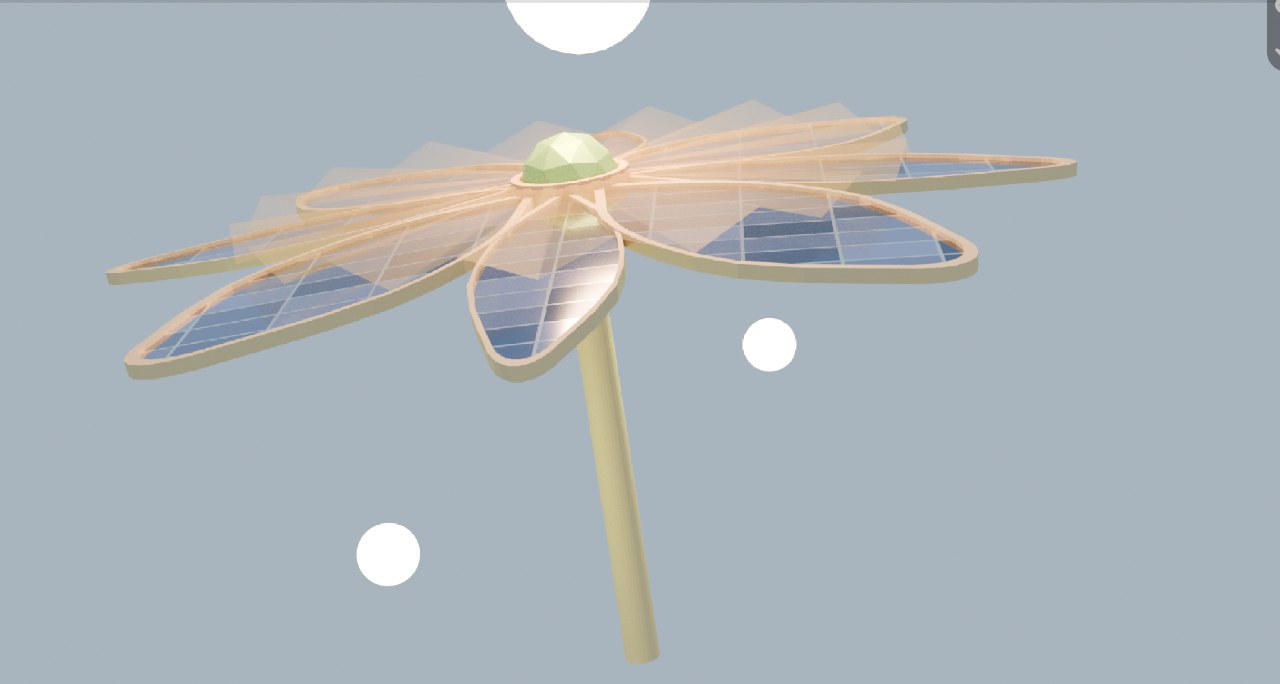
Solflora is a Green Intelligence parasol that connects four functions into one energy and safety loop. It launches at campuses and outdoor parks with unpowered passive racks, then opens the same network to personal B2C parasols.
Solar shade and 25W charging in one loop
A non-conductive fiberglass parasol carries eight thin-film CIGS solar gores (0.43m^2 ring) mounted between the ribs. Walkers get portable UV shade in midday sun. The canopy harvests about 18.9 W in hazy Singapore sun (650W/m^2) and about 26.2 W in clear sun (900 W/m2). The solar ring charges a 25.2 Wh 2S 18650 handle battery that outputs 25W USB-C PD PPS under the canopy shade. Walkers recharge hot phones fast without direct-sun thermal throttling or the brownouts of unbuffered solar hats.
Dual-zone squall alerts and passive-rack tracking
Top-finial sensors $$(P, T_{\text{top}})$$ and shaded under-canopy sensors $$(T_{\text{shade}}, RH_{\text{shade}})$$ measure radiant cooling relief ($$\Delta T = T_{\text{top}} - T_{\text{shade}}$$). They also warn walkers 15 to 20 minutes before convective squalls. An ESP32-S3 broadcasts 28-byte Apple Find My (OpenHaystack) BLE packets and compact rack pings at under 10 mW average draw. Under 5 minutes of sun per day powers the electronics. Campuses deploy unpowered racks with zero electrical wiring and SGD 0 per month in SIM fees.
| Existing Solution | What It Does | Where It Falls Short |
|---|---|---|
| Wezzoo Oombrella (Kickstarter) | Handle capsule ($$P, T, RH$$) + 10 m BLE phone tether | No solar charging, 10 m tether only, rain-first design |
| Anker Solix Solar Umbrella (CES 2025) | 2.15 m stationary 100 W perovskite beach umbrella | Heavy patio rig, no 25W handle battery, no weather or tracking |
| EcoFlow Power Hat (12W wearable) | Sun hat with 12 W direct 5 V USB solar brim | No battery buffer so tree shade resets charging, 12 W max, no weather |
| Sharella / Nestia / ShareLah SG | Open-rack (Sharella) or kiosk-locked (ShareLah) umbrellas | Open racks lost stock, kiosks need grid wiring, rain-only use |
How we built it
The ESP32-S3 keeps Wi-Fi off 99 percent of the time to avoid 2.4 GHz antenna contention with BLE. It interleaves 2-second OpenHaystack Offline Finding beacons on a random static MAC address with low-power status packets. Every 30 seconds, the board logs microclimate samples to flash and PSRAM. It runs harmonic baseline calibration only when excess solar power is available.
On our WTH 2026 bench rig, the issued ESP32-S3-DevKitC-1 and HW-A017 kit run live hardware-in-the-loop sensing. We wire a DS18B20 top radiant probe, a shaded DHT11 temp and humidity sensor, and KY-018 plus KY-026 solar proxies. We also wire a KY-020 tilt switch, a KY-021 magnetic dock switch, and KY-016 RGB plus KY-006 buzzer alerts. A Mac and iPhone verify live OpenHaystack BLE packets. Real Singapore NEA/MSS storm pressure traces supply barometric data because HW-A017 lacks a barometer. We scope the flexible CIGS gores, vented BME280, and Injoinic IP5356 2S 18650 handle pack as the production BOM.
Challenges we ran into
Sunlit top-cap humidity error (-31.7% RH)
Putting temperature and humidity sensors inside a sunlit top cap under $$900\text{ W/m}^2$$ sun heats the cap $$+10^\circ\text{C}$$ above ambient ($$31^\circ\text{C}$ to $41^\circ\text{C}$$). At constant vapor pressure ($$33.65\text{ hPa}$$, true $$RH = 75.0\%$$), cap relative humidity drops falsely by Magnus-Tetens physics:
$$RH_{\text{cap}} = 100 \times \frac{e_s(31^\circ\text{C}) \cdot 0.75}{e_s(41^\circ\text{C})} \approx 43.3\% \quad (-31.7\% \text{ error})$$
We moved $$(T_{\text{shade}}, RH_{\text{shade}})$$ under the shaded canopy runner and kept $$(P, T_{\text{top}})$$ in the vented finial. The canopy acts as a walking radiation shield, and $$\Delta T$$ measures both radiant heat blocked and sudden cloud-anvil shadows.
Singapore 4 PM equatorial pressure-tide false alarms
At $1.3^\circ\text{N}$, barometric pressure follows a 2 to 3 hPa semidiurnal tide that peaks near 10:00 and drops every sunny afternoon near 16:00. A simple pressure-drop rule triggers false alarms daily. We fit a local 24-hour and 12-hour harmonic baseline $\hat{P}_{\text{tide}}(t)$ during solar surplus and fuse four storm precursors:
- Detrended pressure residual $\Delta P_{\text{resid}}(t) = P(t) - \hat{P}_{\text{tide}}(t)$.
- Canopy solar-wattage drop $dP_{\text{solar}}/dt \ll 0$, using the solar ring as a 360-degree irradiance sensor.
- Convective downdraft cooling of $-1.5^\circ\text{C}$ to $-3.5^\circ\text{C}$ over 10 to 15 minutes.
- Dew-point depression squeeze as $T_{\text{shade}} - T_d$ approaches $0^\circ\text{C}$.
Curved-dome shading and 2S BMS matching
At a $45^\circ$ sun angle, anti-sunward gores receive at most $0.36\times$ the irradiance of sunward gores and would choke a series string. Placing eight thin-film gores (about 120 to 260 g) between ribs and wiring them in parallel with Schottky bypass diodes keeps sunward wattage intact and stops crease cracking. Inside the handle, pairing the 2S 18650 pack (about 53 minutes at 25W PD) with a 2S buck-boost IC (IP5356 or IP2368) avoids single-cell (SW6208) voltage limits.
Accomplishments
We connected four separate features into one physical loop backed by Singapore infrastructure, waste, and lightning data. We also caught and solved the $-31.7\%$ top-cap humidity error and the 4 PM pressure-tide trap on paper before writing firmware.
What we learned
SUTD human-centered Design AI focuses on choosing the right user and knowing when physical models beat black-box ML. We rejected hands-full manual laborers and rain commuters in favor of campus and park walkers. We then chose explainable psychrometrics and harmonic tide detrending that fit a milliwatt microcontroller. Separating live bench hardware from the production BOM keeps our engineering claims honest.
What is next for Solflora
- Run a 20-unit passive-rack pilot at SUTD and Sentosa to measure 15-minute squall lead times against NEA 5-minute rain gauges.
- Build one IP65 handle PCB combining the
ESP32-S3, ventedBME280, andIP535625W USB-C PD controller. - Open the street-level heat and lightning warning network to personal B2C parasols across Southeast Asia.
