-
-
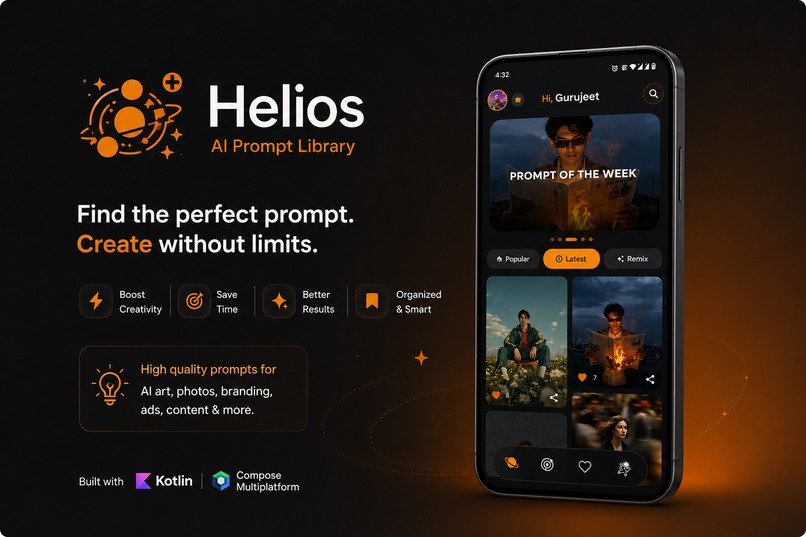
Thumbanail
-
App Icon
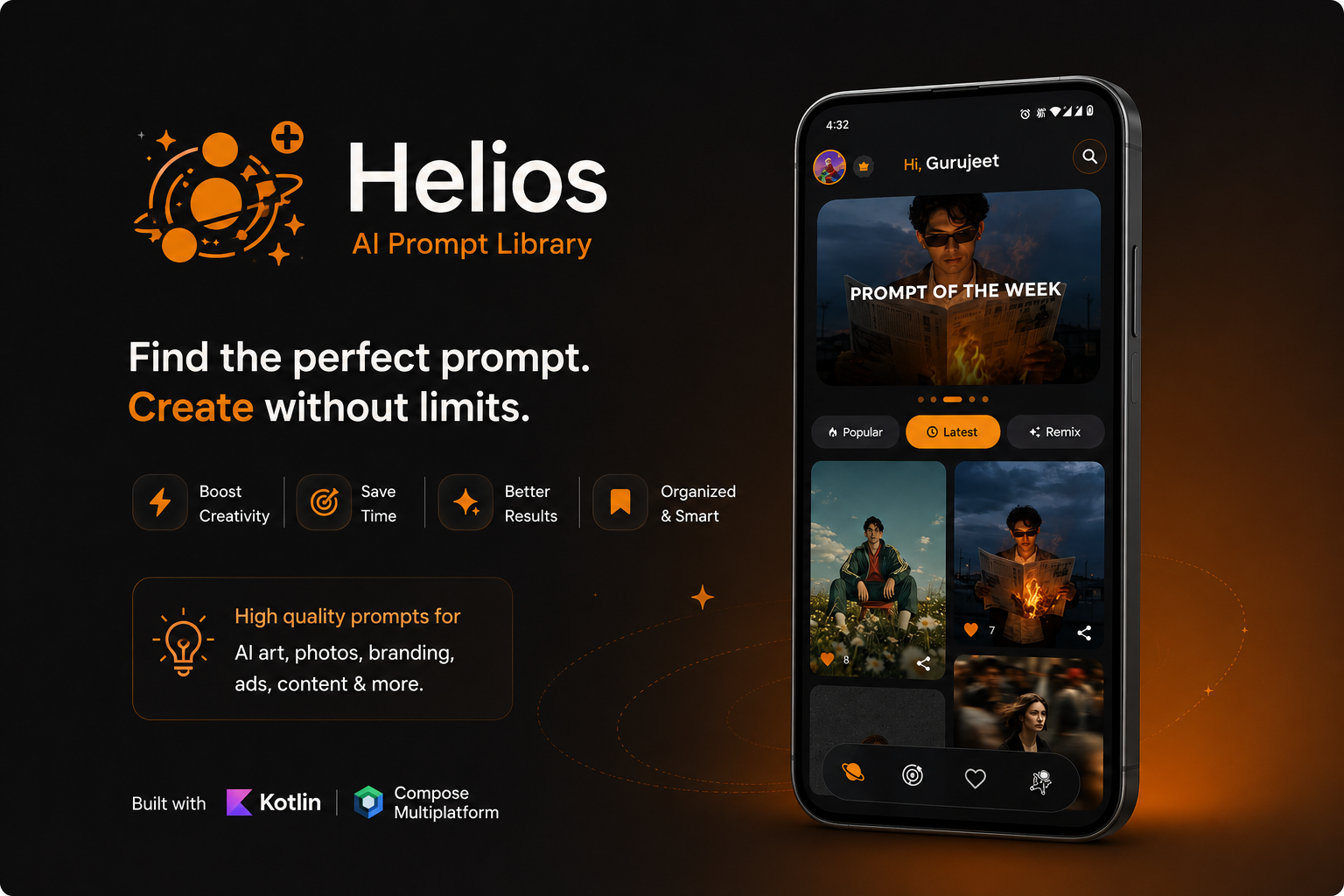
Inspiration
AI image and video generation has become incredibly powerful, but there is still a major gap between what AI can generate and what an ordinary user can actually get it to generate.
Most people know what they want to create, but they don't necessarily know how to write the right prompt to get there. Creating a good result can require repeated prompting, experimentation, and multiple failed generations.
That was the problem we wanted to solve.
Instead of trying to build a huge AI generation platform from day one, we decided to start with one clear pain point: helping people communicate what they want to AI more effectively.
This led to Helios — AI Prompt Library.
We wanted to make AI creation simple enough that even someone with little or no technical knowledge could find a relevant use case, get the right prompt, and use it with their preferred AI tool.
Our goal is to build an assistive layer between what a person has in their mind and what AI can create.
What it does
Helios is an AI Prompt Library built around real-world creative use cases, rather than being a collection of random prompts.
Users can discover prompts for things they actually want to create, including:
- Photo editing
- Portraits
- Fashion
- Product photography
- Product advertisements
- Branding
- Flyers
- Social media content
- Cinematic images
- Posters
- Lifestyle content
- Couples
- Kids & celebrations
- And many more
Instead of learning prompt engineering, users can simply:
Choose a use case → Find a suitable prompt → Customize it → Create
Prompts can be copied and adapted with the user's own details, images, or requirements before being used with their preferred AI model.
The focus is on making AI creation simple, practical, and accessible to everyone.
We are intentionally organizing Helios around use cases because users should not need to understand AI terminology to know where to start.
Someone who wants to create a product advertisement should be able to find Product Ads.
Someone who wants to edit their photograph should be able to find Photo Editing.
Someone who wants to create a business flyer should be able to find Flyers.
The user should think about what they want to create, not about how to engineer a prompt.
How we built it
Helios is an Android application built using Kotlin and Jetpack Compose.
We use Supabase for backend functionality, data management, and managing our growing prompt library.
For subscriptions and premium access, we integrated RevenueCat to manage Helios Pro subscriptions and premium access.
The application is designed around a content-driven architecture so we can continuously improve the prompt collection, add new use cases, and respond to user feedback without requiring major changes to the application.
We intentionally kept the first version focused on one core experience: helping users discover useful prompts quickly and easily.
Challenges We Ran Into
One of our biggest challenges was making the experience simple without making it feel limited.
There are thousands of AI prompts available online, but simply putting thousands of prompts into an application would not solve the problem.
It could actually make the experience worse by creating a noisy, repetitive, and difficult-to-navigate library.
We wanted Helios to provide a curated and useful collection rather than a spammy collection of random prompts.
This meant thinking carefully about:
- What people actually use AI for
- Which categories are useful to everyday users
- How prompts should be organized
- How to make discovery intuitive
- How to support prompts that require a user's own image
- How to make prompts easy to understand and reuse
- How to maintain quality as the library grows
- How to improve the collection based on user feedback
Another major challenge was designing for people who are not familiar with AI.
A technical user may understand how to modify a prompt, but a non-technical user should not have to learn prompt engineering just to create something useful.
This pushed us toward an assistive approach.
Instead of asking users to become better prompt engineers, we want Helios to help users communicate their intent more effectively to AI.
Accomplishments We're Proud Of
We are proud that we took a simple observation about the difficulty of AI prompting and turned it into a publicly available Android application.
We built Helios using Kotlin and Jetpack Compose, implemented our backend with Supabase, integrated RevenueCat for subscriptions, created a categorized prompt library focused on practical use cases, and launched the first public version on the Google Play Store.
More importantly, we created a foundation that can grow beyond a traditional prompt library.
The current version solves one specific problem, but it also gives us a platform to learn from real users and understand what prevents people from getting the results they want from generative AI.
What We Learned
The biggest lesson we learned is that the problem is not simply access to AI.
Powerful AI models already exist.
The bigger challenge is the gap between:
"AI can create this."
and
"I can actually get AI to create this."
Most people don't want to become prompt engineers.
They simply want to say:
"I want a professional advertisement for my product."
or:
"I want to edit my photo in this style."
or:
"I need a flyer for my business."
and get meaningful assistance in creating it.
This changed how we think about Helios.
We learned that building AI tools for everyone means designing for people who don't already understand AI.
The experience needs to be simple, guided, practical, and focused on the user's intended result rather than technical terminology.
We also learned that curation matters.
A smaller collection of genuinely useful prompts organized around real use cases can be much more valuable than thousands of repetitive prompts.
What's Next for Helios — AI Prompt Library
The current prompt library is only Version 1 of a much larger vision.
Our long-term goal is to build an assistive AI creation platform that helps ordinary people create what they have in their mind, even if they have little or no knowledge of prompting, design, or AI tools.
We want to bring a broad range of real-world creative use cases into one simple experience:
- Photo editing
- Image generation
- Video generation
- Product advertisements
- Business flyers
- Branding
- Social media content
- Marketing creatives
- Product photography
- Portraits
- Fashion
- Posters
- And many other everyday creative needs
We are also exploring features such as:
- Prompt personalization
- Intelligent prompt optimization
- Image-to-prompt workflows
- In-app AI image and video generation
- Guided creation based on user intent
- Multi-layer generation and editing
- Bulk creation and editing for businesses
- Templates and workflows for professional use
- More assistive tools that reduce the need to understand prompting
The bigger vision is not simply to give users more prompts.
It is to make AI creation accessible to people who currently find AI complicated.
We want a non-technical person, student, small business owner, designer, content creator, or anyone else to be able to open Helios and explain what they want to create — with Helios assisting them throughout the process.
We believe that making AI simpler, more practical, and more assistive can help more people actually engage with and adopt generative AI.
Today, Helios helps users find better ways to prompt AI.
Tomorrow, we want Helios to become an intelligent creative assistant that helps users get much closer to the result they actually want.
Built With
Kotlin Compose Multiplatform Supabase RevenueCat Android Generative AI AI Prompt Engineering REST APIs Cloud Backend Google Play
Built With
- aiprompt
- android
- cloud
- cmp
- compose
- genai
- google-play
- kotlin
- restapi
- revenuecat
- supabase


Log in or sign up for Devpost to join the conversation.