-
-
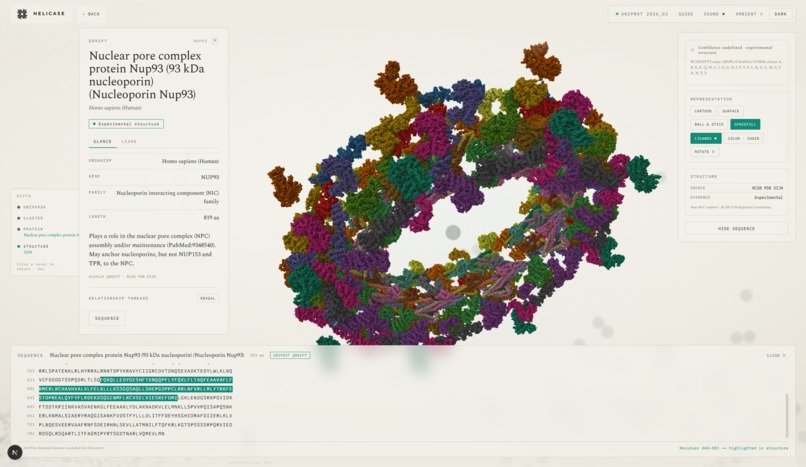
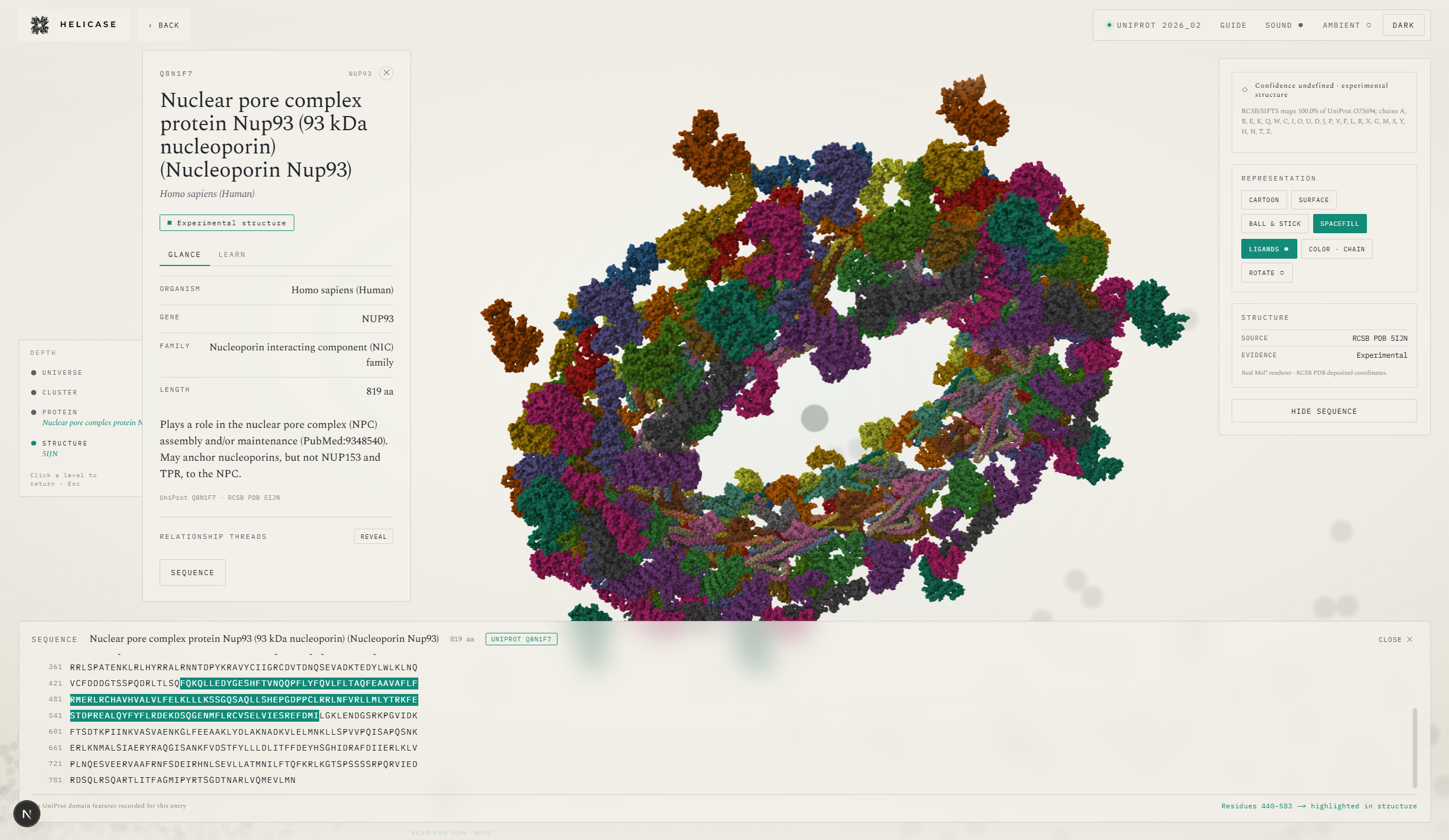
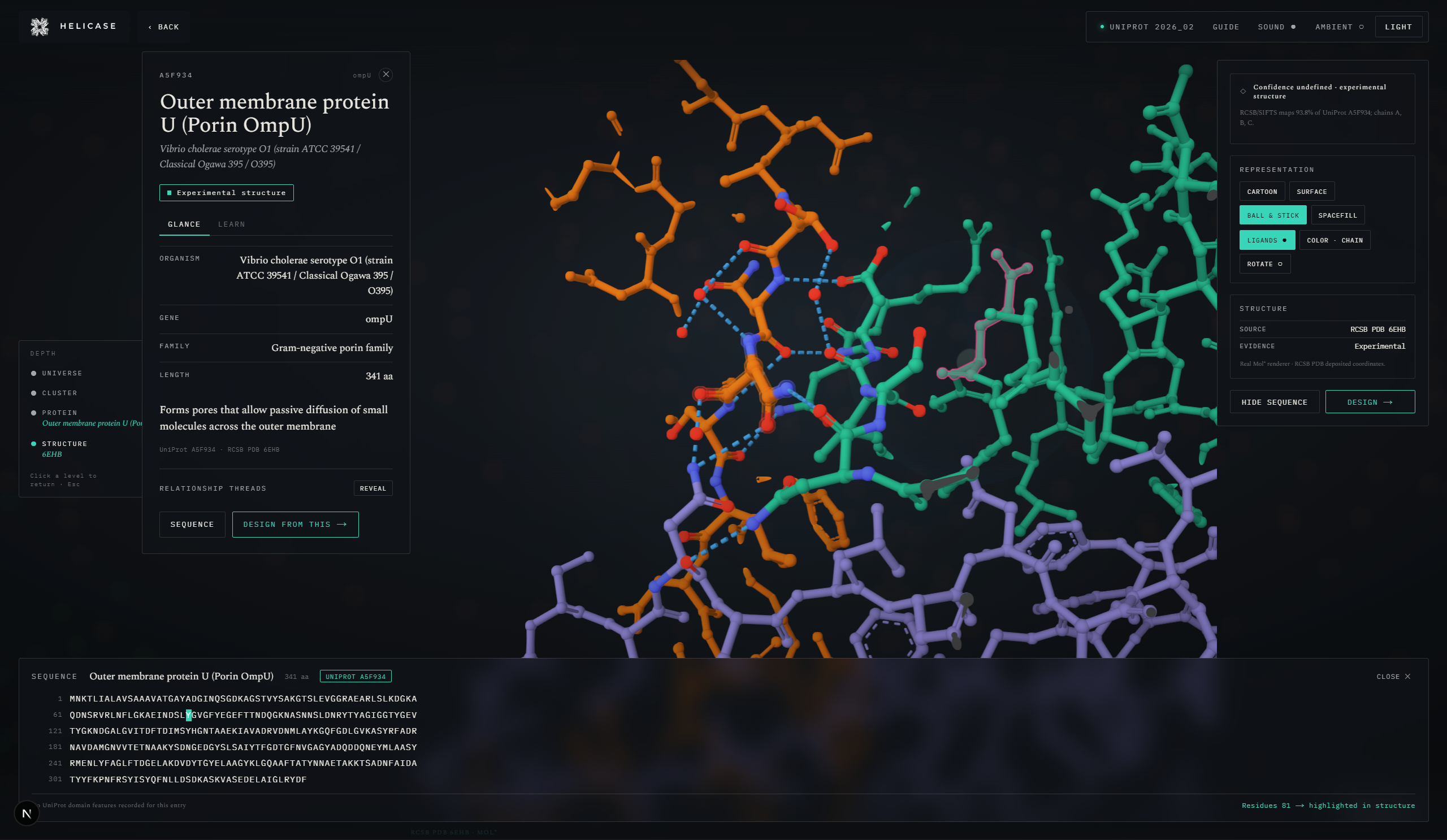
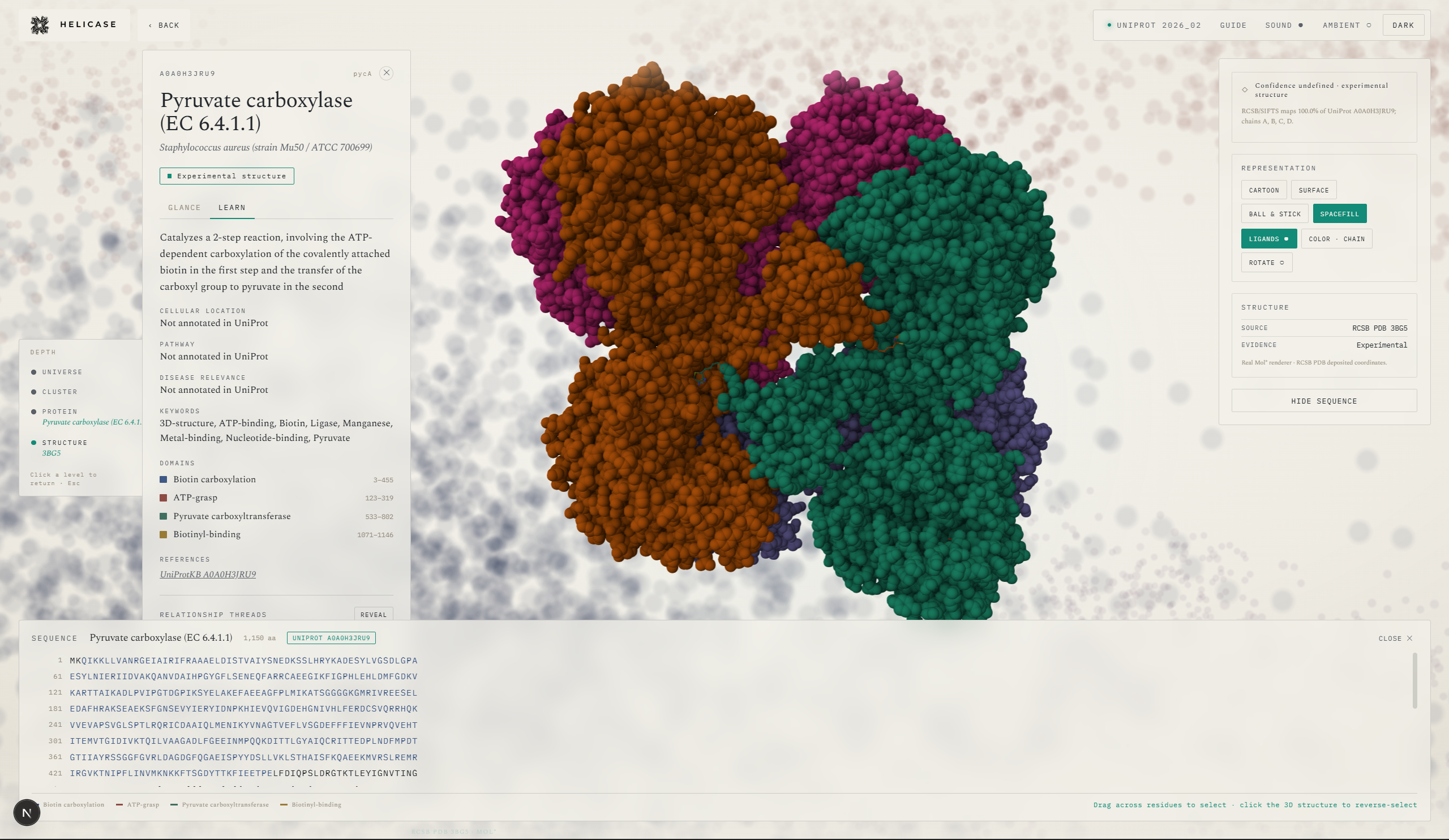
Linked sequence–structure inspection: 3D structures are mapped to residues in sequences.
-
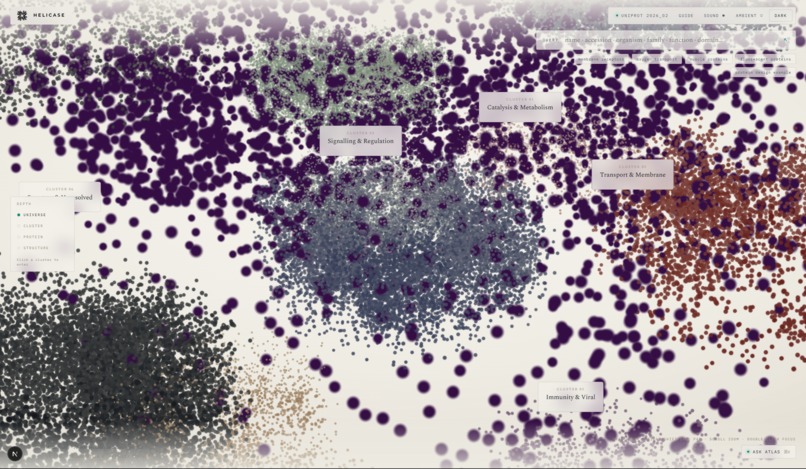
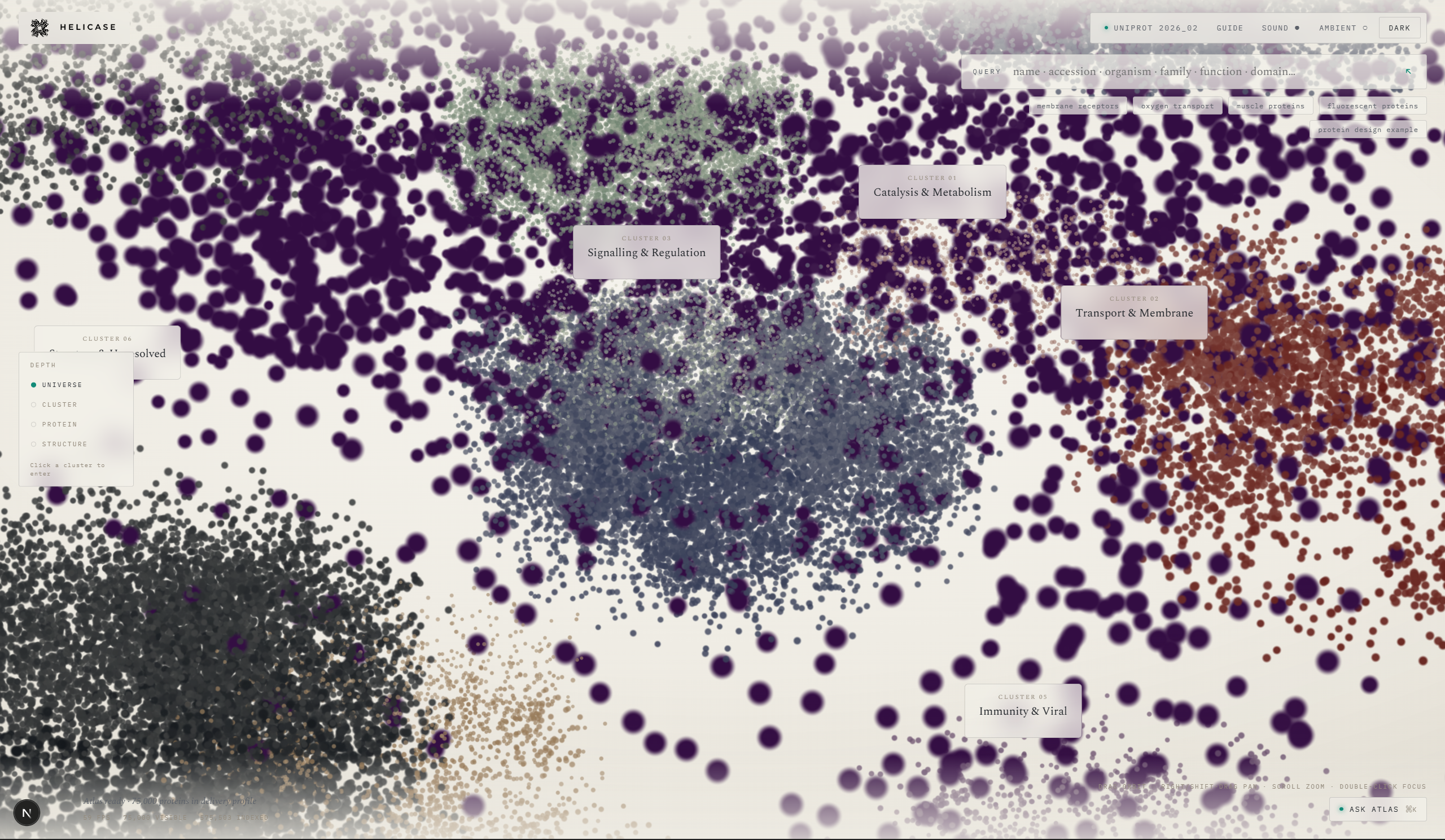
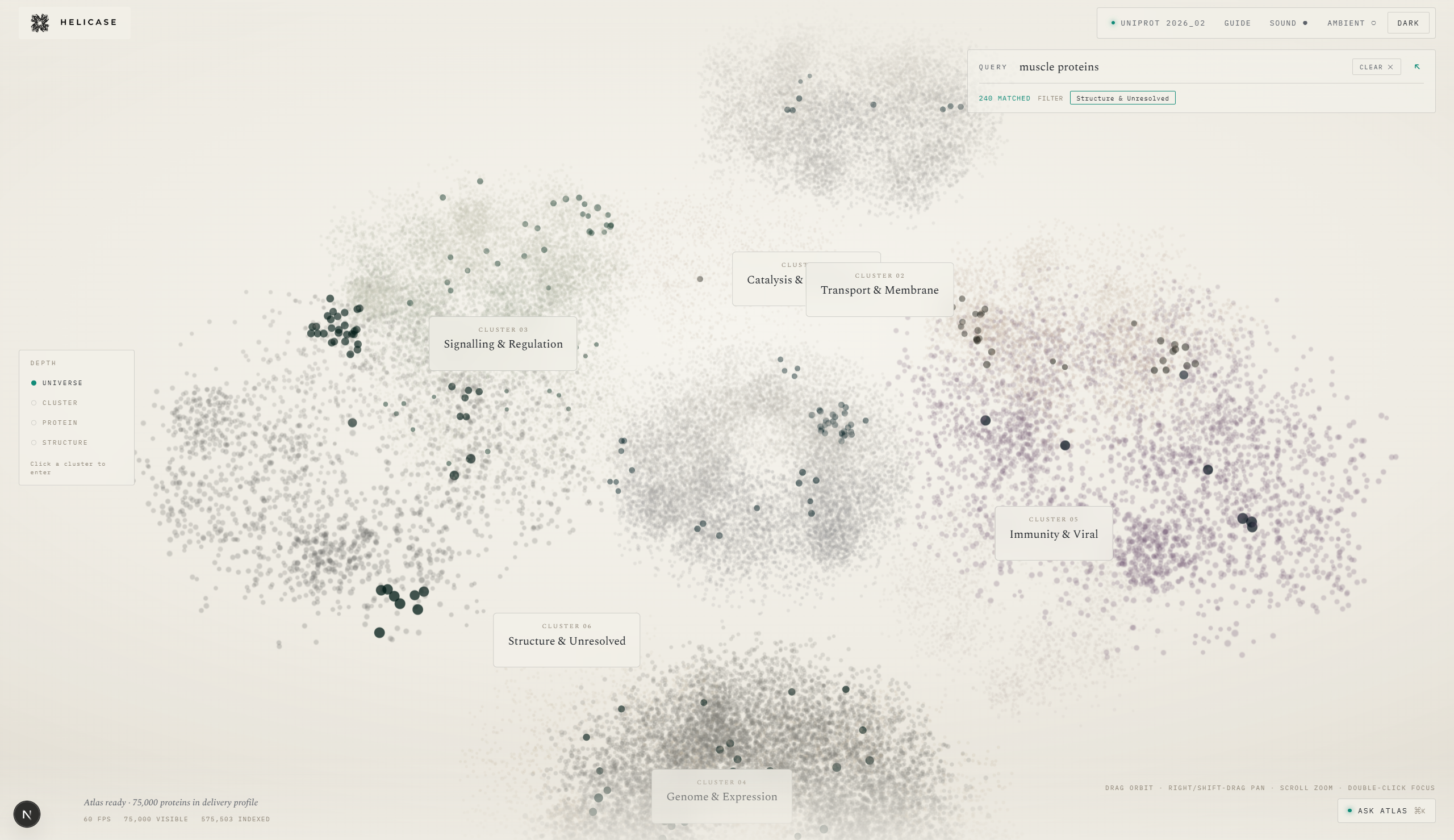
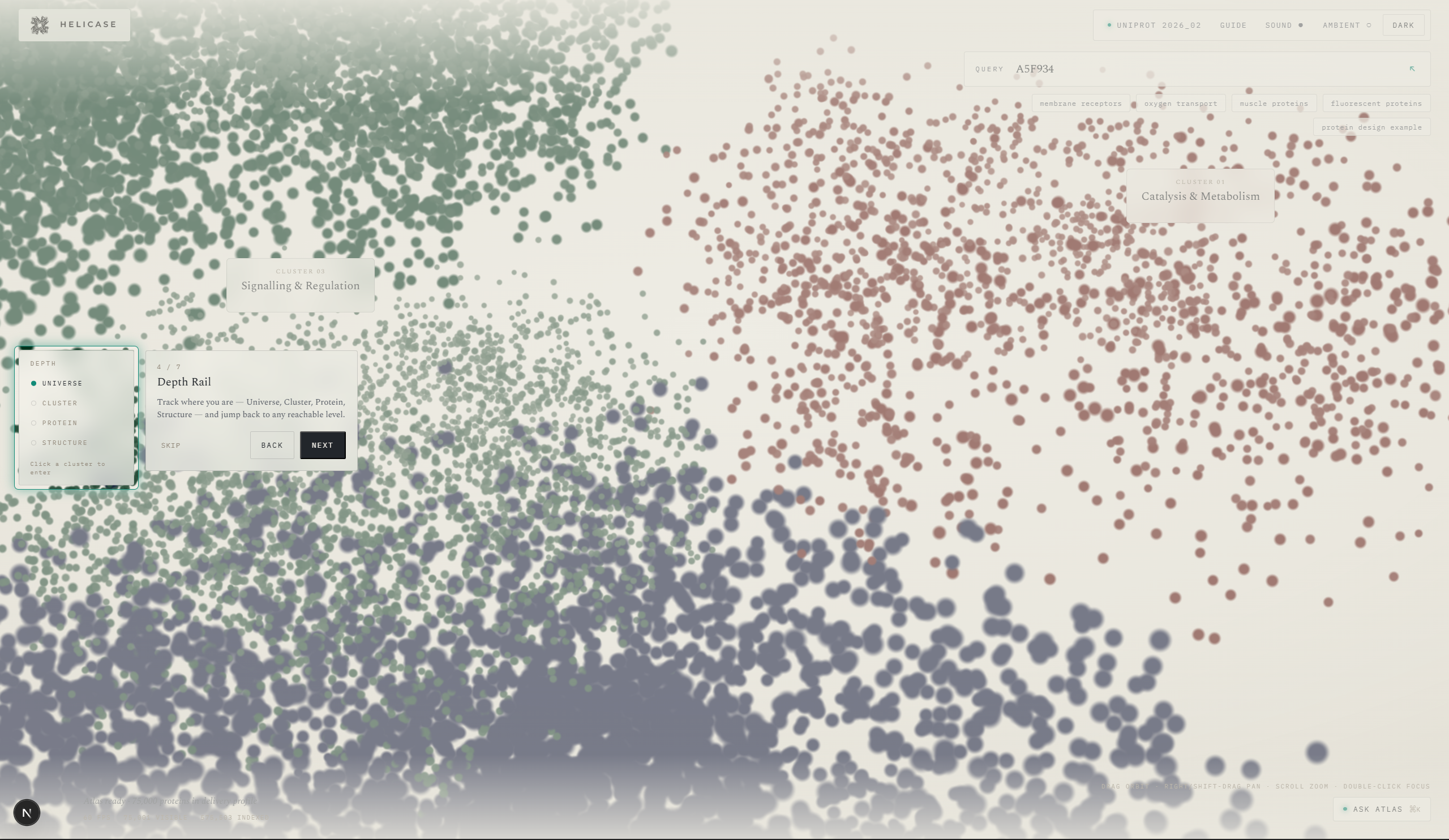
Helicase Atlas in light mode, revealing six major biological neighbourhoods across ~75,000 proteins.
-
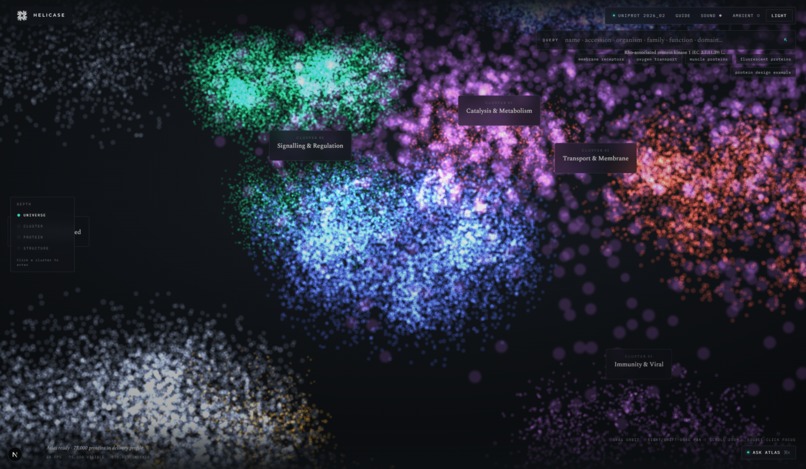
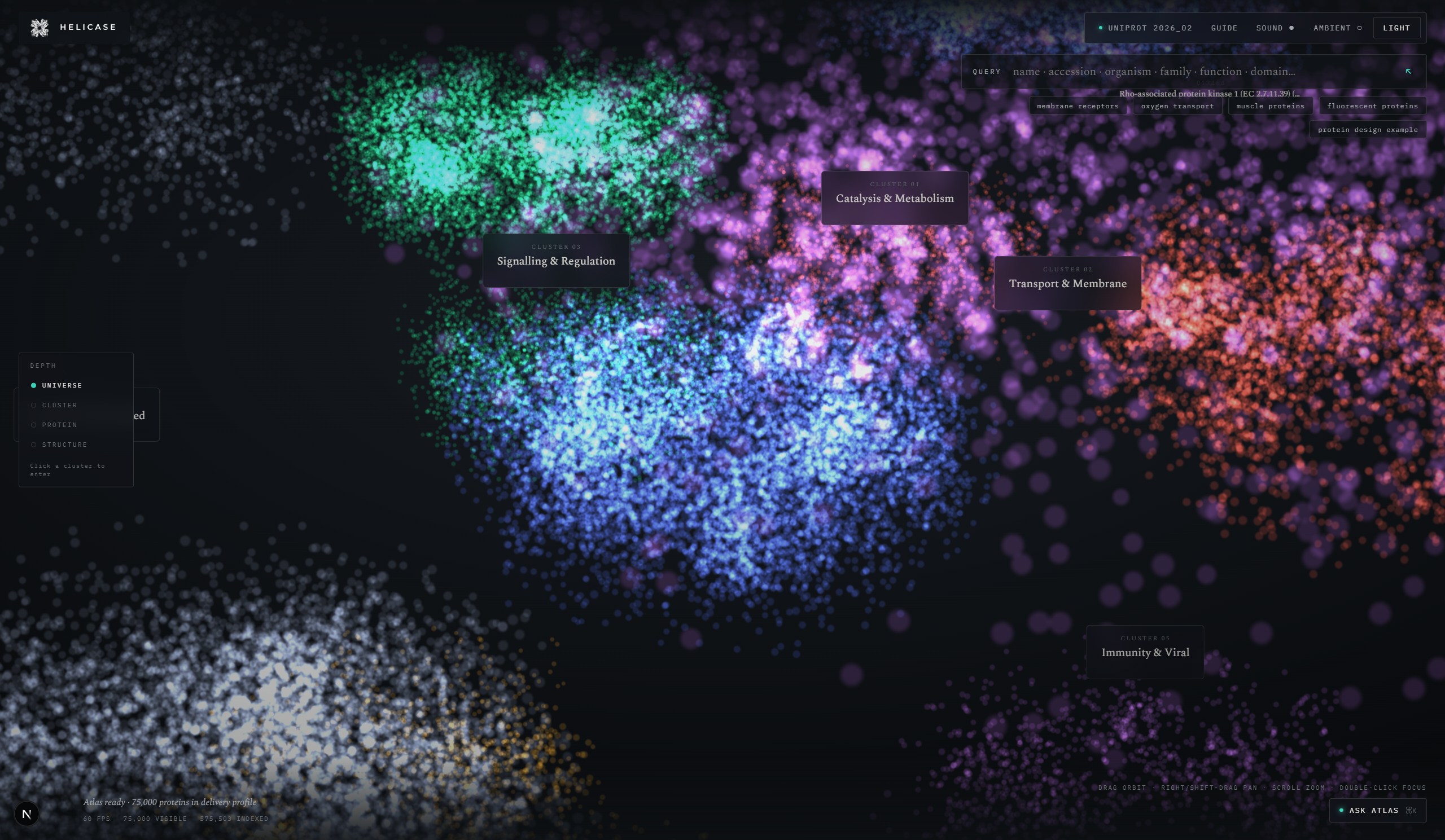
Helicase Atlas in dark mode. The global protein universe organized into functional biological neighbourhoods.
-
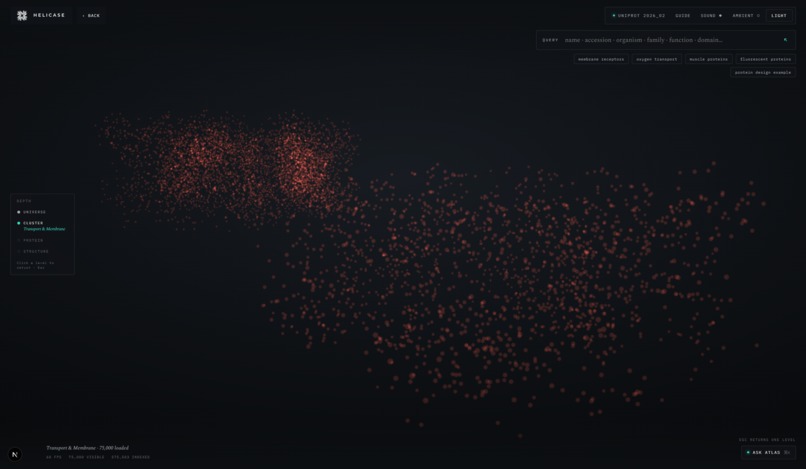
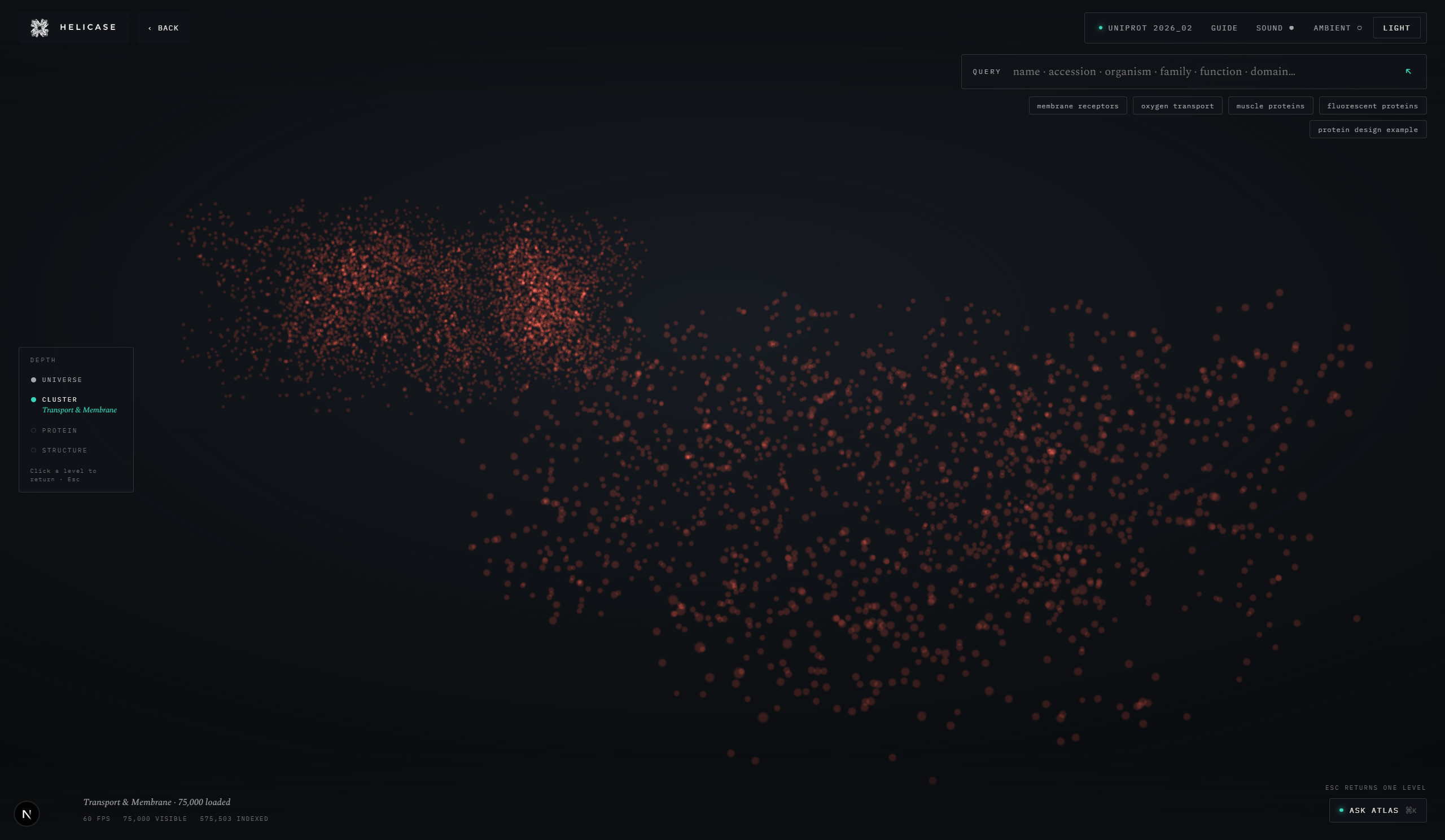
Zoom into an individual biological cluster while preserving its context within the protein universe.
-
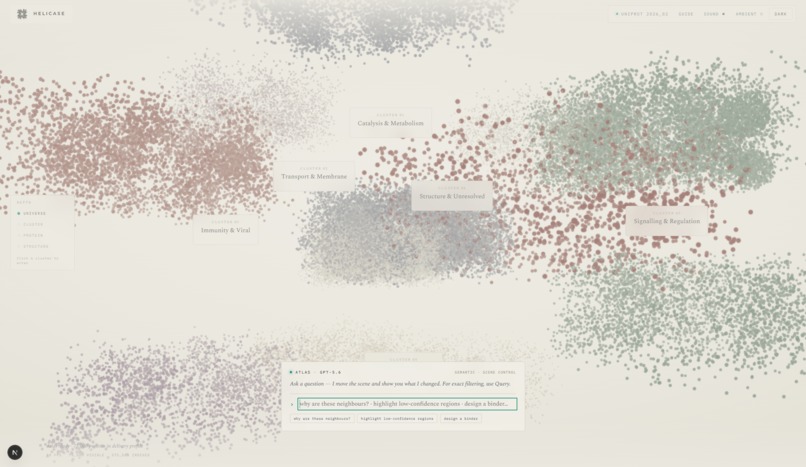
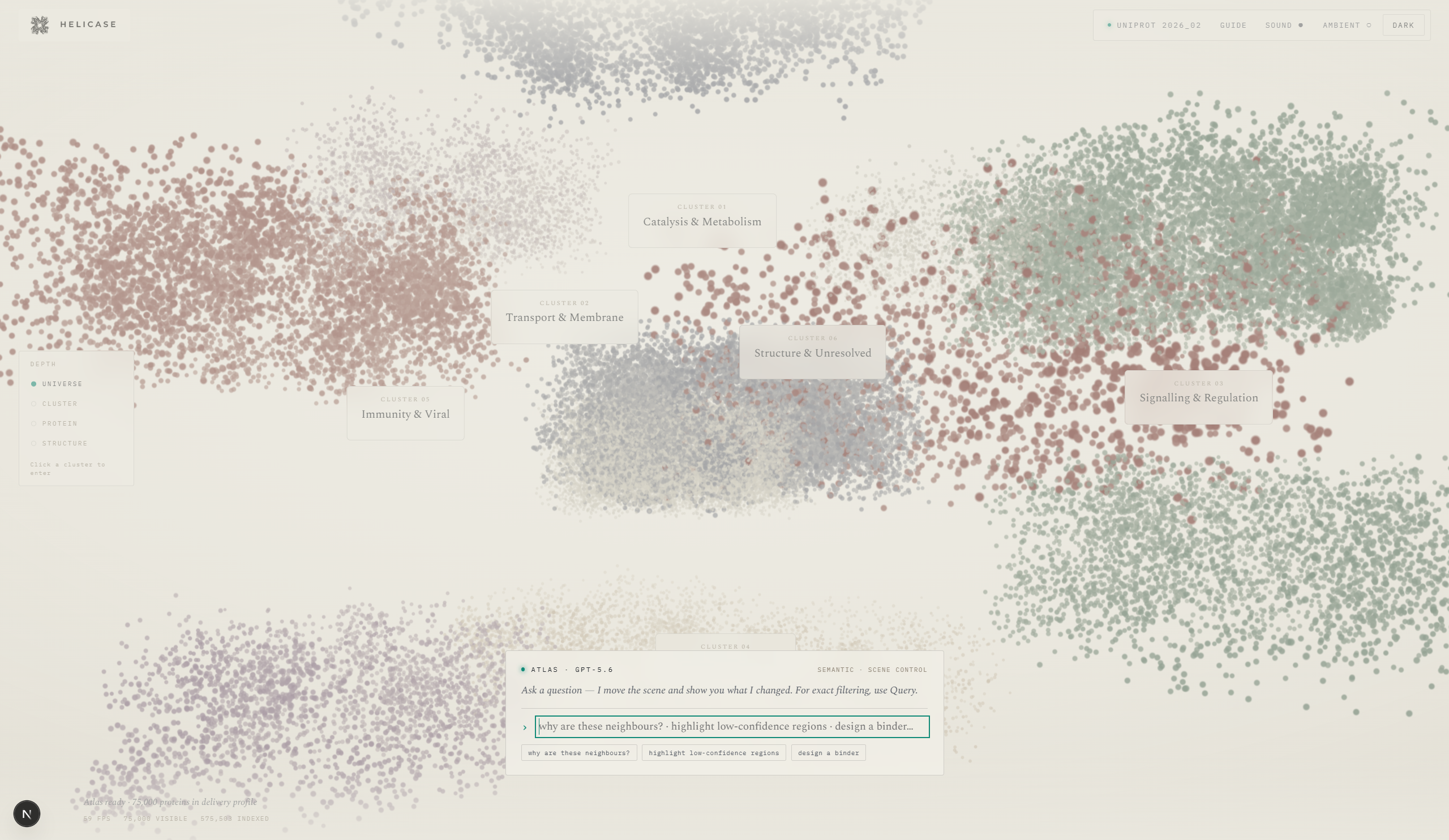
Ask Atlas—GPT-5.6 transforms natural-language questions into interactive exploration of the protein universe.
-
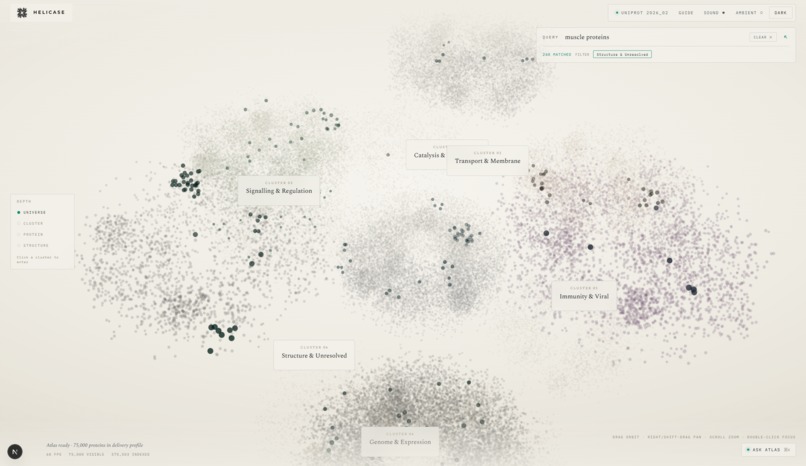
Semantic filtering instantly highlights proteins matching any biological concept or search query.
-
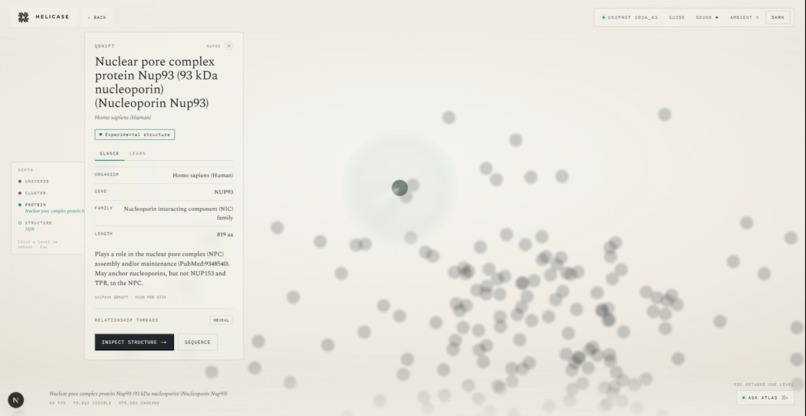
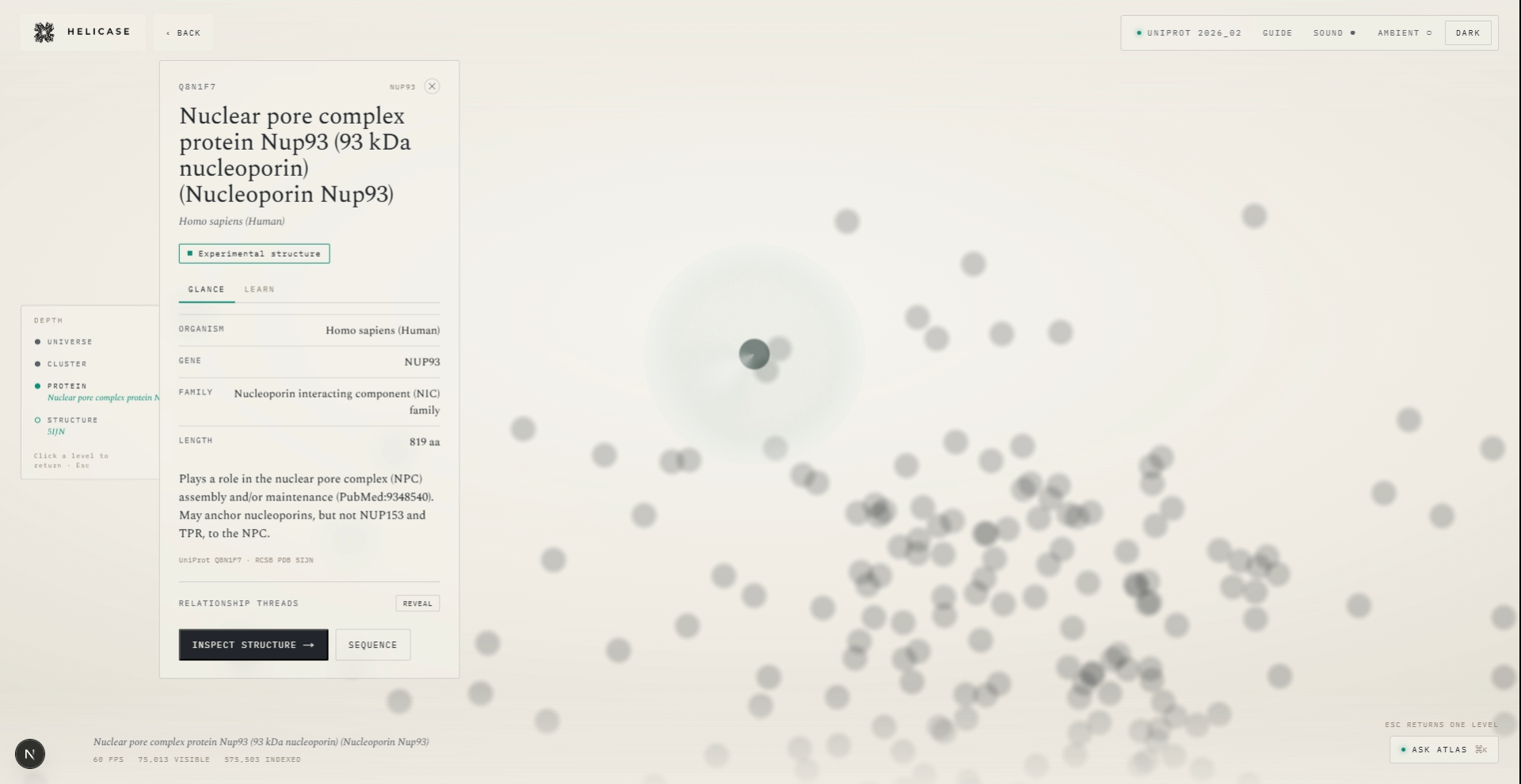
Identity view for human Nup93, showing its position within the global protein landscape before structural inspection.
-
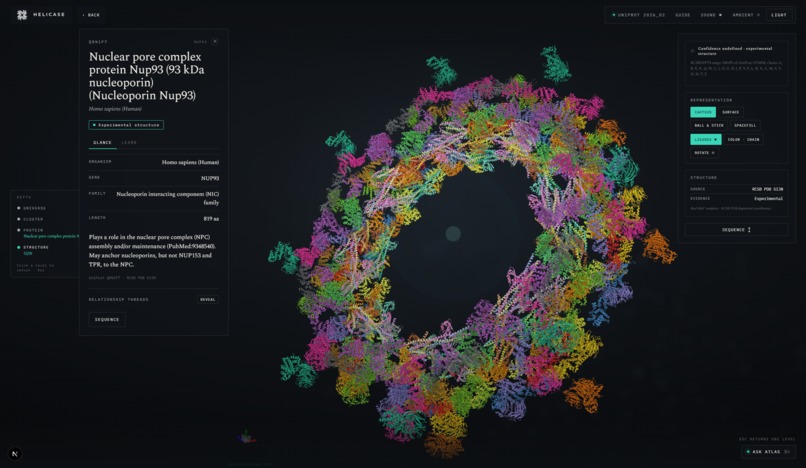
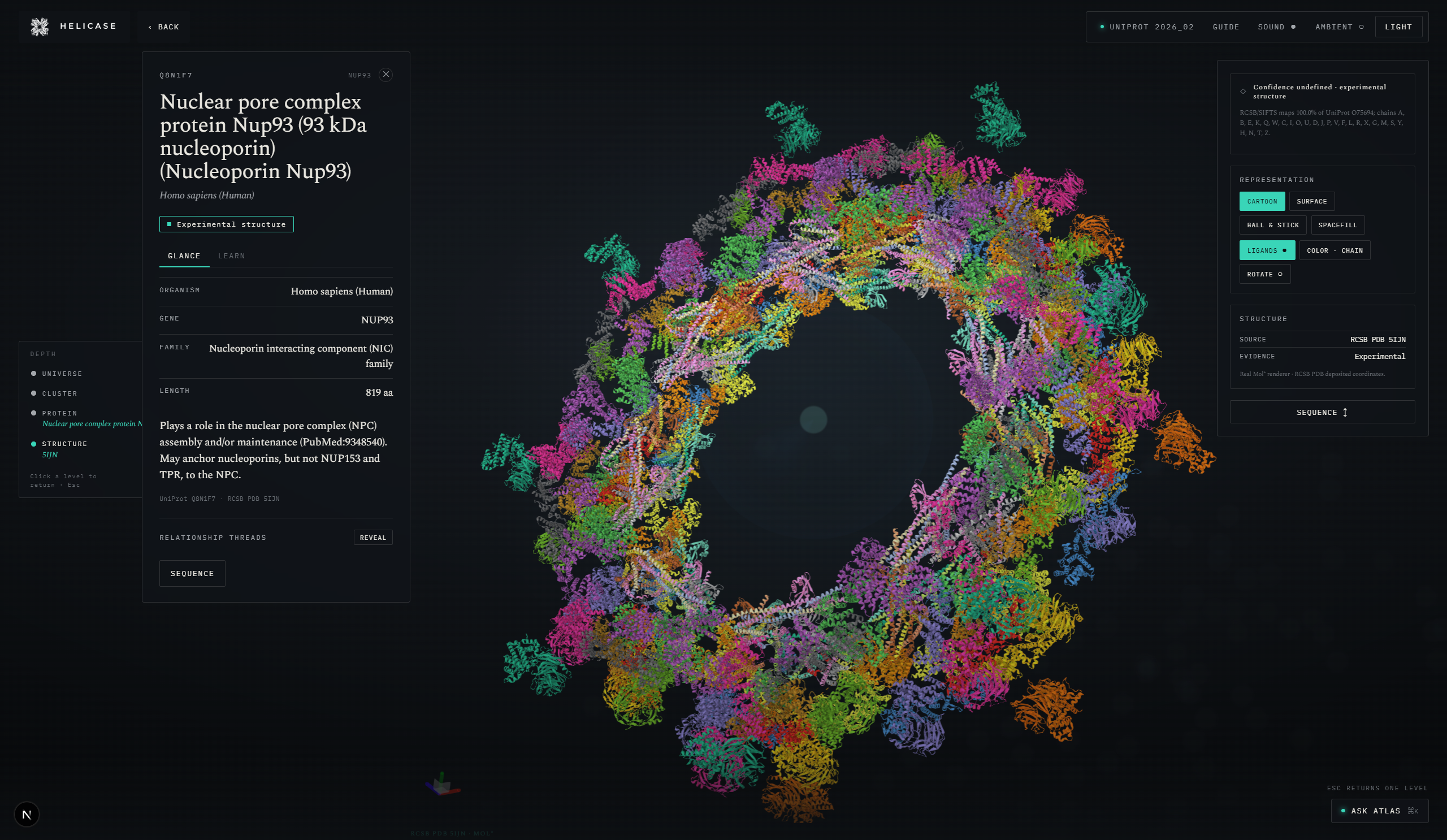
Experimental structure of the human nuclear pore complex rendered in the Atlas' interactive dark workspace.
-
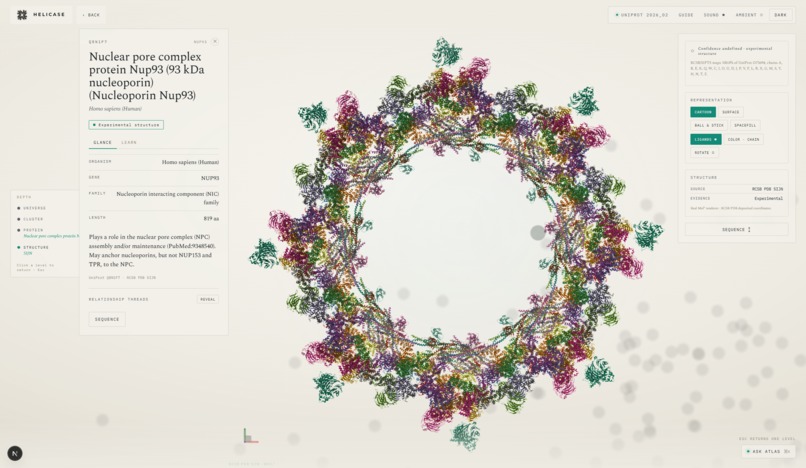
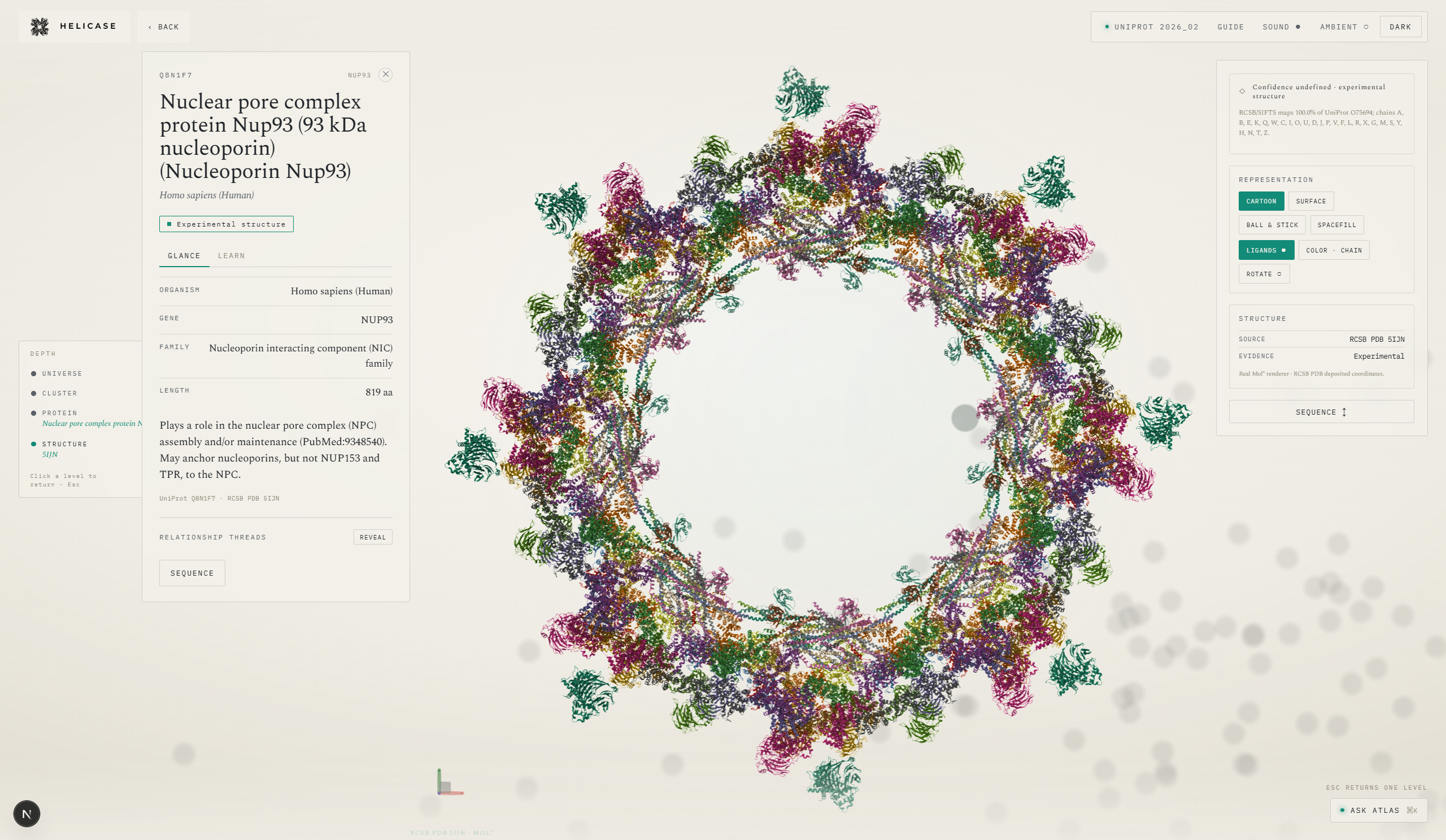
High-fidelity molecular visualization of the human nuclear pore complex in the standard analysis workspace.
-
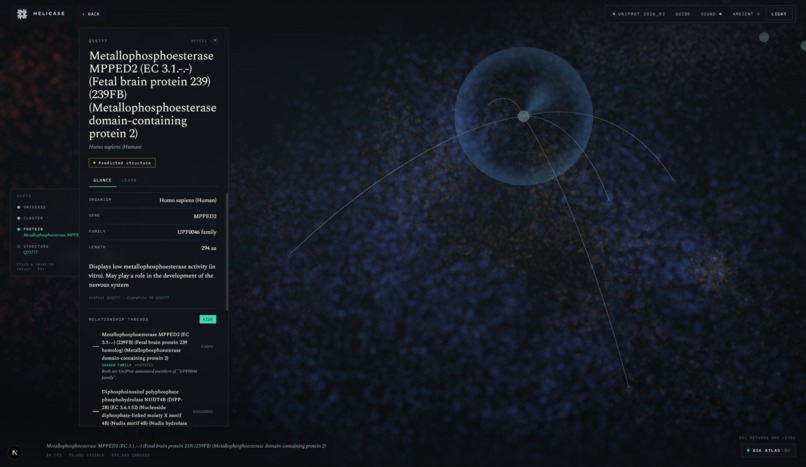
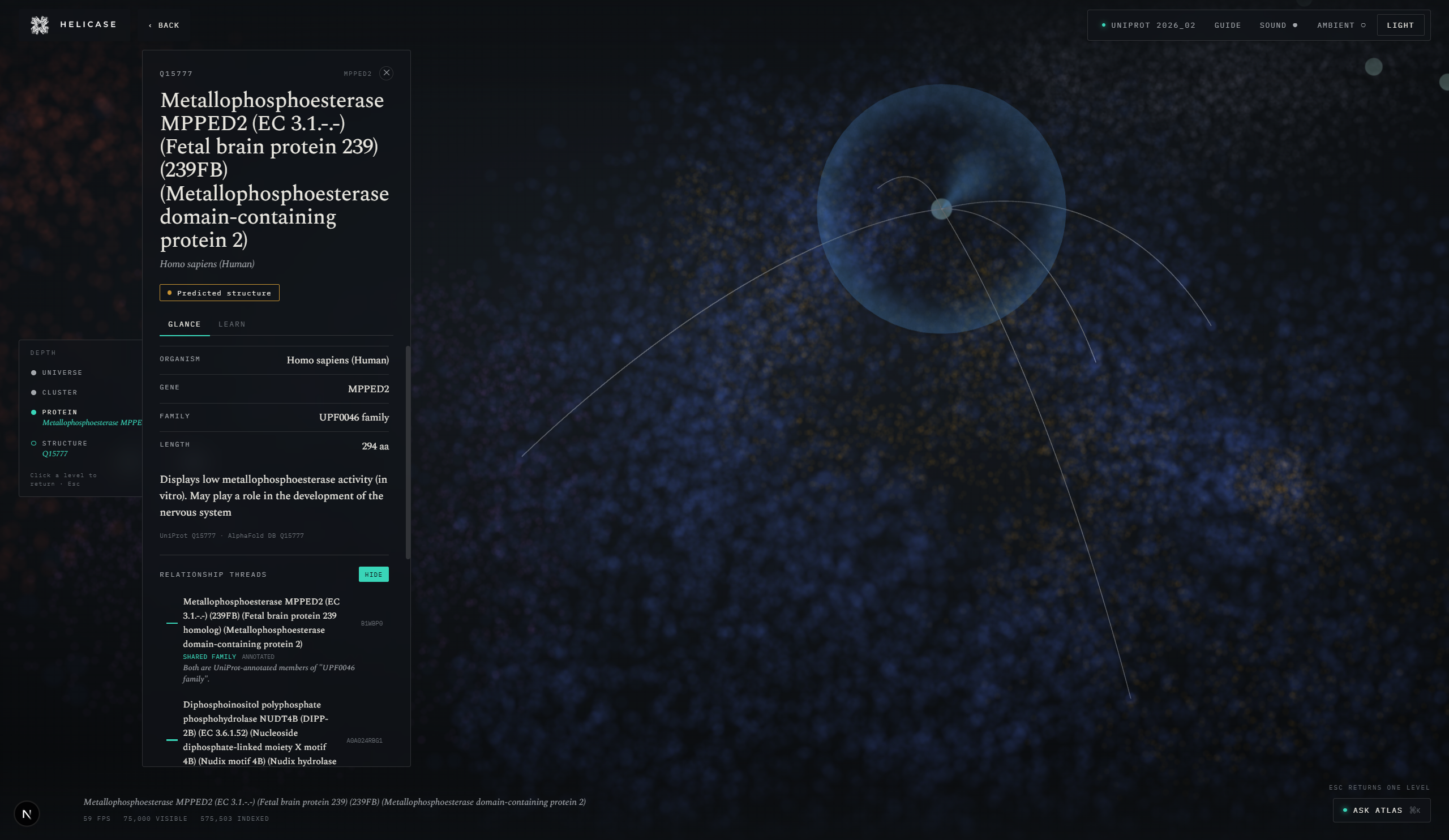
Relationship Threads reveal functional neighbours and evolutionary relationships surrounding MPPED2.
-
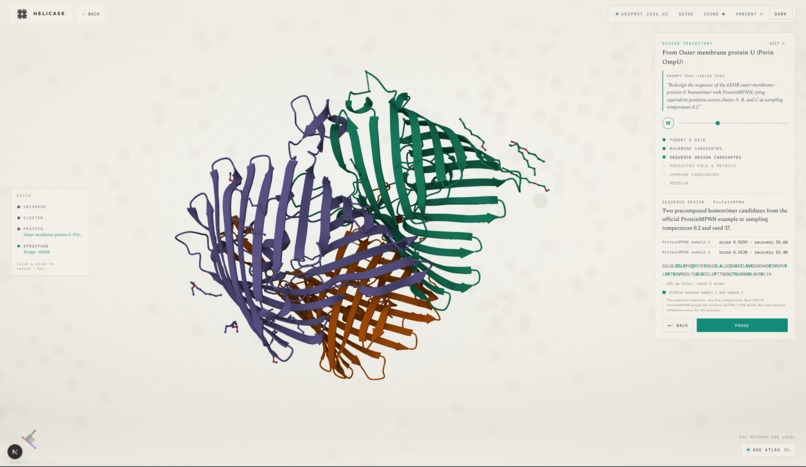
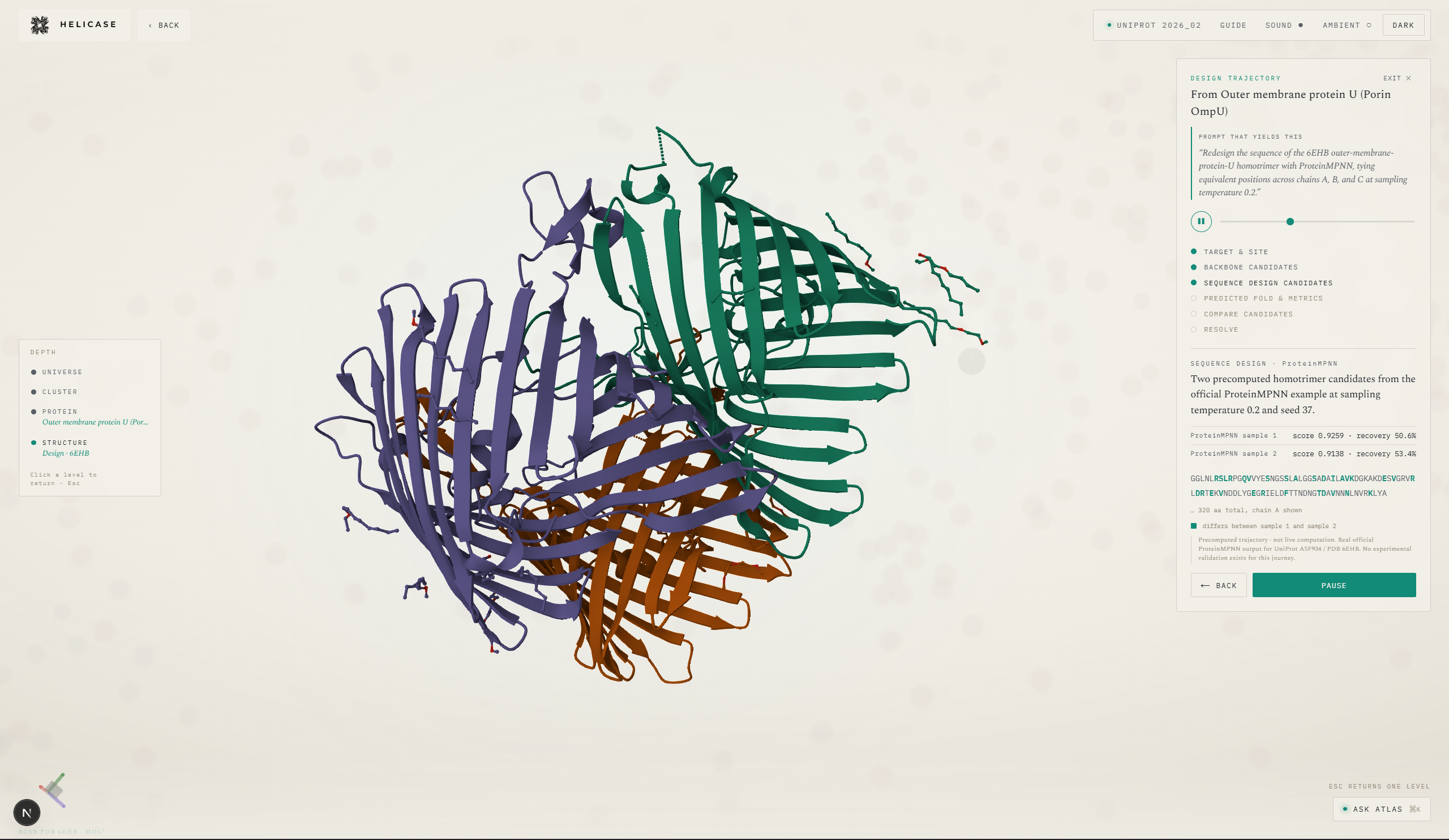
Mock AI-guided protein design trajectory showing progression from a natural protein toward engineered candidates.
-
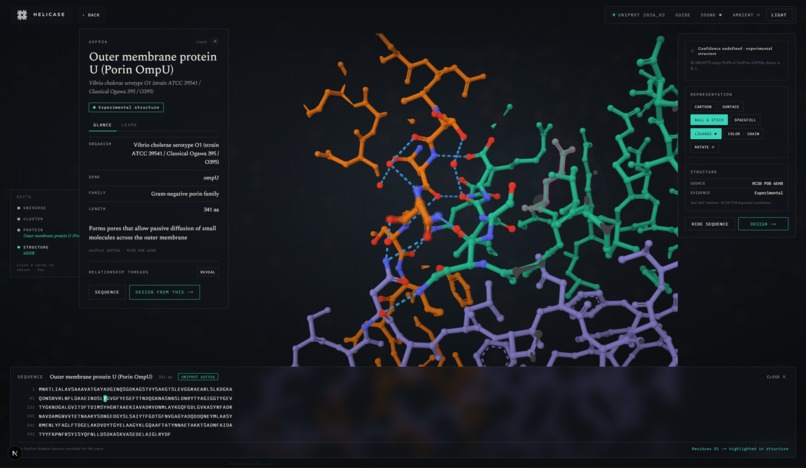
Ball-and-stick representation exposes atomic interactions, ligands, and molecular binding geometry.
-
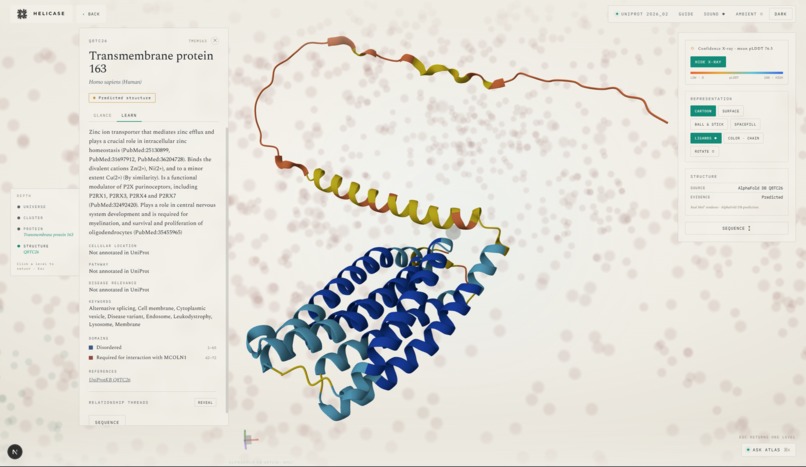
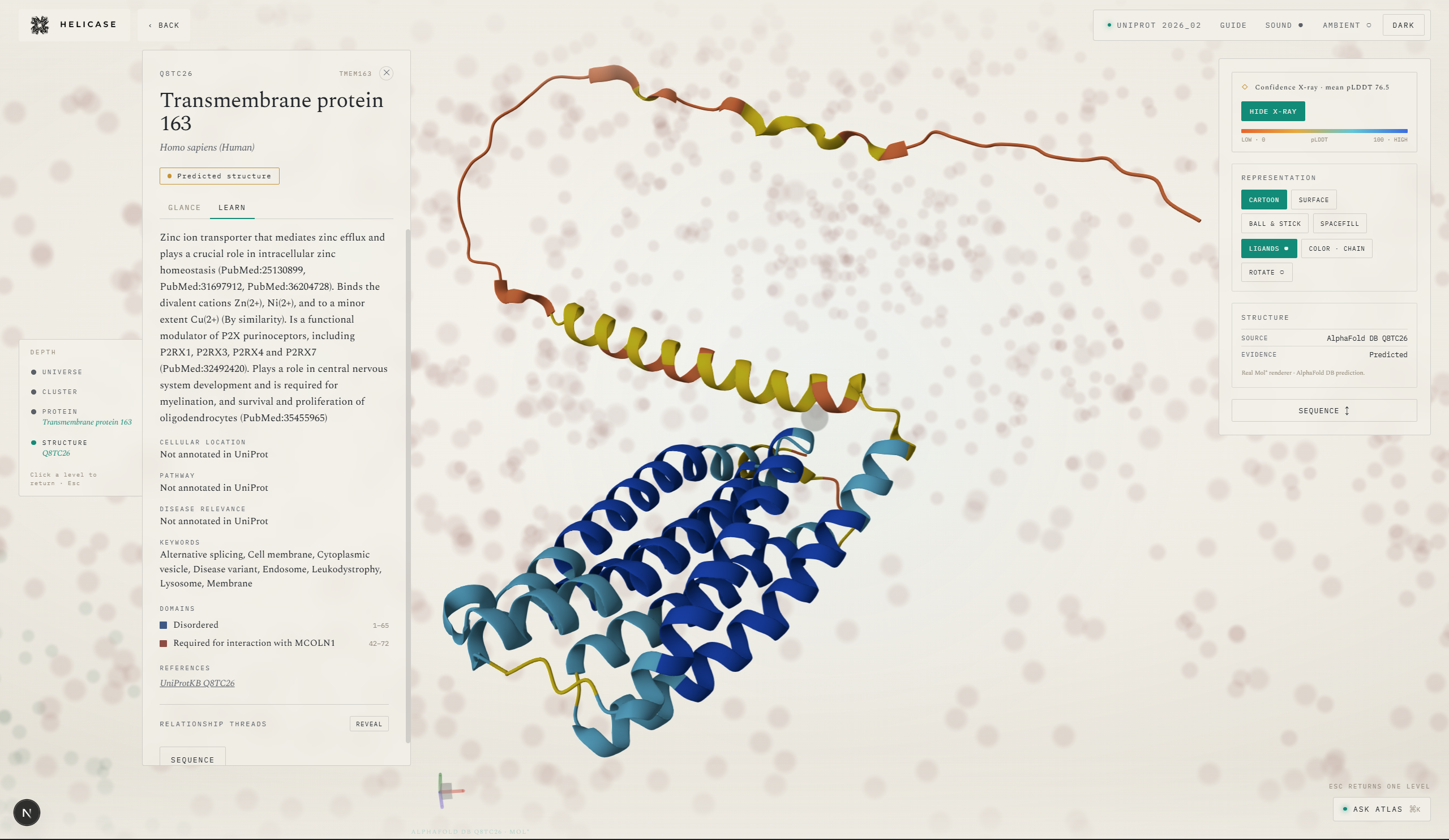
Confidence X-Ray overlays AlphaFold confidence (pLDDT) directly onto predicted protein structures.
-
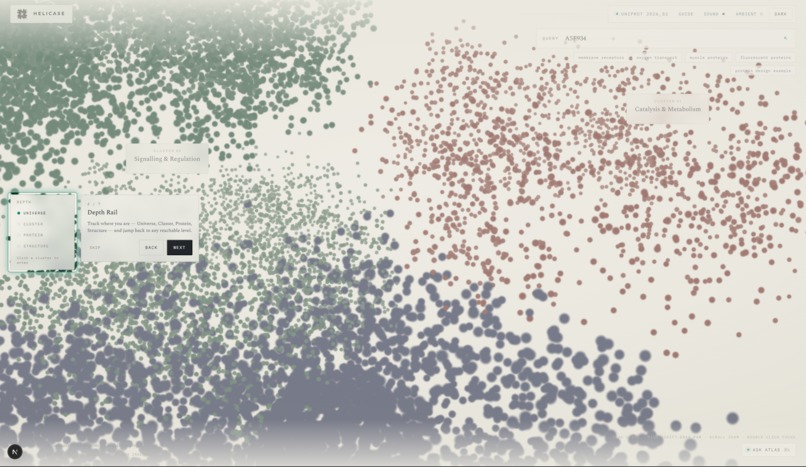
Interactive onboarding introduces the atlas navigation model and progressive depth rail.
-
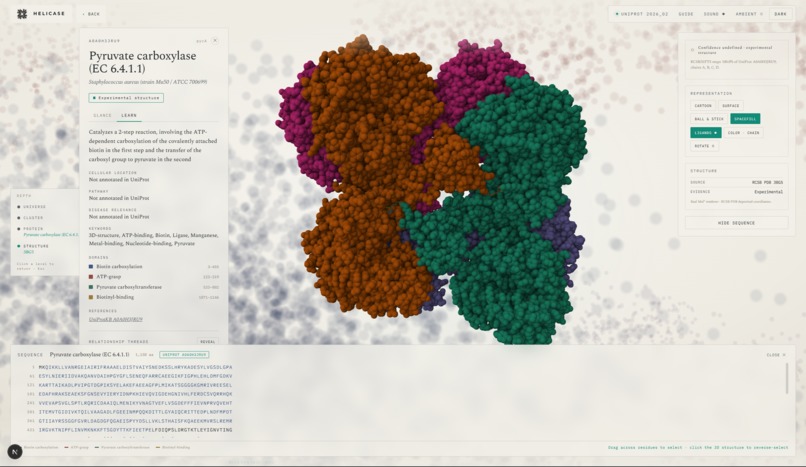
Experimental Pyruvate Carboxylase structure with structural, sequence, and functional annotations.
Inspiration
Protein science contains some of the most extraordinary data humanity has produced, but learning from it still often means moving between accession numbers, tables, sequence databases, structure viewers and specialist tools.
I wanted to build the interface I wished existed when I began exploring protein engineering: one place where a learner could encounter the scale of protein space, move through it visually, understand what an individual protein does, inspect its molecular structure and see how computational design relates to the original biology.
What if the protein universe felt like a place you could enter?
What it does
Helicase Atlas is a browser-native, AI-guided spatial atlas for exploring protein structure, function, sequence, provenance and computational design.
The final application lets users:
- Explore a spatial universe containing 75,000 real proteins.
- Search reviewed protein records by name, accession, organism, family and function.
- Navigate from the atlas into an individual protein record.
- Inspect protein identity, biological context, sequence and provenance.
- Open experimental structures from the RCSB Protein Data Bank.
- Open predicted structures from AlphaFold DB where available.
- Explore molecular structures through Mol*.
- View AlphaFold confidence only when prediction confidence is scientifically applicable.
- Use GPT-5.6 to search, focus, navigate and operate the atlas through typed scene tools.
- Return from molecular inspection to the wider spatial atlas without losing the product's sense of place.
The underlying data pipeline indexes 575,503 reviewed UniProtKB/Swiss-Prot records. The browser delivery profile visualizes 75,000 proteins through progressively delivered atlas data.
How I built it
Helicase Atlas is built with Next.js, React and TypeScript.
Three.js and WebGL render the protein universe. The atlas data pipeline transforms reviewed UniProt records into browser-safe spatial shards, while worker-backed indexing keeps search and interaction responsive.
Mol* provides molecular structure visualization. Experimental structures are resolved through RCSB PDB, while predicted structures and applicable confidence data are resolved through AlphaFold DB.
The application uses a typed scene model so direct user interactions, deterministic search and AI-directed actions all pass through the same bounded command layer.
How GPT-5.6 is used
GPT-5.6 is not a chatbot placed beside the product.
The application sends the current atlas state, selected protein context and user request to a server-side OpenAI Responses API route. GPT-5.6 can choose from a constrained set of tools for search, focus, navigation, inspection and the supported design journey.
Every tool call is validated with strict Zod schemas before it can change the scene. Unknown or invalid actions are rejected. The API key remains server-side, and the application exposes an explicit local fallback when no OpenAI credential is available.
This makes GPT-5.6 a semantic controller for the scientific interface rather than an unrestricted source of UI mutations or invented protein records.
How Codex was used
Codex was the primary engineering collaborator during the core Build Week implementation.
Codex helped me:
- Establish the repository architecture and typed domain contracts.
- Build the reviewed-protein ingestion and atlas-generation pipeline.
- Create the full-corpus index and the measured 75,000-protein browser profile.
- Implement progressive atlas delivery and worker-backed search.
- Develop the Three.js spatial renderer and scene-state architecture.
- Integrate protein search, record and structure APIs.
- Build the GPT-5.6 tool surface and runtime validation.
- Add tests, continuous integration and production-build checks.
- Investigate browser performance and molecular-viewer failures.
- Maintain implementation records and an AI development log.
I retained responsibility for the product thesis, scientific boundaries, information hierarchy, visual direction, interaction decisions and final acceptance criteria.
Claude Code was later used to translate the final visual direction into the working application and complete the final MVP stabilization pass. The submission documents this openly; Codex remained the principal agent used to build the core architecture, data systems and functionality.
Challenges
Making scientific scale usable
The complete source pipeline indexes 575,503 reviewed proteins. Sending the entire corpus directly into every browser would have produced a poor interactive experience, so the final application uses a measured 75,000-protein browser profile while retaining the larger indexed corpus and its provenance.
Preserving one continuous experience
A conventional scientific application would replace the atlas with disconnected pages. Helicase Atlas instead preserves the feeling that the user is moving through one continuous world—from the protein universe into an individual protein and then into molecular structure.
That required the camera, selection state, scientific context and interface hierarchy to remain coordinated.
Integrating real molecular structures
Mol* is a powerful scientific renderer, but it is also stateful and browser-specific. The implementation had to correctly handle experimental and predicted structure sources, binary structure data, viewer lifecycle behaviour and transitions back into the spatial scene.
Keeping the AI scientifically bounded
A convincing scientific interface can easily imply more certainty than the underlying evidence supports.
Helicase Atlas explicitly distinguishes experimental structures from predictions, uses prediction confidence only where valid, and presents the ProteinMPNN journey as precomputed sequence redesign rather than laboratory-validated discovery.
GPT-5.6 can operate only through known, validated tools and cannot invent records or unsupported scientific relationships.
Accomplishments
I am proud that the final Build Week project combines:
- A real reviewed-protein data pipeline.
- A 575,503-record indexed source corpus.
- A 75,000-protein interactive browser atlas.
- Spatial exploration rather than a conventional search-results page.
- Experimental and predicted molecular structure inspection.
- Scientifically qualified AlphaFold confidence.
- GPT-5.6 control through validated typed tools.
- A bounded ProteinMPNN design journey.
- A coherent product experience with production builds, automated tests and release documentation.
What I learned
The central lesson was that making advanced science accessible does not require making it scientifically vague.
The best version of Helicase Atlas is both an instrument and an invitation: understandable on first contact, but able to disclose real scientific depth one interaction later.
I also learned that agentic development works best when product intent is explicit. Codex became substantially more effective when architecture, scientific boundaries, acceptance criteria and tool contracts were written down and continuously tested.
What's next
The next steps are:
- Guided learning journeys for protein structure and function.
- Side-by-side protein-family and structure comparison.
- Educator-authored lessons and classroom exploration modes.
- Richer residue-level sequence and structure synchronization.
- Additional provenance-bound computational-design examples.
- Saved explorations and collaborative annotation.
- Learned sequence and structure embeddings for deeper spatial organization.
The immediate goal remains the same: make the protein universe easier to enter, question and understand.
Built With
- alphafold-db
- codex
- gpt5.6
- mol*
- next.js
- node.js
- openai-api
- playwright
- rcsb-protein-data-bank
- react
- responses-api
- three.js
- typescript
- uniprot
- vitest
- webgl
- webworkers
- zod


Log in or sign up for Devpost to join the conversation.