HedgeHacks
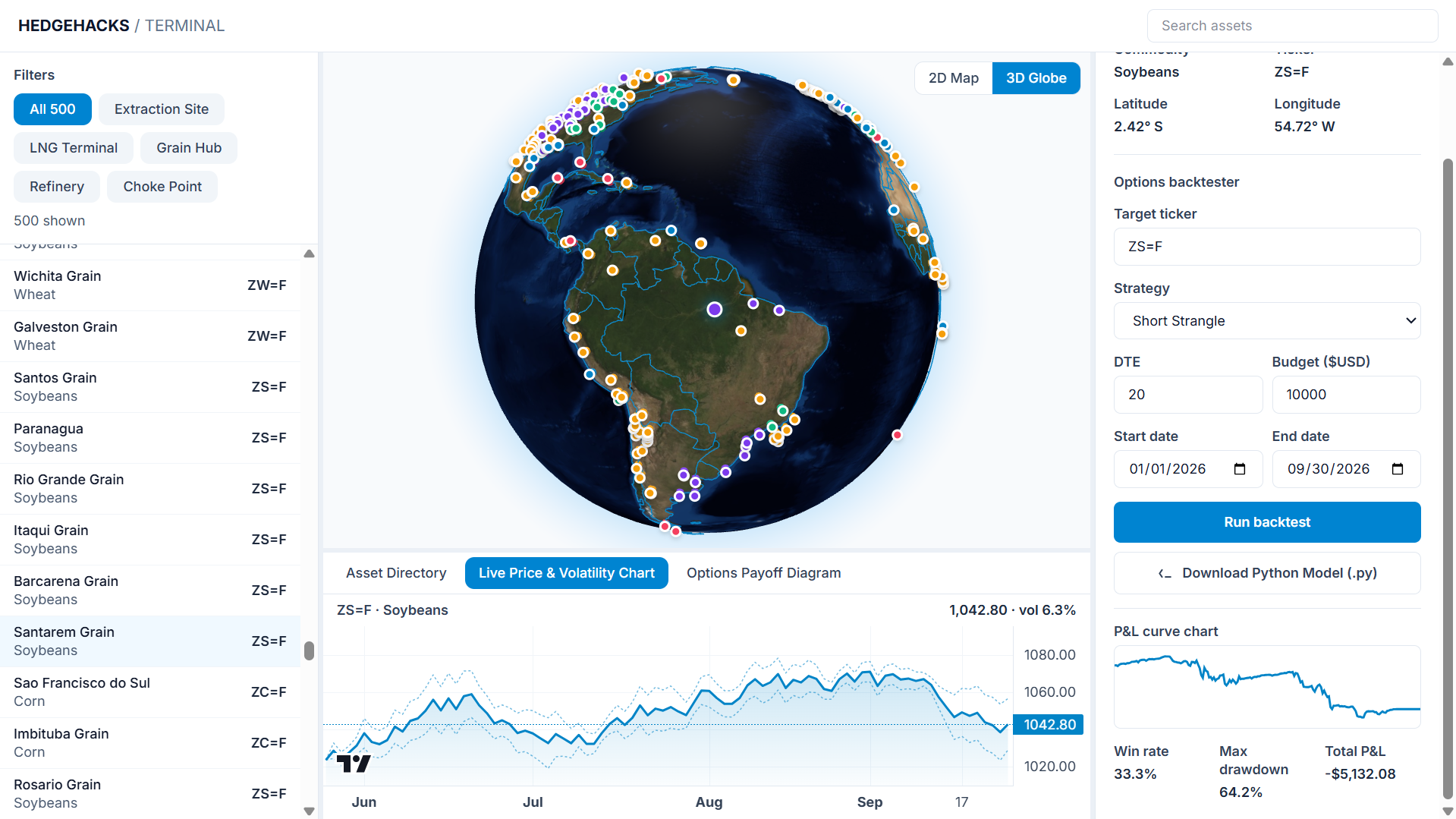
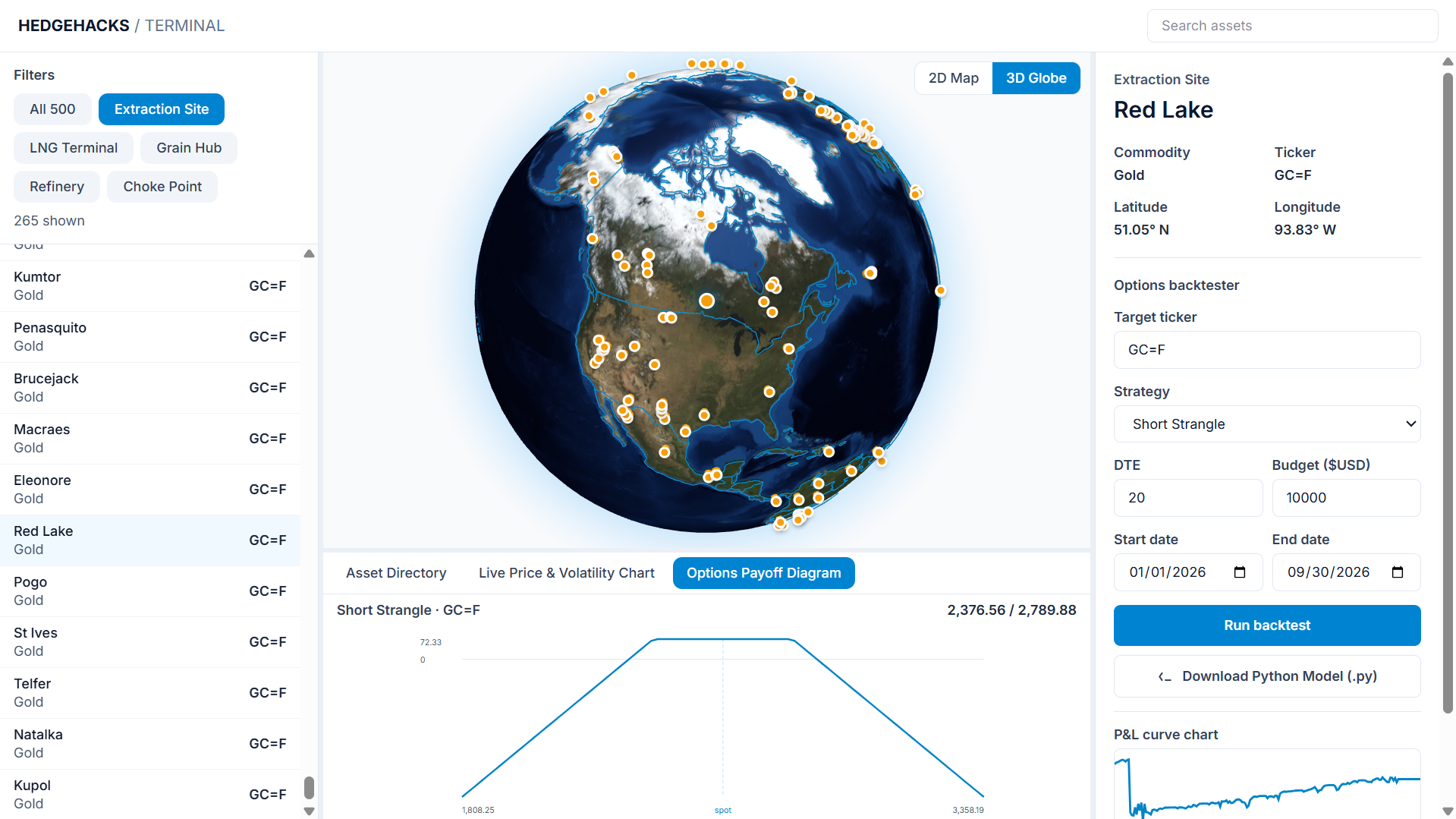
A mini Bloomberg terminal for retail options traders, providing them with commodity options research and institutional Black-Scholes backtesting.
Inspiration
A lot of teams decided to focus on simplifying standard equity portfolios, but we decided to take a different path. The derivatives market vastly dwarfs equities and fixed income, yet it remains one of the most notoriously difficult financial spaces for retail traders to navigate.
Building here in Miami, which is the epicenter for retail options traders in the US, we see this problem firsthand. Fun fact: 97% of retail options traders lose money. Options are complex, multi-dimensional instruments, and institutional firms maintain a massive upper hand largely because of their tooling. Institutional traders pay thousands of dollars per month for Bloomberg Terminals because they understand the immense edge those tools provide.
We built HedgeHacks to bridge this gap: a mini Bloomberg terminal tailored for retail options traders to level the playing field.
What it does
HedgeHacks gives retail traders institutional-grade research and backtesting capabilities in a single workspace:
- Global Commodity & ETF Search: Search commodity assets worldwide to inspect live prices and dynamic multi-leg options payoff diagrams.
- Institutional Options Backtester: Stress test complex options strategies—such as Short Strangles and Long Straddles—against historical price paths and implied volatility data to see how strategies actually performed under real market conditions.
- Complete Risk Metrics: Generates continuous daily P&L equity curves, real win rates, and peak-to-trough max drawdowns so traders can refine their risk parameters before risking real capital.
- Algorithmic Transparency: Features a "Download Python Model (.py)" export button directly in the terminal, letting users inspect the underlying
yfinanceandscipyresearch scripts offline.
How we built it
- Languages: JavaScript (ES6+), Python 3.11+, HTML5, CSS3
- Frontend: React 18, Vite, Lucide Icons, Recharts / Lightweight Charts, Tailwind CSS
- Backend & Infrastructure: Node.js (Vercel Serverless Edge Functions), RESTful JSON APIs
- Quantitative Research Stack (Python):
yfinancefor historical commodity market datascipy.stats(norm) for Black-Scholes option pricing model formulations:
d1=(S/K)+r+22TT,d2=d1-T
numpyfor Geometric Brownian Motion (GBM) stochastic price path simulation:
St+t=St-22t+tZt
pandasfor time-series manipulation and daily Mark-to-Market (MTM) calculations- Version Control & Deployment: Git, GitHub, Vercel Monorepo deployment
Challenges we ran into
- Sub-100ms Serverless Latency: Heavy quantitative Python runtimes on serverless functions introduced 4s–8s execution delays due to cold starts. We solved this by compiling our verified mathematical algorithms into Node.js edge functions for sub-50ms client feedback while keeping the Python research models accessible for export.
- Modeling Real Tail Risk: Standard option backtesters often show unrealistic 100% win rates. We incorporated daily Mark-to-Market valuation loops, entry/exit slippage penalties, and commodity jump shocks to reflect true tail risk when spot price St breaches option strike wings (Kput,Kcall).
- Monorepo Directory Routing: Unifying build paths between our React frontend subfolder (
/frontend) and serverless API endpoints on Vercel without triggering deployment build errors (e.g., Exit Code 254).
Accomplishments that we're proud of
- Zero-Latency Terminal: Achieving sub-50ms execution for dynamic equity curves and option pricing without relying on static mock data.
- Mathematical Consistency: Successfully aligning trade averages, win rates, and cumulative P&L math to be 100% mathematically consistent across short and long volatility strategies: $$\text{Total P&L} = \sum_{i=1}^{N_{\text{win}}} \text{Gain}i - \sum{j=1}^{N_{\text{loss}}} \text{Loss}_j$$
- Bridging Research & Web Production: Creating a clean, two-tier architecture where offline Python quantitative research pairs with an instant web terminal.
What we learned
- Options Microstructure Matters: A high win rate (e.g., >70%) can easily mask heavy drawdowns if an engine ignores unrealized Mark-to-Market swings and volatility spikes ().
- Institutional Tooling for Retail: Retail options traders don't need fewer features—they need faster, clearer visual models of complex risk parameters (,,,).
What's next for HedgeHacks
- SaaS Subscription Monetization: Today's retail traders spend thousands on courses, signals, and fragmented subscriptions. HedgeHacks is built to transition seamlessly into a subscription-led SaaS terminal (29–99/mo) for retail options communities.
- Greeks Exposure Heatmaps: Real-time Delta (), Gamma (), Theta (), and Vega () exposure tracking across active portfolios.


Log in or sign up for Devpost to join the conversation.