-
-
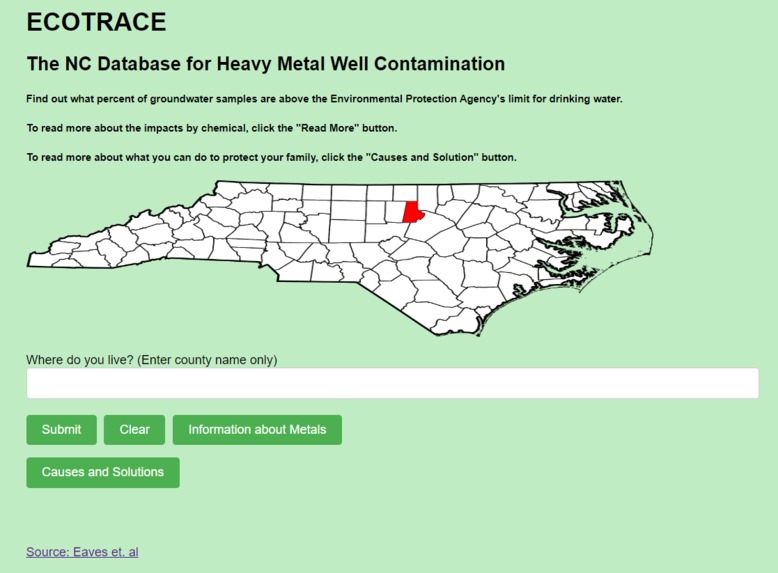
Our Main Page
-
The environmental justice got its kickstart in North Carolina, according to the EPA, when in 1982, North Carolina announced a plan to dump 40,000 cubic yards of soil contaminated with PCBs to a landfill located in Warren County, one of only a few counties in the state with a majority black population. In 2024, the water quality is not going away, with 188 million people living within three miles of a CERCLA, RCRA, or Brownfields (contamination) site, i.e., roughly 59 percent of the American population, including 60 percent of all children in the United States of America under the age of five (US EPA, 2019b).
EcoTrace is dedicated to raising awareness towards groundwater quality issues in N.C., across all 100, empowering our state’s 10 million residents to understand the risks and take action to protect the health of their families.
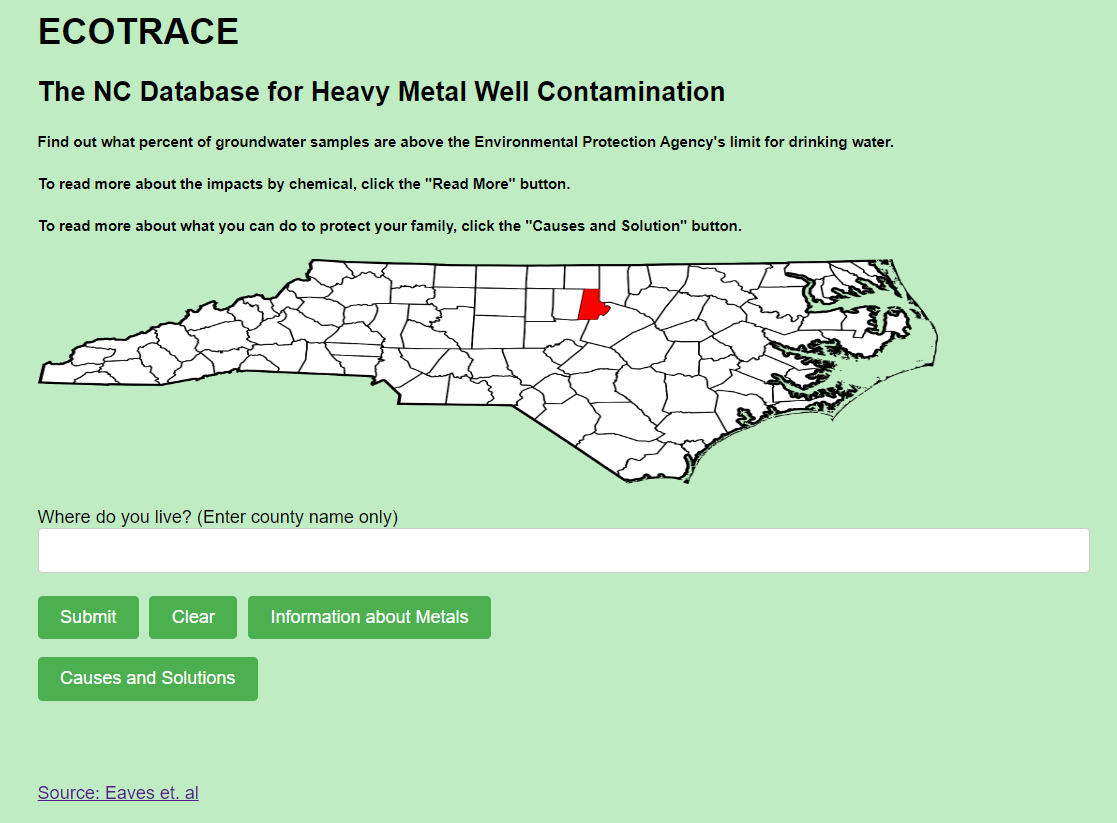
Ecotrace pulls from a dataset hosted by the University of Chapel Hill Superfund Research Program, pulling from three decades of data (1989-2019). The EcoTrace team narrowed this down to 14 key heavy metals that pose a risk to public health, contained within a CSV. We use to node.js for our server-side application (meaning we are not running it on the browser, but using the computer’s resources) to process the queries. We use JSON to return our text-based data from the CSV. We use HTML and CSS for the front-end application, to display our results, to display the information regarding the chemical risks, and solutions, and we use Javascript for the backend as well.
Some challenge we ran into was understanding how to parse a CSV to create a search engine-like platform. We overcame this by using node.js for the queries and JSON to parse through our CSV. It was our first time using this server-side architecture or node.js. Another challenge we faced as we were getting started was finding our dataset. We first looked for geochemical data of sediments from USGS, but we quickly discovered that those data were obsolete (1970), so we transitioned to the Superfund dataset. One of the seniors on our team works with the Superfund for her mentorship position in toxicology, so we know that this is a well-funded and reputed government organization for environmental health.
In the future, we hope to include more classes of pollutants besides just heavy metals, including polyaromatic hydrocarbons (PAHs), polyfluoryl alkyl substances (PFAS), and polychlorinated biphenyls (PCB) for a more holistic understanding. In addition, EcoTrace hopes to incorporate ways to regularly update our CSV database, whether it is by adding new results from tests. Our original database consists of the number of tests, the number of tests above the limit, and the percentage of total tests about the limit, and so we believe that there is still more work to do to make this a more dynamic program, able to keep up with scientific and community health understanding. In addition, we may also look for ways to connect users to safe, affordable drinking waters, like compiling grocery store data.
We hope that ECOTRACE empowers user to better understand the chemical composition of their water, which has impacts on their health and well-being.


Log in or sign up for Devpost to join the conversation.