-
-
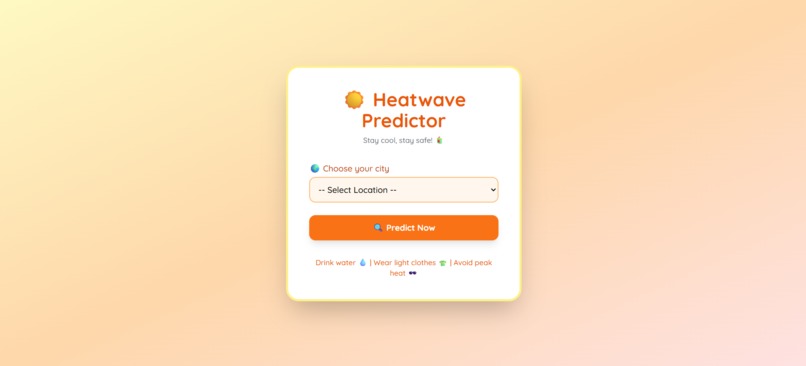
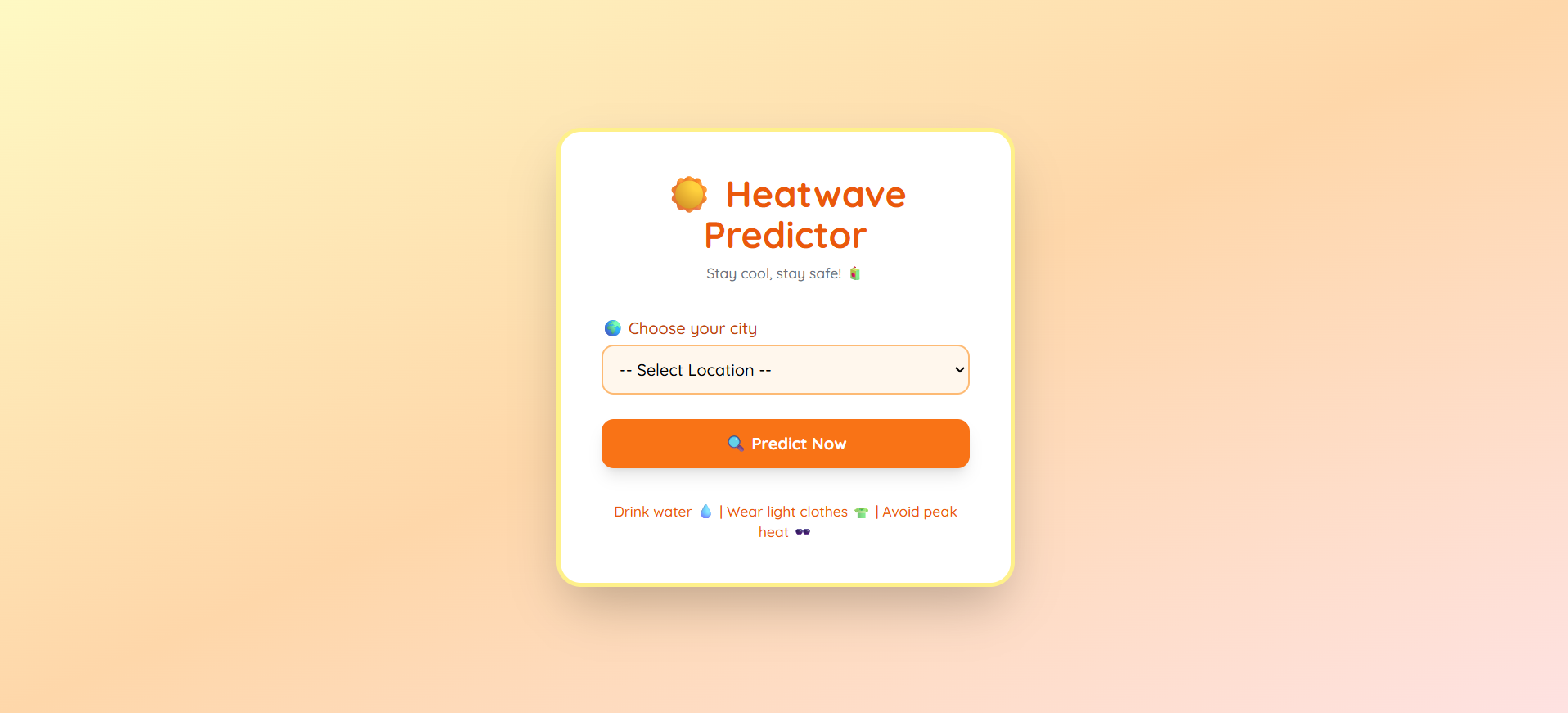
Real-time Heatwave Alert Interface — Enter a location, get instant predictions.
Inspiration
With the increasing frequency and intensity of heatwaves due to climate change, there's a growing need for timely and accessible early warning systems. We were inspired to build a lightweight solution that could empower people and communities to prepare better by using real-time weather data and machine learning.
What it does
->The Heatwave Alert System is a web-based application that: ->Takes a location input from the user ->Fetches real-time weather data (humidity, wind speed, etc.) ->Processes the data into a format suitable for prediction ->Uses a pre-trained machine learning model to determine whether a heatwave is expected ->Displays a user-friendly result: either "Heatwave Predicted" or "No Heatwave", along with weather info
How i built it
->Frontend: Basic HTML with Flask templating for simplicity and responsiveness. ->Backend: Python with Flask to handle routing, form submission, API integration, and prediction logic. ->Model: A classification model trained on historical weather data. We used scikit-learn for training and joblib to save the model. ->API Integration: Used WeatherAPI to fetch live weather parameters based on user input.
Challenges we ran into
->Handling a large dataset during training required memory optimization and data filtering. ->Choosing the right machine learning model that balanced accuracy and speed. ->Making the system real-time, which involved integrating a weather API and ensuring fast inference from the trained model.
Accomplishments that we're proud of
->Successfully built an end-to-end ML application that integrates live weather data. ->Ensured the system is user-friendly and only requires a city input. ->Learned best practices in project structuring, .gitignore, and GitHub documentation.
What we learned
->Real-world datasets need extensive cleaning, especially with imbalanced data that can affect model performance. ->How to work with real-time weather data from APIs and integrate it into a prediction pipeline. ->Gained hands-on experience in building a Flask-based web application. ->Understood the severity and impact of heatwave situations, and how AI can play a role in early alerts.
What's next for Heatwave Alert System
->Add alert threshold customization for different risk groups. ->Send email/SMS alerts using Twilio or similar services. ->Extend the model to predict cold waves or general weather anomalies. ->Deploy as a web app or integrate with WhatsApp for accessibility

Log in or sign up for Devpost to join the conversation.