-
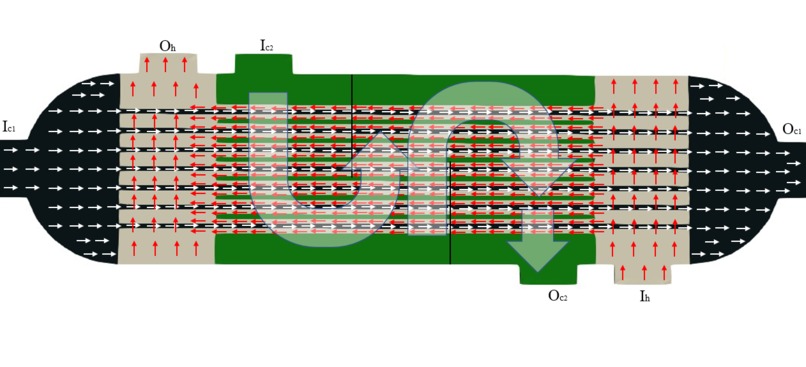
Operating Principle of S&TinT

ABSTRACT
The Shell and Tube-in-Tube (S&TinT) heat exchanger is a superior solution compared to conventional counterparts, boasting an innovative design that includes three heat-transfer elements for three fluid paths. This work initially, addresses the challenges in traditional heat exchanger designs and further considering the drawbacks, a novel design of S&TinT heat exchanger is proposed which provides dynamic control over heat transfer performance, facilitating rapid changes to meet specific operational requirements. Multiple advantages make the S&TinT heat exchanger a promising solution for industries demanding high efficiency and adaptability in their heat transfer processes. Secondly, the Logarithmic Mean Temperature Difference (LMTD) algorithm was chosen to calculate the necessary parameters in which it is modified the standard LMTD algorithm to accommodate heat transfer dynamics between the three fluids. The modified LMTD algorithm ensures the accuracy of the design process and contributes to a deeper understanding of the complex heat transfer mechanisms in multi-fluid systems. Finally, Controlling the parameters of the designed S&TinT heat exchanger is performed by Model Predictive Controller (MPC) as it can handle multi-input multi-output systems. Along with this a comparative analysis with a conventional proportional-integral-derivative (PID) controller is studied and it reveals considerable insights. The error analysis further confirms the superior performance of the MPC controller, establishing it as an effective and effective control technique for advanced heat transfer systems such as the S&TinT heat exchanger.
CONCLUSION
The S&TinT heat exchanger outperforms its conventional counterparts by incorporating three heat-transfer elements, as opposed to the usual two elements in traditional designs. Adopting a cross-flow configuration for three fluid paths contributes to a significant increase in heat transfer rates. This unique architecture addresses challenges inherent in conventional heat exchanger designs. In addition, the flexibility to change flow direction and rate provides a dynamic means of controlling heat transfer performance, allowing rapid changes to meet specific operational requirements. The manifold advantages offered by the S&TinT heat exchanger act as a promising solution for industries demanding greater efficiency and adaptability in their heat transfer processes. In the case of shell and tube-in-tube (S&TinT) heat exchanger, the logarithmic mean temperature difference (LMTD) algorithm is selected for design purposes. However, a significant challenge arises in modifying the standard LMTD algorithm to accommodate the heat transfer dynamics between the three fluids. The traditionally designed LMTD algorithm for calculating heat transfer rates between two fluids is modified to effectively capture the temperature distribution and heat transfer interactions in three-fluid S&TinT heat exchangers. Addressing this change in the algorithm not only ensures the accuracy of the design process, but also contributes to understanding the complex heat transfer mechanisms in multi-fluid systems. Control of designed shell and tube-in-tube (S&TinT) heat exchanger parameters is an important aspect. In this study, Model Predictive Controller was chosen for its ability to handle multi-input multi-output systems. A comparative analysis with a conventional proportional-integral-derivative controller revealed significant insights. PID control has shown success in stabilizing the temperature of cold and hot fluids, but has faced challenges associated with process interactions, leading to high overshoot and unreliable responses. The introduction of model predictive controller showed significant improvements. The MPC controller effectively minimizes overshoot and provides precise control over the temperature of hot and cold fluids. Comparative analysis of error values further confirms the superior performance of MPC controller over PID controller in advanced heat transfer systems like S&TinT heat exchanger.
Built With
- c
- cloud
- flask
- influx
- iot
- javascript
- linux
- matlab
- modbus
- python
- raspberry-pi
- vue

Log in or sign up for Devpost to join the conversation.