-
-
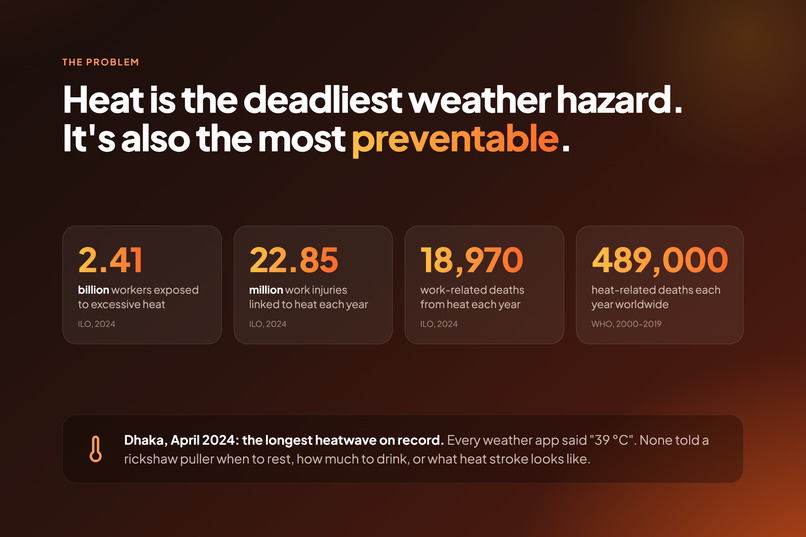
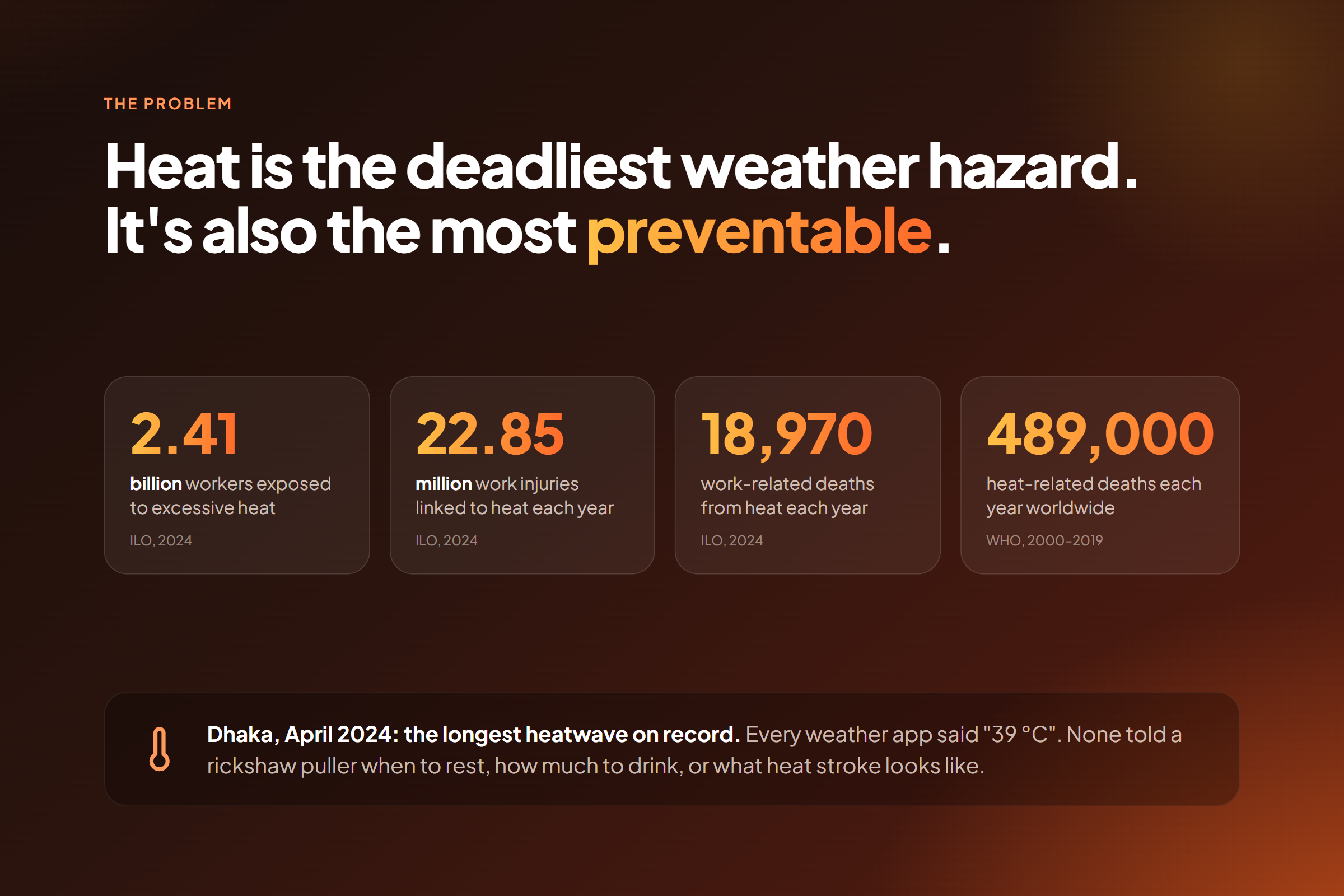
2.41 billion workers face excessive heat, and heat illness is preventable
-
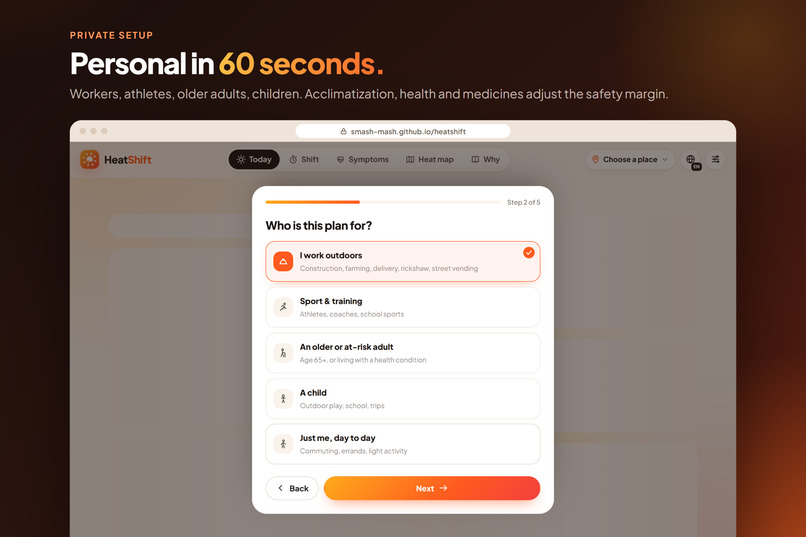
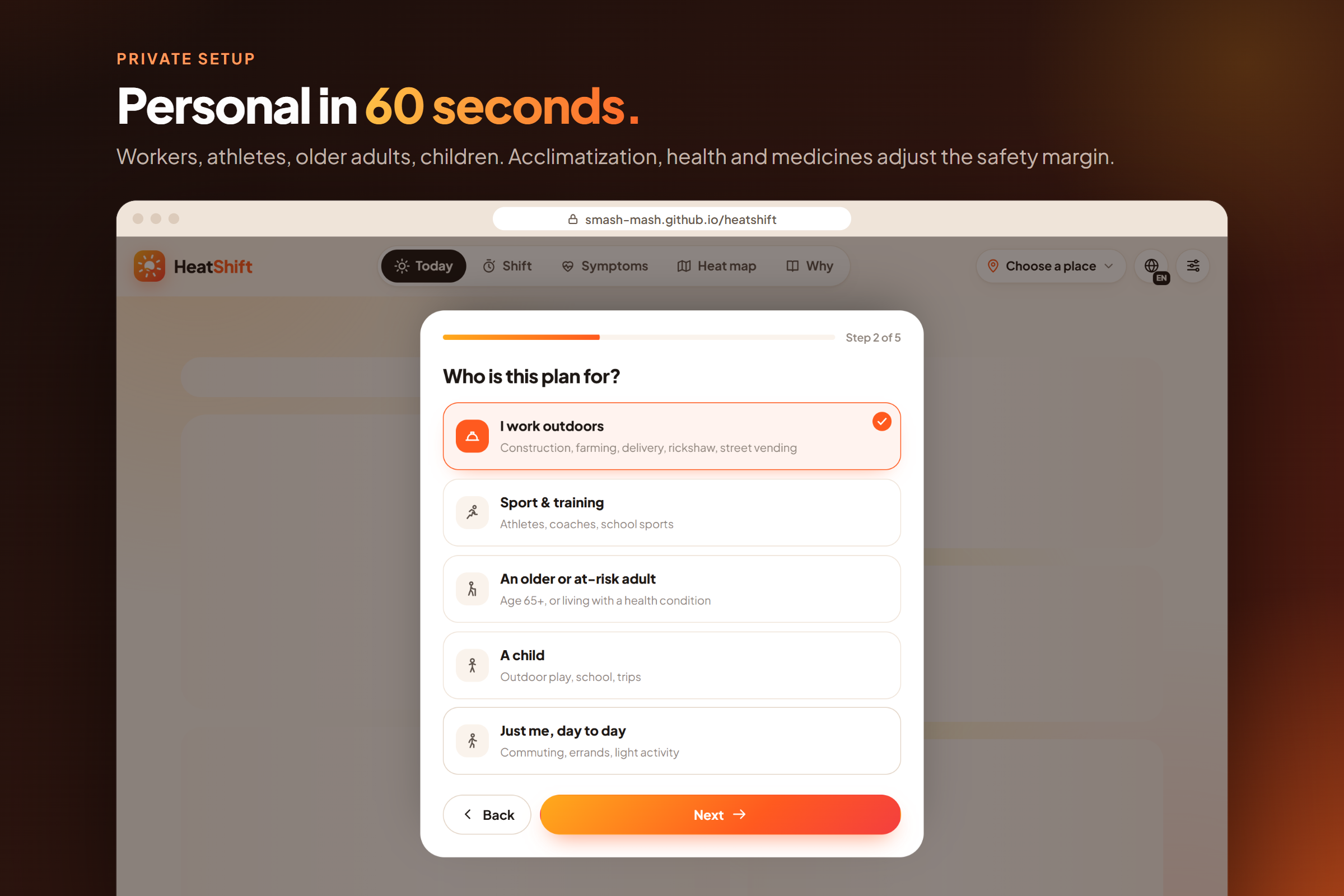
60-second private setup
-
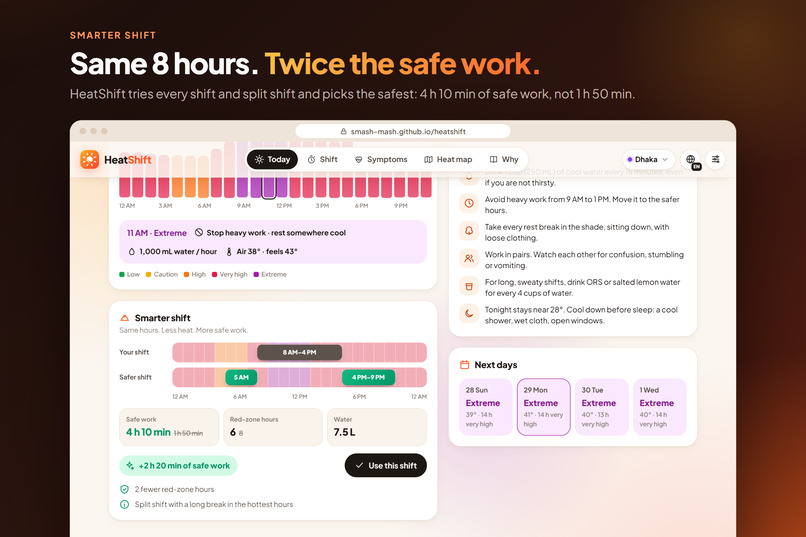
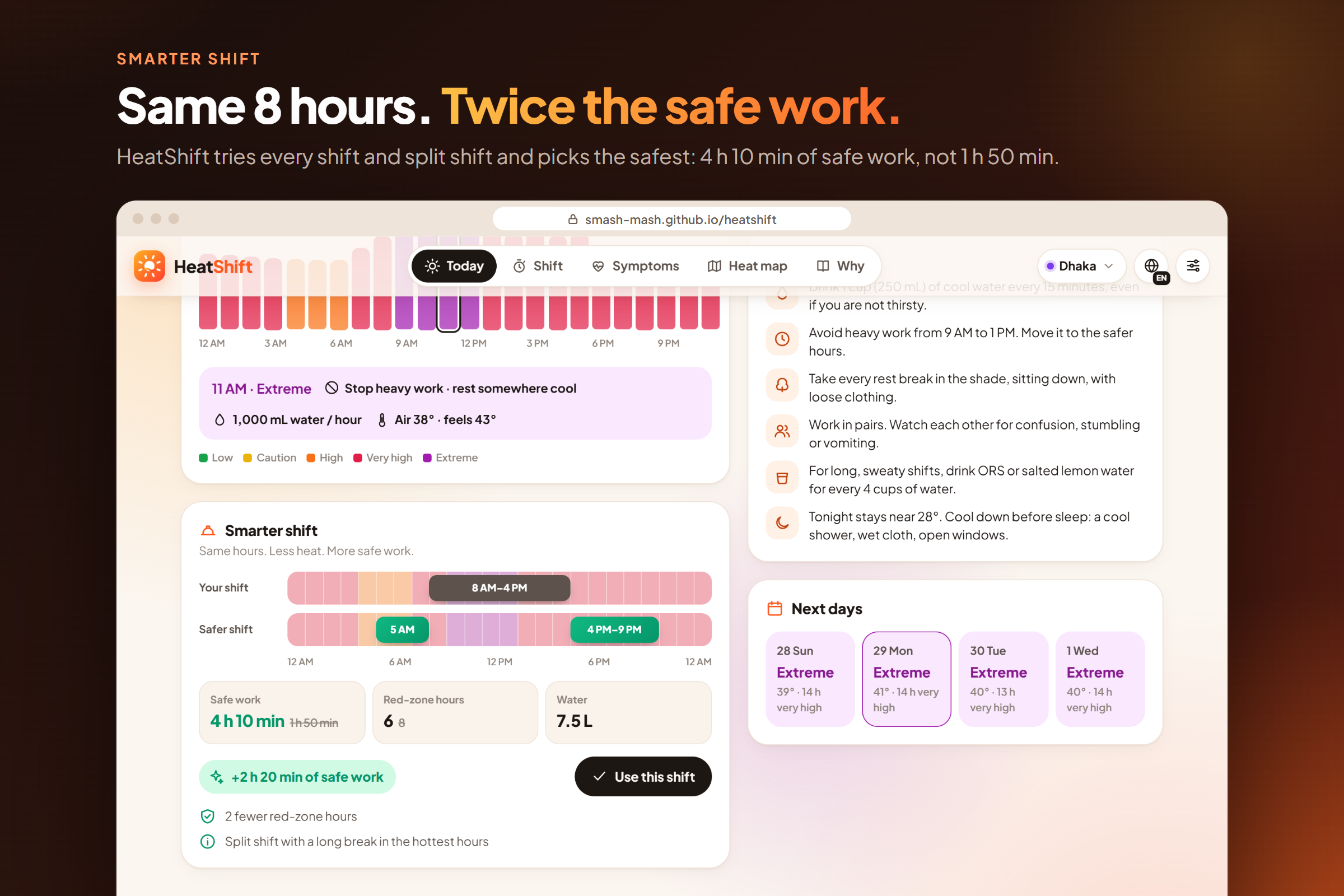
Smarter shift: the same 8 hours, more than twice the safe work
-
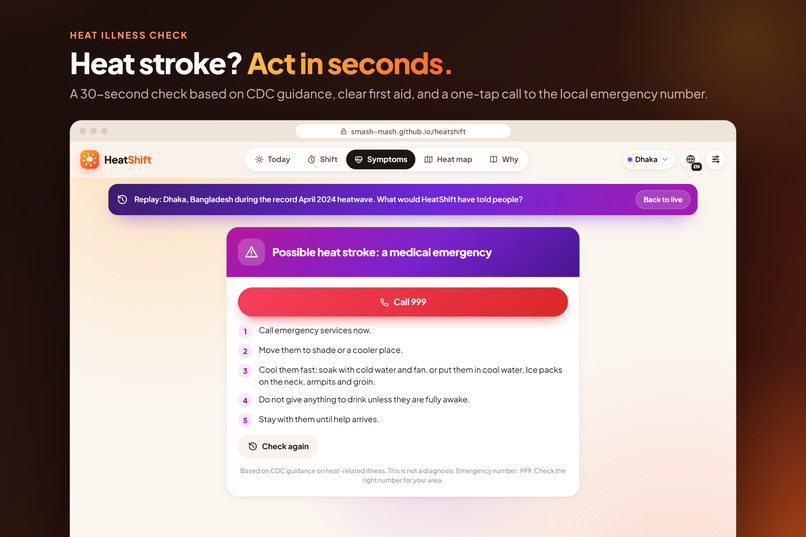
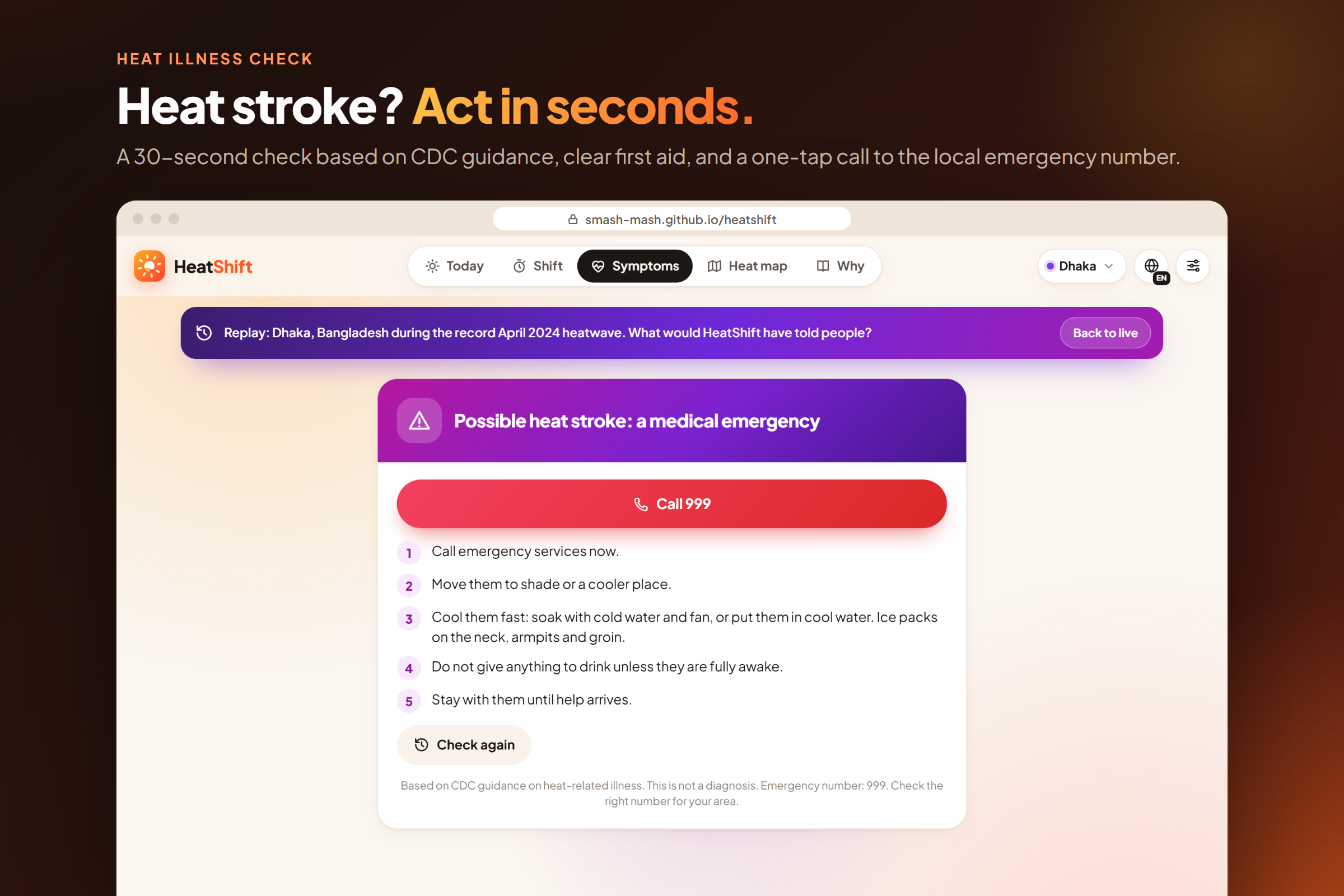
Heat illness check: first aid and a one-tap emergency call
-
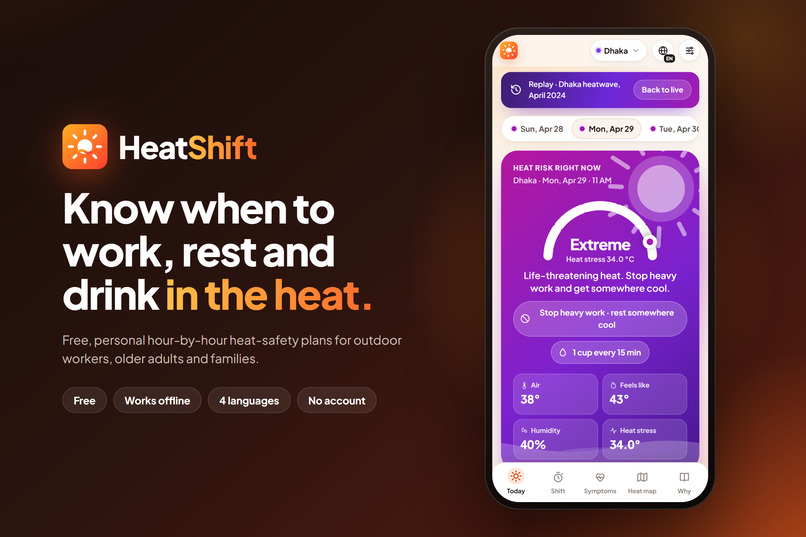
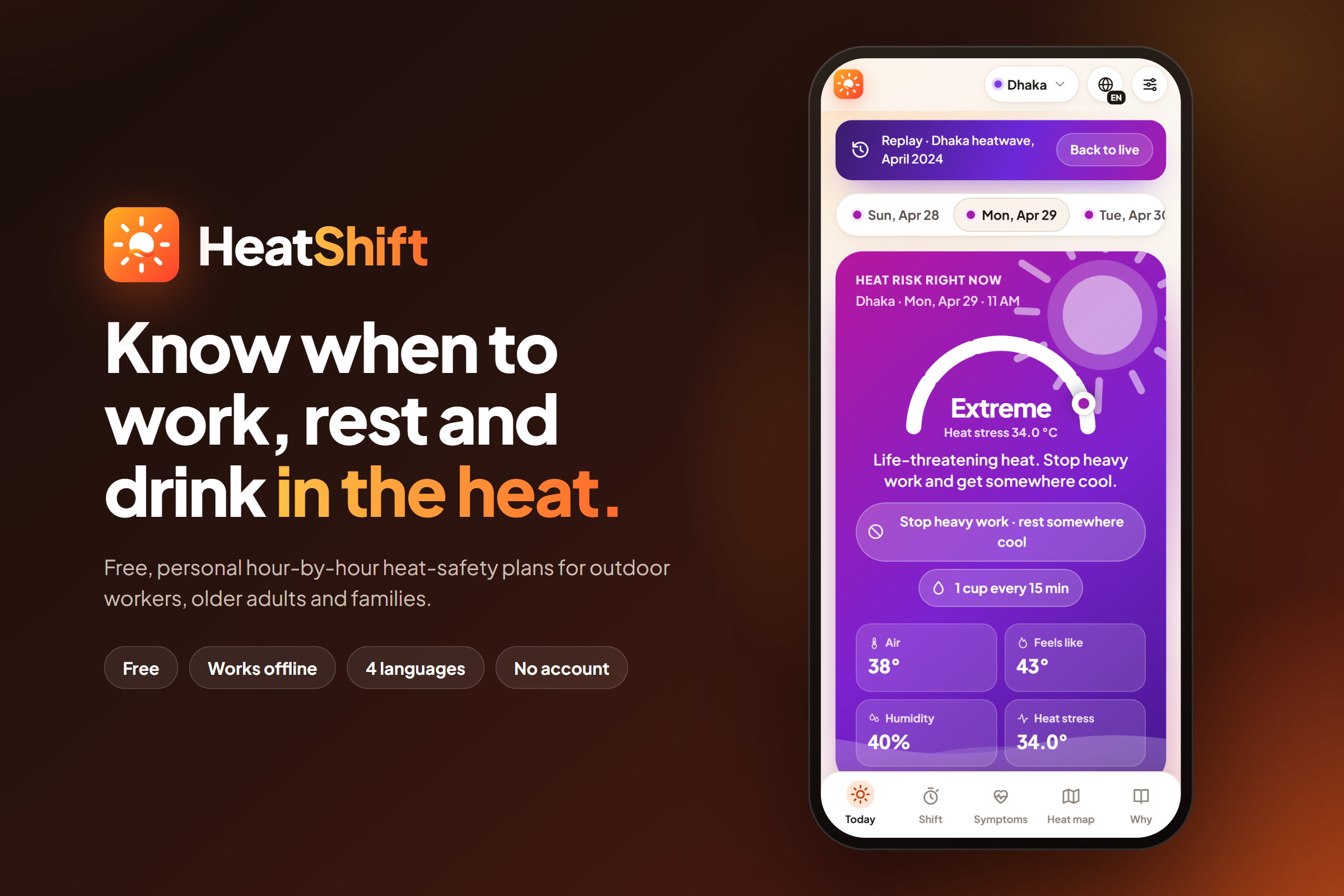
HeatShift: know when to work, rest and drink in the heat
-
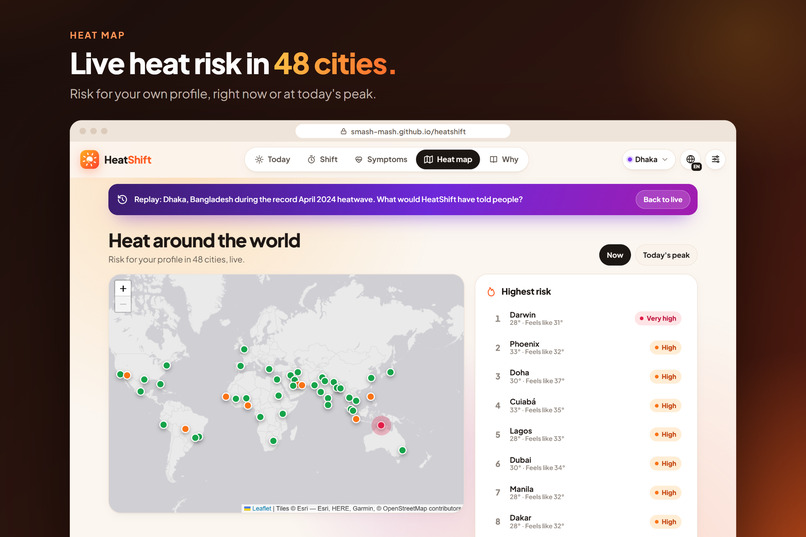
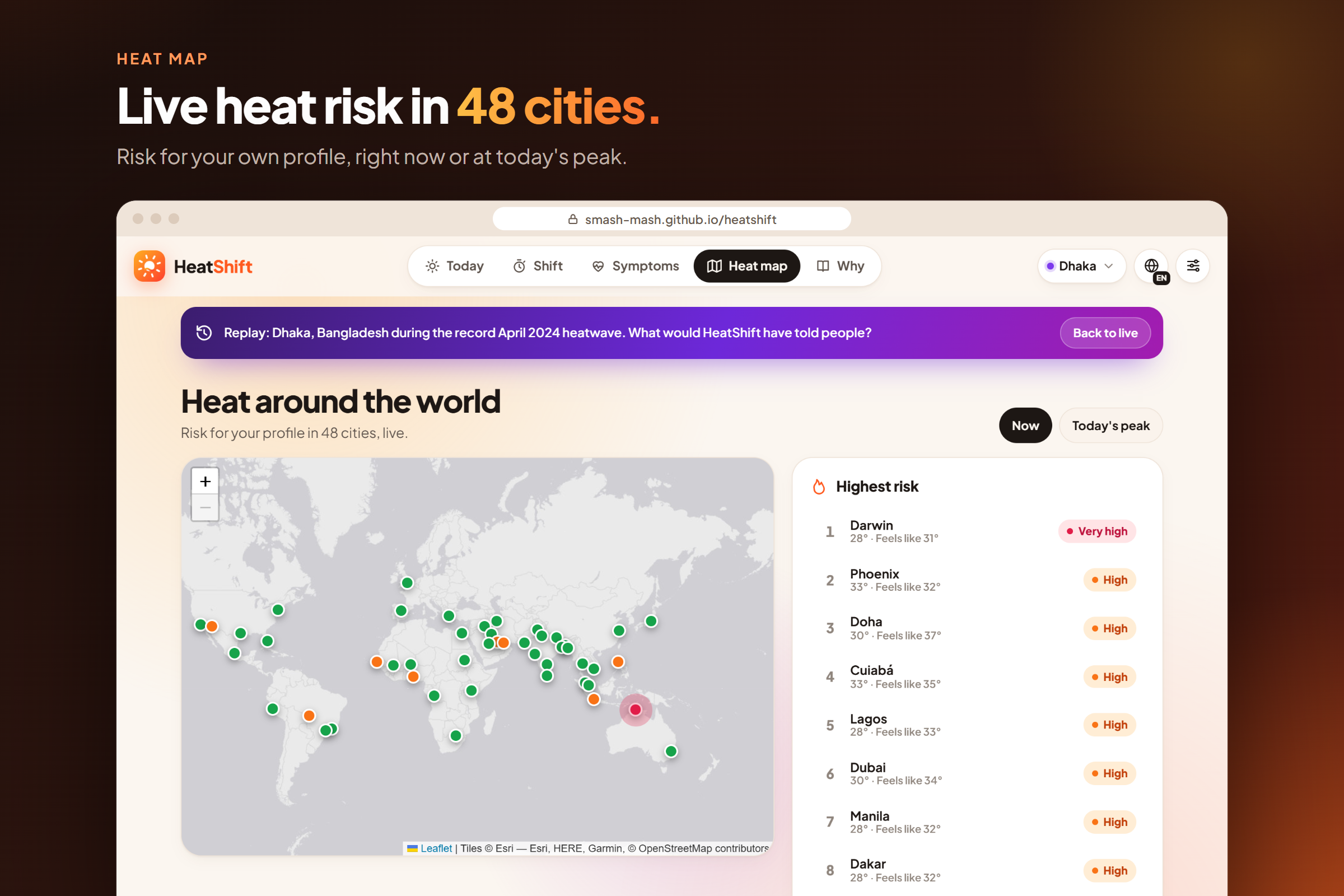
Live heat risk in 48 cities
-
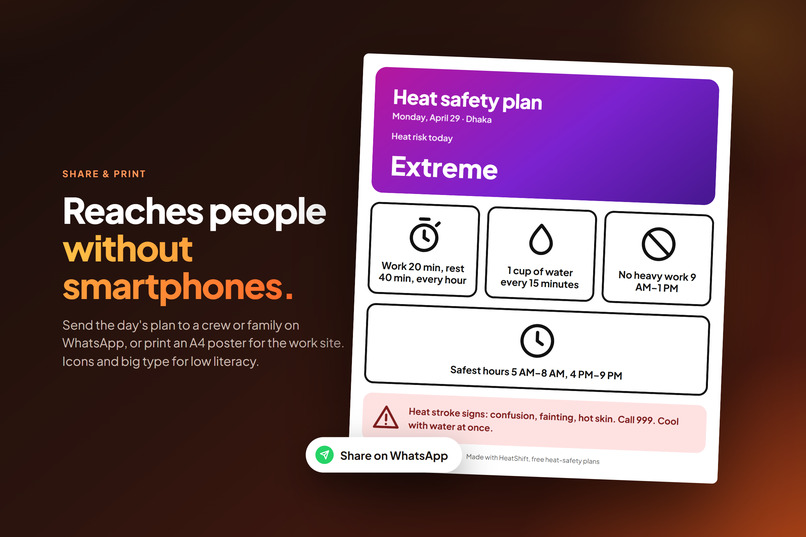
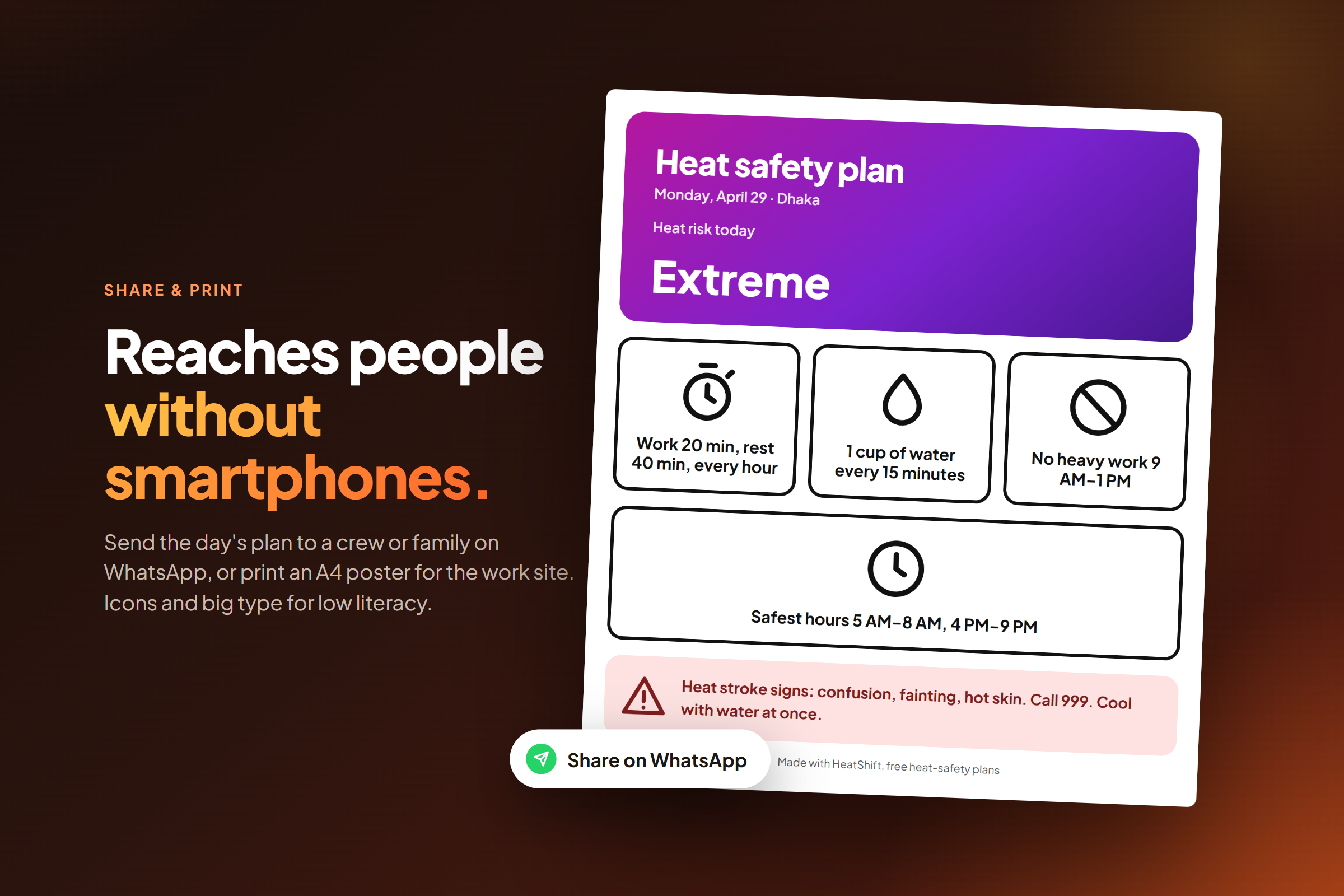
Printable work-site poster and WhatsApp sharing
-
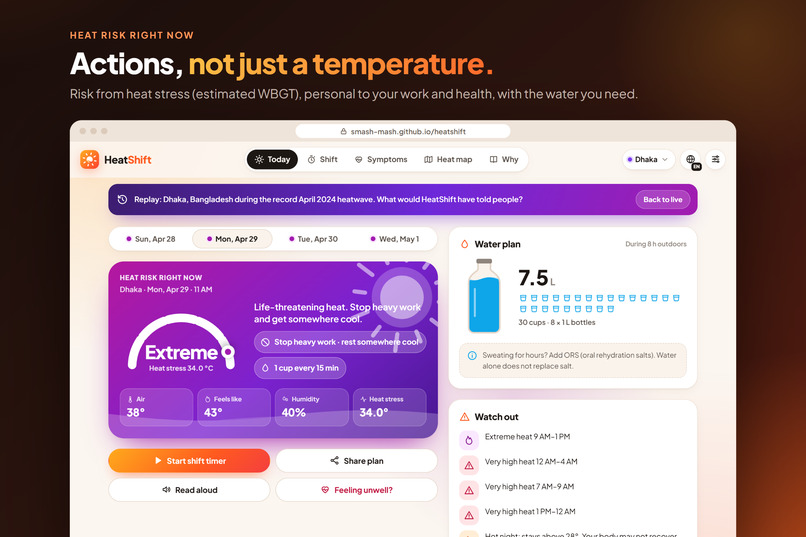
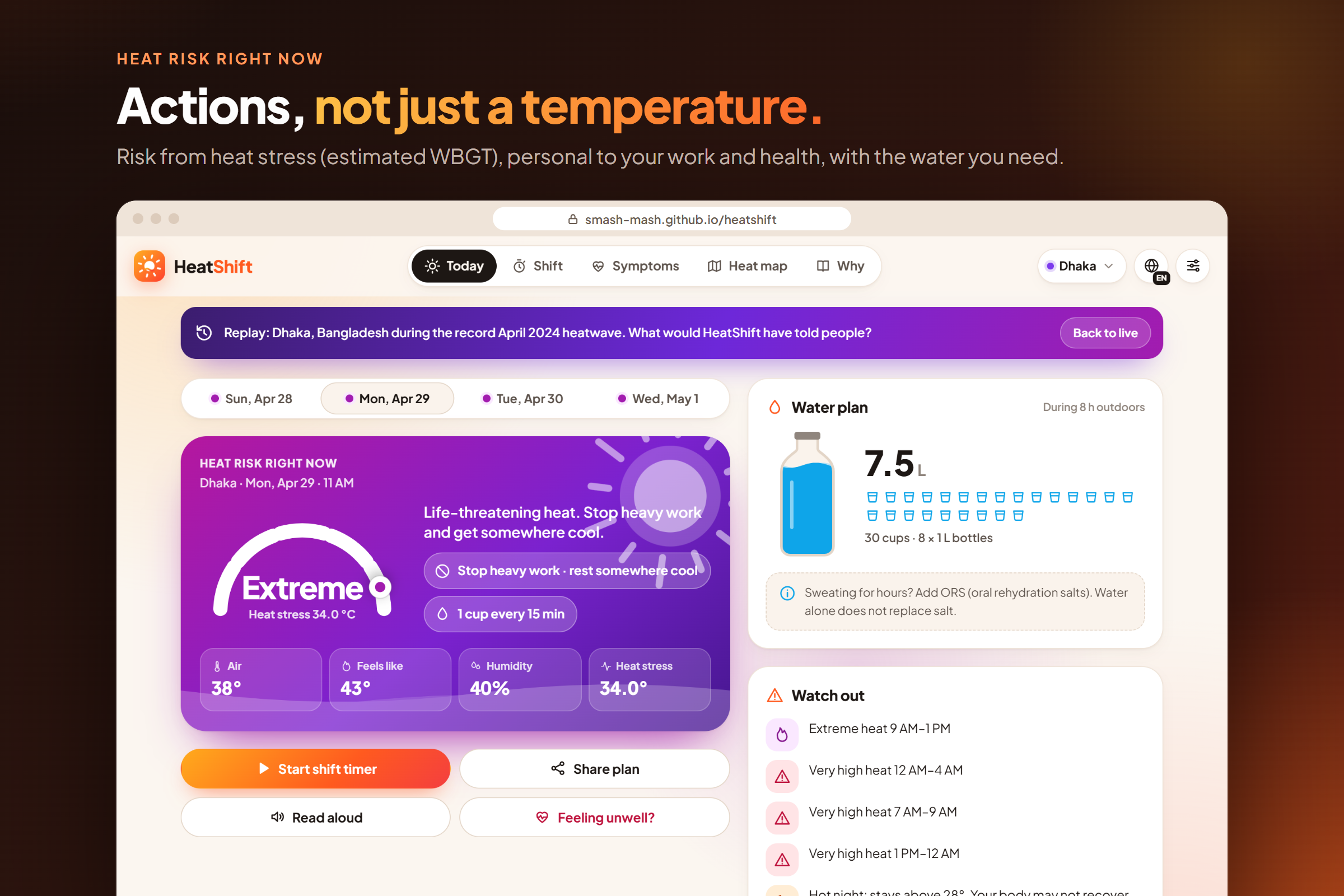
Heat risk right now, shown as actions (Dhaka heatwave replay)
-
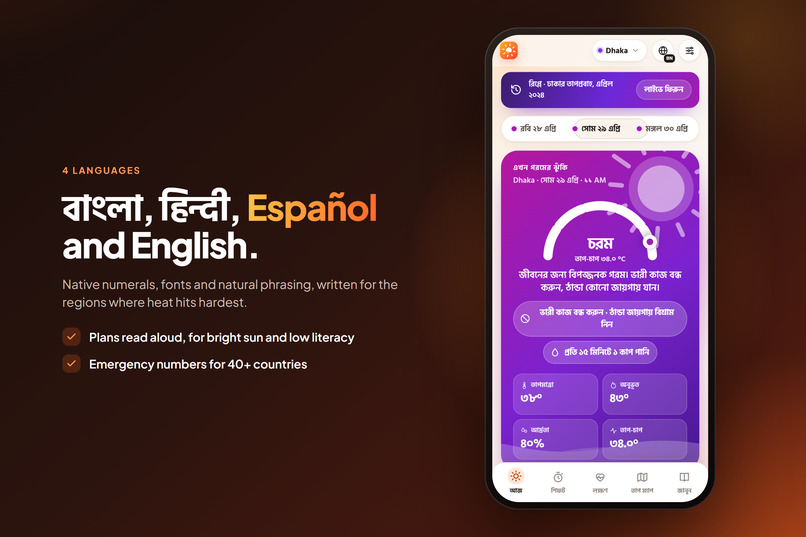
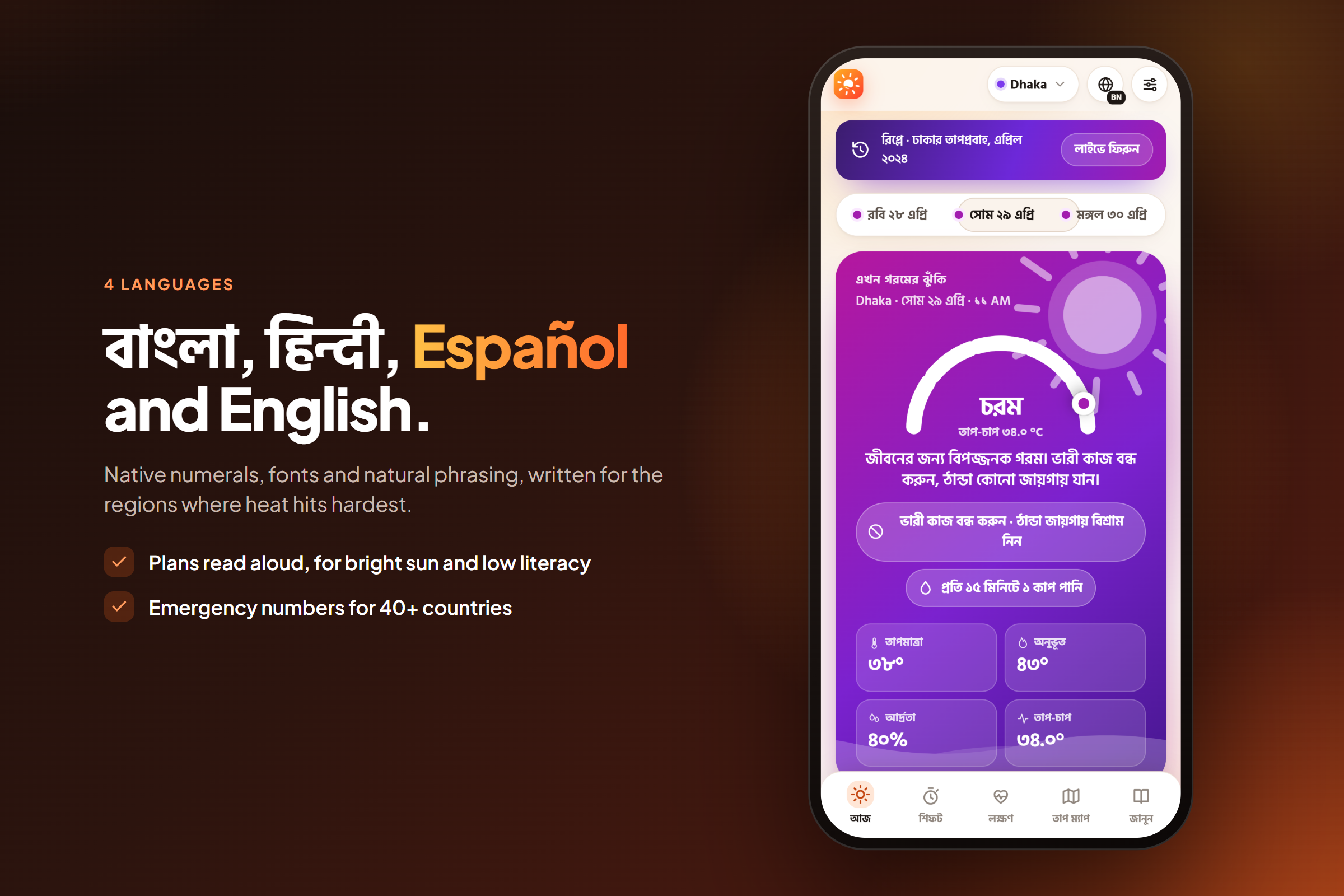
Full Bangla interface (also Hindi, Spanish and English)
-
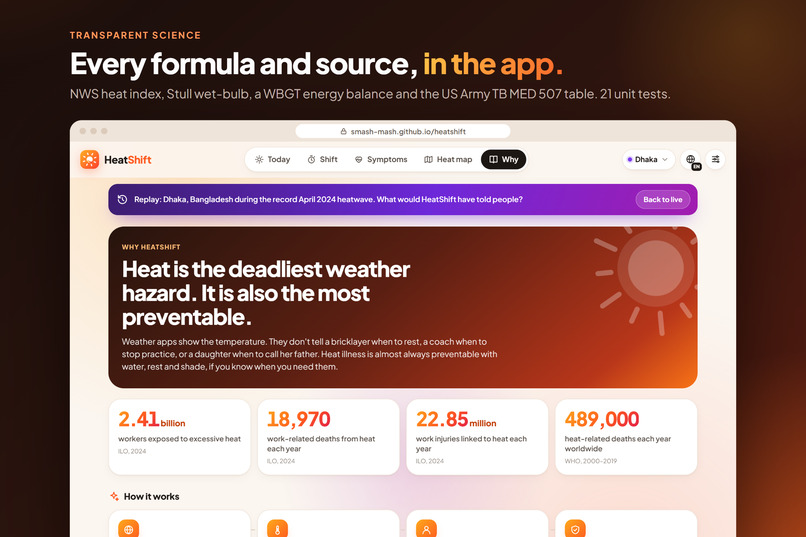
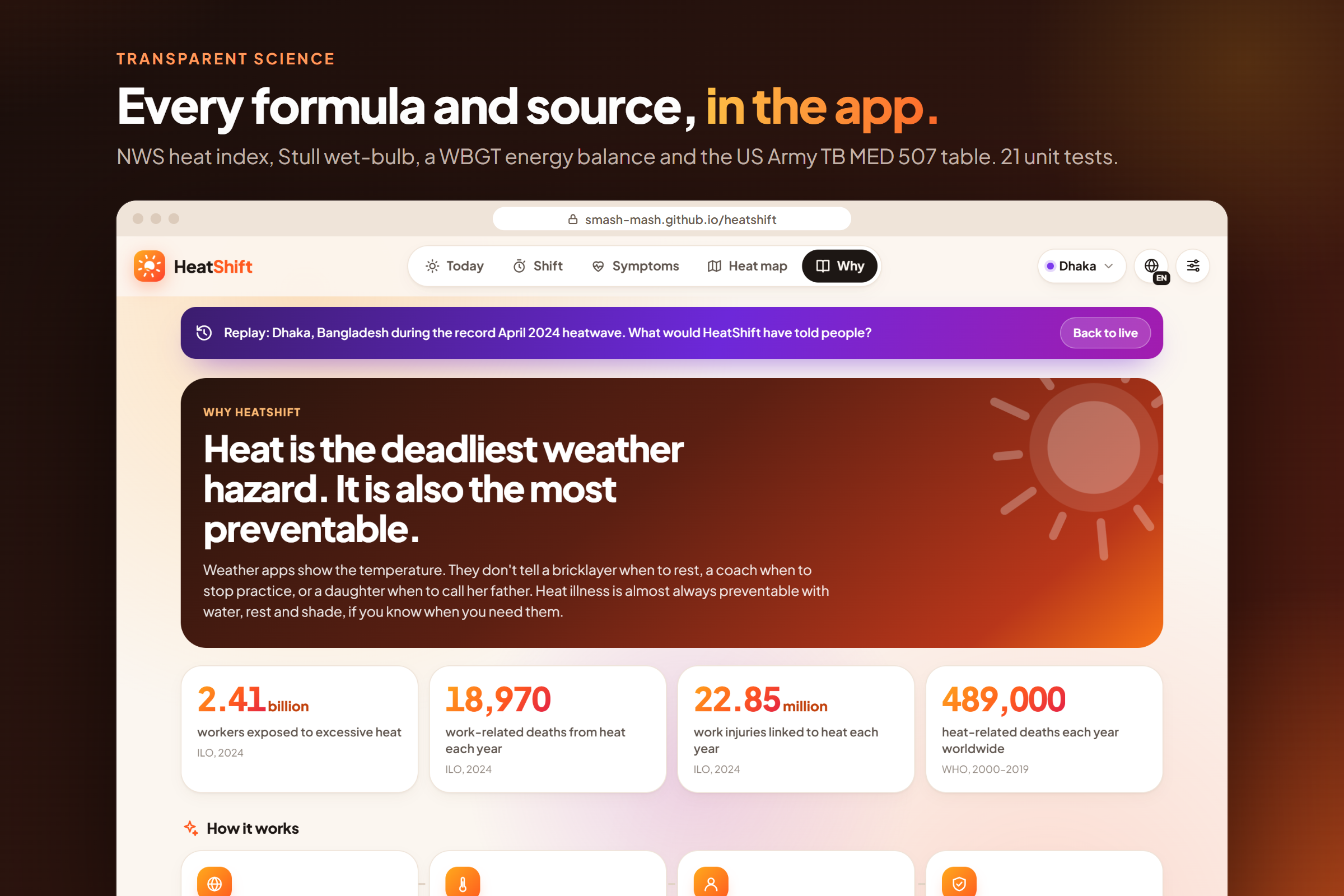
Every formula and source, explained in the app
-
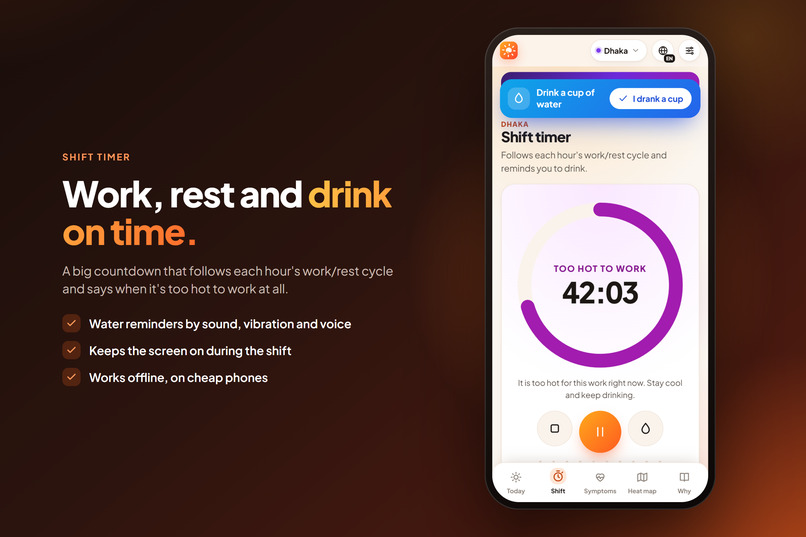
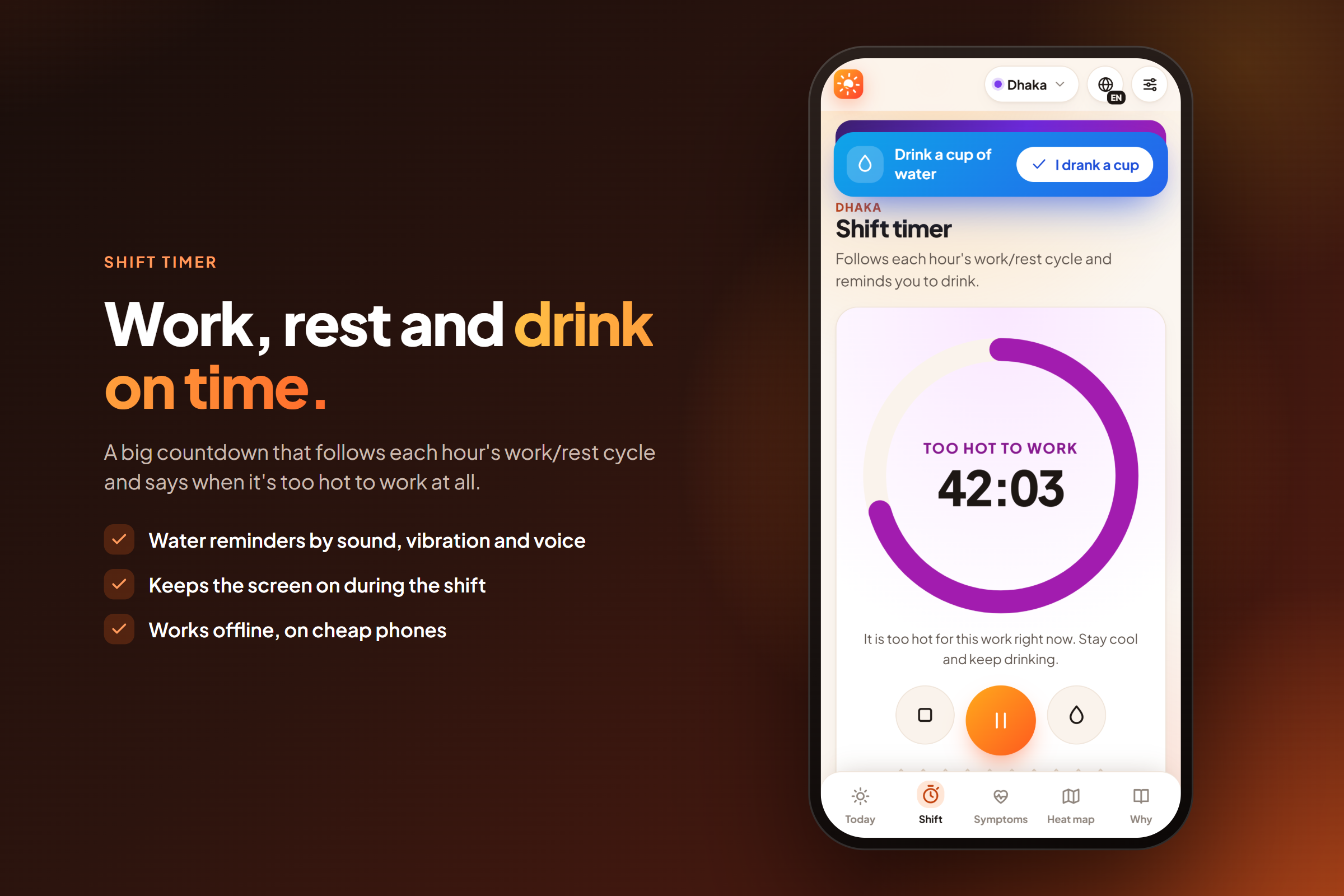
Shift timer with water reminders
Inspiration
In April 2024, Bangladesh lived through its longest heatwave on record. Schools closed for more than 30 million students. But rickshaw pullers, construction crews and farm workers kept working through the hottest hours of the day, because a day without work is a day without pay.
They all had weather apps, and every app said "39 °C". None of them said what actually keeps a person alive: "Rest 40 minutes of every hour between 10 and 2. Drink a cup of water every 15 minutes. If someone is confused, it's heat stroke: call 999 and soak them with water."
This isn't just a Bangladesh problem:
- 2.41 billion workers (70% of the world's workforce) are exposed to excessive heat (ILO, 2024).
- Heat at work causes 22.85 million injuries and 18,970 deaths every year (ILO, 2024).
- About 489,000 people die from heat each year worldwide (WHO, 2000–2019).
Heat illness is almost entirely preventable with water, rest and shade. The missing piece is knowing when, how much and for whom. HeatShift is that piece.
What it does
HeatShift turns the live weather forecast into a personal, hour-by-hour heat-safety plan:
- Your heat risk right now (Low → Extreme), based on heat stress (an estimate of Wet Bulb Globe Temperature, the index used by occupational safety agencies and armies), not just temperature. It accounts for sun vs shade vs indoors, how hard you work, clothing, acclimatization, age, health conditions and medicines.
- Hour by hour: for every hour of the next 4 days, the minutes to work, the minutes to rest in the shade, and how much water to drink.
- Smarter shift: HeatShift searches every possible shift and split shift of the same length and recommends the safest. On 29 April 2024 in Dhaka, moving a heavy 8-hour shift from 8 AM–4 PM to 5–8 AM + 4–9 PM gives more than twice the safe working time in the same number of hours.
- Best time to go out: for older adults, parents and everyone else, the safest window for errands, a walk or children's play.
- Shift timer: a big work/rest countdown with water reminders by sound, vibration and voice.
- Heat illness check: a 30-second check based on CDC guidance that separates heat stroke from exhaustion, cramps and rash. It gives first aid and a one-tap call to the local emergency number (40+ countries).
- Share and print: send the day's plan on WhatsApp or print an A4 poster for a work site, so it reaches people without smartphones.
- Read aloud: the plan is spoken for people who can't read small text in bright sun.
- 4 languages: English, বাংলা, हिन्दी and Español, with native numerals and fonts.
- Heat map: live risk for your profile in 48 cities.
- Heatwave replay: see what HeatShift would have told people during the real April 2024 Dhaka heatwave (bundled data, works offline), or on any past date for any place.
- Private and free: no account, no tracking, no API keys. Your health profile never leaves your phone. It's an installable app that works offline.
How we built it
HeatShift is a zero-dependency progressive web app: plain HTML, CSS and JavaScript modules, with no framework and no build step. It loads fast on cheap phones and slow networks, and costs nothing to host (GitHub Pages).
The science pipeline:
- Live data: an hourly forecast (temperature, humidity, wind, direct and diffuse sunlight) from the free Open-Meteo API for any place on Earth. Replays use its ERA5 historical archive.
- Heat stress: the NWS heat index, and wet-bulb temperature (Stull, 2011). We estimate the black-globe temperature \(T_g\) from a steady-state energy balance of a 150 mm globe, then compute WBGT, separately for sun, shade and indoors:
$$0.95\left(\frac{\mathrm{DNI}}{4} + \frac{D}{2} + \frac{0.2\,\mathrm{GHI}}{2}\right) = \left(13.5\,u^{0.6} + 6\right)\left(T_g - T_a\right)$$
$$\mathrm{WBGT} = 0.7\,T_{nwb} + 0.2\,T_g + 0.1\,T_a$$
- Personal safety margin: the published work/rest tables assume healthy, heat-acclimatized adults. HeatShift adds precautionary degrees for being new to the heat, age, chronic conditions, heat-sensitive medicines, pregnancy and heavy clothing.
- Work/rest and water come from the US Army TB MED 507 table, plus two precautionary categories above it. A wet-bulb temperature of at least 31 °C, near the measured limit of human heat balance (Vecellio et al., 2022), is always Extreme.
- Shift optimizer: an exhaustive search over continuous and split shifts between 05:00 and 21:00. It maximizes safe working minutes, then minimizes hours in the red zone.
The experience was designed for a rickshaw puller's phone, not a designer's laptop:
- mobile-first, big tap targets, color-coded levels and icons for low literacy
- built and tested on a 2-core laptop: every animation moves only
transform/opacity, uses the View Transitions API, and respects reduced-motion settings
Quality: 21 unit tests check the formulas against published reference values (NWS heat index chart, Stull's worked example, TB MED 507 rows) and run against real ERA5 data from the 2024 Dhaka heatwave.
Challenges we ran into
- Estimating WBGT without a sensor. Real WBGT needs a black-globe thermometer on site. We built a physically based estimate from forecast sunlight and wind, then checked that it behaves sensibly: sun is worse than shade, which is worse than indoors; wind cools; and midday in Dhaka in April 2024 comes out as Extreme.
- Turning science into one sentence. "WBGT 33.4 °C, category 5" helps no one. "Work 10 min · rest 50 min · 1 cup every 15 min" does.
- Not everyone works. Shift advice is meaningless for an 80-year-old at home, so HeatShift switches to home risk plus best time to go out.
- Time zones at midnight. The forecast API sometimes still serves "yesterday" just after local midnight, so we fetch an extra day and trim to the location's local "today".
- Smooth on a weak laptop. Rich animation without dropping frames on a 2-core machine, including recording the demo video on it.
- Language. Bangla and Hindi need their own fonts, numerals and natural phrasing, and the safety wording had to stay medically accurate.
Accomplishments that we're proud of
- A complete, working product, not a mockup: live data for any place on Earth, offline mode, 4 languages, installable.
- The smarter shift, which turns heat safety from a cost into a win: more safe work in the same hours.
- The heatwave replay, which shows what HeatShift would have told people in Dhaka in April 2024.
- Transparent science: every formula and source is on the in-app Why page, and the core is unit-tested.
What we learned
- Humidity can matter as much as temperature. 33 °C in humid Dhaka can be more dangerous than 40 °C in dry air, which is why WBGT and wet-bulb matter more than "feels like".
- Acclimatization is critical. OSHA notes that 50–70% of outdoor heat deaths happen in a worker's first few days in the heat. That's why HeatShift asks "are you used to this heat?" and suggests ramping up 20% a day.
- Night heat matters. When nights stay above about 26–28 °C the body can't recover, so HeatShift warns about hot nights.
What's next for HeatShift
- People without smartphones: an SMS and voice-call line that reads the day's plan in Bangla or Hindi each morning.
- Partners: pilots with worker unions, NGOs and city heat officers, plus a crew dashboard for site managers.
- Validation against on-site WBGT meters, calibrated per region.
- Push alerts the evening before an extreme day ("start at 5 AM tomorrow").
- More languages: Urdu, Arabic, Swahili, Tagalog and Portuguese.
Built With
- bigdatacloud
- css3
- esri
- ffmpeg
- github
- html5
- javascript
- leaflet.js
- node.js
- open-meteo
- playwright
- progressive-web-app
- service-worker
- view-transitions-api
- wake-lock-api
- web-audio-api
- web-share-api
- web-speech-api

Log in or sign up for Devpost to join the conversation.