-
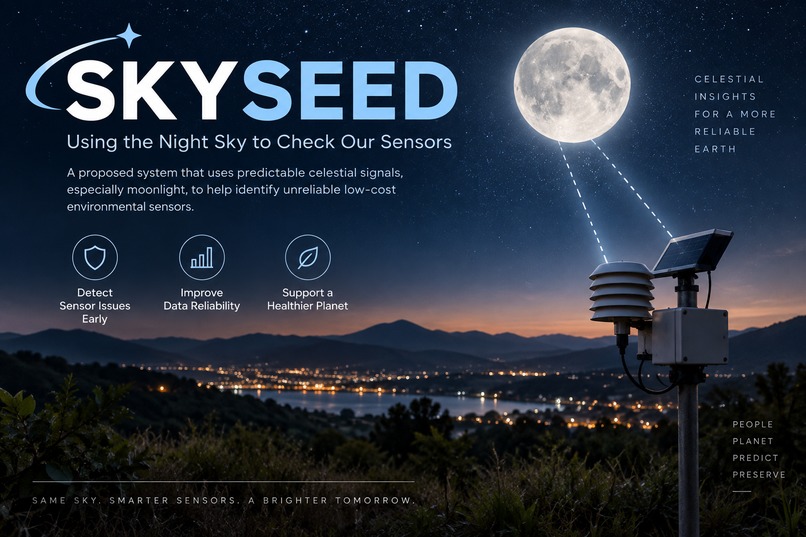
SKYSEED overview
-
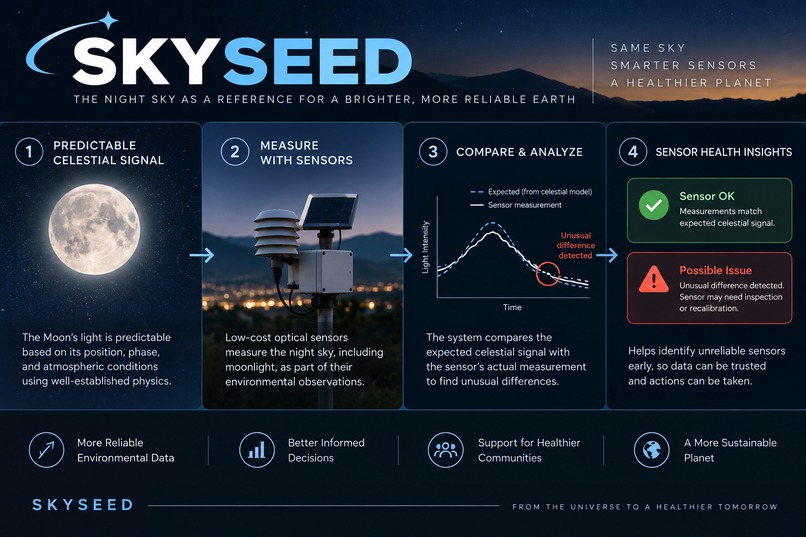
working
-
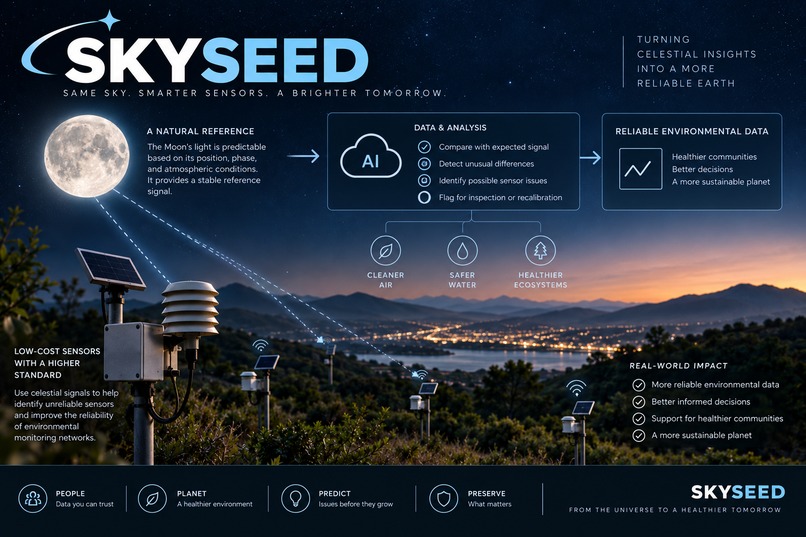
technology
-
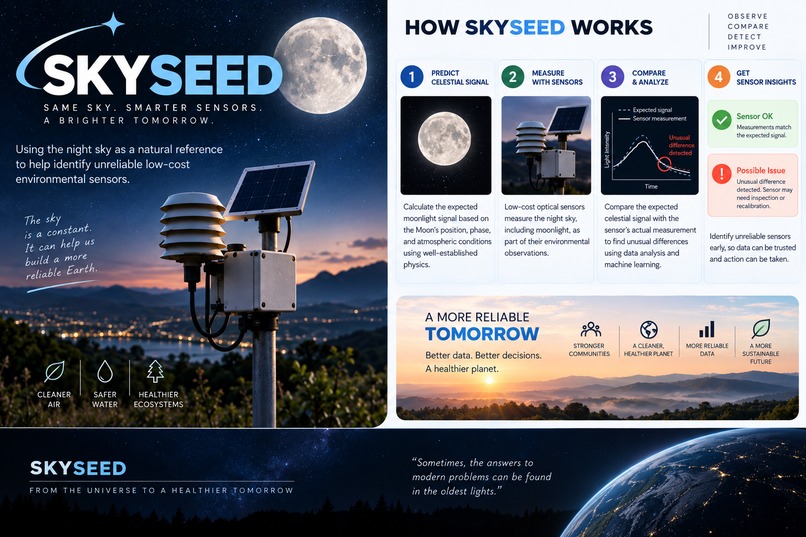
social impact
Inspiration
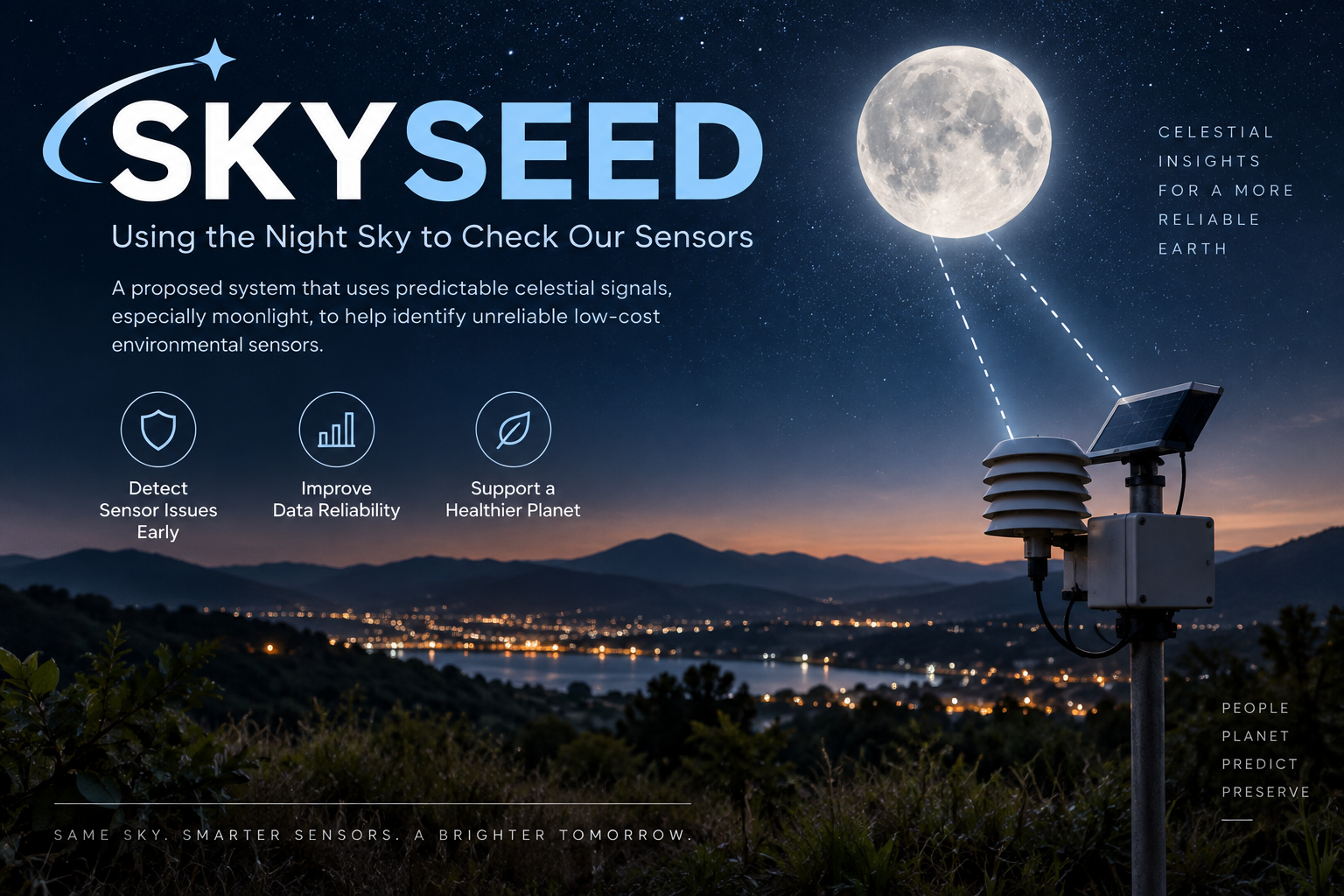
The idea for SKYSEED started from something I found interesting while learning about astronomy and sensors. We usually think of the night sky as something we observe, but I started wondering if predictable things in the sky could also help us check the technology we use on Earth.
Low-cost sensors are useful because they make environmental monitoring cheaper and easier to deploy. However, sensors can become less reliable over time because of aging, dust, damage, or changes in their surroundings. This made me think: could a predictable signal from the sky help us notice when a sensor is starting to give unreliable readings?
The Moon was especially interesting to us because its position and phases can be predicted. This led us to the idea of using celestial observations as an additional reference for checking sensor health.
While exploring this idea, we also came across research on using the Moon for sensor and satellite calibration. That research showed us that the Moon can be used as a stable reference for measuring instruments. Instead of trying to repeat that work, we became interested in a different question: could the same basic idea be used to help detect problems in networks of low-cost sensors?
That question became the starting point for SKYSEED.
What it does
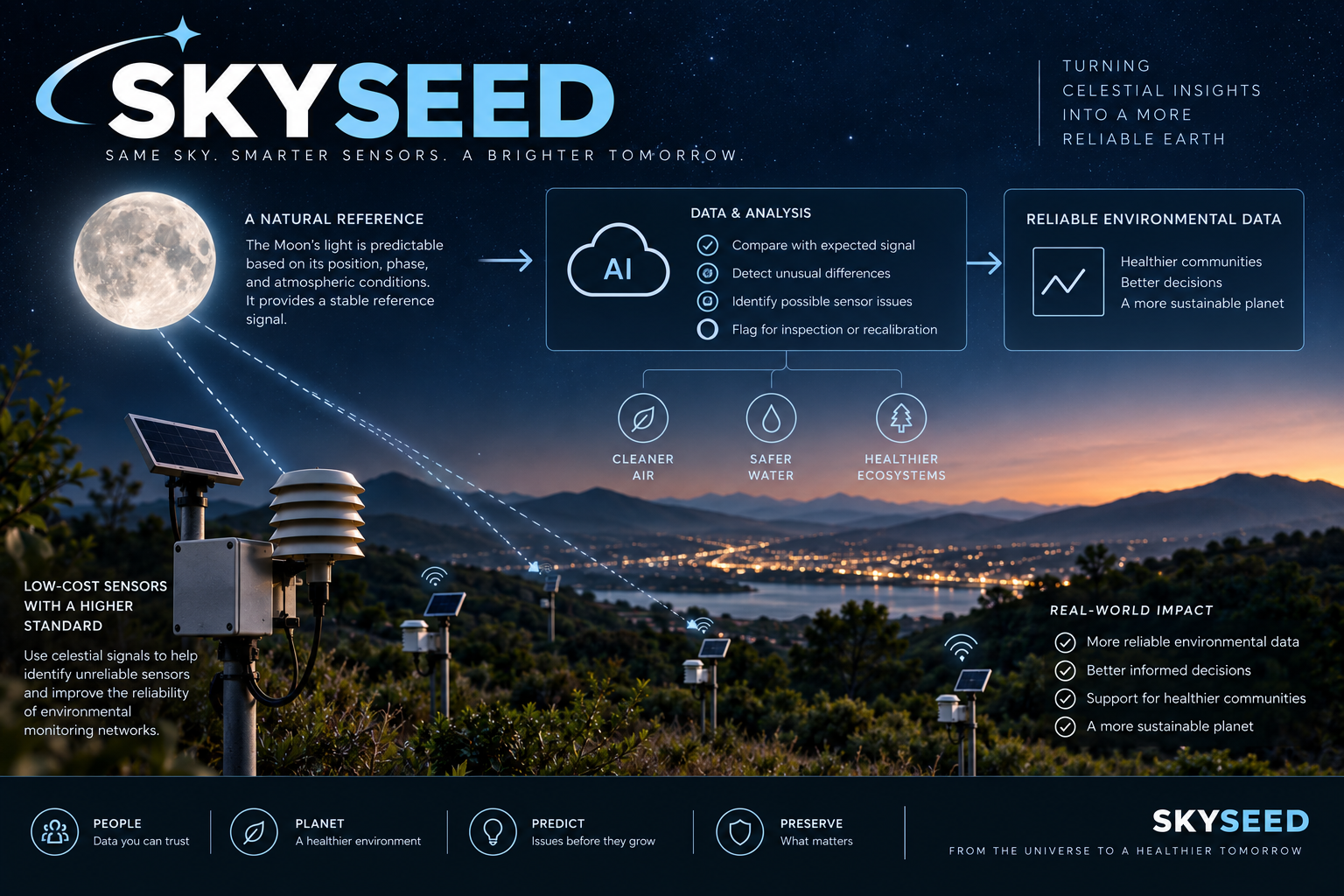
SKYSEED is a concept for a low-cost sensor network that can check the reliability of its own measurements using predictable signals from the night sky.
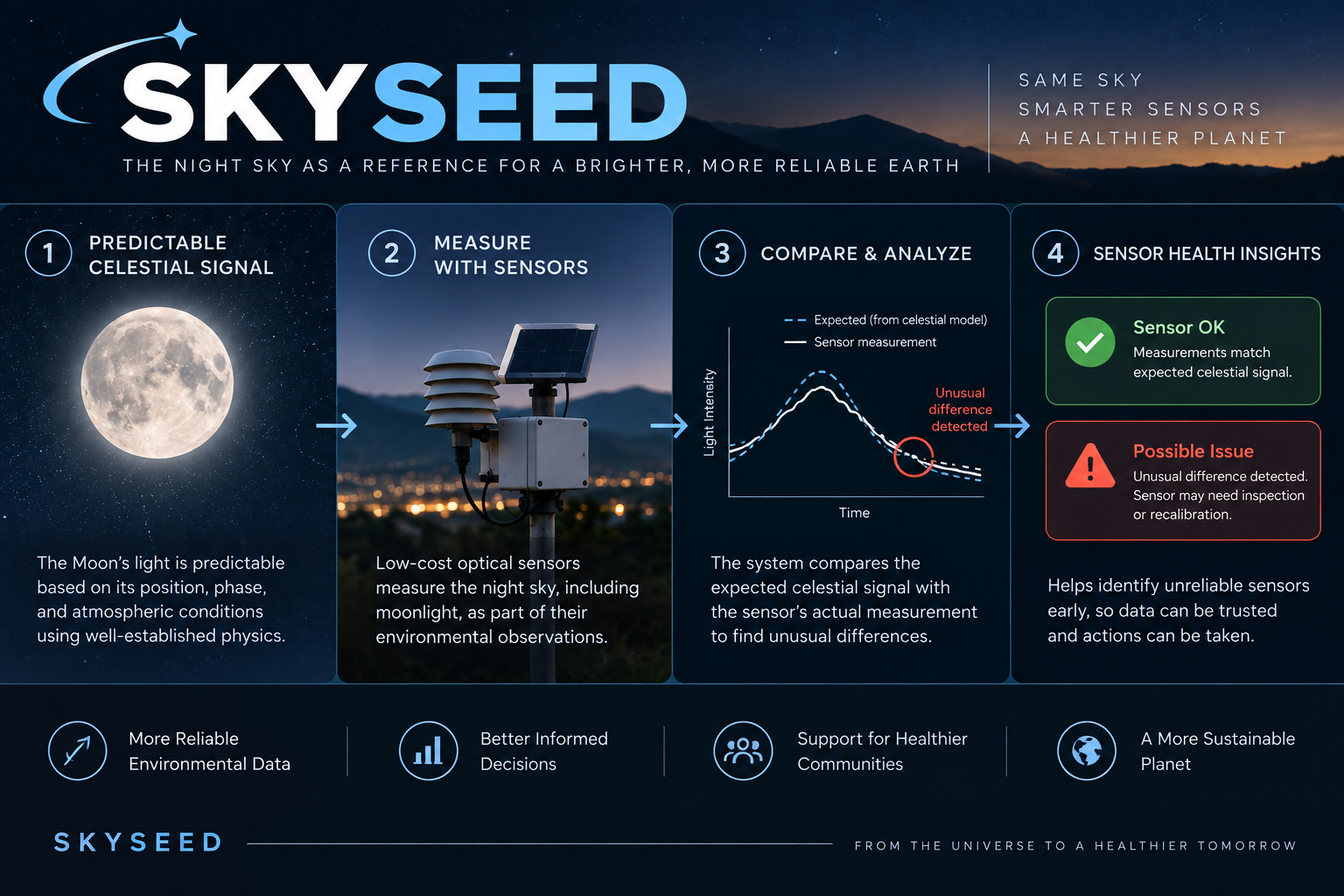
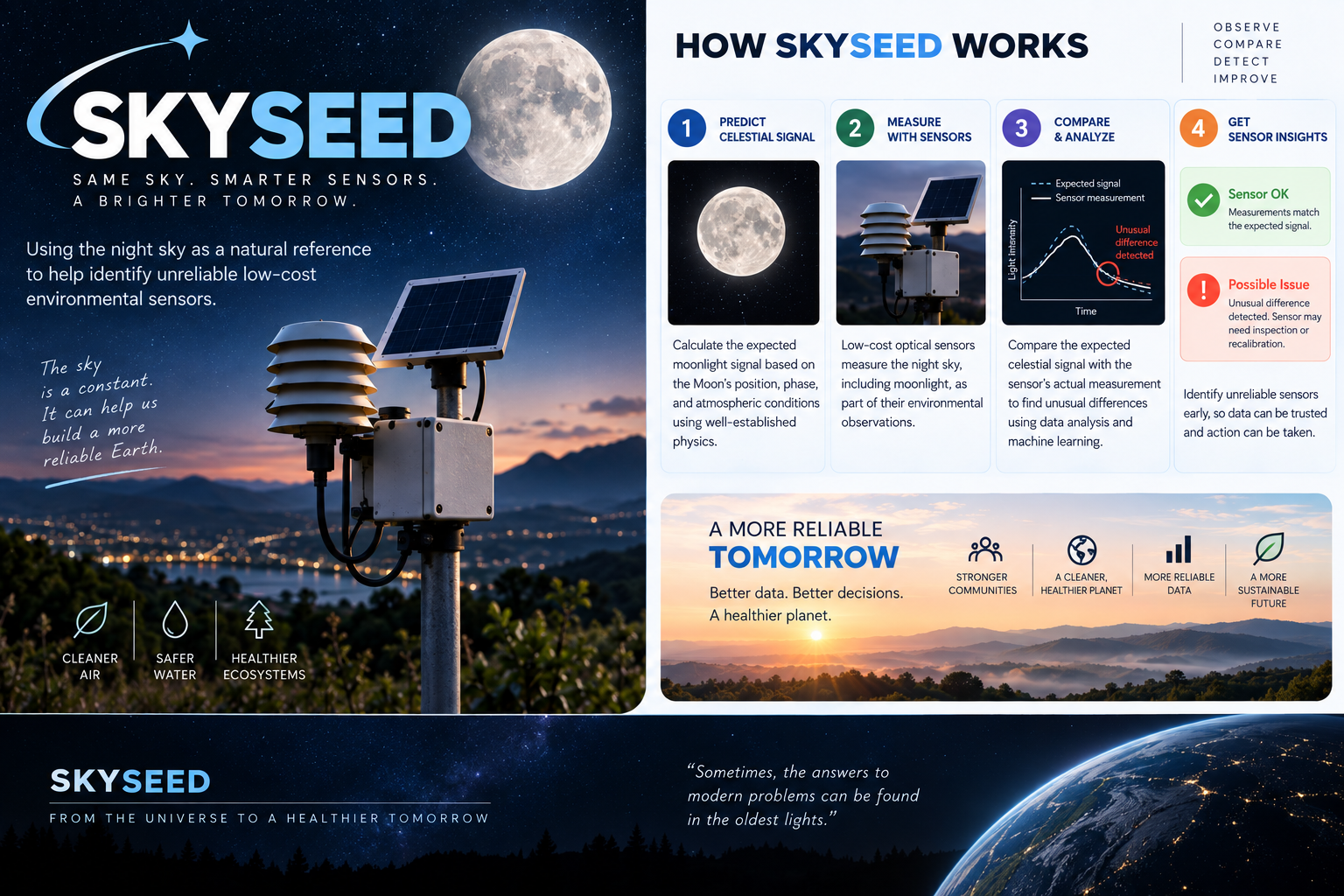
The basic idea is simple. A sensor observes a celestial signal and compares what it measures with what would normally be expected. If the difference becomes unusual or continues to increase, the system could flag that sensor for further checking.
For example, a sensor might slowly become less sensitive because of aging or damage. Instead of waiting until someone manually discovers the problem, SKYSEED could potentially identify that something has changed.
The system would not replace proper laboratory calibration. It would act more like an additional warning system that helps identify sensors that may need attention.
How we built it
SKYSEED is currently an ideathon concept, so we did not build a working prototype.
We developed the idea by combining astronomy, physics, optical sensing, and data analysis. We looked at how the position and illumination of the Moon can be predicted and how an optical sensor could respond to a known light source.
A possible future system could work like this:
Celestial Observation
        ↓
Expected Celestial Signal
        ↓
Sensor Measurement
        ↓
Compare Expected and Observed
        ↓
Analyze the Difference
        ↓
Check for Possible Sensor Drift
        ↓
Sensor Health Alert
A simple way to represent the difference would be: $$ E = |S_{observed} - S_{expected}| $$ where $$S_{observed}$$ is what the sensor measures and $$S_{expected}$$ is the expected signal. This is only a simplified model. A real system would need to consider clouds, atmospheric conditions, artificial light, sensor angle, sensor type, and other factors.
Challenges we ran into
The biggest challenge was realizing that the sensor does not observe the Moon in a perfectly controlled environment. For example, clouds could reduce the measured light even if the sensor is working perfectly. Dust, humidity, atmospheric scattering, nearby lights, and changes in the sensor itself could also affect the result. This means that simply finding a difference between expected and observed light would not be enough to say that a sensor is broken. Because of this, we had to think about how SKYSEED could separate changes caused by the environment from changes caused by the sensor. Another challenge was making sure that our idea was actually different from existing lunar calibration research. We found that using the Moon as a reference for instrument calibration is already an established area of research. That helped us change our focus from calibrating a sensor with the Moon to exploring whether celestial observations could help a distributed network detect sensors whose measurements are becoming unreliable.
Accomplishments that we're proud of
We are proud that the idea started from a simple question and developed into a connection between astronomy and a real technology problem. We also like that SKYSEED does not require expensive astronomical equipment in its basic concept. A future version could investigate whether relatively inexpensive optical sensors could be used. Most importantly, we did not want to stop at an interesting astronomy idea. We tried to think about how the idea could solve a practical problem and what would need to be tested before it could actually work.
What we learned
We learned that research is often about asking a better question rather than simply finding a new technology. At first, using the Moon as a reference sounded like the main idea. After looking at existing research, we realized that this part was already being studied. Instead of ignoring that research, we used it to ask a different question about sensor networks and reliability. We also learned that physics can connect ideas that seem unrelated at first. Astronomy gives us predictable celestial signals, while physics helps us understand light and measurement. Technology can then be used to collect and analyze the data. This experience also taught us that an idea should be honest about its limitations. SKYSEED is not a finished solution yet, and testing it would be an important part of finding out whether it actually works.
What's next for SKYSEED
The next step would be to test the idea with real sensor measurements. We could start with a controlled experiment where an optical sensor observes the Moon under different conditions. We could record measurements over time and compare them with an astronomical model. After that, we could introduce controlled changes to a sensor and see whether SKYSEED can distinguish those changes from normal environmental variation.
We could eventually expand the idea to multiple sensors:
        Celestial Reference
                ↓
       ┌────────┼────────┐
       ↓        ↓        ↓
    Sensor A  Sensor B  Sensor C
       ↓        ↓        ↓
       └────────┼────────┘
                ↓
       Compare Sensor Data
                ↓
        Sensor Health Check
                ↓
      Identify Possible Drift
If the results are promising, SKYSEED could be explored as a way to improve the reliability of low-cost environmental sensor networks.
Built With
- astronomy
- celestial-observation
- computational-astronomy
- computer-vision
- data-analysis
- environmental-monitoring
- machine-learning
- optical-sensing
- physics
- sensor-calibration
- sensor-networks
- signal-analysis


Log in or sign up for Devpost to join the conversation.