Inspiration
Heat and poor air quality can affect decisions about when, where, and how long people spend time outdoors. We wanted to explore a simple question: Could a lightweight tool bring several exposure factors together and make the situation easier for someone to understand before starting an activity?
That idea became HeatSafe, a climate-health exposure planner built for the Health in Climate 2026 NYC Hackathon.
The goal was not to create a medical diagnostic system. Instead, we wanted to build an understandable planning aid that considers heat, air quality, activity, exposure duration, and vulnerability together.
What it does
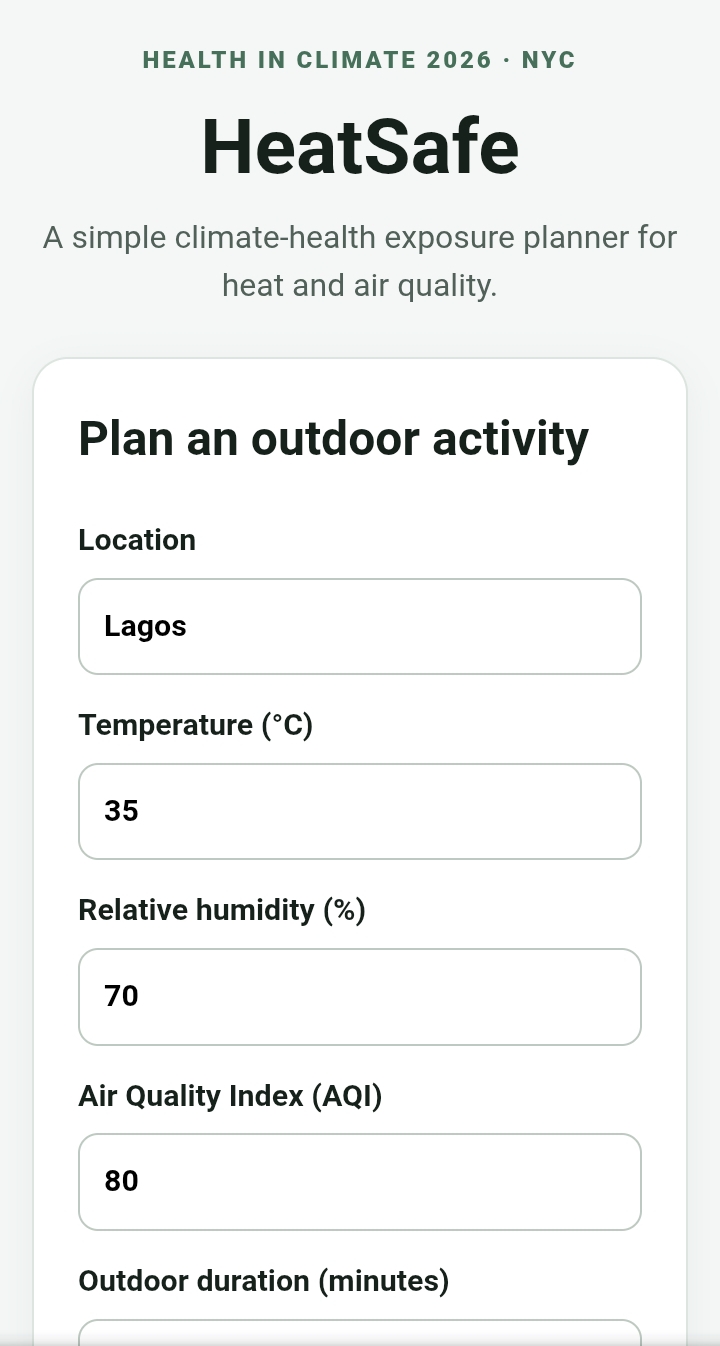
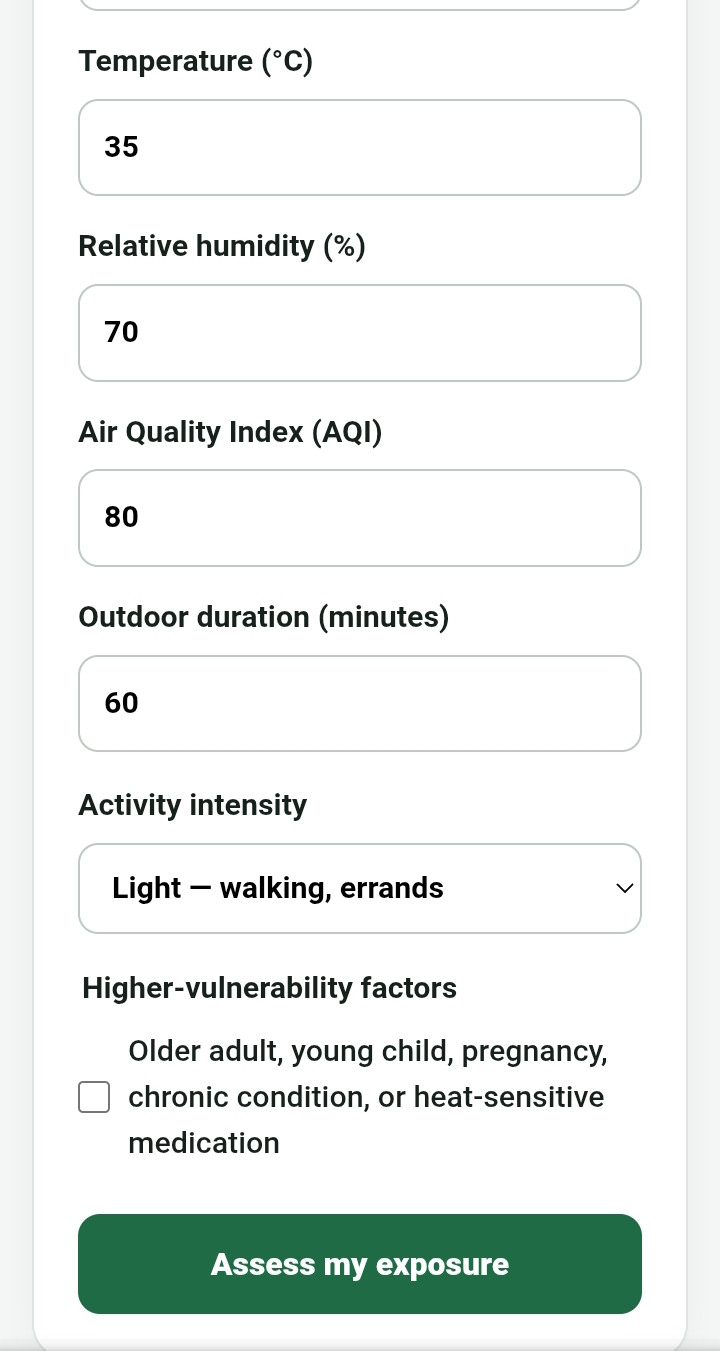
HeatSafe lets a user enter:
- Location
- Temperature
- Humidity
- Air Quality Index (AQI)
- Planned exposure duration
- Activity intensity
- A higher-vulnerability factor
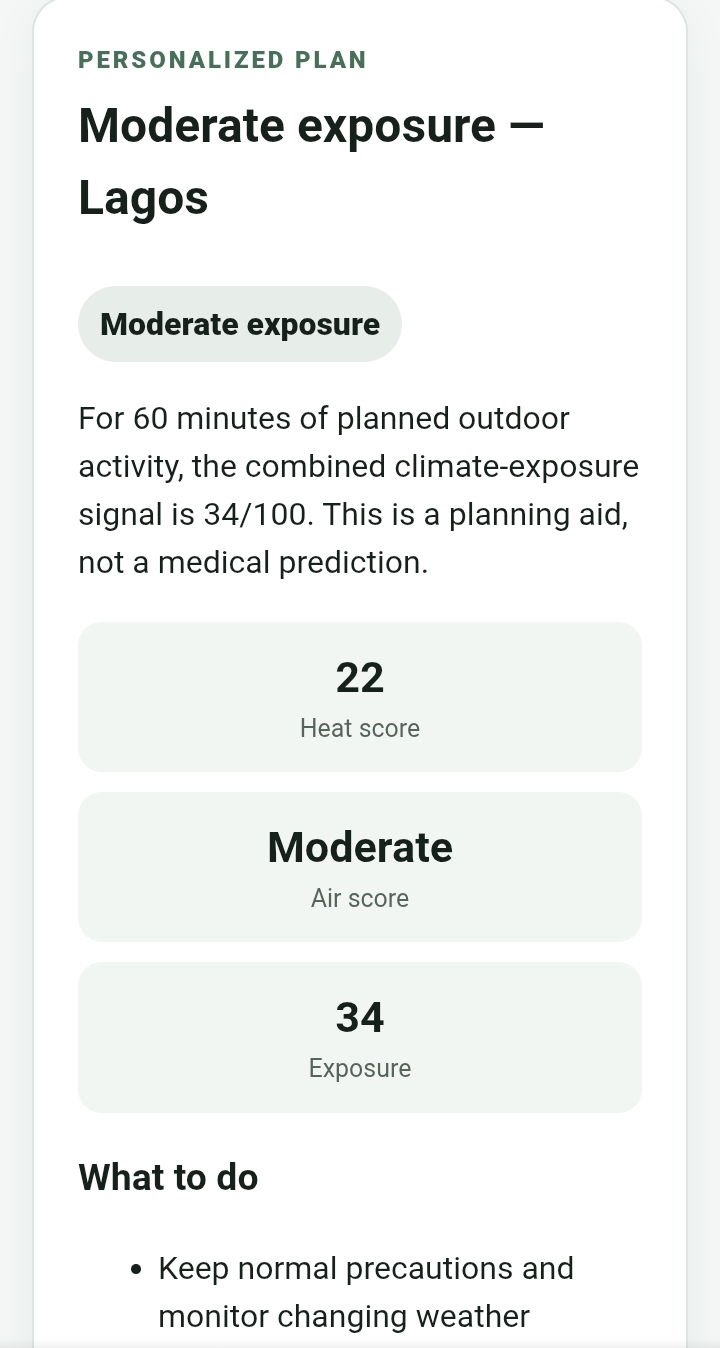
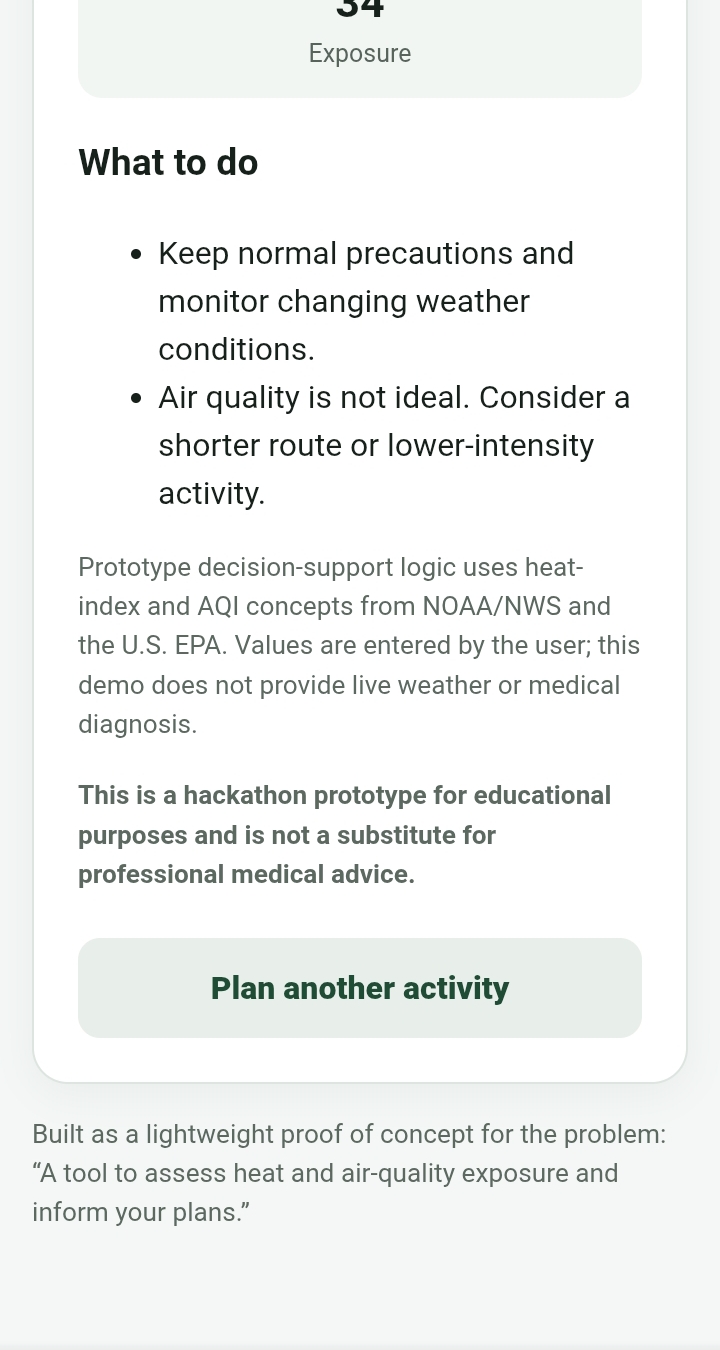
The prototype combines these inputs into a transparent exposure signal and provides practical planning suggestions.
For example, the user can see how factors such as higher heat, poor air quality, longer exposure, heavier activity, or higher vulnerability can change the overall exposure assessment.
The current prototype uses user-entered values rather than live environmental data.
How we built it
We deliberately kept the MVP lightweight and transparent.
HeatSafe is a static HTML, CSS, and JavaScript prototype that runs directly in a web browser without a backend or API key.
The decision logic uses concepts informed by:
- NOAA/National Weather Service heat-index guidance
- U.S. EPA Air Quality Index categories
The prototype uses a transparent scoring function rather than an opaque machine-learning model. This makes it possible to inspect how the different inputs contribute to the result.
AI-assisted development helped us rapidly prototype the interface, decision logic, documentation, and presentation materials.
The result is a small, accessible proof of concept that can run locally and is easy to inspect and modify.
Challenges we ran
One of the biggest challenges was balancing simplicity with responsible health communication.
It would have been easy to present a numerical score as if it were a clinically validated prediction. We deliberately avoided that. The prototype describes its result as an exposure signal and planning aid, not a medical prediction or diagnosis.
Another challenge was designing a useful assessment without depending on a backend, API keys, or live data. For the hackathon MVP, we chose user-entered values so the core interaction could work reliably as a lightweight browser prototype.
We also had to think carefully about how heat, humidity, air quality, activity, duration, and vulnerability interact without making unsupported scientific claims.
Accomplishments that we're proud of
We are proud that we turned the initial idea into a working browser-based prototype that can be tested immediately.
We created:
- A functional exposure-planning interface
- Transparent deterministic decision logic
- Heat and AQI assessment components
- Practical action recommendations
- A mobile-friendly experience
- Project documentation
- An open-source GitHub repository
We are particularly proud of keeping the prototype understandable and inspectable instead of hiding the decision process behind an opaque AI model.
What we learned
We learned that building a climate-health tool requires more than simply combining environmental numbers.
The way information is communicated matters. A score without context can create false confidence, while a complicated explanation can make the tool difficult to use.
We also learned the importance of clearly separating a prototype heuristic from a validated health model.
The project reinforced the value of starting with a small, transparent MVP and identifying where real-world validation, authoritative data, and domain expertise would be required before making stronger health-related claims.
What's next for HeatSafe
The next version of HeatSafe could move from a static prototype toward a validated, real-world climate-health planning tool.
Potential next steps include:
- Real-time environmental data — connect trusted weather and air-quality data sources.
- Validated heat-health models — replace prototype heuristics with appropriately validated models and guidance.
- Localized information — incorporate local climate and public-health context for different cities and populations.
- Geospatial exposure — consider location-specific exposure conditions and routes.
- Accessibility-first alerts — make guidance useful across different abilities and user needs.
- Expert and community validation — work with public-health professionals, clinicians, and community users to evaluate the experience and guidance.
The long-term goal is simple:
Help people understand environmental exposure before they make decisions about time, place, and activity.
Built With
- accessibility
- airquality
- aqi
- climatechange
- climatehealth
- climatetech
- environmentalhealth
- extremeheat
- healthtech
- javascript
- publichealth
- resilience
- sustainability
- webapp

Log in or sign up for Devpost to join the conversation.