-
-
Patient Page
Inspiration
Heat alerts are issued at the scale of a city. Medication risk exists at the scale of a person. Nothing currently joins the two, and the gap falls on patients whose prescriptions make heat more dangerous for them than for their neighbours.
The pharmacology is not in dispute. Working from CDC heat-health guidance and our own compiled drug-heat table, the common antihypertensives carry distinct mechanisms of harm in heat:
- Diuretics (furosemide, hydrochlorothiazide, chlorthalidone) cause fluid loss and electrolyte disturbance — hypokalemia and hyponatremia — on top of the fluid a patient is already losing to sweat.
- Beta-blockers (metoprolol, atenolol, propranolol) reduce cardiac output and skin blood flow, the two responses the body relies on to shed heat, and blunt the tachycardia that would otherwise signal trouble.
- ACE inhibitors and ARBs (lisinopril, losartan) reduce renal perfusion in a volume-depleted patient, raising the risk of acute kidney injury and hyperkalemia.
- Anticholinergics suppress sweating outright. Antipsychotics impair central thermoregulation. Lithium has a narrow therapeutic index that dehydration pushes toward toxicity.
- Others carry no meaningful heat interaction at all — amlodipine, statins, second-generation antihistamines — which is equally worth knowing.
What is missing is not the pharmacology but the workflow around it. Several gaps are visible in ordinary practice:
Heat is not part of medication review. Prescribing systems flag drug–drug interactions and renal dosing. None of them flag drug–weather interactions, so a clinician reviewing a patient in February has no prompt to revisit that list in July.
The clinician cannot see who is exposed. A chart records the diagnosis and the prescription. It rarely records whether the apartment has working air conditioning, whether anyone checks in on the patient, or whether they work outdoors — the factors that decide whether generic heat advice is actionable. During a heat wave, a care team has no ranked list of which patients on their panel to call first.
General advice can contradict clinical advice. "Drink plenty of fluids" is the standard public message and the wrong message for a patient on a fluid restriction for heart failure or advanced kidney disease. Broadcast alerts cannot make that distinction; a system with the medication list can.
Warnings do not translate into clinical action. A weather alert tells a patient it will be hot. It does not tell a clinician that this specific patient, on these three medicines, without air conditioning, at age 67, warrants a phone call today — and it produces no record that anyone acted.
We scoped the project to hypertension because it is common, because it is treated with exactly the drug classes above, and because its patients are already in regular contact with a care team that could act on a warning.
What it does
HeatSafe NYC turns a weather forecast and a medication list into one decision: who needs to hear from their care team today, and what each patient should do.
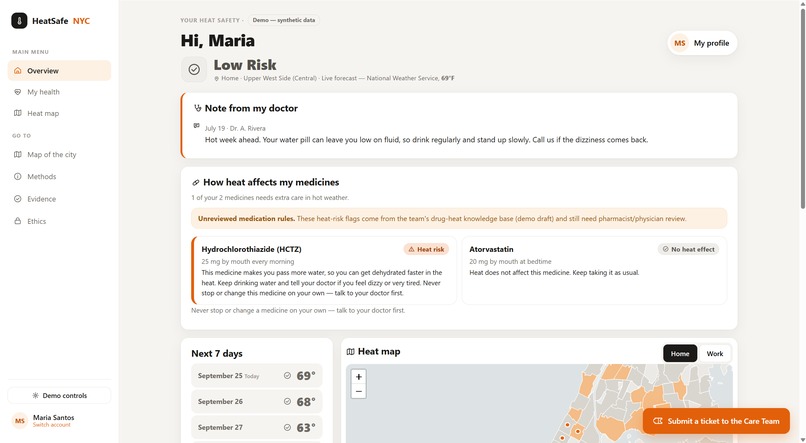
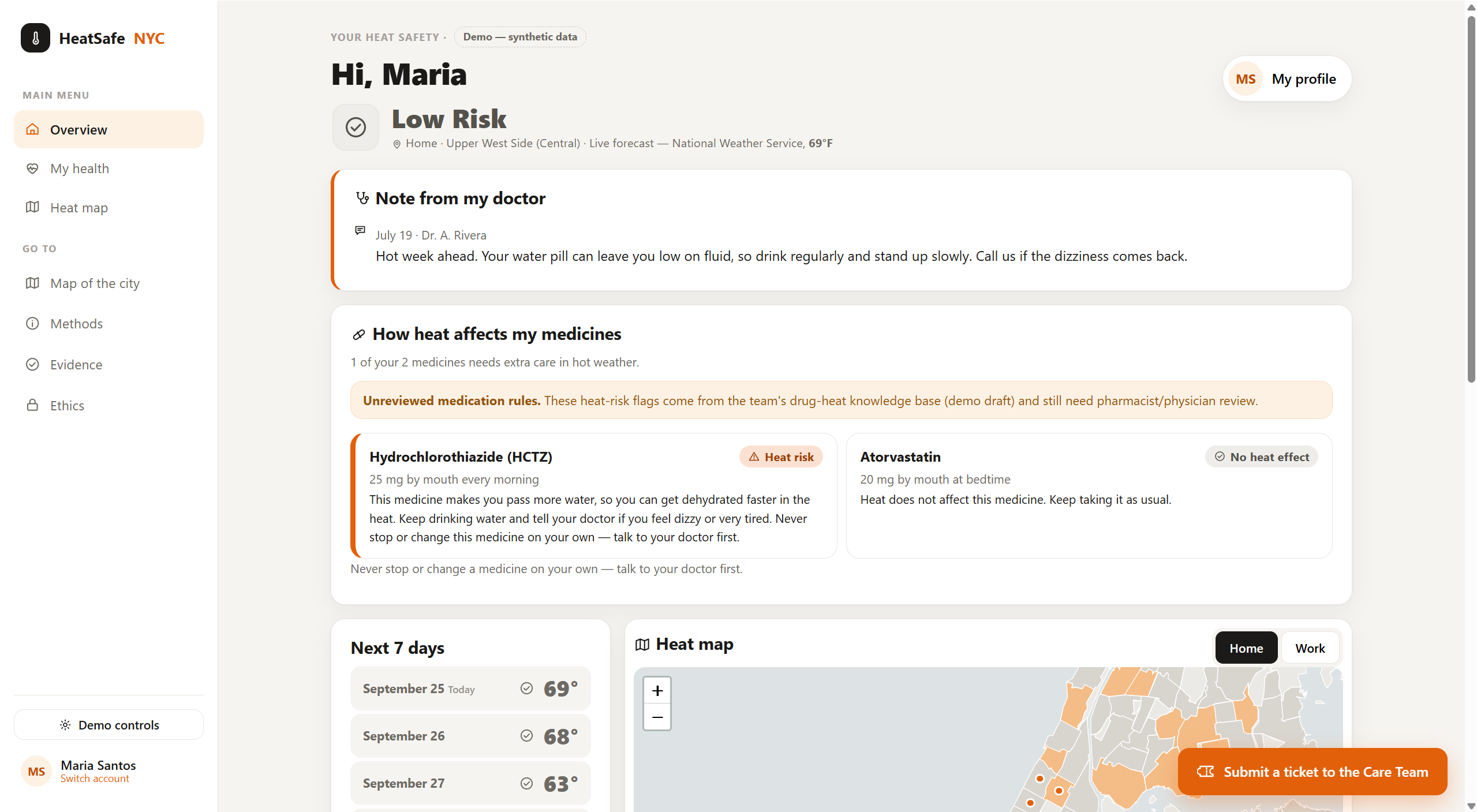
For the patient, the service opens on their risk level for today, at the place they actually are rather than a citywide average, followed by any note their doctor has left them. Beneath that sits the part no broadcast alert can provide: each of their medicines by name, with what heat does to that specific drug and what to watch for. A patient on hydrochlorothiazide reads that it makes them lose fluid faster and that dizziness is the signal to call; the same screen marks their atorvastatin as unaffected, which narrows the problem instead of widening the worry. The day's actions are drawn from CDC guidance and filtered by circumstance — a patient with no air conditioning is told to plan a cool place rather than to use one, and a patient on a fluid restriction is never shown a generic instruction to drink more. A seven-day strip carries the live National Weather Service forecast, coloured by that patient's own risk rather than by temperature, so a 90°F day can read as dangerous for one person and unremarkable for another. A map shows where they are, their saved places, and nearby public cool spaces, and a single button sends a note to the care team describing how they feel.
For the clinician, the same information arrives as a work queue. Only high-risk situations raise a notification; medium risk never pages anyone, and a patient at that level can send a note that lands in a separate list. Each alert opens with the rules that fired, then the patient's current medications, with heat-risk drugs marked red and carrying both the mechanism and the source of the flag, alongside a standing statement that this is decision support and not an instruction to change any prescription. Patients aged 65 or older trigger an explicit prompt to phone rather than message, with the healthcare proxy's number shown. The clinician's map reports counts per neighborhood and never names or plots individuals, so it answers "where are my people relative to the heat" without becoming a tracking tool. From any alert, the full chart is one click away: medications, visit notes, after-visit summaries, appointments, labs with trends, imaging, pharmacy and proxy details.
Underneath both faces is a single scoring engine, and every colour the product shows can be traced back to it. The engine grades each neighborhood for the day, then adjusts for the individual, and records the reason for each adjustment so that the patient's question — why am I medium risk? — and the clinician's question — why was I paged about this person? — are answered by the same list of rules. Consent governs the handoff between the two faces: automatic notification of a high-risk day happens only for patients who agreed to it, and a patient who declined is instead prompted to report it themselves. What crosses that boundary is deliberately narrow — identity, neighborhood, risk level, the rules that fired, and the heat-relevant drug classes, with no new clinical data attached.
Three synthetic patients make the difference visible. In the same heat episode, a 34-year-old on amlodipine in an air-conditioned apartment reads Low; a 58-year-old on one diuretic reads Medium; a 67-year-old on furosemide, metoprolol and lisinopril, with stage 3 kidney disease and no air conditioning, reads High and his care team is notified without him doing anything. Two of them live in the same neighborhood, where the city forecast is identica
How we built it
We built the prototype as a Python notebook backed by a versioned JSON model definition. The pipeline calculates patient vulnerability using four domains: clinical susceptibility, medication considerations, cooling access, and available support. It retrieves the official NWS HeatRisk forecast for the patient’s ZIP code and combines it with the vulnerability score through an explicit priority matrix. A medication-normalization layer maps common hypertension medications to heat-relevant classes. The result includes the vulnerability score or range, outreach priority, reason codes, recommended actions, missing information, and forecast provenance.
Challenges we ran into
The greatest challenge was translating public-health guidance into clear rules without suggesting more clinical certainty than the evidence supports. We addressed this by keeping HeatRisk and patient vulnerability separate, documenting the provisional scoring policy, and establishing strict boundaries around diagnosis and medication advice. Missing information was another major challenge. Treating unanswered questions as “no” could underestimate vulnerability, so the model calculates minimum and maximum possible scores and identifies when uncertainty could change the outreach priority.
Accomplishments that we're proud of
Built an explainable path from patient and ZIP-code inputs to an auditable outreach recommendation. Made uncertainty a first-class output rather than silently filling missing data. Added live NWS lookup and offline assessment modes. Ensured an unavailable forecast is never treated as low risk. Limited weather-service requests to ZIP codes, keeping patient and medication data private. Created a human-readable, versioned model definition that matches the notebook’s scoring and action logic.
What we learned
Heat outreach is not solely a medical-risk problem. Cooling access, transportation, check-in support, and assistance with carrying out a safety plan can determine whether prevention advice is actionable. We also learned that provenance and failure behavior are as important as the score itself. A responsible recommendation should identify the model version and forecast behind it, disclose missing information, and clearly state when it should not be used. Most importantly, explainability does not equal validation. Transparent rules make review and testing easier, but clinical usefulness, fairness, calibration, and real-world impact must still be demonstrated.
What's next
Next, we plan to: Review the model with clinicians, pharmacists, public-health teams, and community health workers. Test it using representative de-identified and historical scenarios. Evaluate performance and equity across patient groups and locations. Convert the notebook into a tested Python package. Carefully expand medication and forecast coverage. Before any clinical pilot, the project would require privacy and security review, governance, prospective validation, clear escalation procedures, and monitoring for both missed risk and unnecessary outreach.
Built With
- claude
- codex
- figma
- jupyter
- loveable
- pptx
- python
- vscode


