-
-
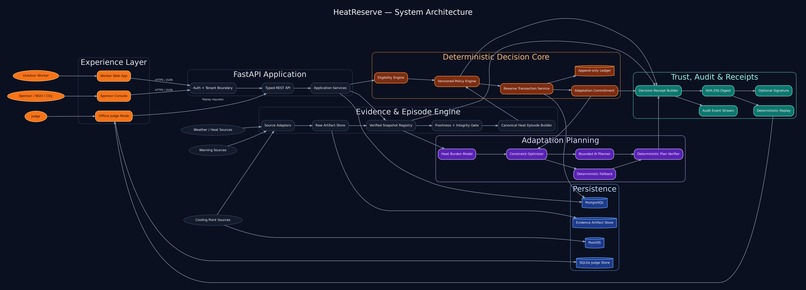
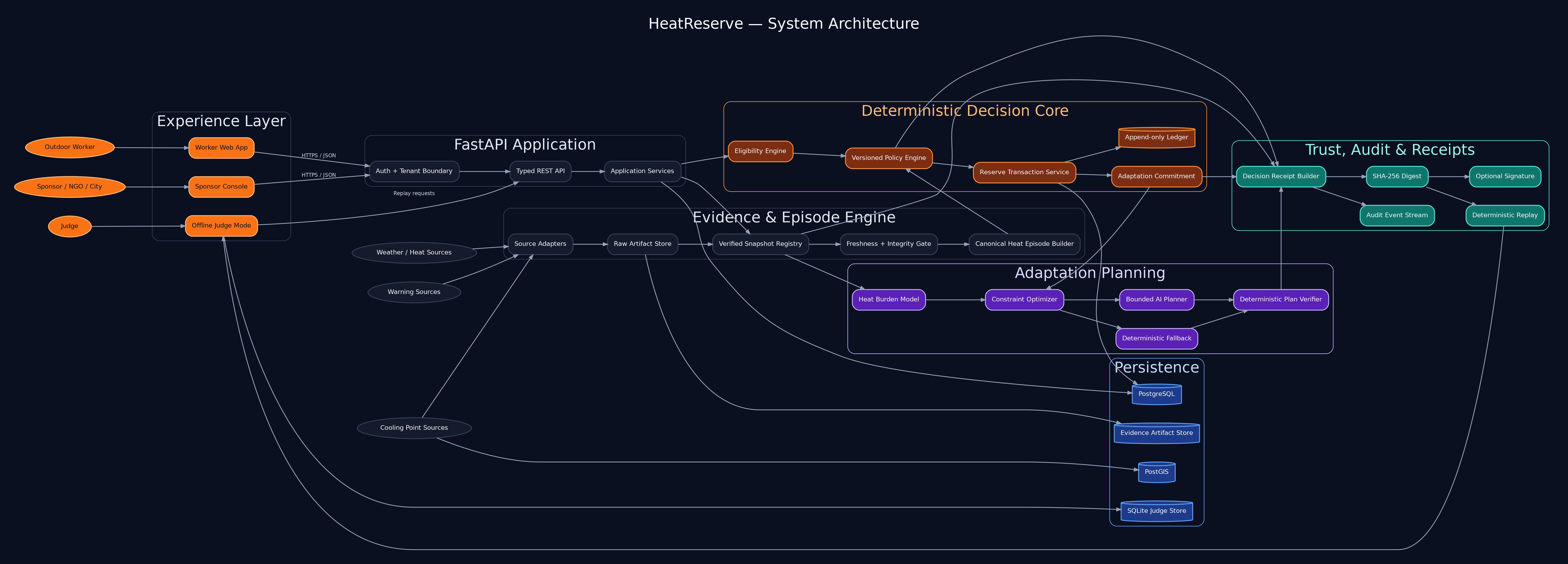
system_architecture
-
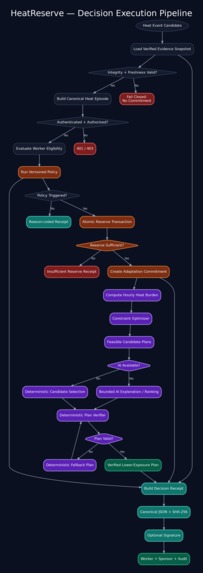
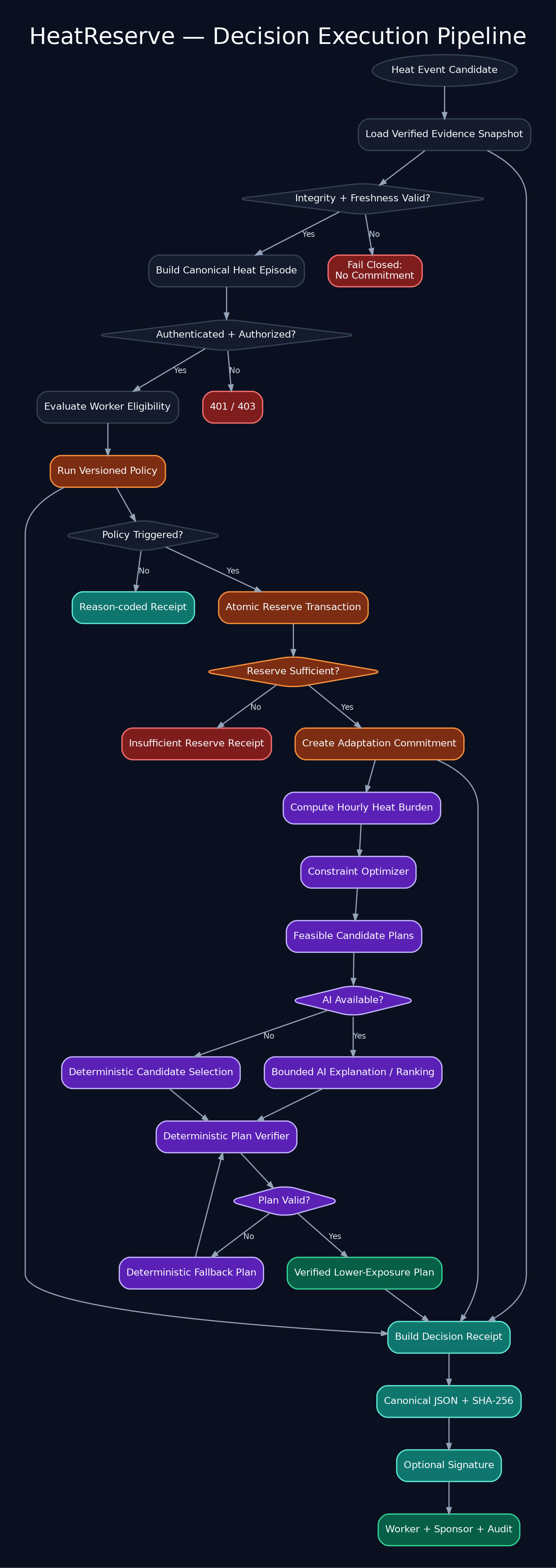
decision_pipeline
-
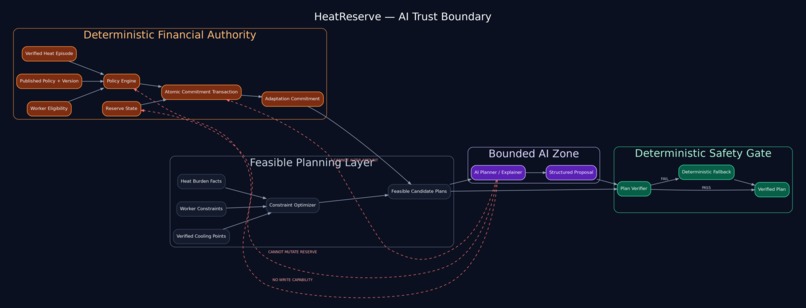
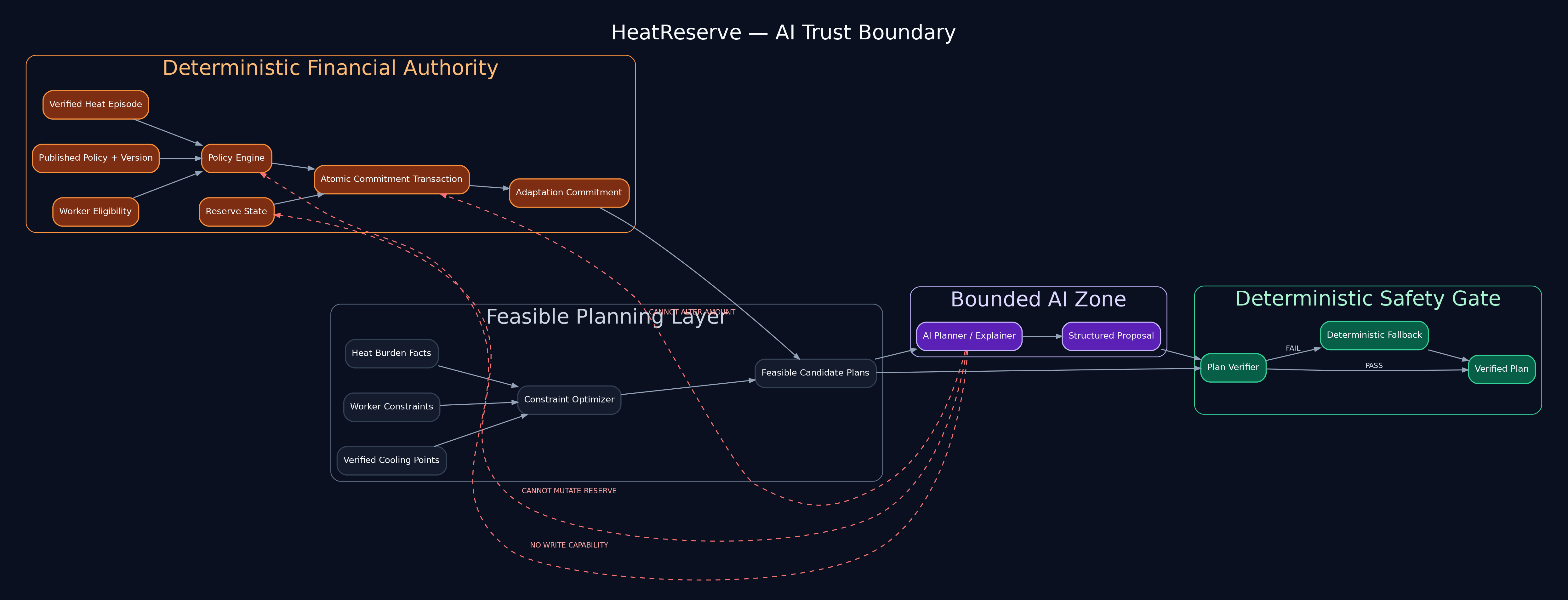
ai_trust_boundary
-

receipt_provenance
-
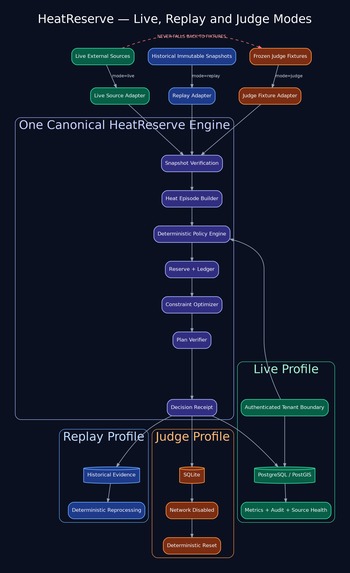
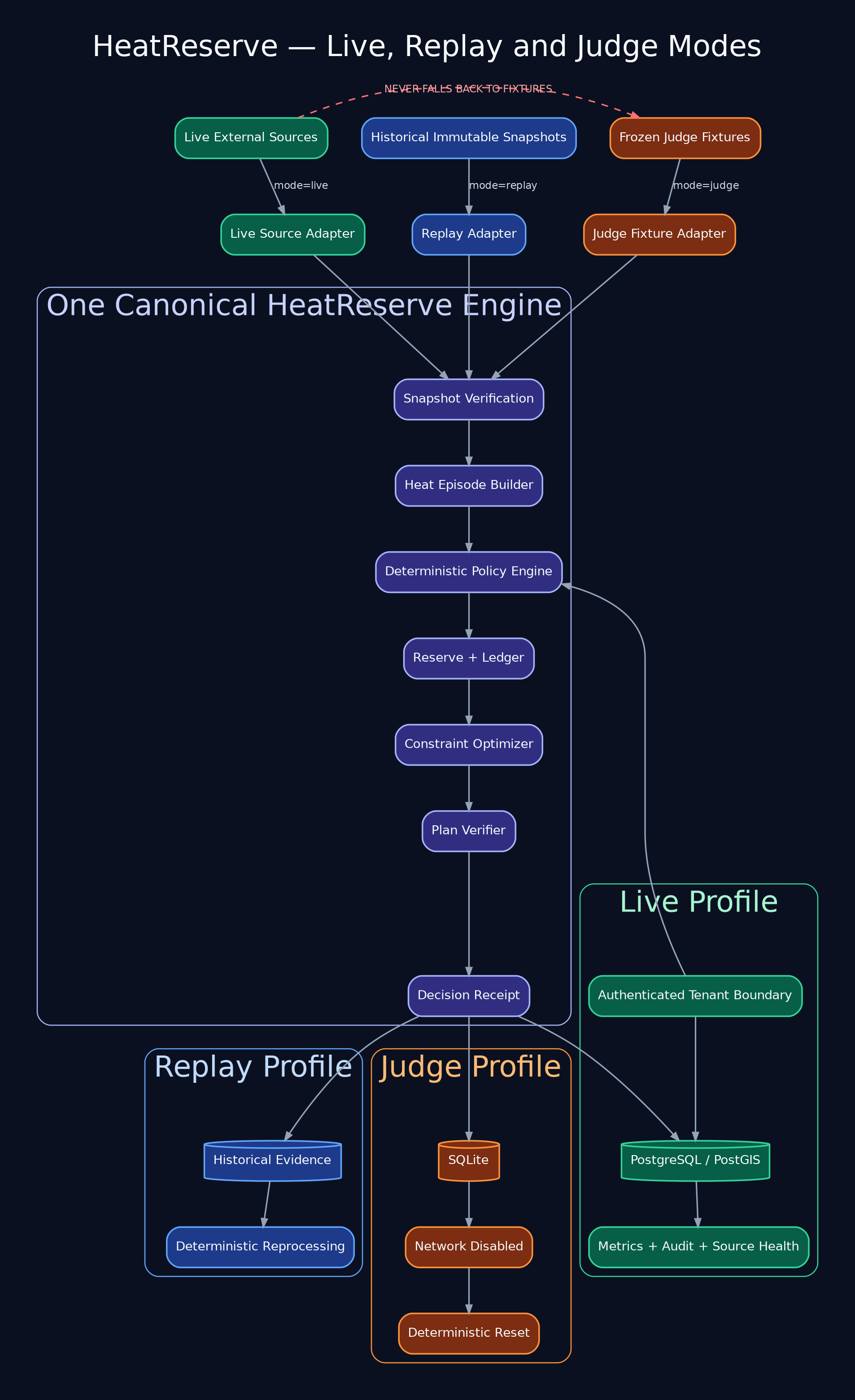
live_replay_judge_mode

Inspiration
Extreme heat is becoming part of everyday work for millions of people. But for an outdoor worker, knowing that it is dangerously hot does not always mean they can stop working.
Imagine a delivery worker getting a heat warning at 1 PM. The warning says to avoid the hottest hours, but those same hours may be when they earn the money they need for that day. Taking a break is not just a health decision. It can mean losing income.
That gap inspired HeatReserve.
Research with gig delivery workers in Delhi and Gurugram showed something important: warnings help people understand the risk, but timely financial support can actually give them the freedom to change when and how they work.
We wanted to explore a simple question:
What if a heat warning did more than tell someone to be careful? What if it actually gave them room to act?
That became HeatReserve.
What it does
HeatReserve is a climate resilience platform that helps outdoor workers adapt to extreme heat without forcing them to choose between protecting themselves and earning their income.
A city, company, NGO, CSR program or climate fund can create a sponsor-funded HeatReserve. When a verified heat episode meets the program's published rules, eligible workers can receive an adaptation commitment from that reserve.
HeatReserve then looks at hourly heat conditions, the worker's available schedule and verified cooling locations to suggest a lower-exposure work plan.
For example, instead of simply saying "avoid working this afternoon," HeatReserve can help a worker shift part of their schedule away from peak heat, identify possible cooled breaks and explain why that plan reduces their modeled heat exposure.
We deliberately keep AI away from financial decisions. AI can help create and explain adaptation plans, but it cannot decide who receives support or how much they receive. Those decisions are made by a deterministic, versioned policy engine.
Every important decision also produces a Decision Receipt showing what data was used, which policy triggered the decision, what the system recommended and how the result can be verified.
HeatReserve also gives sponsors tools to compare how a limited climate adaptation budget could be distributed across workers while considering coverage, heat burden and fairness.
How we built it
We designed HeatReserve around one principle: policy before AI.
The backend uses a deterministic policy engine for heat-event qualification, worker eligibility, reserve accounting and financial commitments. This makes the important decisions reproducible instead of depending on an unpredictable AI response.
Heat and warning data are stored as versioned evidence snapshots so the system can reproduce exactly what information was available when a decision was made.
For adaptation planning, we use a tool-grounded AI layer that works with structured information such as hourly conditions, worker constraints and verified cooling points. Every generated plan then passes through a deterministic verifier that can reject impossible schedules, invented locations or unsupported safety claims.
If the AI service is unavailable, HeatReserve can fall back to deterministic planning instead of stopping completely.
We also designed an auditable Decision Receipt system. Each receipt records the source data, policy version, reason codes, planner provenance and verification result, along with a tamper-evident SHA-256 digest.
For the technical stack, HeatReserve is designed around React and Next.js with TypeScript on the frontend, FastAPI and Python on the backend, and PostgreSQL with PostGIS for production-scale data and geospatial features.
We also created a replay-first Judge Mode so the complete decision flow can be demonstrated using frozen evidence without depending on external APIs during evaluation.
Challenges we ran into
The hardest challenge was separating what AI is good at from decisions where AI should not have authority.
It would have been easy to ask an LLM to look at a worker and simply decide whether they should receive support. We felt that would make an important financial decision difficult to explain, reproduce and audit.
Instead, we had to design a clear boundary. Financial eligibility and reserve decisions stay deterministic. AI is only used where it adds value, such as planning and explanation.
Another challenge was avoiding false confidence around heat safety. Temperature alone cannot tell us whether a worker is completely safe. Heat exposure depends on several factors, so HeatReserve never tells someone that it is "safe to work." We describe recommendations as lower-exposure alternatives and make their limitations visible.
We also had to think carefully about fairness. A climate fund will always have a limited budget. Giving support to everyone equally sounds fair, but it may not help workers facing the highest burden. That led us to build allocation scenarios that let sponsors compare different strategies instead of hiding that trade-off.
Finally, external APIs can fail at exactly the wrong moment in a hackathon demo. That is why replayability and graceful fallback became part of the architecture rather than an afterthought.
Accomplishments that we're proud of
We are most proud that HeatReserve is more than another heat-alert dashboard.
It connects four things that are normally separated: climate warnings, financial flexibility, personal adaptation planning and verifiable decision-making.
We created a system where AI can be useful without becoming the authority over someone's money.
We designed tamper-evident Decision Receipts so a worker, sponsor or auditor can understand why a decision happened instead of being asked to trust a black box.
We also built the concept around a fixed adaptation budget, which makes HeatReserve useful not only for an individual worker but also for organizations trying to decide how limited climate funding can create the greatest impact.
Another accomplishment we care about is evidence honesty. HeatReserve clearly separates external research, engineering measurements, simulations and future targets. We do not present simulated impact as something that has already happened in the real world.
Most importantly, the product starts from a very human idea: a warning only becomes useful when someone has the ability to act on it.
What we learned
The biggest thing we learned is that climate adaptation is not only an information problem.
People can understand a risk perfectly and still be unable to respond because of economic constraints.
That changed how we thought about the product. Instead of building a better heat warning, we started asking what actually prevents someone from following the warning.
We also learned that responsible AI is sometimes about deciding where not to use AI.
Using deterministic rules for money and AI for constrained planning gave us a system that is both useful and much easier to explain.
Another major lesson was that transparency should be part of the product itself. Provenance, receipts, reason codes and replayability are not just technical extras. They help workers and funders understand and challenge decisions that affect them.
Finally, we learned that climate resilience becomes much more interesting when we measure action rather than awareness. Instead of asking how many warnings were sent, we want to understand how much high-heat exposure a limited adaptation budget can realistically help workers shift.
What's next for HeatReserve
The next step is to move HeatReserve from a prototype into a real pilot with outdoor workers and a sponsoring organization.
We want to integrate live official heat-warning and weather feeds, expand verified cooling-location data and test the adaptation planner with real worker schedules and preferences.
We would also like to work with cities, NGOs, gig platforms, worker organizations and CSR or climate-finance programs to test different sponsor-funded reserve models.
Over time, HeatReserve could support other climate-exposed occupations such as construction workers, street vendors, sanitation workers and other people whose income depends on spending time outdoors.
We also want to improve the allocation engine so sponsors can understand not only how much money was distributed, but how effectively each rupee of climate funding translated into modeled reductions in high-heat exposure.
The long-term vision is bigger than an app.
We want HeatReserve to become infrastructure for anticipatory climate adaptation, where a verified climate risk can trigger transparent support that actually gives people the ability to respond.
Built With
- aiplanning
- auditability
- climateresilience
- climatetech
- decisionreceipts
- deterministicai
- explainableai
- fastapi
- geospatial
- heatrisk
- nextjs
- policyengine
- postgis
- postgresql
- python
- react
- replaymode
- responsibleai
- restapi
- sdg13
- sdg8
- sha256
- tailwindcss
- typescript

Log in or sign up for Devpost to join the conversation.