-
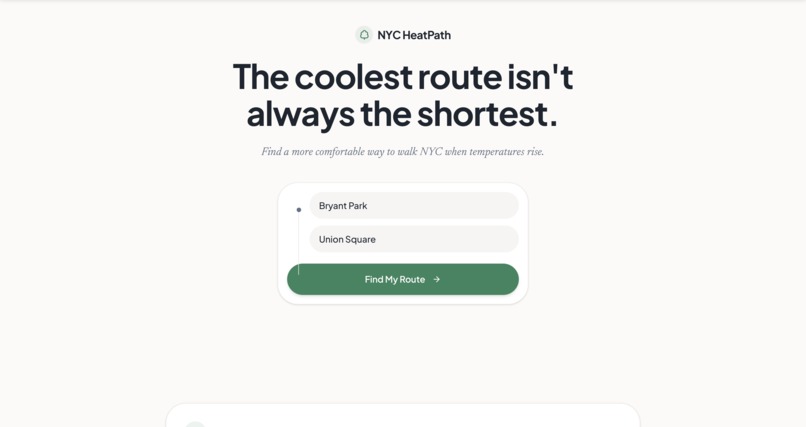
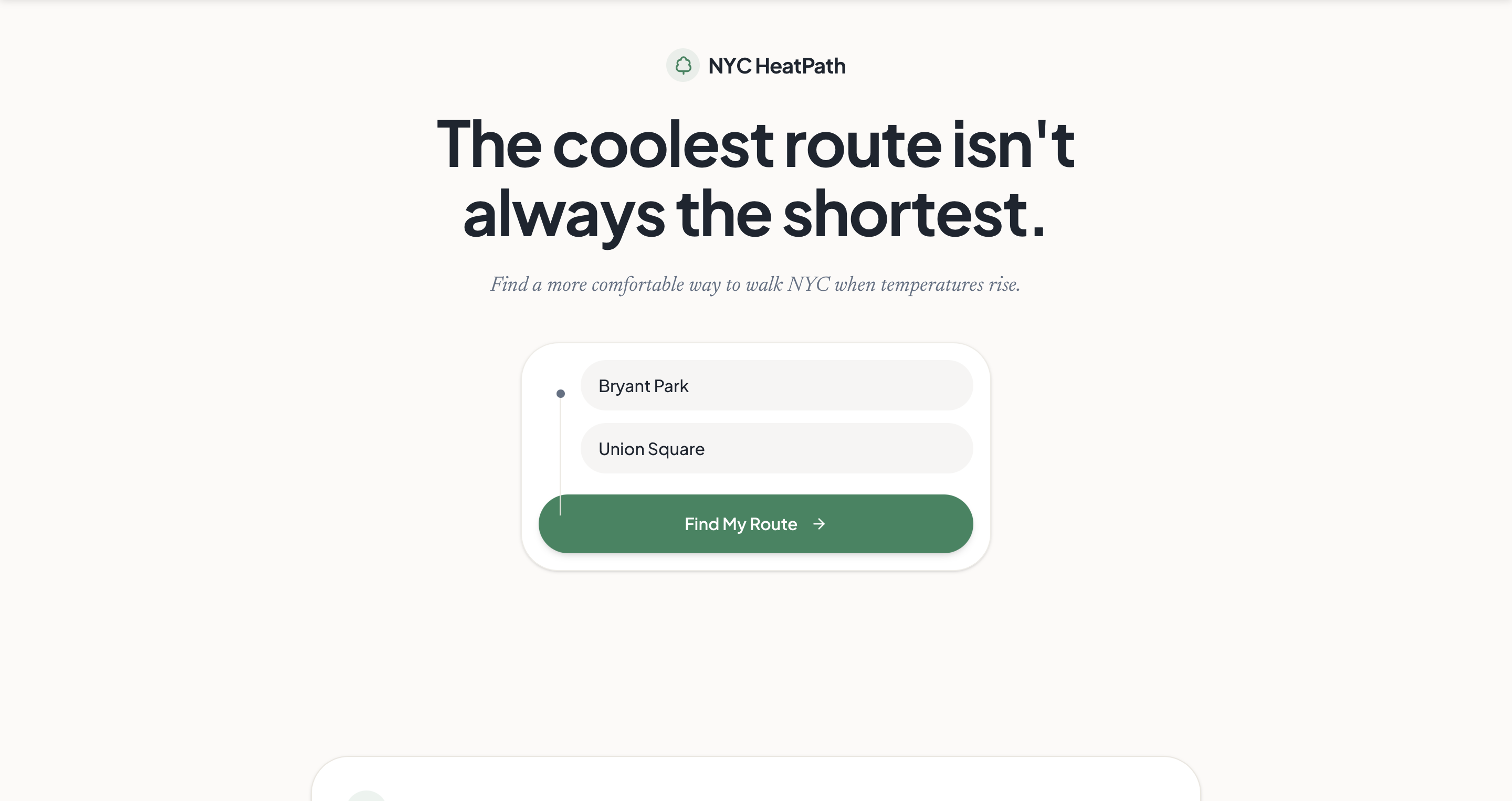
The coolest route isn't always the shortest.
-
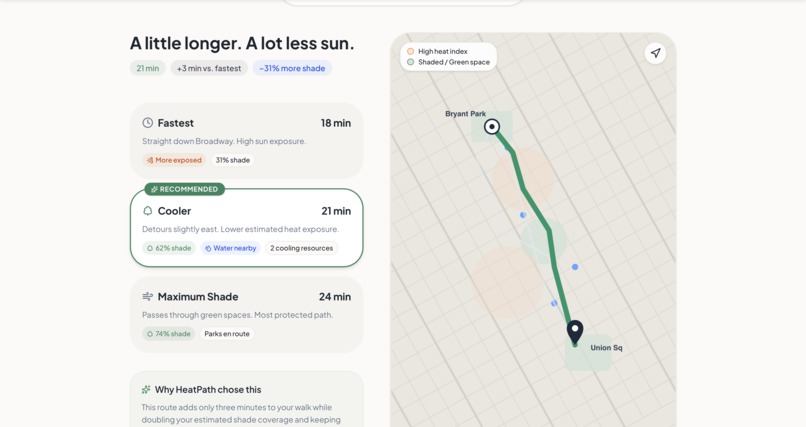
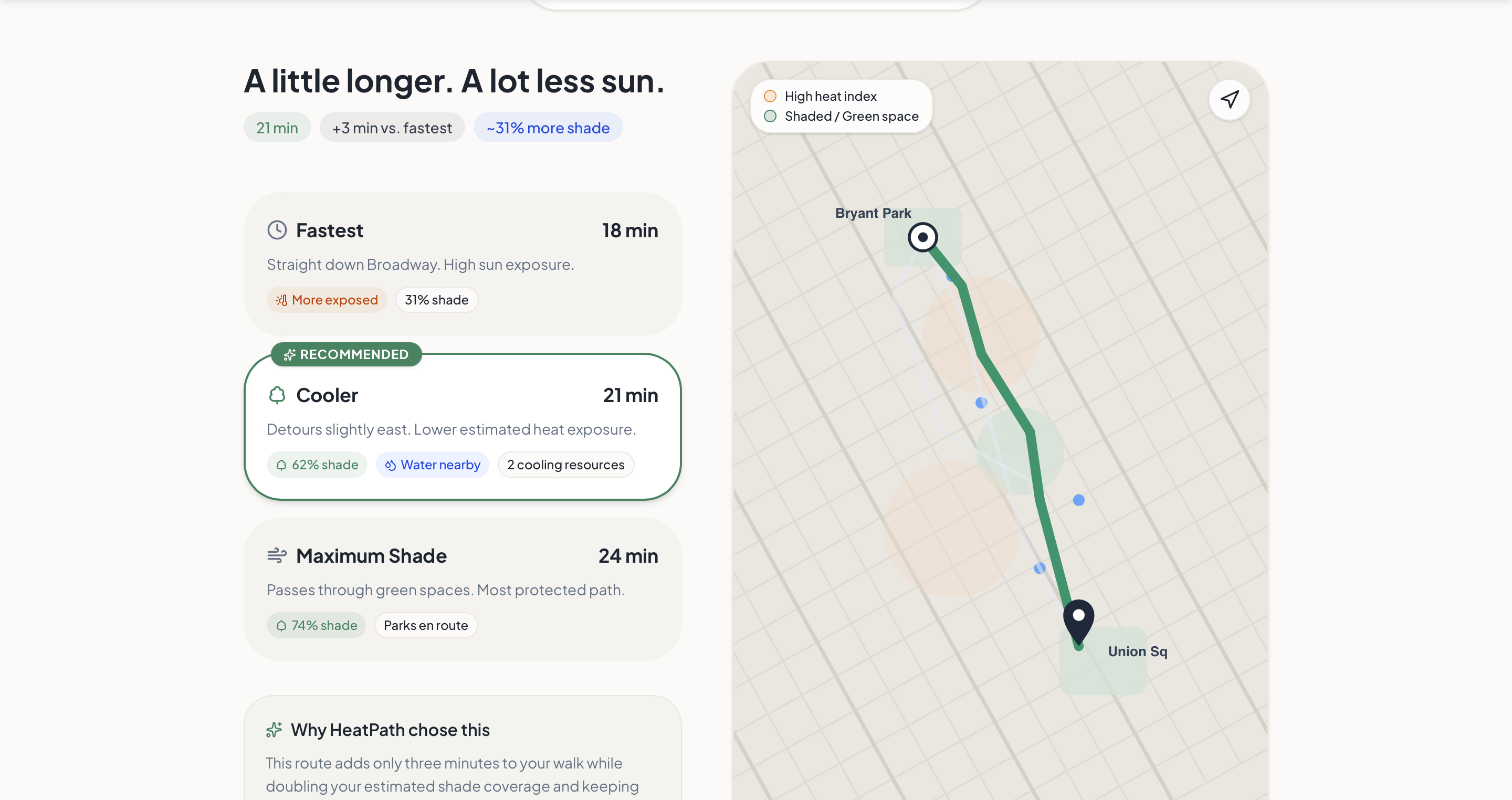
A little longer. A lot less sun.
Inspiration: What if navigation optimized not only for where you're going, but for what your body needs along the way?
In New York City, the shortest walk isn't always the safest or most comfortable one. On a hot day, two routes to the same destination can create very different experiences. One may be three minutes faster but leave you exposed to direct sun. Another may take slightly longer while providing substantially more shade, access to water, green space, or places to rest.
Traditional navigation primarily optimizes for distance and time. HeatPath explores a more human-centered approach: optimizing for the person, not merely the trip.
What it does: HeatPath is a context-aware navigation prototype that helps people compare routes based on environmental conditions and personal needs.
For the MVP, HeatPath focuses on extreme heat as a timely use case. A user can compare three sample routes:
- Fastest - the shortest option, but with greater heat exposure
- Cooler - a slightly longer route with substantially more shade and nearby cooling resources
- Maximum Shade - the most heat-protected option
HeatPath also lets users describe what matters to them in natural language. It interprets stated needs and adapts the route recommendation accordingly, prioritizing explicit needs first and then adding relevant contextual considerations.
How we built it: I built HeatPath as a frontend-first functional prototype in Replit. The experience uses sample route calculations inspired by NYC Open Data categories including the NYC Street Tree Census, NYC Parks open space, public drinking fountains, and cooling centers.
The current prototype demonstrates the product logic and user experience rather than live citywide routing. A production version would combine live weather, geospatial data, accessibility information, environmental conditions, and real-time routing infrastructure.
Challenges: One of the central design challenges was avoiding the assumption that the "best" route means the fastest route. HeatPath needed to make tradeoffs understandable without overwhelming the user.
Another challenge was personalization. A person's circumstances can change what makes a route appropriate, so the interaction was designed to preserve needs the user explicitly states before introducing reasonable contextual considerations.
What's next: Heat is the starting point, not the boundary of the idea.
The longer-term vision is context-aware navigation that helps people move through cities in ways that better support their well-being, accounting for factors such as accessibility, comfort, age, mobility, environmental exposure, health-related needs, and personal circumstances.
Because sometimes the best route isn't the shortest one. It's the one that gets you there better.
Challenges we ran into: The biggest challenge was defining what a "better" route actually means. Traditional navigation makes speed and distance easy to compare, but human needs are more contextual. HeatPath needed to communicate tradeoffs like a few additional minutes in exchange for substantially more shade, nearby water, green space, or places to rest without making the experience feel complicated.
Another challenge was designing personalization responsibly. A user's circumstances may change what makes a route appropriate, but the product should not make assumptions that override what someone actually says they need. I refined the interaction so that HeatPath prioritizes explicit user needs first, then adds reasonable contextual considerations.
Finally, this was built within the constraints of a hackathon. The current experience therefore demonstrates the product concept and interaction logic using sample route calculations rather than claiming to provide live, citywide environmental routing.
Accomplishments that we're proud of: I'm proud that HeatPath developed into more than a heat-routing concept. The prototype demonstrates a different way of thinking about navigation itself: the best route can depend on the person taking it.
The MVP makes an otherwise invisible tradeoff tangible. A user can see that spending only a few additional minutes walking may provide substantially more shade and access to cooling resources, then choose the route that better fits their circumstances.
I'm also proud of the personalization experience. Users can tell HeatPath what matters to them in their own words, and the interface translates those needs into an adjusted recommendation while keeping the reasoning visible.
Most importantly, the prototype preserves a larger vision without trying to build everything at once. Extreme heat provides a focused starting point for exploring what human-centered, context-aware navigation could become.
What we learned: Building HeatPath reinforced that optimization is only as useful as the objective being optimized.
Navigation systems are extremely good at answering questions like "What is the fastest way there?" But people may actually be asking a different question: "What is the best way for me to get there under these circumstances?"
I also learned how important it is to make algorithmic recommendations legible. Rather than simply labeling one route "recommended," HeatPath explains the tradeoff: additional walking time, estimated shade coverage, nearby cooling resources, and why a particular route was selected.
The project also highlighted the potential value of combining public datasets that are often treated separately. Tree canopy, parks, drinking fountains, cooling resources, environmental conditions, and accessibility information can become much more useful when translated into decisions people can act on in everyday life.
What's next for HeatPath: Heat is the starting point, not the boundary of HeatPath.
The next step would be moving from sample route calculations to live geospatial routing that combines weather conditions with NYC environmental and infrastructure data. That could include more dynamic information about shade, temperature, tree canopy, parks, drinking water, cooling resources, accessibility, and other conditions that affect how a journey feels and functions.
Over time, HeatPath could expand beyond heat into a broader context-aware navigation layer that accounts for accessibility, comfort, age, mobility, environmental exposure, health-related needs, and personal circumstances.
The larger vision is navigation that doesn't simply ask, "How quickly can we get you there?" It also asks, "What does getting there well look like for you?"
Because sometimes the best route isn't the shortest one. It's the one that gets you there better.
Built With
- css
- html5
- javascript
- replit
- svg

Log in or sign up for Devpost to join the conversation.