Inspiration
We're a team of three. Two of us are international students from Bangladesh, one at UT Austin and one at Cal Poly Pomona, and our third teammate goes to community college. When we first started talking, it was about home: the food, the noise, the people. The thing that stuck with all of us was simple. We miss our families, a lot.
And calling them isn't simple. Dhaka is 11 hours ahead of Austin and 13 hours ahead of Pomona. When we walk out of a midterm at 2 PM, it's 3 AM at home, and everyone's asleep. When we can't sleep at 2 AM, they're at work, and we don't want to worry them with a call about nothing. Between classes, jobs, and time zones, there are nights when we just want to hear Ammu's voice, and we can't. The good moments go unshared too: the exam we aced, the dish we finally cooked right.
We're far from the only ones. In the 2024–2025 Healthy Minds Study of about 84,000 students, 52% of U.S. college students reported high loneliness. In 2024/25, 1,177,766 international students studied in the U.S. (IIE Open Doors). So we built HearU: a way to hear the people you love when you can't reach them, and then get back to them.
What it does
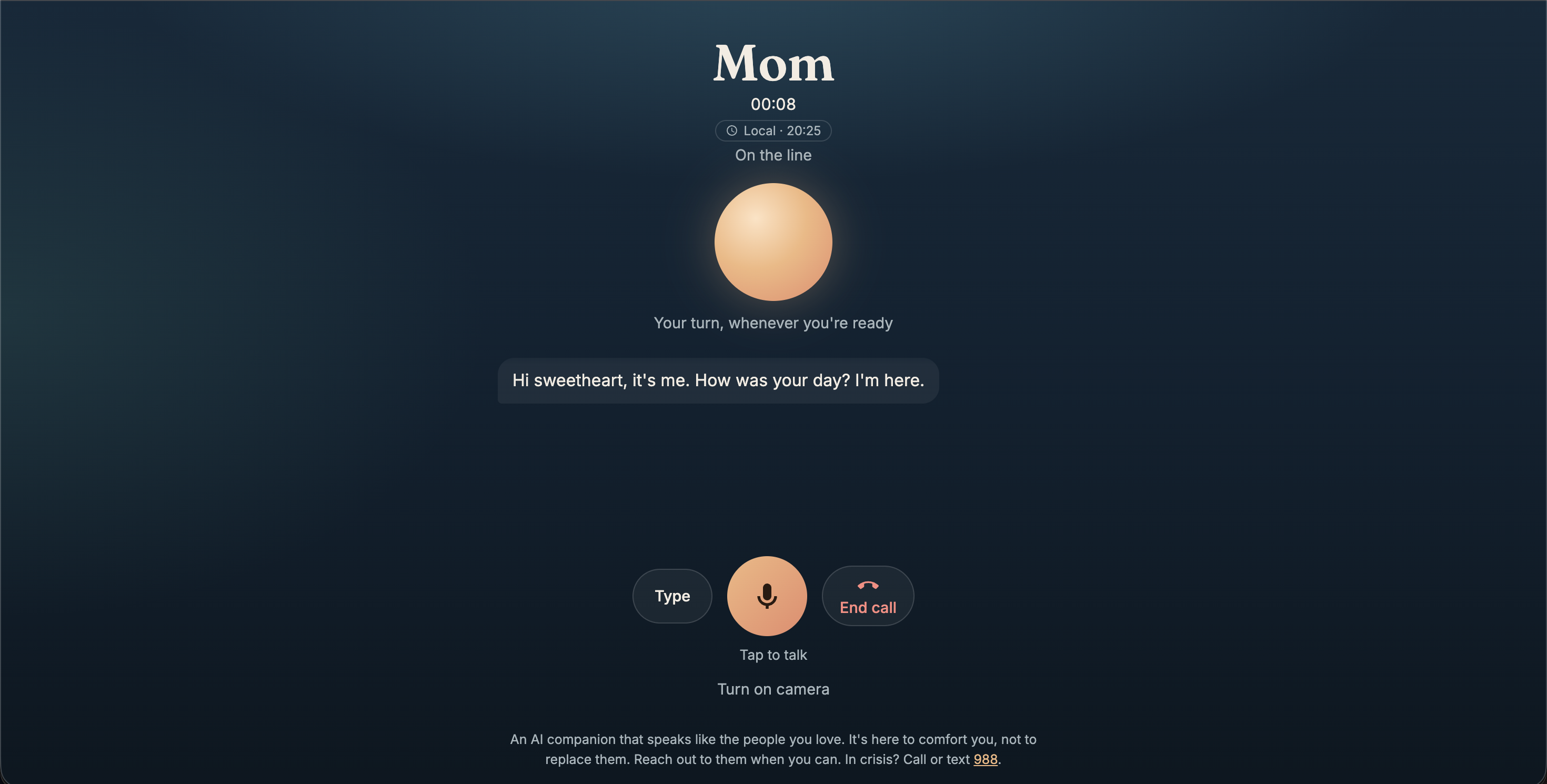
HearU works like a phone call with someone who loves you.
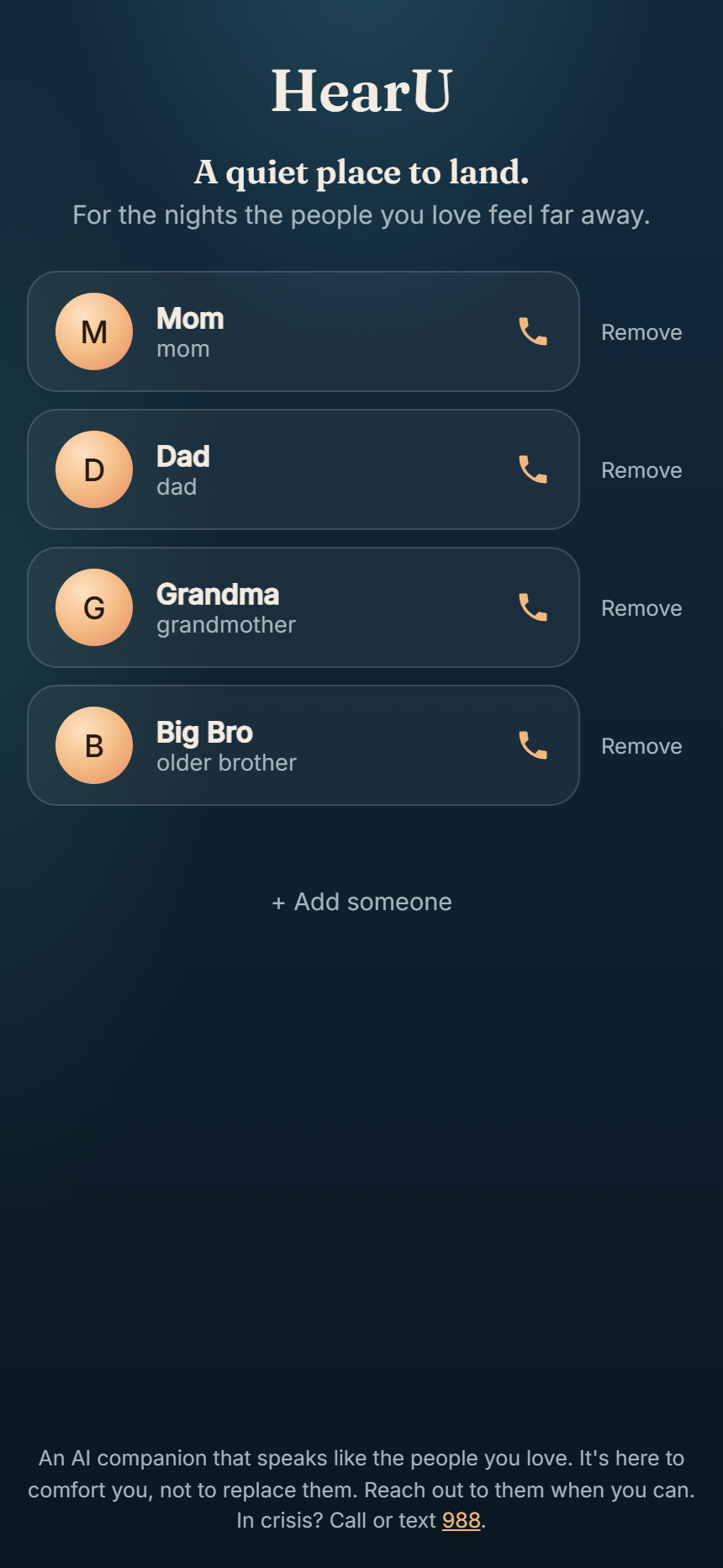
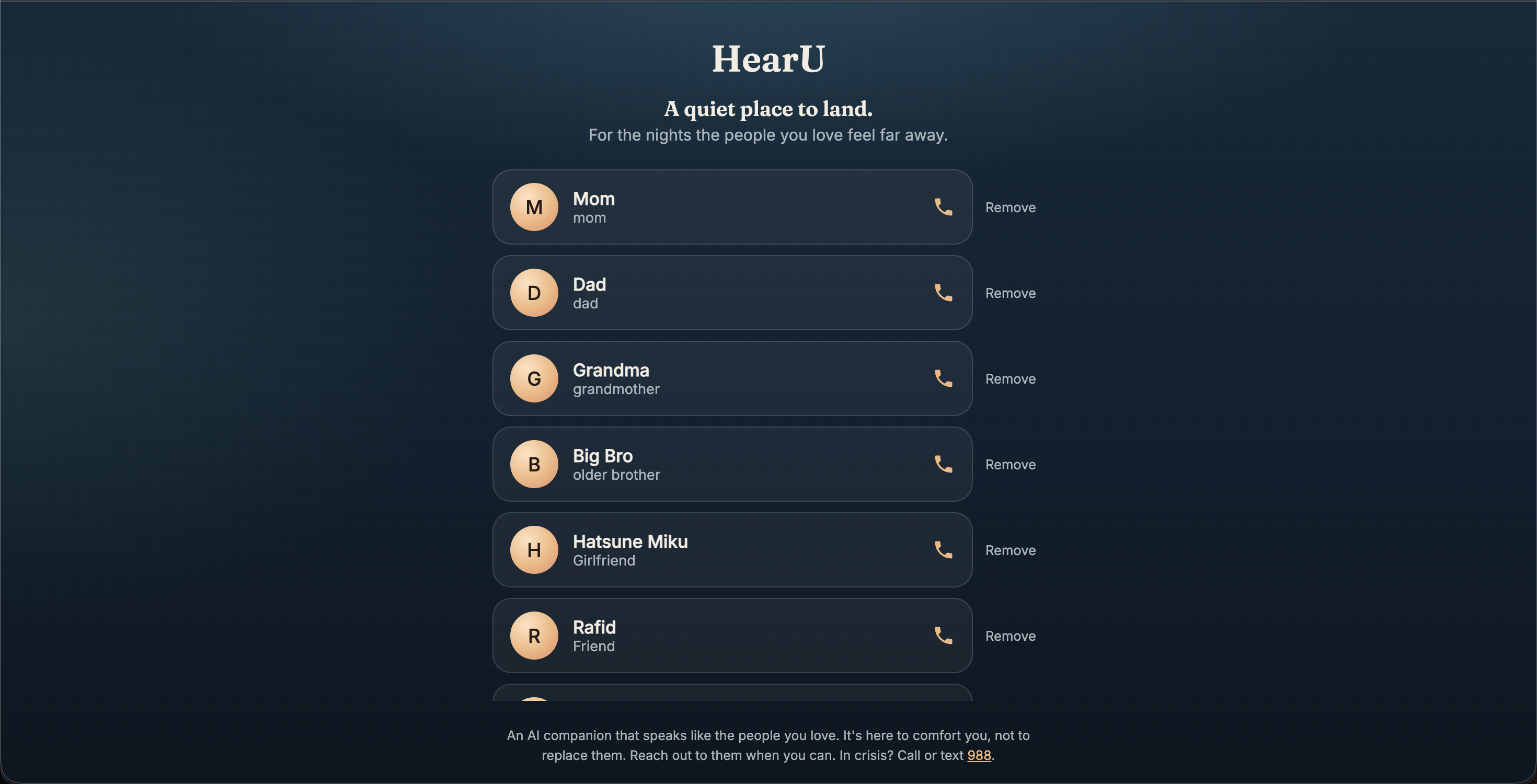
- Call a loved one. Mom, Dad, Grandma, and Big Bro are ready, each with their own voice, pace, and way of talking. You can also add your own person: their name, what they call you, and how they talk.
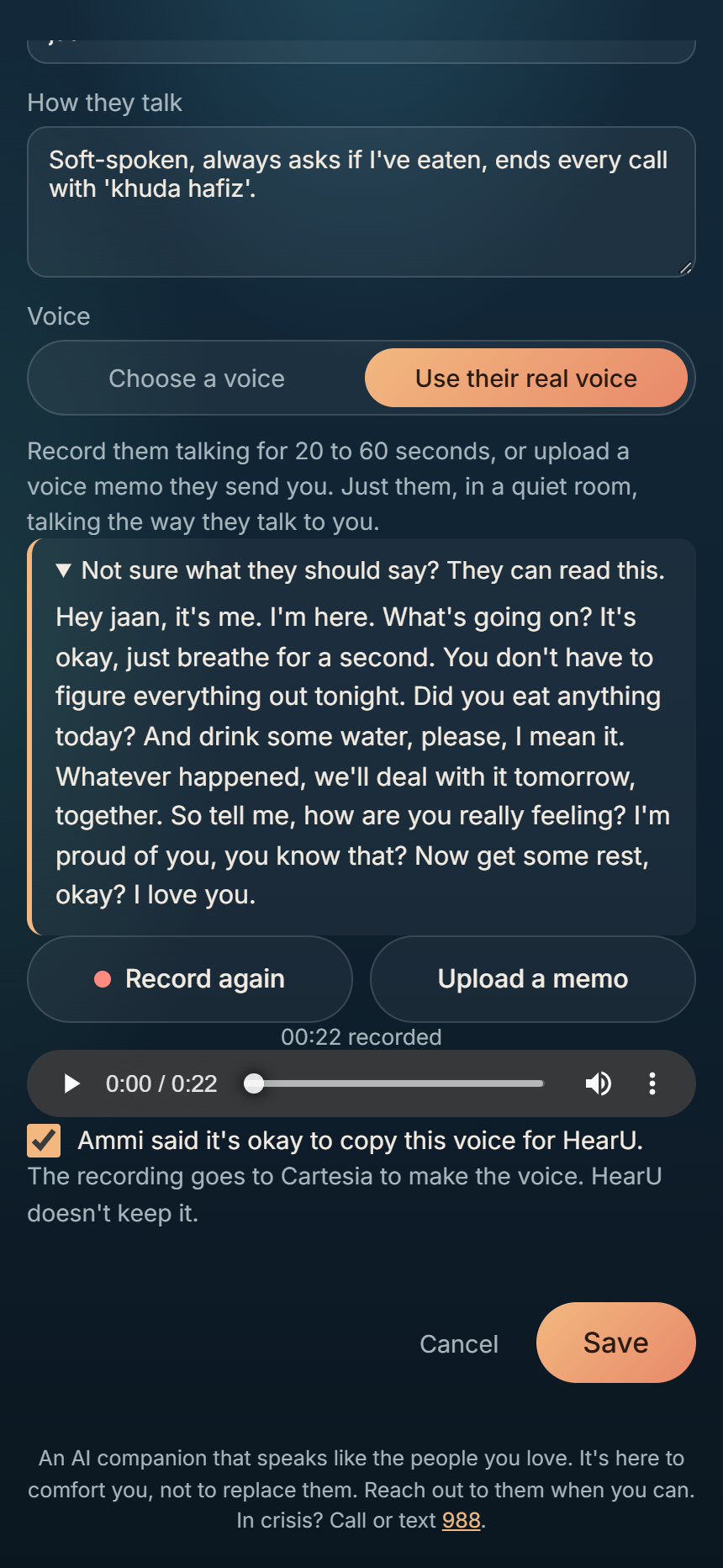
- Their real voice, with their consent. Record your loved one for 20 to 60 seconds, or upload a voice memo they sent, and HearU copies their voice. It won't do this until you confirm they said yes.
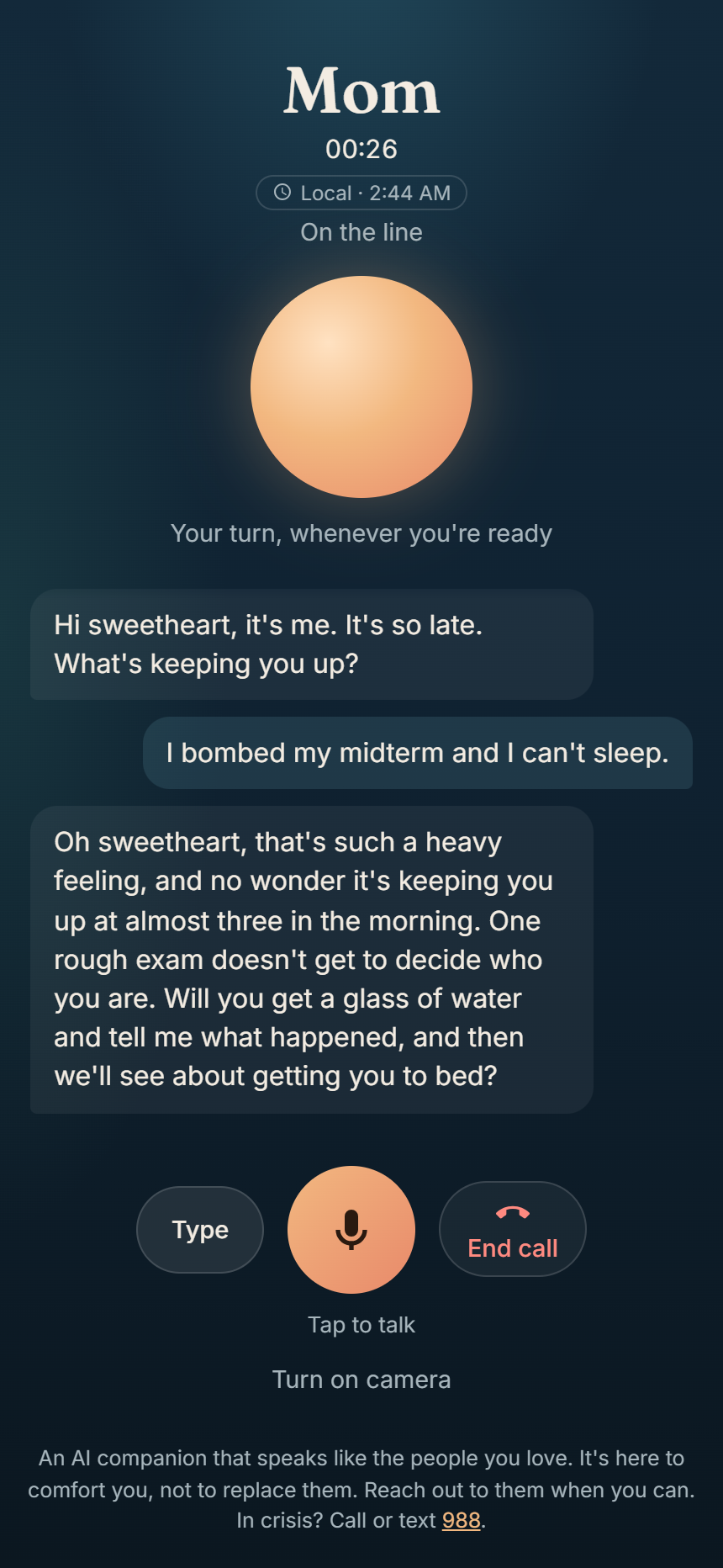
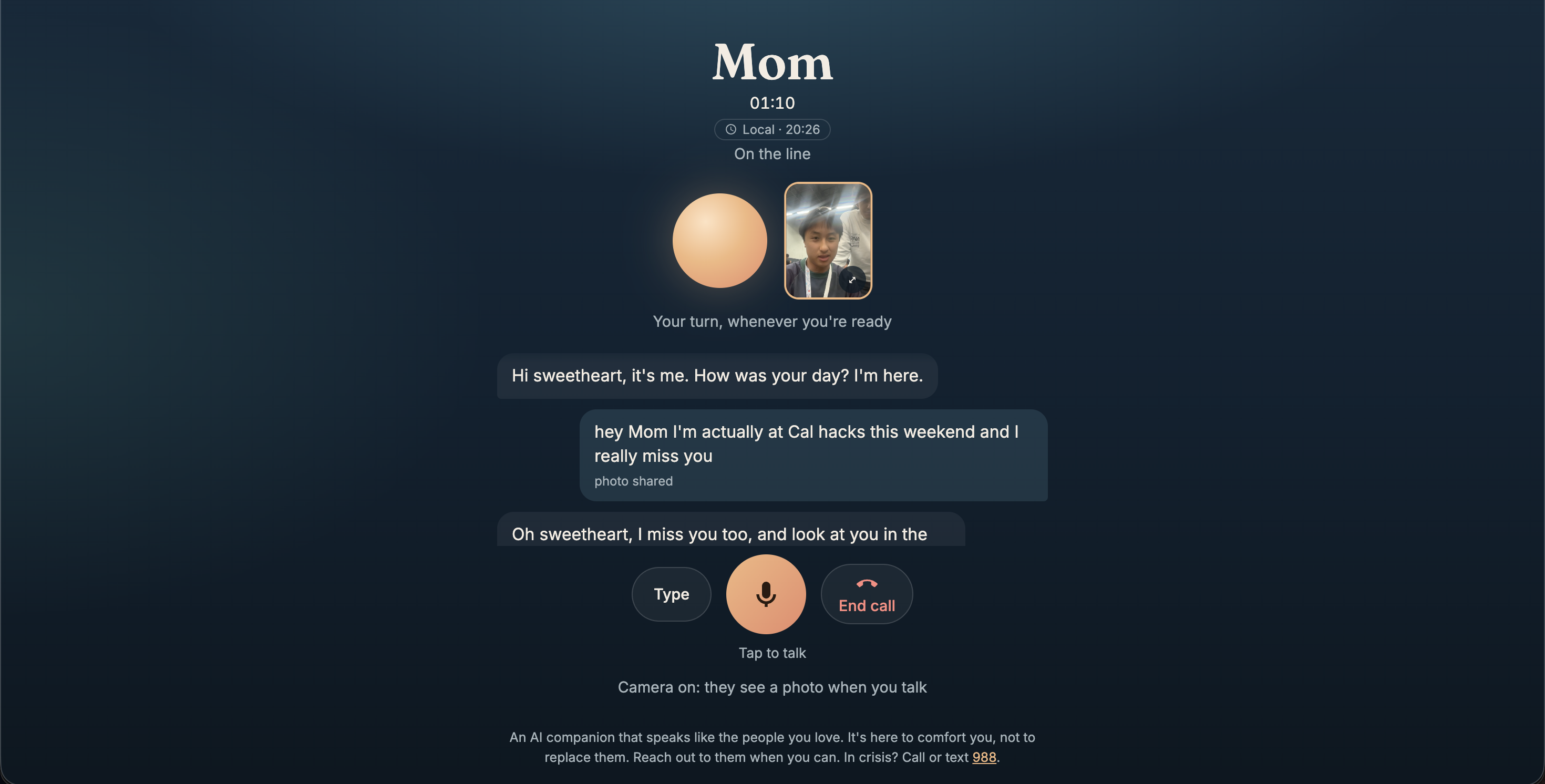
- It hears you, and can see you if you want. Tap the mic and talk. If you turn on the camera, one still photo goes with each message, so they can notice you look exhausted or have been crying.
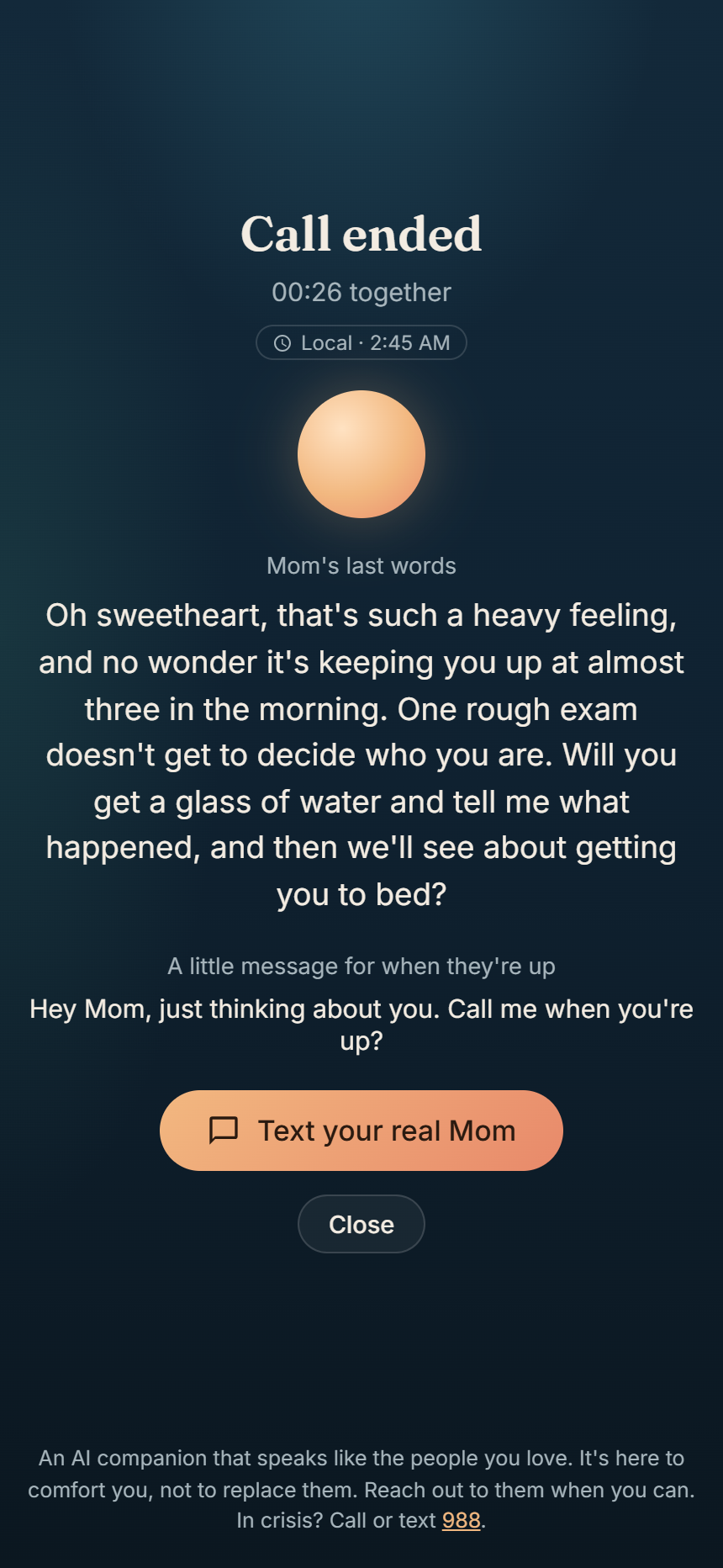
- It knows your time. At 2 AM, they pick up with "It's so late. What's keeping you up?"
- Comfort and gentle guidance. They listen first, then nudge you the way family does: eat something, drink water, get some rest. No lectures.
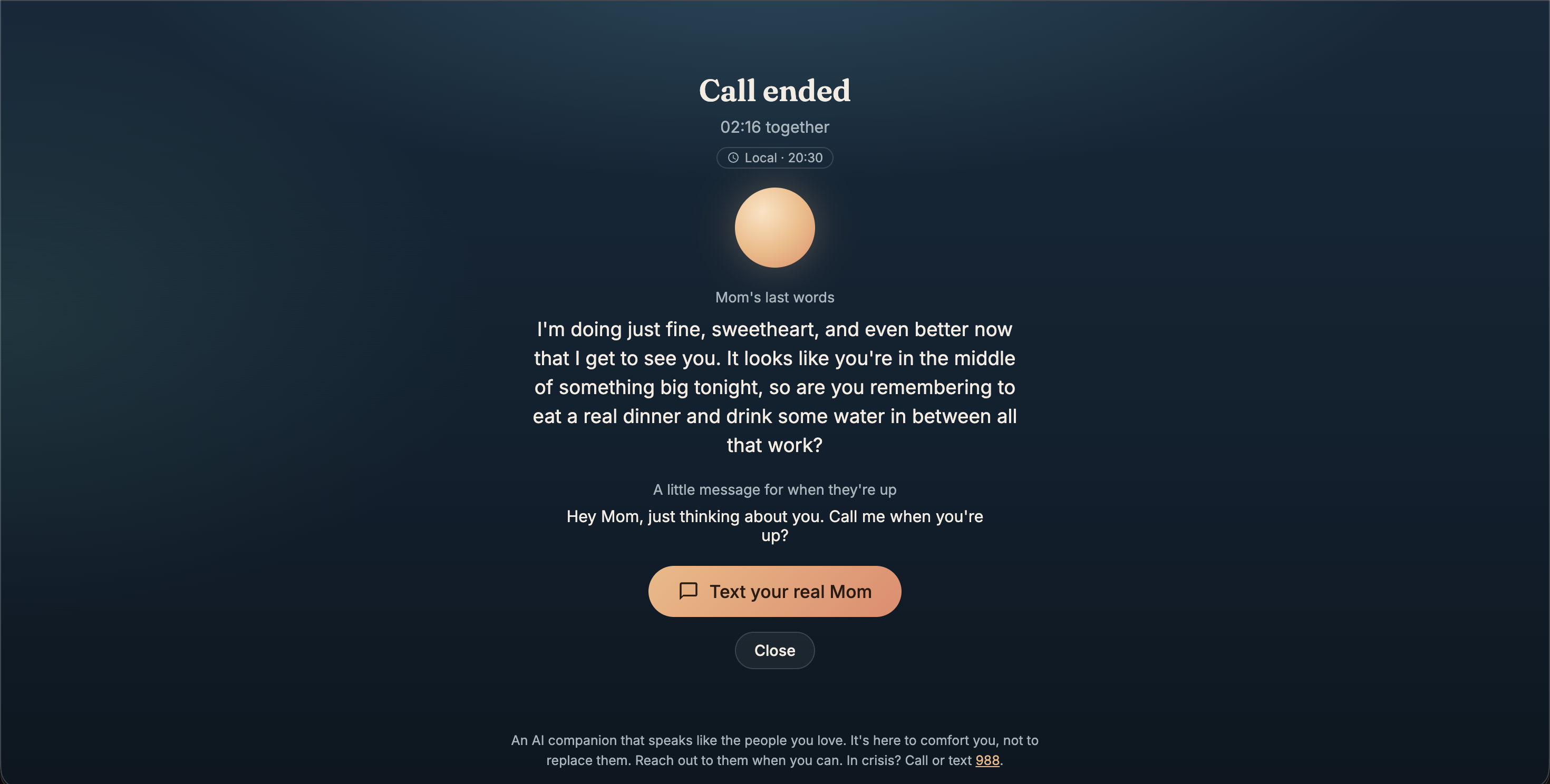
- Back to the real person. Every call ends with "Text your real Mom" and a message ready to send.
How we built it
- Claude Opus 5.5 writes every reply from a persona built for each person, with safety rules in every prompt. It also reads the camera photo when you share one, and knows your local time.
- Cartesia Sonic 3.6 speaks each reply in that person's voice, at their own pace. Cartesia instant voice cloning turns a short recording into their real voice.
- The browser turns your speech into text (Web Speech API), records voices (MediaRecorder and Web Audio API), and uses your camera only when you turn it on.
- Vercel runs three small Python functions, so the API keys never reach the page.
- Figma for the design, and Claude Code to build the app, debug the deploy, and screenshot-test every screen.
Safety nets
An AI that speaks in your mom's voice has to be careful, so we built these in from the start:
- Consent first. Copying a voice requires confirming the person agreed, and the server refuses the request without that confirmation.
- Honest. Ask "are you really my mom?" and it tells you it's an AI, and that the real her would love to hear from you.
- Crisis-aware. It points you to 988 and a real person. The 988 link is always on screen.
- No made-up memories. It never invents shared moments or family facts.
- Private. No accounts. We don't store conversations, photos, or recordings. The camera is off by default and never comments on how you look.
- Not a replacement. Every call is designed to end with you reaching the real person.
Challenges we ran into
- Comforting, not creepy. No faces, a clear disclosure on every screen, and honesty whenever you ask.
- Speed. A long pause feels like a dropped call. At maximum reasoning effort, replies took 4.6 to 7.1 seconds. At medium effort they took 2.8 to 4.4 seconds and were just as warm. Sonic 3.6 speaks a line in 0.5 to 0.75 seconds.
- iPhone voice memos. They're m4a, which Cartesia's cloning API doesn't accept. We re-encode every recording in the browser as 24 kHz mono WAV, which also fits Vercel's request limit:
$$ 24{,}000\ \tfrac{\text{samples}}{\text{s}} \times 2\ \tfrac{\text{bytes}}{\text{sample}} \times 60\ \text{s} \approx 2.9\ \text{MB} < 4.5\ \text{MB} $$
- Deploying. Vercel picked the wrong Python preset, and the build failed until we configured it ourselves.
- A generic first design. Our first Figma pass looked like every AI app, so we rebuilt it around a real phone call.
Accomplishments that we're proud of
- Hearing a cloned mom's voice say "It's so late, what's keeping you up?" at 2 AM, and feeling it.
- Building voice cloning, consent checks, and camera support into a live app anyone can open in a browser, with no install and no account.
- Making safety part of the product instead of a disclaimer.
What we learned
- Comfort is mostly timing: a 3-second pause feels like listening; a 7-second pause feels broken.
- More AI reasoning isn't always better. For short spoken replies, less was faster and just as kind.
- Voice is identity. Once Mom sounded like a mom, consent became the heart of the product, and it's what we'd build out first.
What's next for HearU
- Let the loved one set it up: your mom records her own voice, approves how HearU speaks as her, and can turn it off anytime.
- Speak Bangla, so Ammu and Abbu can answer the way they really talk.
- Start speaking sooner by streaming each sentence as it's written.
- A nudge the next day: "You had a rough night. Want to call home today?"
Built With
- anthropic-api
- cartesia
- claude
- claude-code
- css
- html
- javascript
- mediarecorder
- python
- sonic
- vercel
- voice-cloning
- web-audio-api
- web-speech-api


Log in or sign up for Devpost to join the conversation.