-
image
-
Graphs
-
Graphs
-
Graphs
HeartSync — Multi-Modal AI for Cardiovascular Disease Detection
Hack4Health AI Challenge
Inspiration
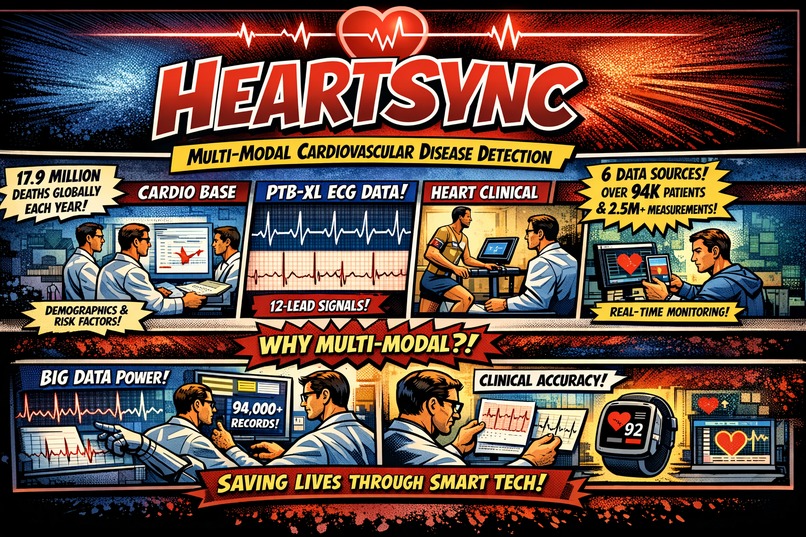
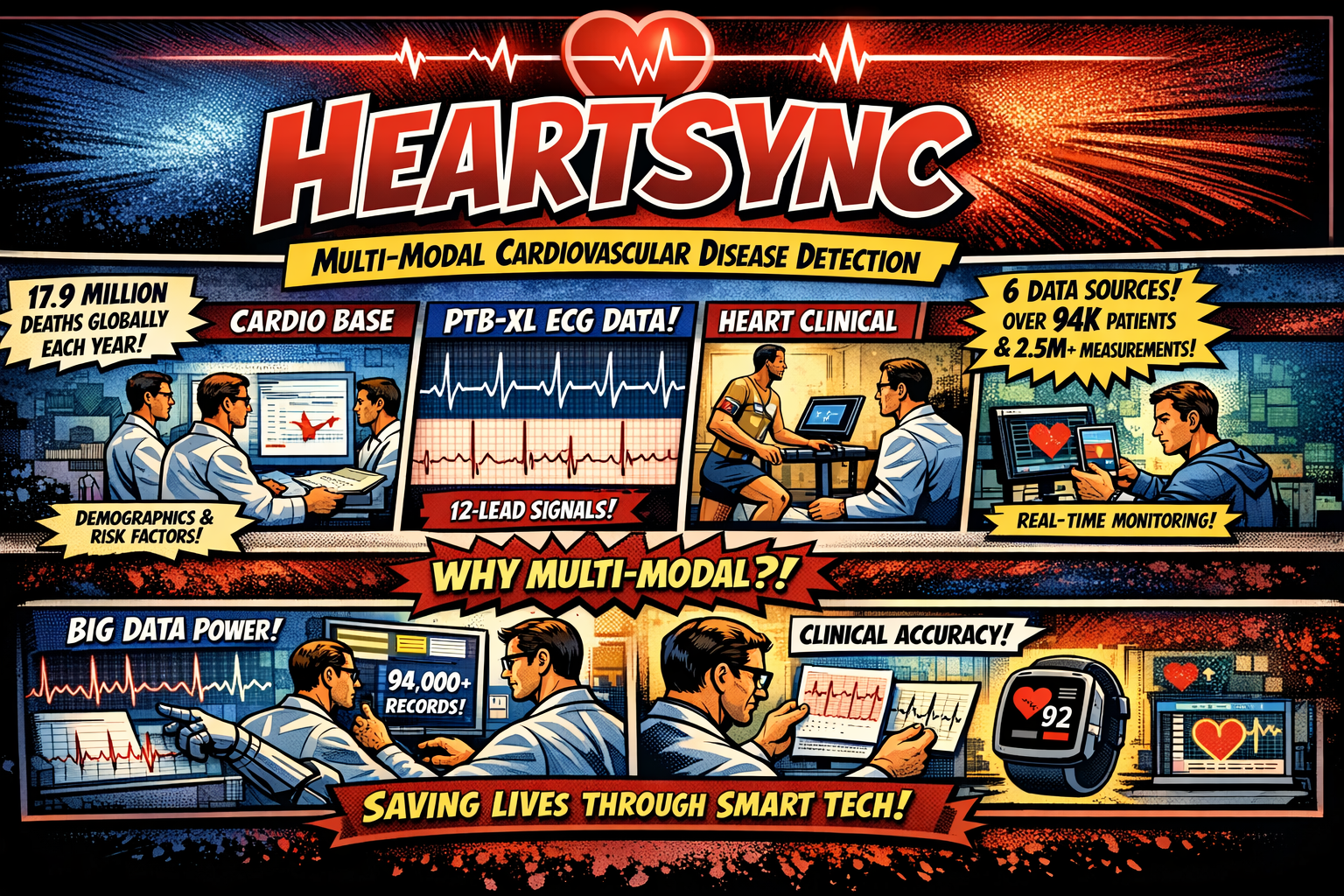
Cardiovascular diseases (CVDs) remain the leading cause of death worldwide, responsible for over 17.9 million deaths annually.
Despite major advancements in healthcare, most diagnostic systems still rely on single-source data — either clinical reports, ECG readings, or lifestyle indicators — which often miss the full physiological picture.
We asked:
What if we could unify clinical data, ECG signals, and real-world wearable monitoring into one intelligent early-detection system?
HeartSync was created to answer that challenge.
What it does
HeartSync is a multi-modal AI cardiovascular detection platform that integrates:
- 🧬 Population health records
- 🏥 Clinical diagnostic features
- 📈 Raw and labeled ECG signals
- ⌚ Wearable heart-rate sensor data
The system:
- Extracts physiological features
- Trains ML models across data modalities
- Predicts cardiovascular disease risk
- Produces interpretable health insights
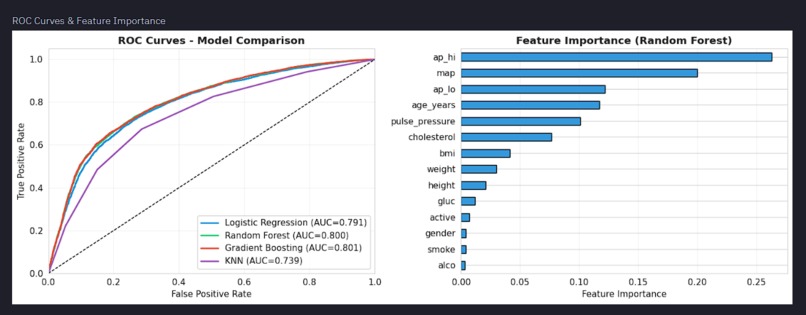
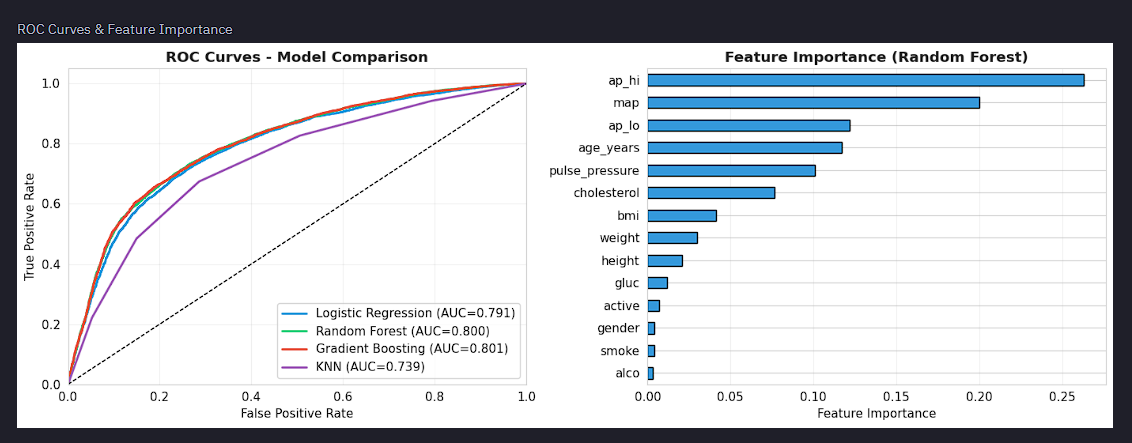
Model performance exceeded 0.80 AUC across datasets.
Inline metric example: ( AUC > 0.80 )
Displayed equation:
$$ AUC = \int_0^1 TPR(FPR)\,d(FPR) $$
How we built it
Data Fusion
| Dataset | Size | Why We Used It |
|---|---|---|
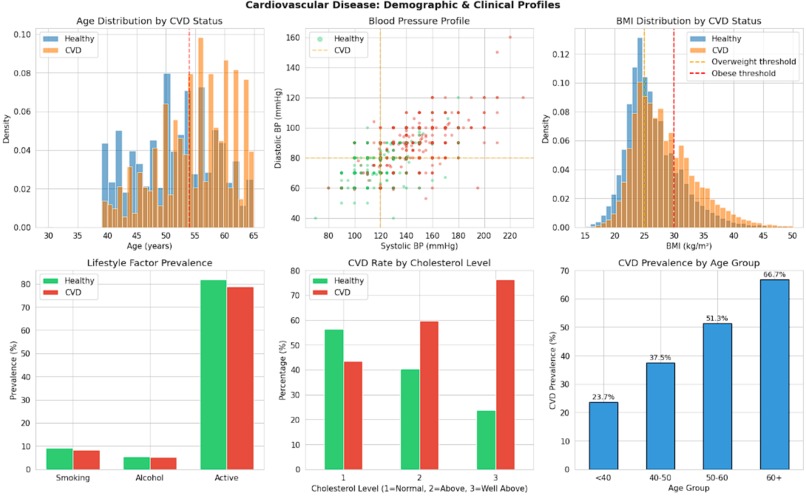
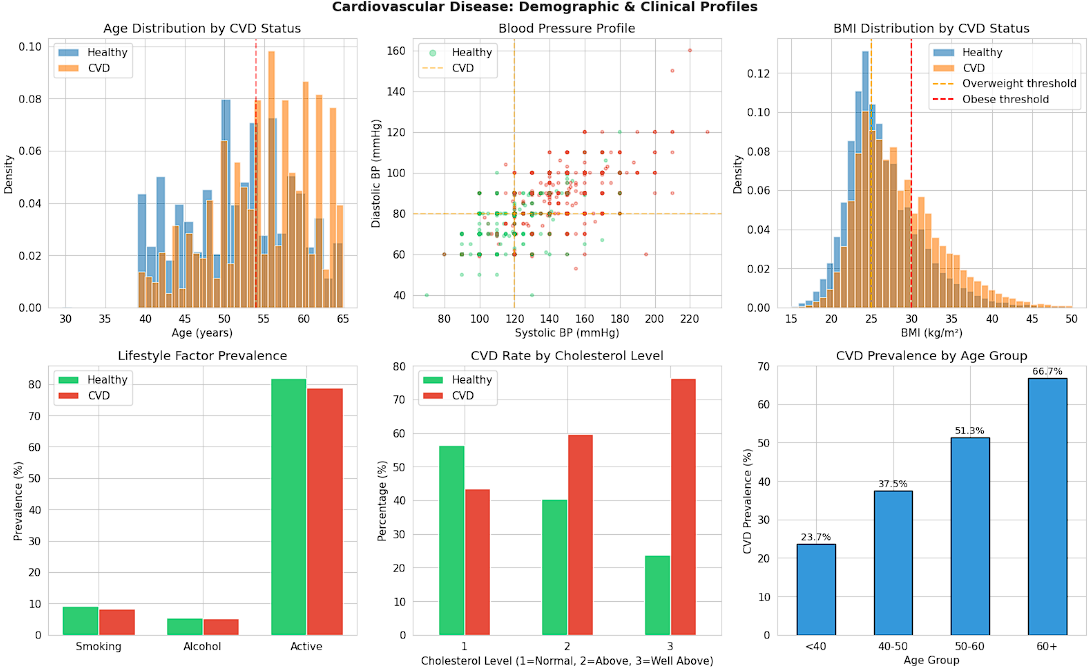
| Cardio Base | 70K | Large-scale risk factor analysis |
| Heart Clinical | 918 | High-quality diagnostic features |
| PTB-XL ECG | 21,837 | Expert-labeled ECG patterns |
| Raw ECG Signals | 500 | Signal-level feature engineering |
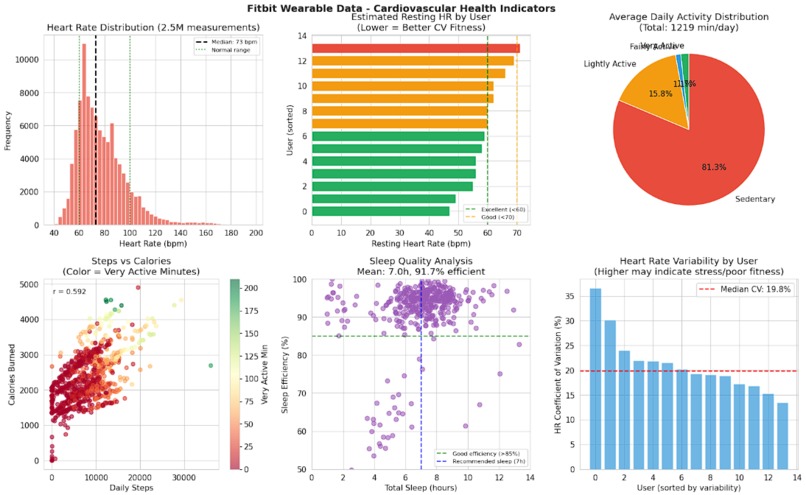
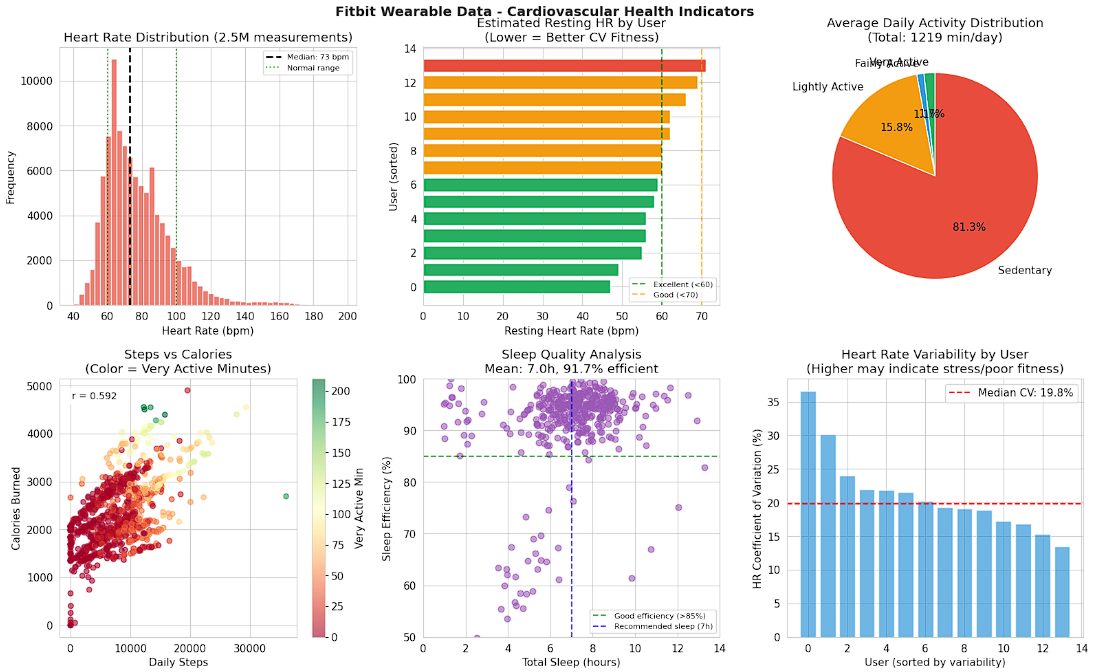
| Fitbit Wearables | 2.5M HR points | Real-world continuous monitoring |
| SCP Codes | 73 | Clinical interpretability |
Modeling Pipeline
- Signal processing on ECG waveforms
- Feature extraction & normalization
Machine learning classifiers:
- Logistic Regression
- Random Forest
- Gradient Boosting
- Neural Networks
- Logistic Regression
Cross-validation and AUC benchmarking
Challenges we ran into
- Data format heterogeneity
- Noisy ECG and wearable signals
- Class imbalance in medical data
- Feature alignment across modalities
Accomplishments that we're proud of
- Built a full multi-modal AI healthcare system
- Achieved strong predictive performance
- Integrated wearable sensor analytics
- Developed interpretable medical risk models
What we learned
- Multi-modal AI outperforms single-source models
- Biomedical signal processing is critical
- Interpretability is essential in healthcare
- Real-world data improves preventive detection
What’s next for HeartSync
- Real-time wearable integration
- Deep learning on ECG streams
- Mobile health dashboard
- Clinical deployment trials
- Preventive risk alert systems
HeartSync’s mission:
Unifying AI and healthcare data to prevent cardiovascular disease before it strikes.
Built With
- collab
- python

Log in or sign up for Devpost to join the conversation.