Inspiration
Heart disease is one of the leading causes of death worldwide, and early detection can save lives. Many people don’t have access to quick and affordable medical checkups, so we were inspired to build an AI-powered tool that can help predict heart risk from basic health parameters.
What it does
HeartRiskDetector-AI takes user health data (such as age, blood pressure, cholesterol, blood sugar, etc.), preprocesses it, and runs it through a trained machine learning model to predict whether the person is at risk of heart disease. The system provides quick, reliable, and accessible health insights.
How we built it
Collected and cleaned a publicly available heart disease dataset.
Applied data preprocessing (handling missing values, normalization, feature scaling).
Built and trained multiple machine learning models (Logistic Regression, Random Forest, etc.).
Evaluated models based on accuracy, precision, recall, and F1-score.
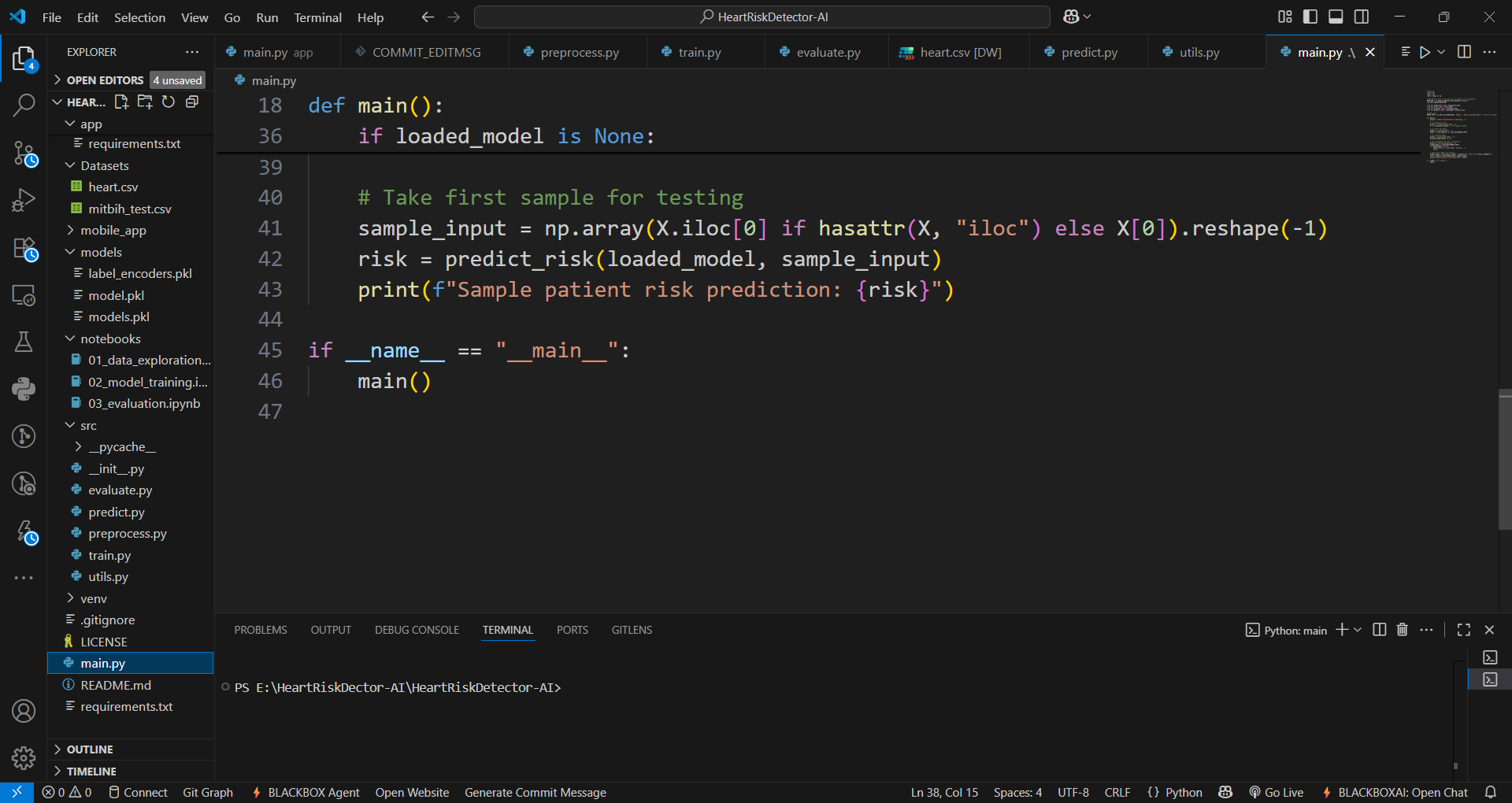
Integrated the best model into a Python-based system with a simple interface for user input and predictions.
Challenges we ran into
Handling missing and imbalanced data.
Choosing the best model and avoiding overfitting.
Optimizing accuracy while keeping predictions explainable.
Integrating preprocessing and prediction pipelines smoothly without runtime errors.
Accomplishments that we're proud of
Successfully built a working AI model that predicts heart disease risk with good accuracy.
Designed a structured and reusable pipeline for preprocessing and model training.
Learned how to debug and optimize real-world AI applications.
What we learned
Practical experience in data preprocessing and feature engineering.
Hands-on application of ML algorithms and evaluation techniques.
The importance of model interpretability in healthcare applications.
Collaboration and structured project development.
What's next for HeartRiskDectector-AI
Building a web or mobile app for easy accessibility.
Adding explainable AI (XAI) features to show why predictions are made.
Expanding the dataset for higher accuracy and global usability.
Integrating with wearable devices for real-time monitoring.


Log in or sign up for Devpost to join the conversation.