Inspiration
Cardiovascular Disease (CVD) continues to be the leading cause of global mortality. Despite this, most individuals lack clarity about the specific factors driving their personal risk and what measurable actions could reduce it. Existing risk calculators typically output a single numerical score, offering little to no explanation or guidance.
This project was inspired by the need for a transparent and user-centric AI solution that not only predicts cardiovascular risk but also clearly explains the underlying drivers and demonstrates how modifiable health factors can improve long-term outcomes.
What It Does
CardioInsight AI estimates an individual’s 10-year CVD risk and extends beyond traditional prediction tools by:
Identifying the most influential clinical and lifestyle risk factors
Quantifying potential risk reduction through improvements in modifiable variables
Providing actionable, interpretable insights instead of a black-box score
Supporting both complete clinical records and limited-input scenarios
Additionally, the system enables population-level risk evaluation using real-world cardiovascular datasets and interactive individual-level analysis.
How We Built It
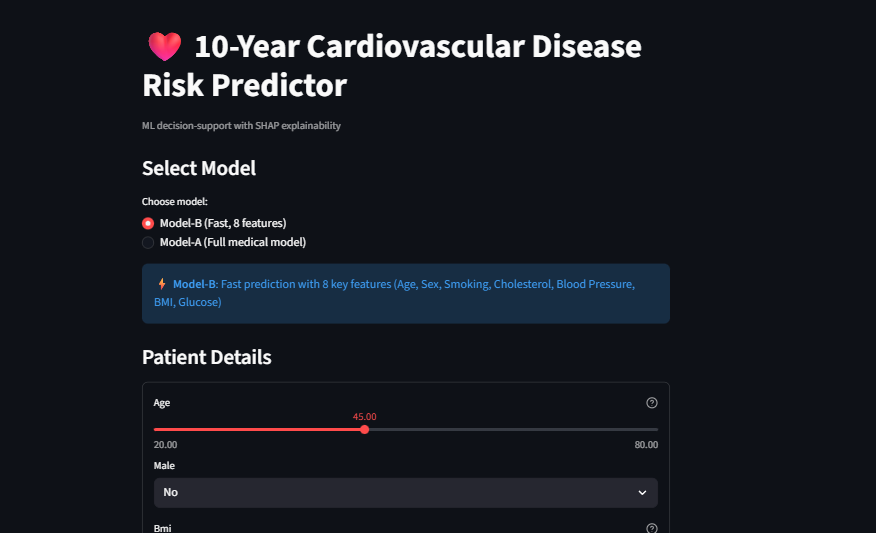
The system follows a dual-model architecture:
Clinical Model: Uses a rich set of medical features for high-precision predictions in clinical or research environments
Lightweight Model: Operates with fewer, commonly available inputs to ensure accessibility in constrained settings
Both models are trained using XGBoost, with explicit handling of class imbalance and probability calibration for reliable risk estimation.
Explainability and trust were enhanced through SHAP-based feature attribution, counterfactual “what-if” analysis, and deployment via an interactive Streamlit application.
Challenges
Managing severe class imbalance in medical datasets
Producing well-calibrated probabilities suitable for medical decision support
Translating complex ML explanations for non-technical users
Designing medically realistic simulations
Ensuring dataset consistency across training and evaluation
Accomplishments
Built a transparent and explainable CVD risk prediction system
Delivered actionable risk-reduction insights
Designed a scalable dual-model framework
Deployed a functional interactive web application
Ensured reproducibility with structured notebooks and saved artifacts
What We Learned
Accuracy alone is insufficient in healthcare AI—interpretability and calibration are equally critical. Even limited data can yield meaningful insights when used carefully, and explainable models significantly increase user trust.
What’s Next
Future work includes large-scale clinical validation, personalized lifestyle guidance, wearable data integration, fairness analysis, and collaboration with healthcare researchers.
Built With
- google-colab
- jupyter
- numpy
- pandas
- python
- scikit-learn
- shap
- streamlit
- xgboost

Log in or sign up for Devpost to join the conversation.