HeartLens AI
Inspiration
Cardiovascular disease remains one of the most critical global health challenges, accounting for millions of deaths annually. Despite advancements in medical technology, early detection and preventive risk assessment remain inaccessible to many individuals due to limitations in healthcare infrastructure, cost, and awareness.
HeartLens AI was inspired by the need for an intelligent, data-driven system capable of supporting early cardiovascular risk identification through Machine Learning and explainable analytics. Our objective was to design a solution that not only delivers accurate predictions but also provides interpretable insights that healthcare professionals and patients can understand and trust.
By combining Artificial Intelligence with healthcare data analysis, we aimed to develop a scalable and accessible tool that contributes toward preventive healthcare and informed clinical decision-making.
What it does
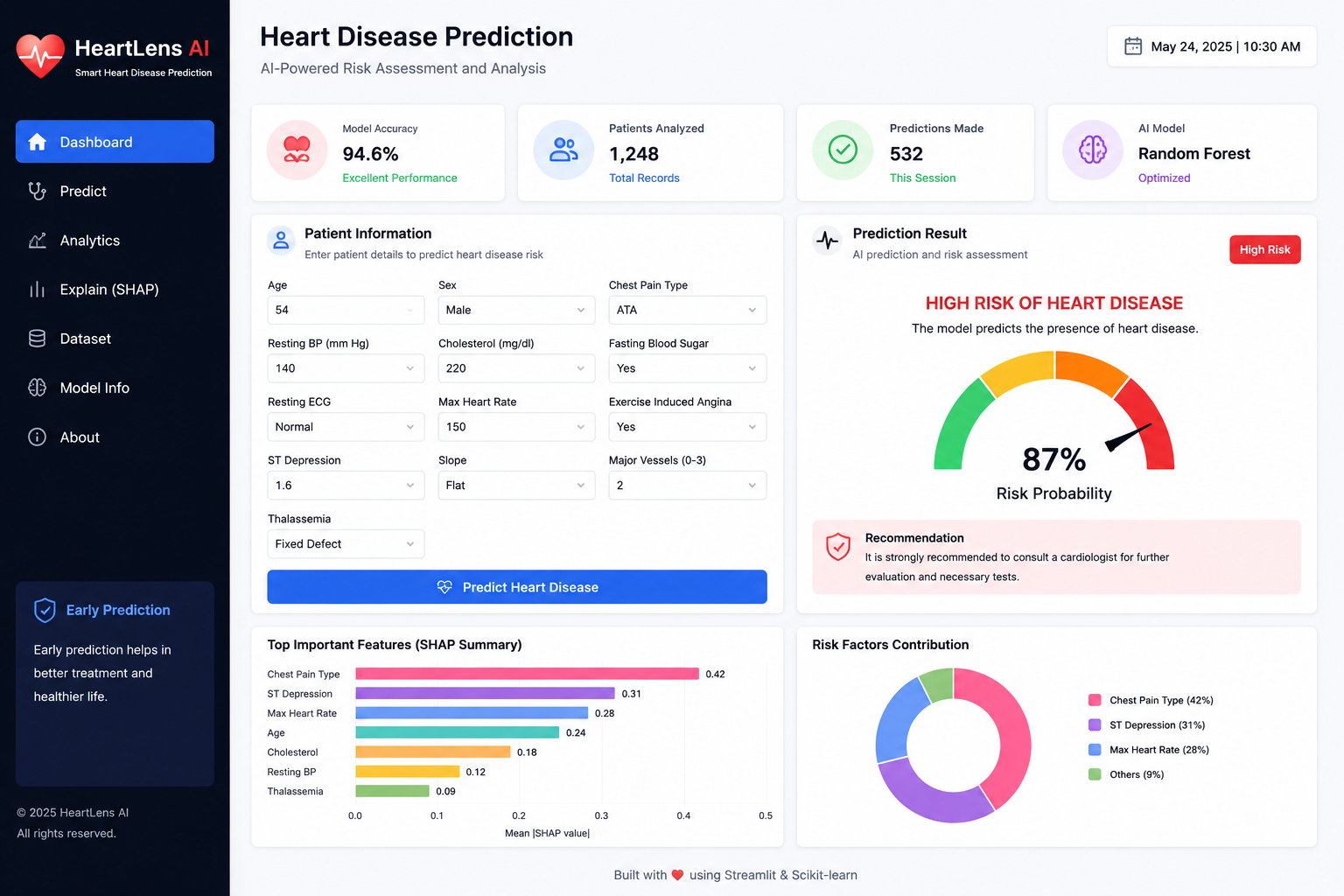
HeartLens AI is an AI-powered cardiovascular risk assessment platform designed to predict the likelihood of heart disease using patient health data.
The system analyzes multiple clinical parameters, including:
- Age
- Blood pressure
- Cholesterol levels
- Maximum heart rate
- Blood sugar levels
- Chest pain type
- Exercise-induced angina
Using these inputs, the platform:
- Predicts cardiovascular disease risk
- Generates a confidence-based risk score
- Identifies influential contributing factors
- Provides visual insights through an interactive dashboard
A key component of the platform is its Explainable AI framework, which enhances transparency by demonstrating how individual health parameters contribute to prediction outcomes.
How we built it
The development of HeartLens AI followed a structured end-to-end Machine Learning pipeline.
Data Collection and Preprocessing
We utilized publicly available cardiovascular datasets containing patient diagnostic records and clinical health parameters. The preprocessing pipeline included:
- Data cleaning
- Missing value handling
- Feature encoding
- Data normalization and scaling
- Exploratory Data Analysis (EDA)
Feature standardization was performed using statistical normalization techniques to improve model performance and consistency.
Machine Learning Model Development
We evaluated multiple Machine Learning algorithms, including:
- Logistic Regression
- Decision Trees
- Random Forest Classifier
After comparative analysis based on accuracy, stability, and interpretability, Random Forest was selected as the primary predictive model due to its strong performance on structured healthcare datasets.
The model was trained and validated using standard train-test split methodologies and evaluated using:
- Accuracy
- Precision
- Recall
- F1-score
Explainable AI Integration
To improve model transparency and user trust, we integrated SHAP (SHapley Additive Explanations).
This enabled the system to:
- Interpret prediction outputs
- Visualize feature importance
- Explain how specific clinical parameters influenced the final prediction
The Explainable AI layer transformed the platform from a conventional prediction tool into an interpretable clinical decision-support system.
Frontend and Deployment
We developed an interactive dashboard using Streamlit to provide a user-friendly healthcare interface.
The dashboard allows users to:
- Input patient health information
- View real-time predictions
- Analyze feature contribution graphs
- Access risk interpretation visually
The platform architecture was designed to support scalability and future deployment enhancements.
Challenges we ran into
One of the primary challenges involved preprocessing healthcare datasets, as medical data often contains inconsistencies, missing values, and highly sensitive features requiring careful handling.
Another significant challenge was balancing prediction accuracy with interpretability. While several advanced models produced strong performance metrics, ensuring that the prediction process remained transparent and understandable was equally important.
Additional challenges included:
- Feature selection and optimization
- Hyperparameter tuning
- Integrating Explainable AI into the prediction workflow
- Connecting backend Machine Learning pipelines with frontend visualization components
- Designing an intuitive healthcare-focused user experience within limited development time
Accomplishments that we're proud of
We are proud to have successfully developed a fully functional AI-powered cardiovascular risk prediction platform with integrated Explainable AI capabilities.
Key accomplishments include:
- Building a complete end-to-end Machine Learning system
- Achieving reliable prediction performance on healthcare datasets
- Successfully implementing SHAP-based interpretability
- Developing an interactive and responsive healthcare dashboard
- Creating a scalable foundation for future healthcare AI applications
Most importantly, we developed a solution that emphasizes transparency, accessibility, and preventive healthcare impact rather than focusing solely on predictive accuracy.
What we learned
Through the development of HeartLens AI, we gained practical experience in:
- Healthcare data analysis
- Machine Learning model development
- Data preprocessing and feature engineering
- Explainable AI methodologies
- Frontend integration and visualization
- Model evaluation and optimization
Beyond technical implementation, we also learned the importance of ethical and interpretable AI systems in healthcare environments, where trust and transparency are critical factors in adoption and usability.
What's next for HeartLens AI
Our future roadmap for HeartLens AI includes:
- Integration of ECG waveform analysis
- Deployment of Deep Learning architectures
- Real-time wearable device integration
- Automated medical report generation
- Multi-disease predictive analytics
- Cloud-based deployment for broader accessibility
In the long term, we envision HeartLens AI evolving into a comprehensive AI-driven preventive healthcare platform capable of assisting healthcare professionals and supporting early diagnosis through intelligent clinical insights.

Log in or sign up for Devpost to join the conversation.