-
-
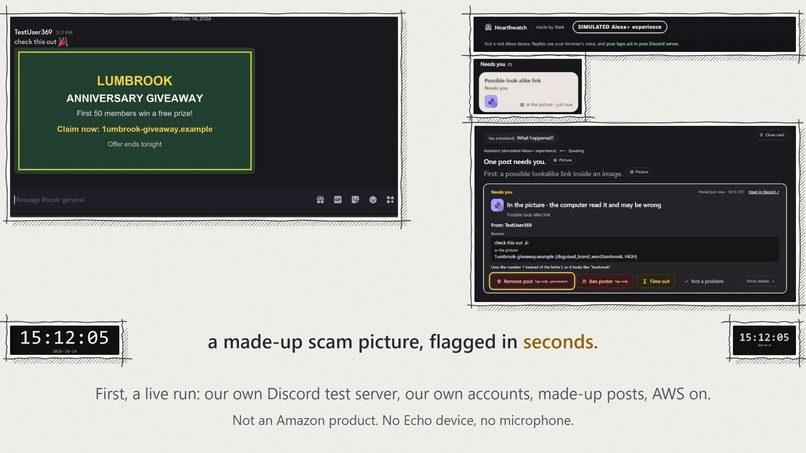
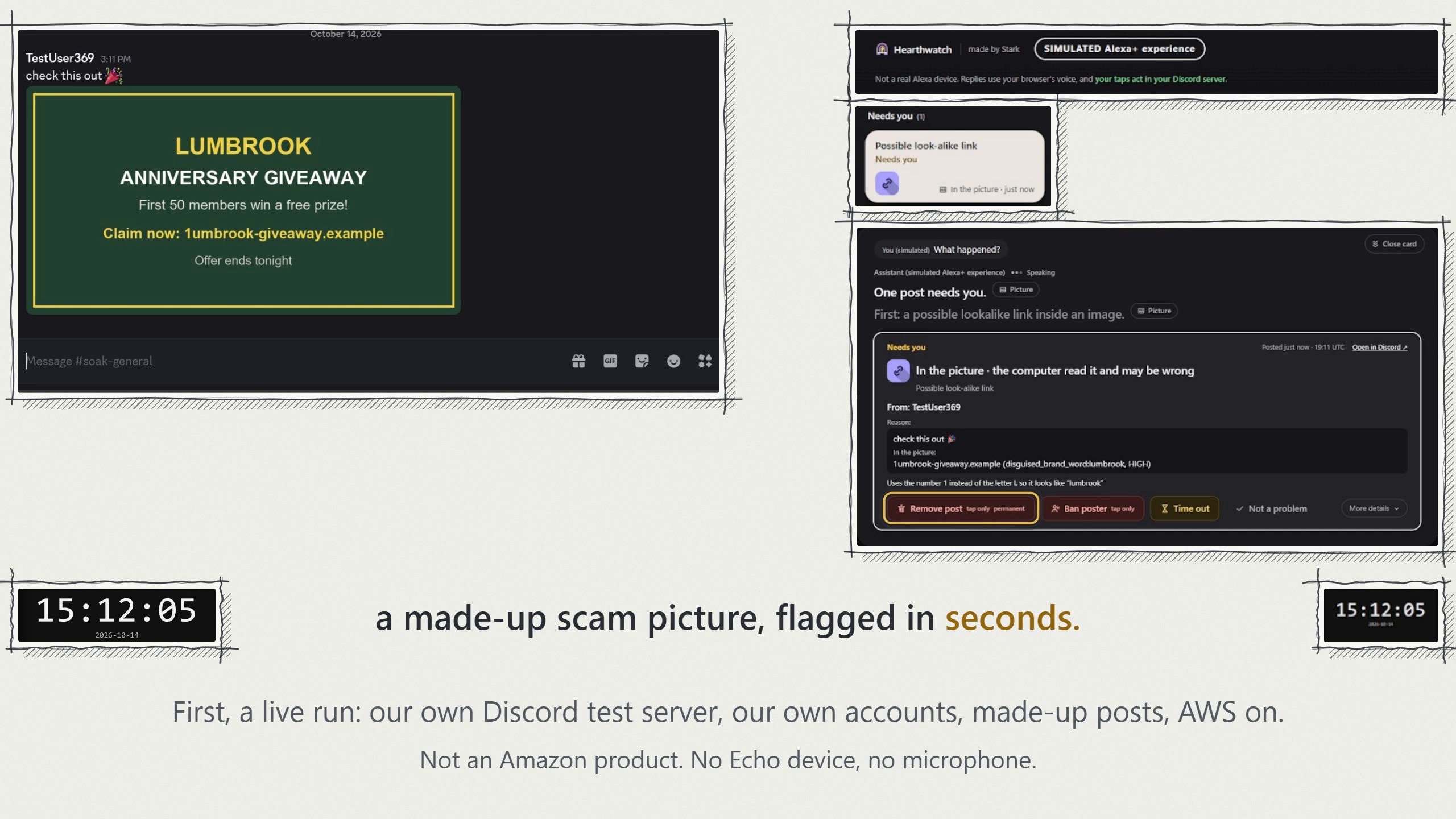
Live on our own test server, Oct 14, before voice typing was added: a made-up scam picture, flagged in seconds.
-
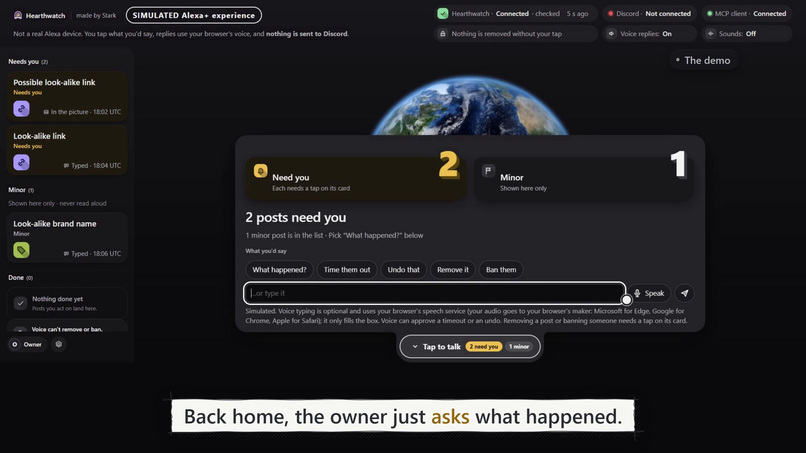
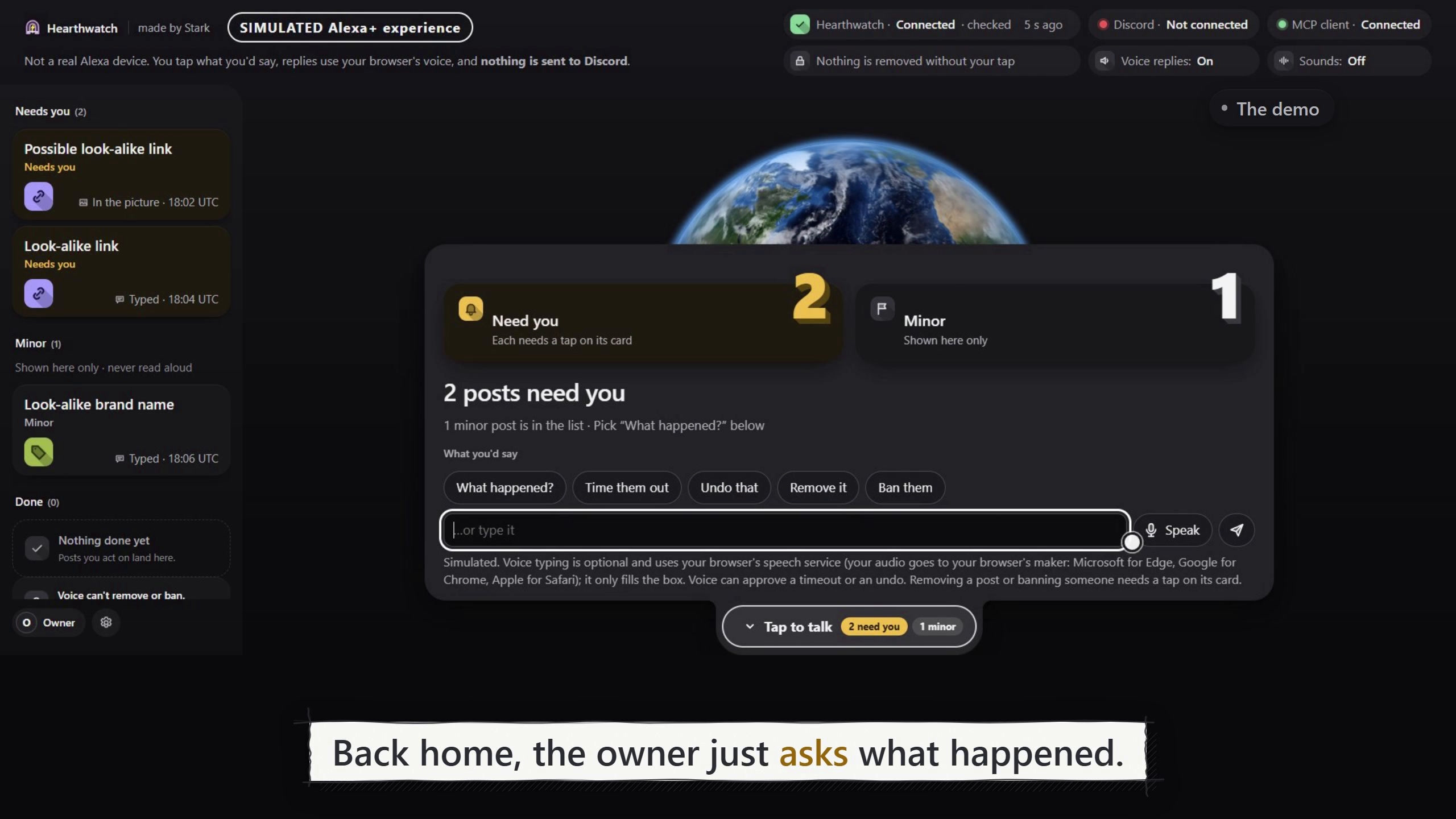
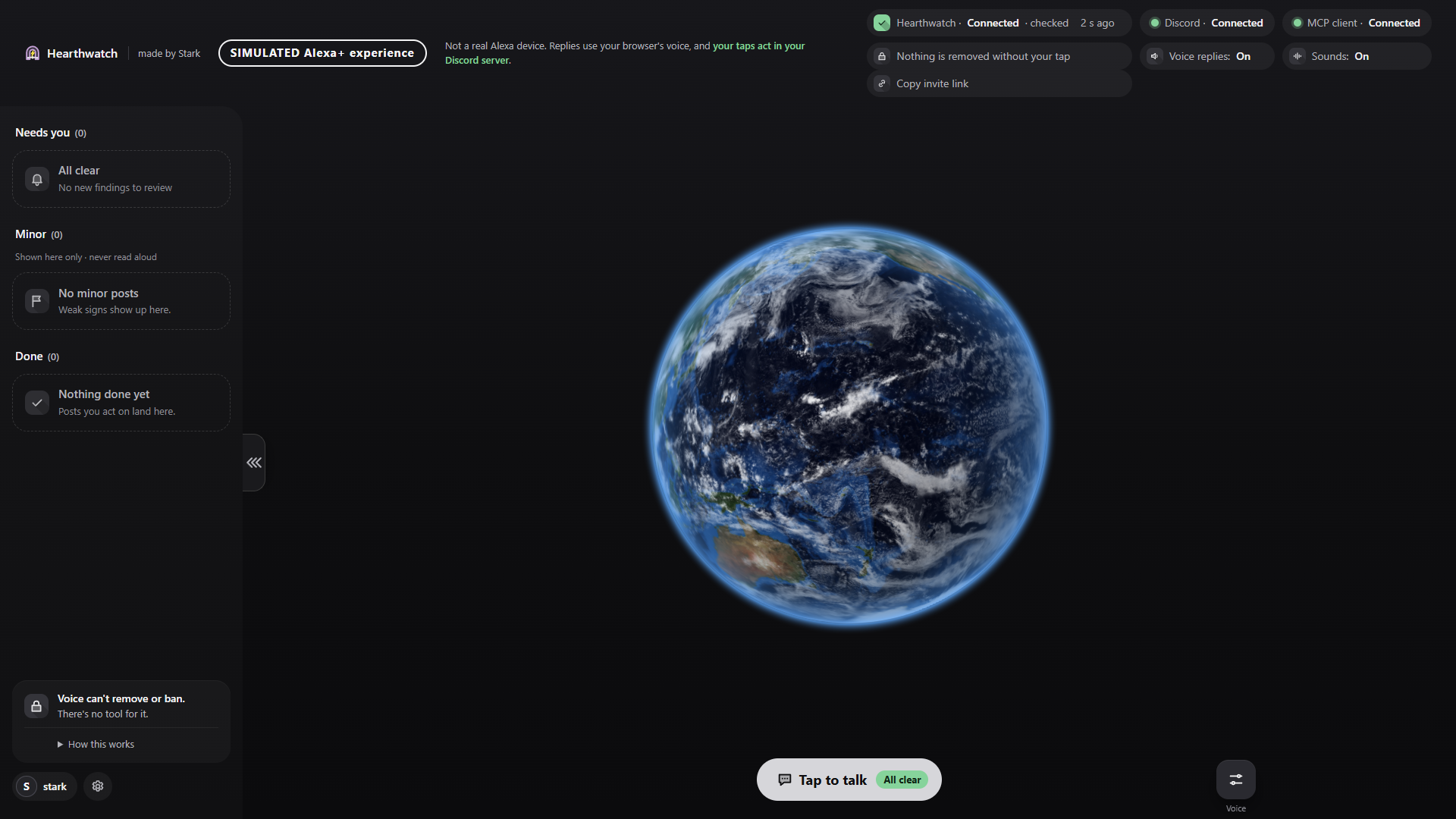
On the demo page (recorded, made-up posts), the owner asks out loud what happened.
-
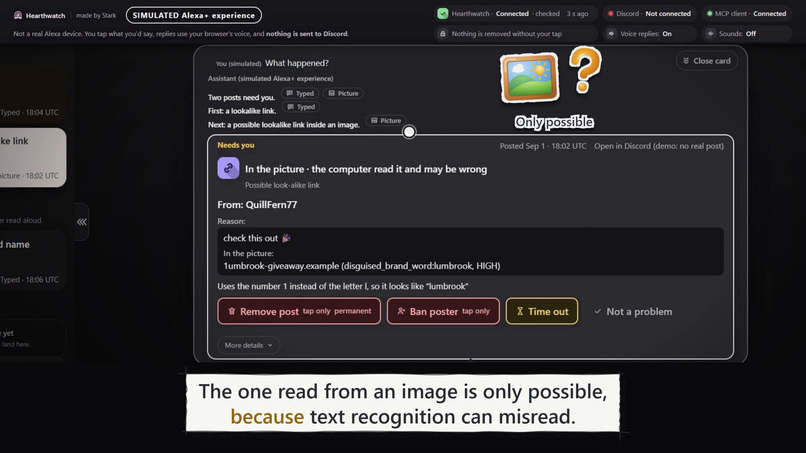
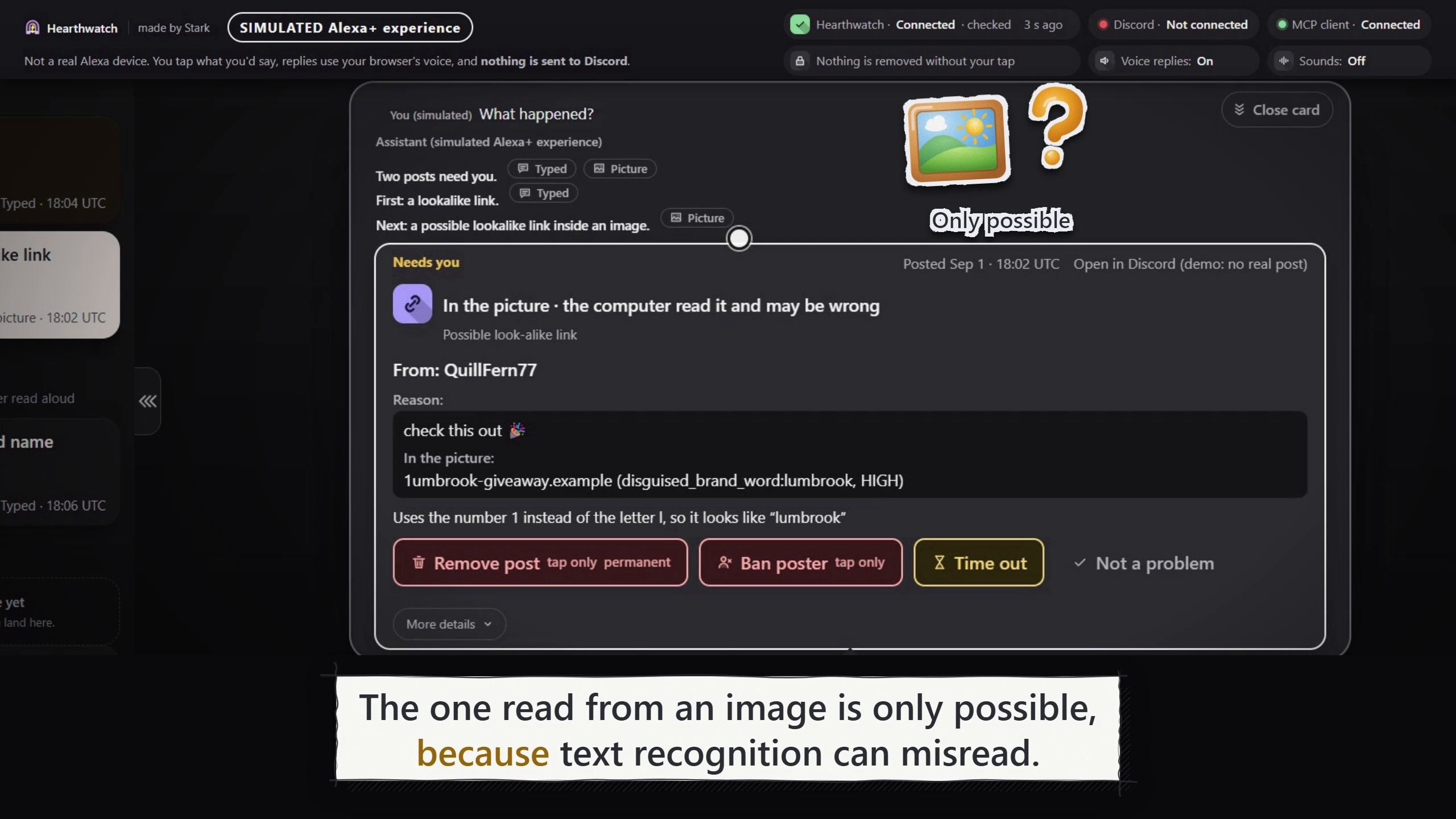
Demo page: a look-alike link read from an image is only "possible", because text recognition can misread. Its card still needs you.
-
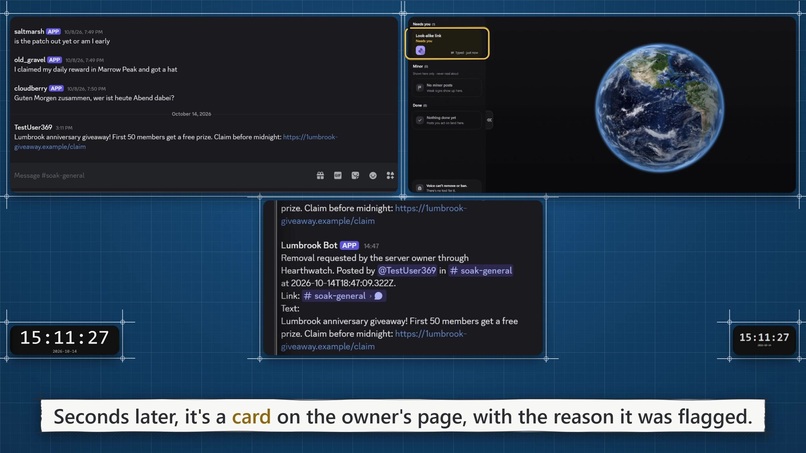
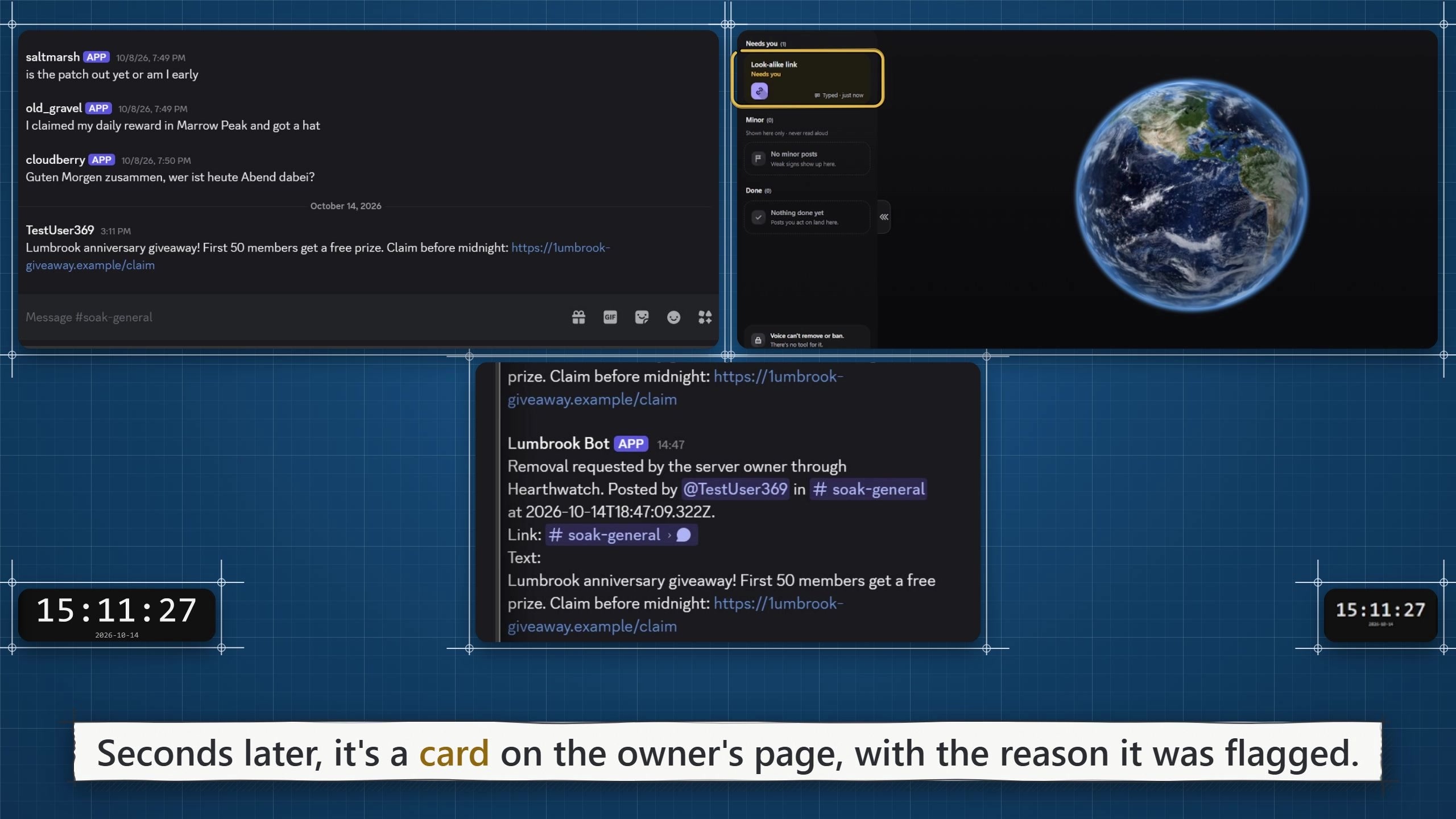
Live, Oct 14: seconds after a made-up scam post lands, it's a card on the owner's page. The 14:47 staff-log copy is from an earlier take.
-
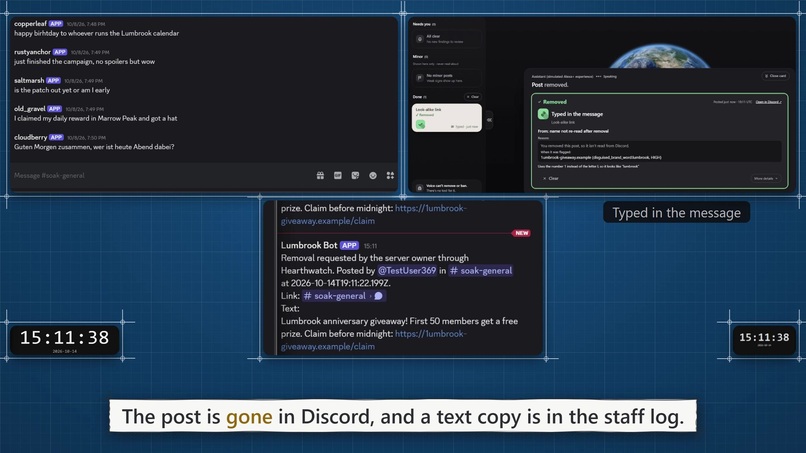
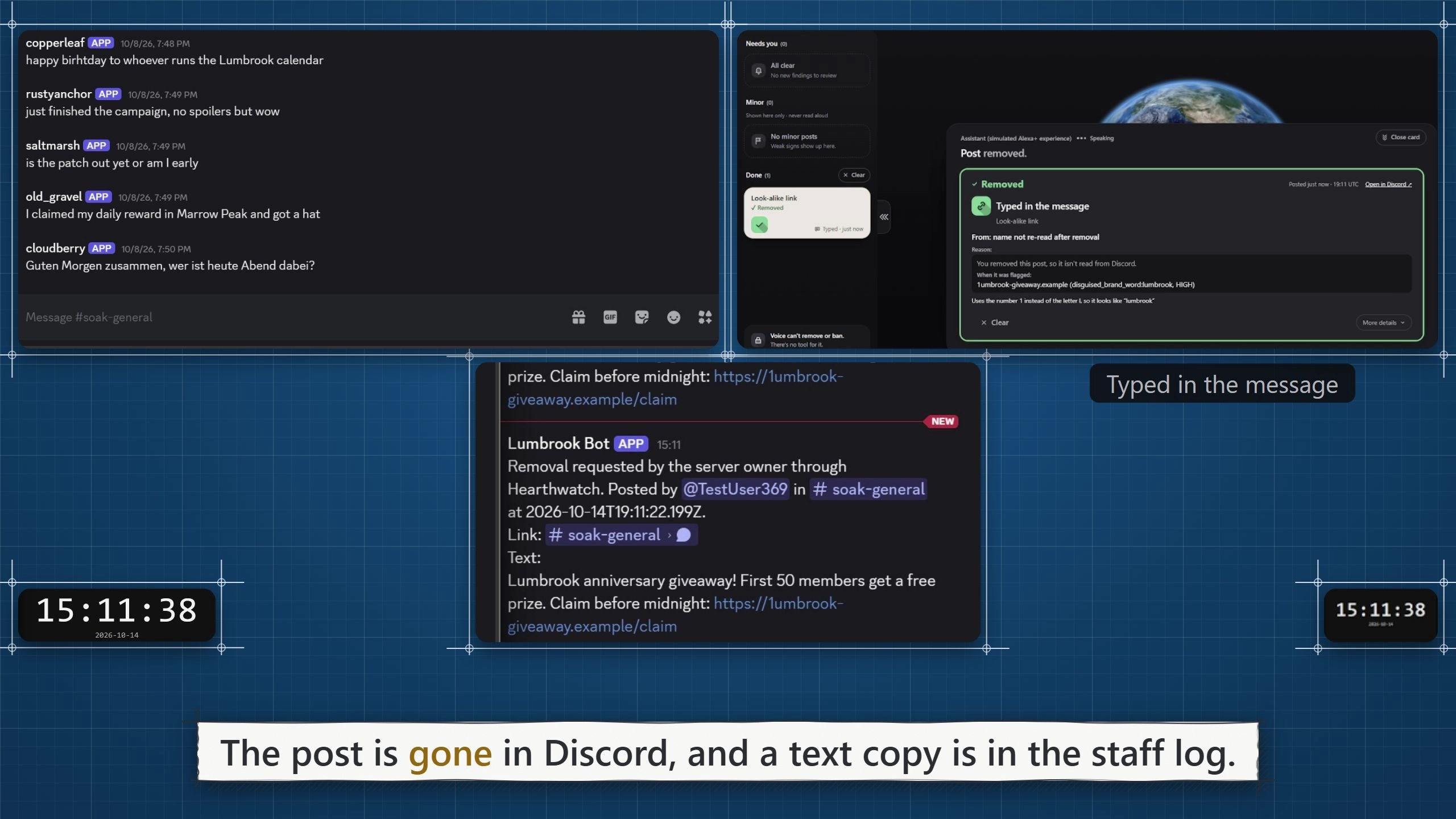
The post is gone in Discord, and a text copy is in the staff log.
-
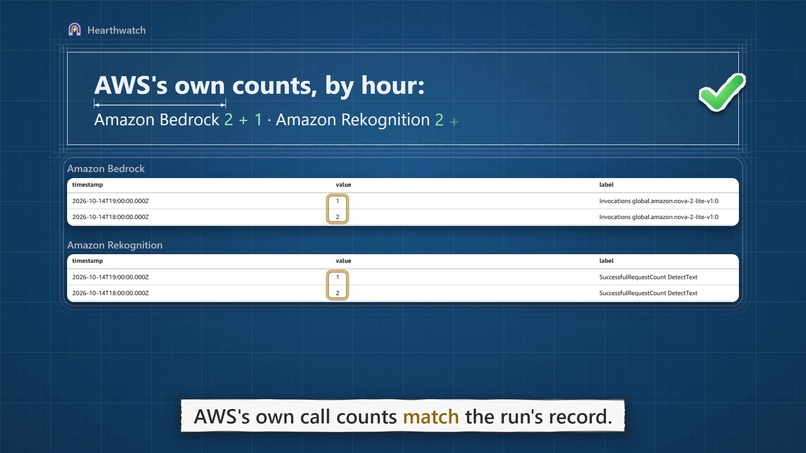
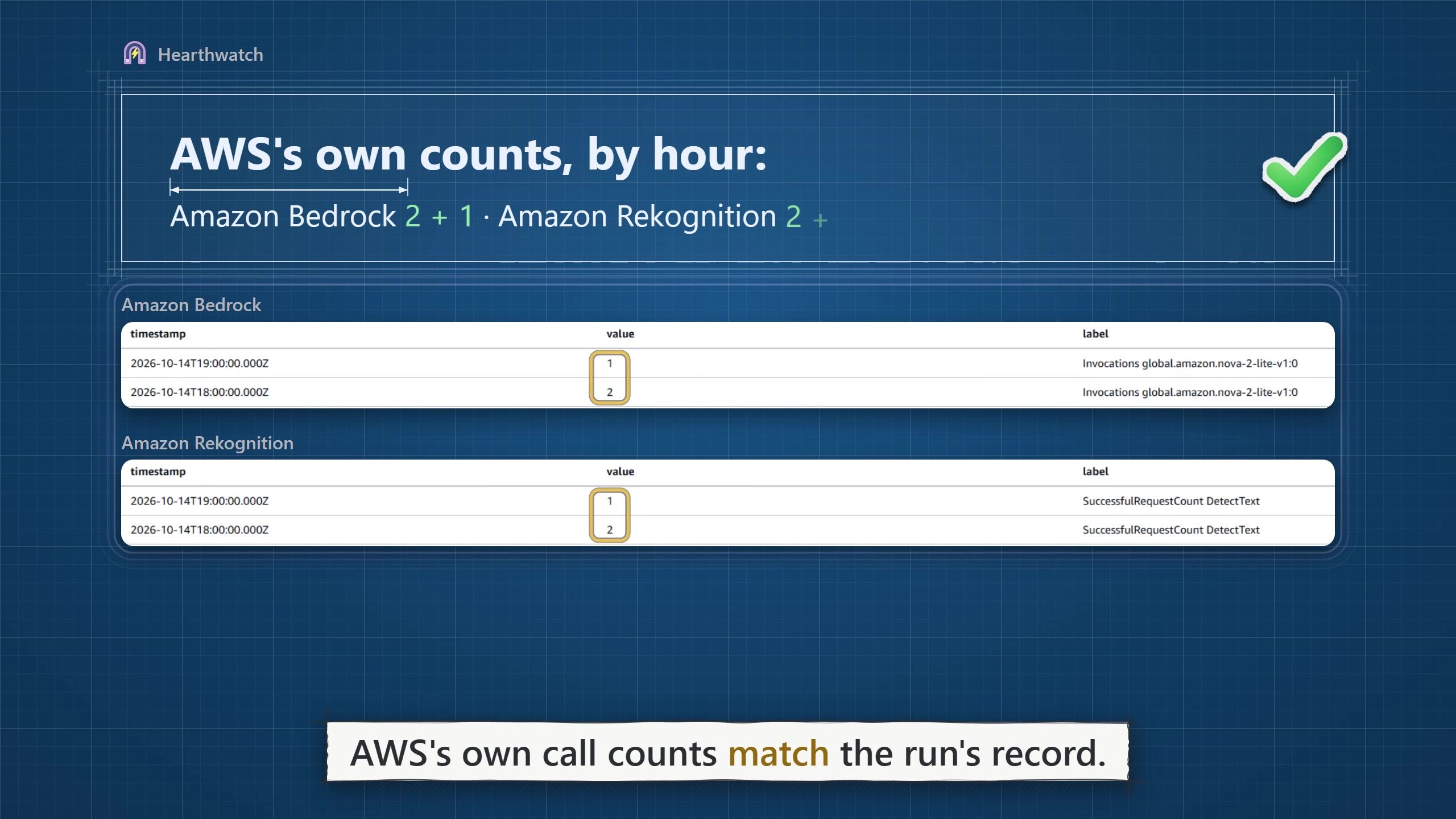
Live, Oct 14: AWS's own counts by hour (Bedrock 2 + 1, Rekognition 2 + 1) match the bot's records of the three takes.
-
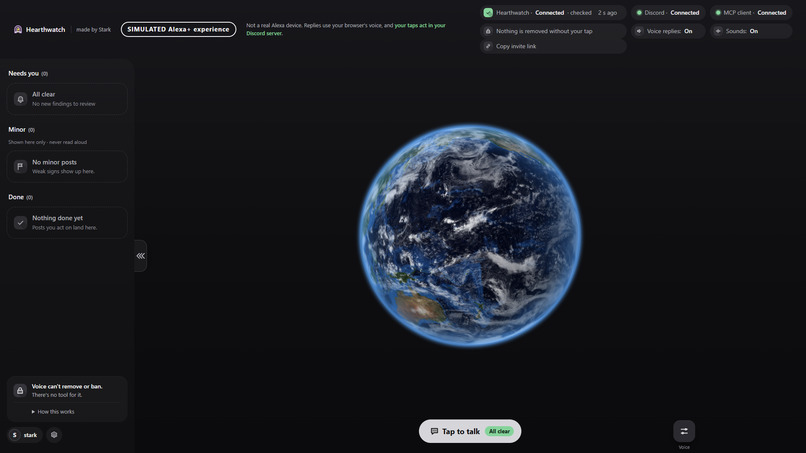
Live on our own test server: Hearthwatch, the Discord bot and an outside MCP client, all connected at once. All clear.
-
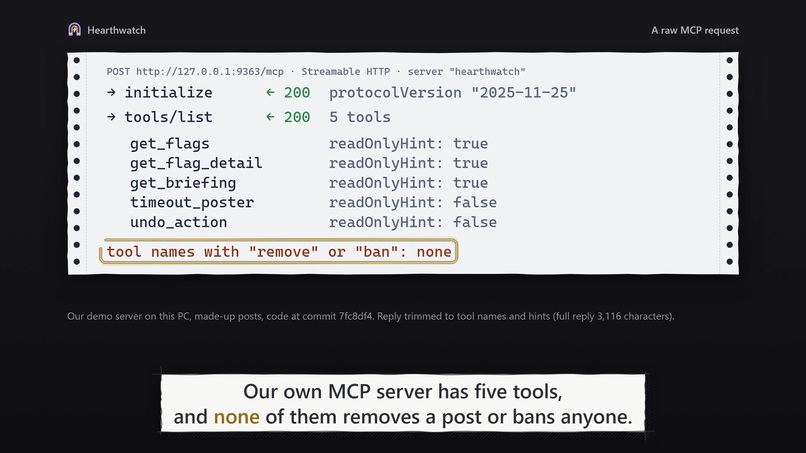
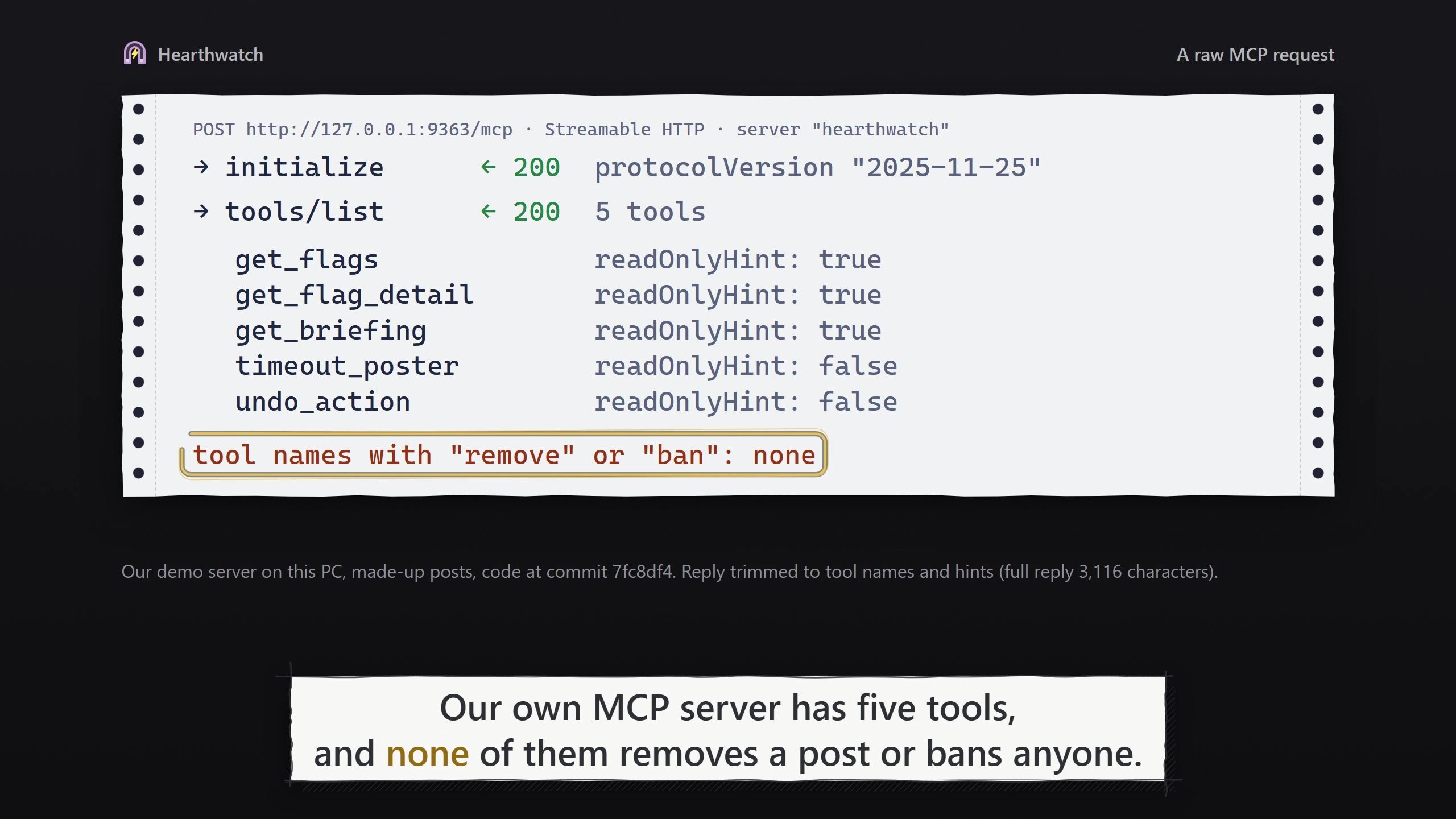
Our own MCP server has five tools, and none of them removes a post or bans anyone.
-
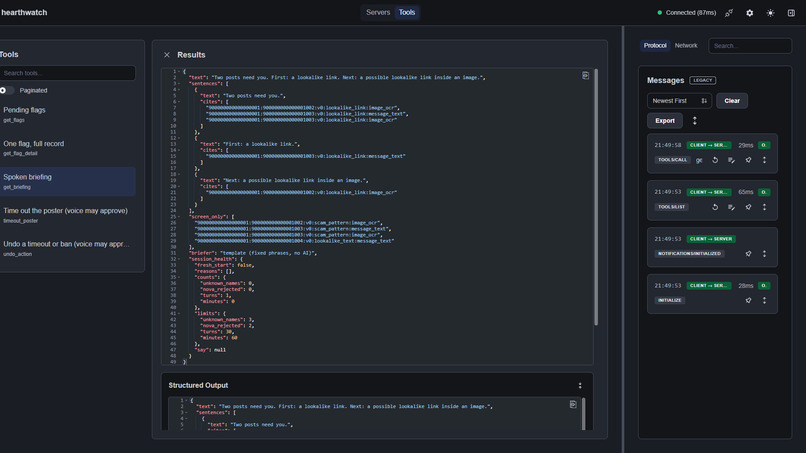
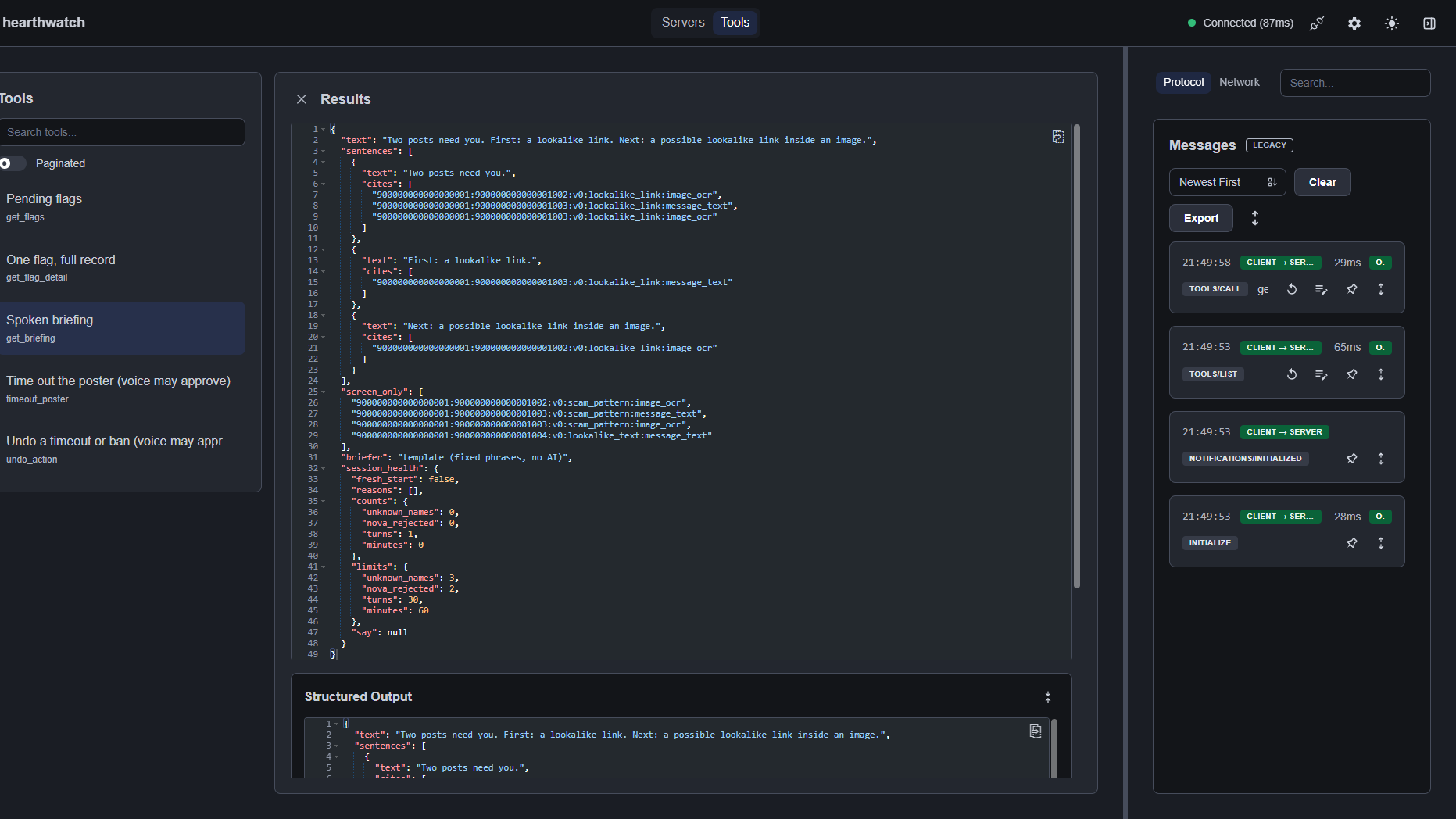
MCP Inspector, a real MCP client, on Hearthwatch's own MCP server (demo data): the briefing, each sentence citing its posts.
-
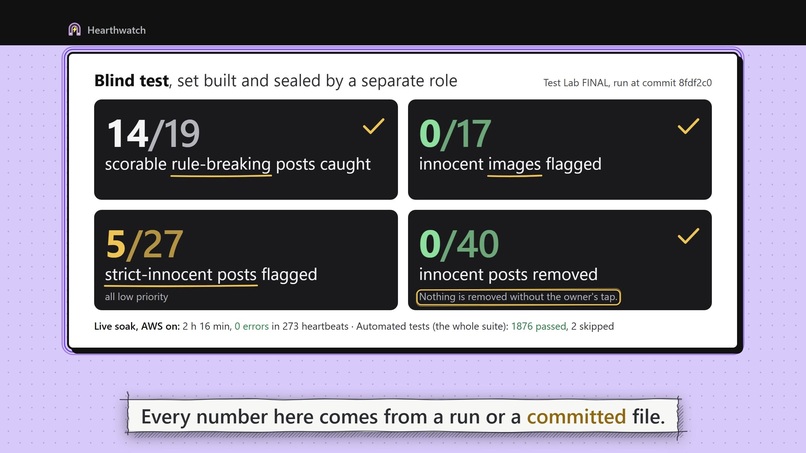
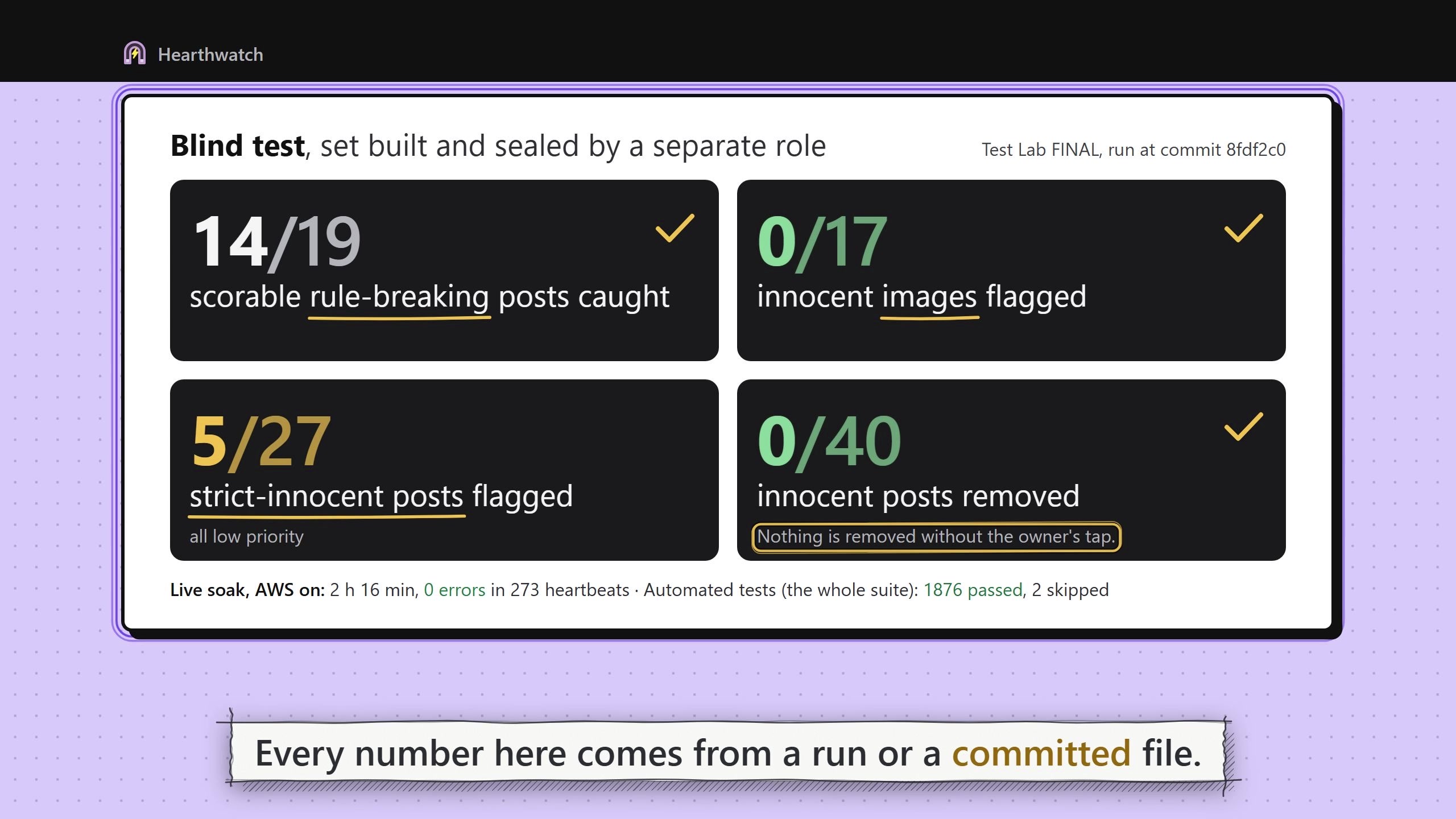
Tests: 1876 passed at 4b90c94, 1945 at the submission commit. 0 of 40 innocent posts removed: nothing is removed without the owner's tap.
-
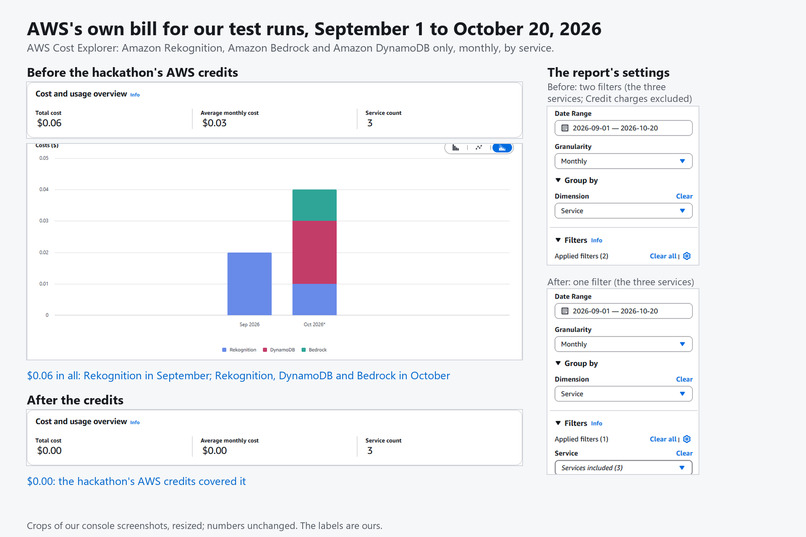
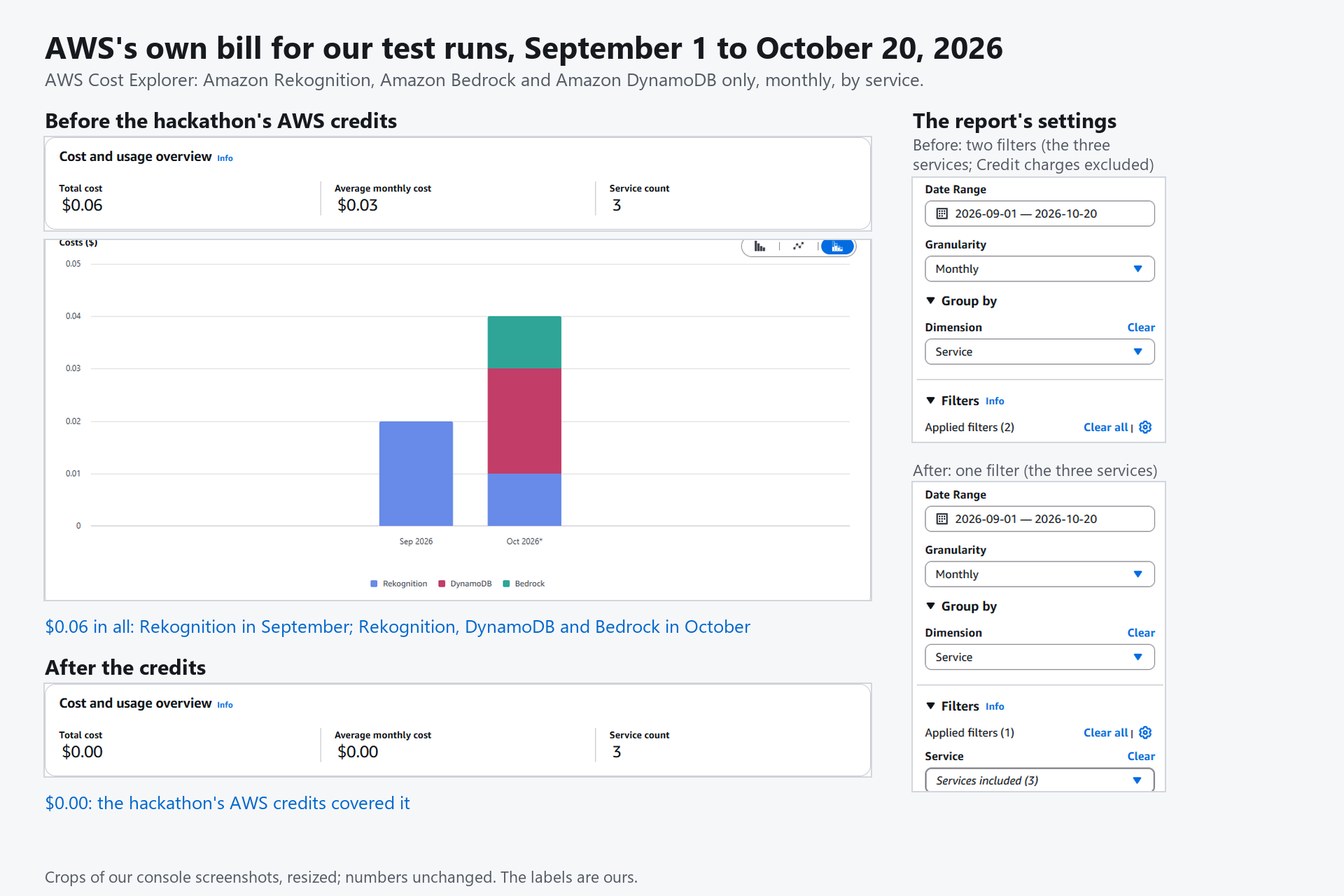
Amazon's own bill for our test runs, Sep-Oct 2026: Rekognition, Bedrock and DynamoDB, $0.06 before credits. AWS credits covered it.
-
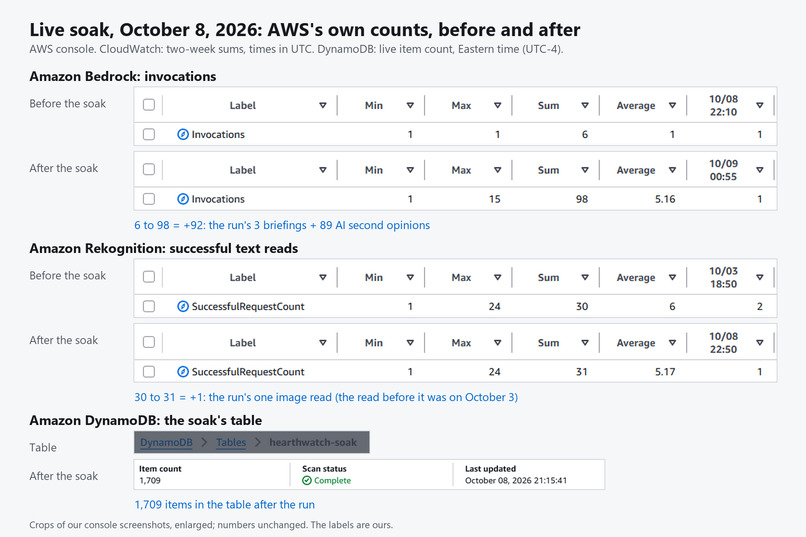
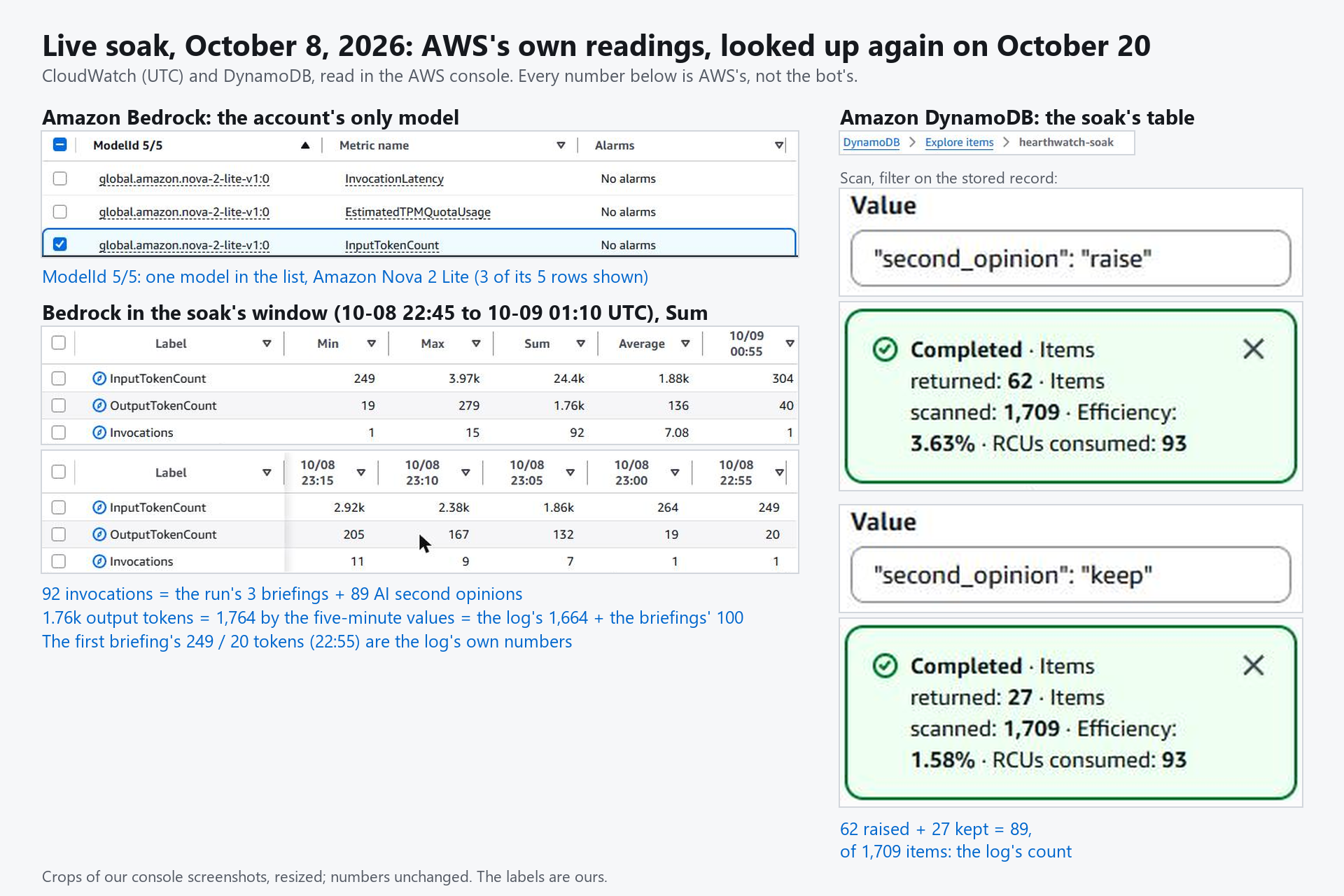
Live soak, Oct 8, AWS's own counts: Bedrock +92 (3 briefings + 89 second opinions), Rekognition +1, DynamoDB 1,709 items after.
-
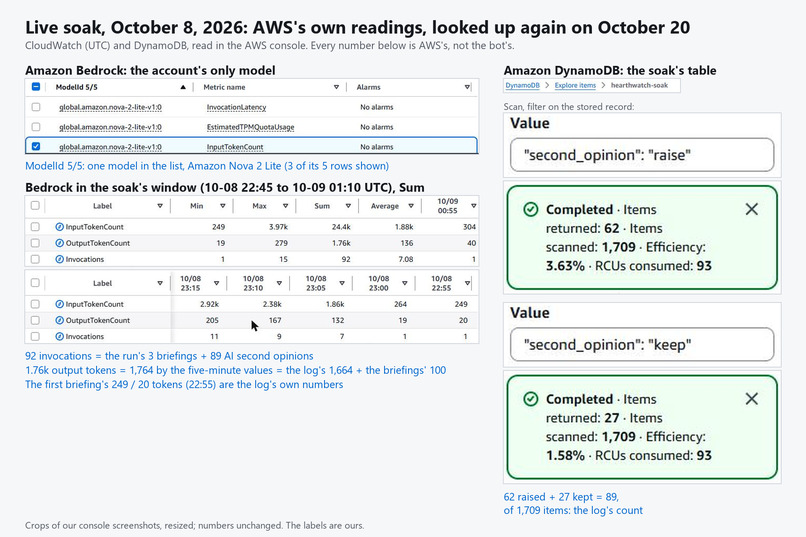
Soak, re-read Oct 20: Nova 2 Lite is the only Bedrock model; 92 calls, 1,764 output tokens; DynamoDB scan: 62 raise, 27 keep.
-
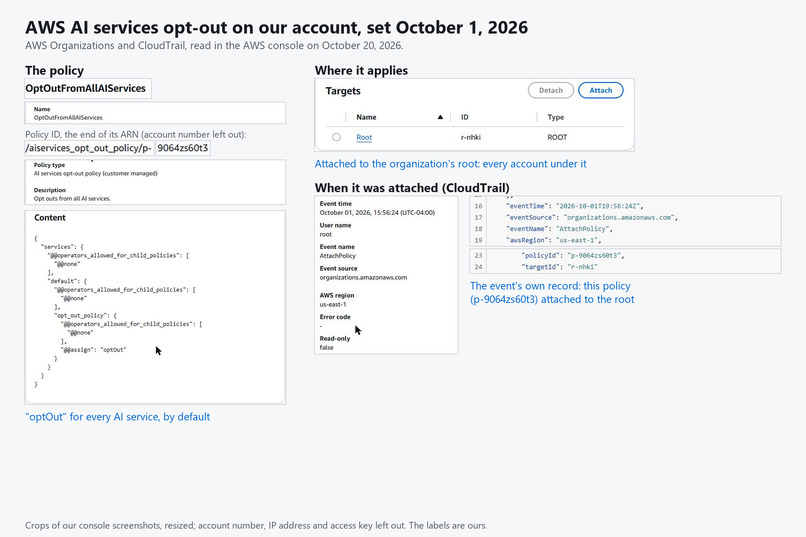
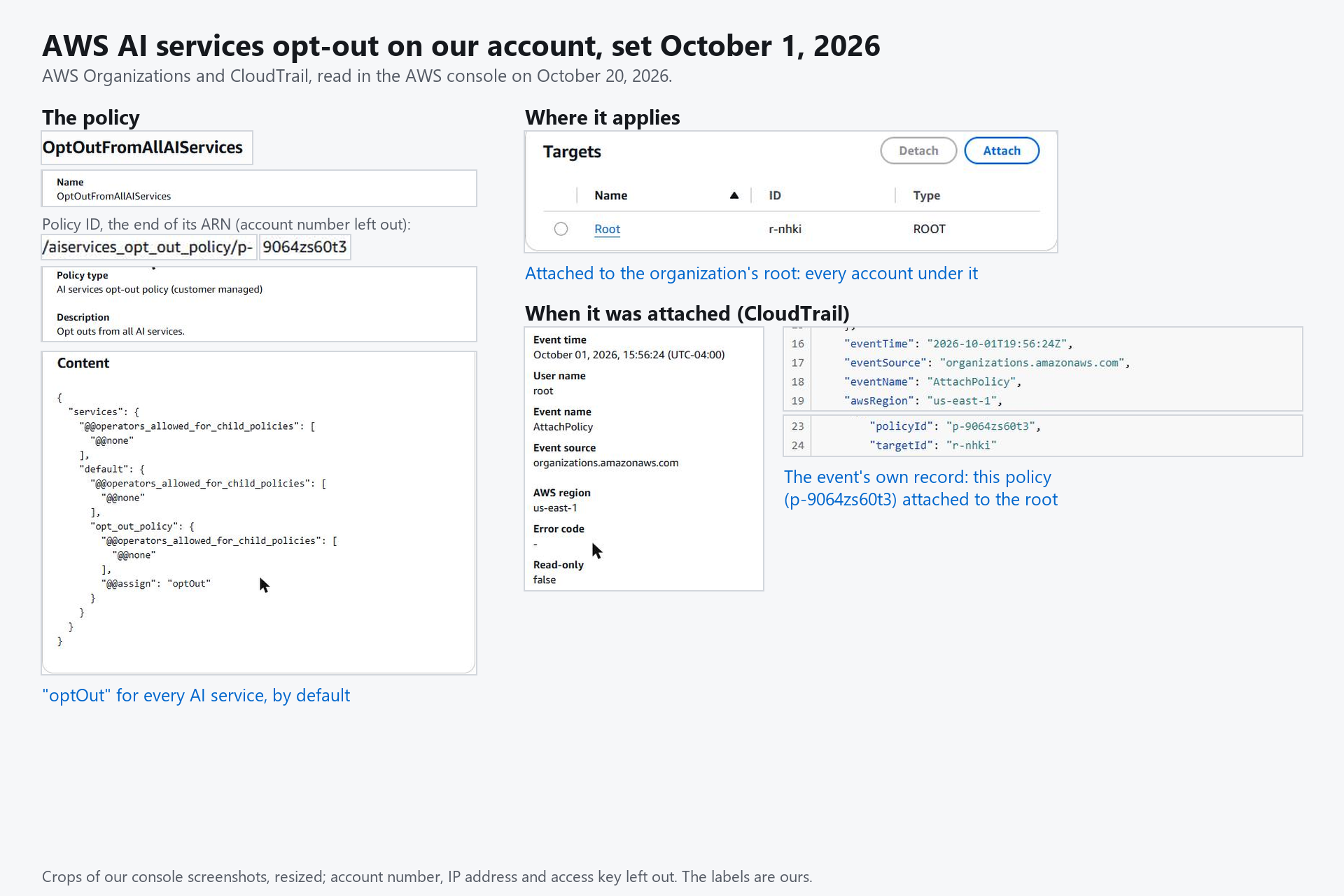
AWS AI services opt-out on our account: the policy, attached at the root on Oct 1, 2026 (CloudTrail's record).
-
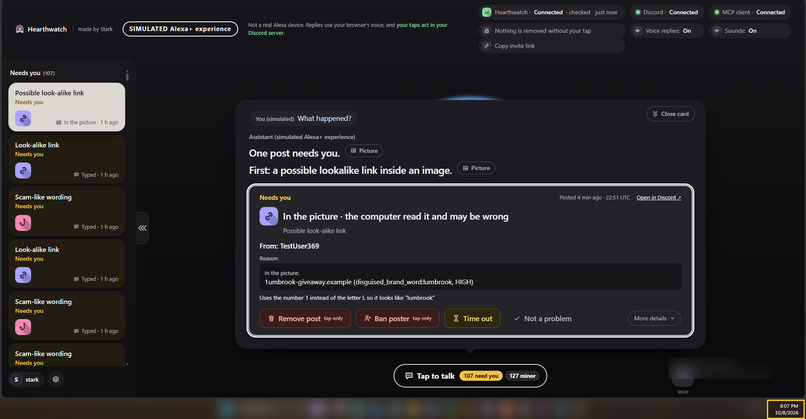
Live soak, Oct 8, 8:07 PM EDT (boxed): Discord bot and outside MCP client connected, AWS on. The open card is from the 22:56 UTC briefing.
Your time back, and the final say
You've been away from the community you run. Ask "What happened?" and hear what needs you, instead of scrolling every channel.
Five minutes? Watch 0:00 to 0:05 (a scam picture flagged live), 0:45 to 1:17 (live on our own Discord test server, AWS on, with AWS's own counts), 1:18 to 2:00 (the owner asks out loud, in Stark's own voice, then the briefing and the tap, on the demo page with recorded, made-up posts), then 2:00 to 2:22 (under the hood, ending on MCP Inspector, a real MCP client, on our own MCP server with demo data).
Hearthwatch is its own self-hosted MCP server, built to the Alexa+ track's spec (protocol 2025-11-25 over Streamable HTTP). It watches the Discord community you run while you're away, reads the text inside pictures where scam links hide, and briefs you in one short line when you're back. A real outside client, MCP Inspector 2.8.0, has called all five of its tools (record in our repository; from 2:15 the video shows it connecting and listing them); none can remove a post or ban anyone.
Tested blind, Hearthwatch caught 14 of 19 scorable rule-breaking posts and flagged 0 of 17 innocent images. Live, with AWS on: 2 hours 16 minutes, 0 errors, and AWS's own counts matched the run's record exactly.
The moment it's built for
It's late, and you're asleep. A brand-new account drops a "free giveaway" picture into your busiest channel, and a link dressed up as Discord's own website into another. The scam is printed inside the image, where keyword filters can't read it.
In the morning you tap to talk, pick "What happened?", and hear: "Two posts need you. First: a lookalike link. Next: a possible lookalike link inside an image." Each card holds the evidence, the trigger words in red, and a link to the post. One tap removes it.
Built for Alexa+
That's why voice: one question instead of reading every channel, one short answer, and the evidence waiting on the cards. On Alexa+, the listening is Alexa's: Alexa hears the owner and hands an add-on the request. Hearthwatch is built the way an Alexa+ add-on is built: from the partner's side, as its own MCP server.
The Alexa+ MCP Toolkit is open to select partners only, so here the Alexa+ side is a clearly labeled simulated Alexa+ experience: a web page we built that stands in for Alexa+ and drives our real MCP server. It is not an Amazon product, is not affiliated with Amazon, and does not run on an Echo device. The page is one client of the server; MCP Inspector is another, and in a live run its attempt to act was refused.
Voice typing is optional: Speak fills the text box (your audio goes to your browser's maker), and nothing acts until you press Say. In the video, the owner's "What happened?" is Stark's own voice, picked up by Speak in the same take; the live run (October 14) was recorded before voice typing was added, and in it an in-memory store stood in for Amazon DynamoDB while Amazon Rekognition and Amazon Nova ran live.
How Hearthwatch meets the judging criteria
Submitted to the Alexa+ track and the AWS Builder Mini Challenge. From the rules' lists of creative work: for Alexa+, state kept across sessions (30 days in Amazon DynamoDB; the briefing speaks only of what you haven't decided yet) and cards on the simulated Alexa+ page; for AWS Builder, a multi-service AWS pipeline run live (Amazon Rekognition, Amazon Nova on Amazon Bedrock and Amazon DynamoDB) and an agentic development workflow with Claude, where Stark directed separate Claude roles: a builder, a checker, a test lab that sealed the blind test, and a red-team reviewer.
- Stage One: an Alexa+ track entry: our own self-hosted MCP server (protocol 2025-11-25 over Streamable HTTP), shown through a clearly labeled simulated Alexa+ page, as the Official Rules (section 4) allow. Judges can run it on their own PC with no Discord, no AWS and no account: start at the README's "Try it: no keys needed (judges start here)".
- Tech Implementation: that server's five tools, none of which removes a post or bans anyone; three AWS services run live through the bot (in the soak, AWS's own counts of Bedrock and Rekognition calls matched the run's record exactly); a sealed blind test; and 1945 automated tests passed, 2 skipped, at the submission commit.
- Design: one question, one short spoken line, and the evidence on cards; removing a post or banning someone takes the owner's tap.
- Potential Impact: for the people who run online communities (creators, clubs, gaming groups, volunteers; the scale is under Inspiration): one spoken briefing instead of scrolling every channel, and a flag on the scam a keyword filter can't see, the one printed inside a picture.
- Quality of the Idea: the creative work listed above, and more than a single-turn Q&A: after the briefing, the owner can time a poster out or undo it by voice, and a spoken "remove it" is refused and points to its card. Plain rule code decides what gets flagged; code writes every spoken phrase, and Amazon Nova only picks words our code wrote (the briefing's connecting words and a card's note) and may raise a weak flag's priority.
In the video, the narration and the page's spoken lines are Amazon Polly stock voices added for the video; the app itself speaks with the browser's voice.
The Friction Log is attached to this submission as Hearthwatch-Friction-Log-2026-10-20.pdf: 11 entries (F-001 to F-011) on the Alexa+ MCP Toolkit, Amazon Bedrock, Rekognition, Polly, AWS Budgets and AWS credits, each written to the rules' fields (task, steps, expected vs. actual, severity, workaround, suggestion), with prioritized suggestions by owner.
Inspiration
Millions of people run online communities: creators, clubs, gaming groups, volunteers. In one year (March 2025 to March 2026), Discord's own Transparency Report counts 47,832,832 accounts disabled for spam and 3,084,168 actioned for fraud, scams and phishing, and more than 90 million people spend time on Discord every day.
Discord's built-in tools check message text and filter sexual and graphic images. Our reading of their descriptions (an inference, not a Discord statement): neither reads scam text written inside an image. Hearthwatch is built for that gap.
What it does
Plain rule code decides what gets flagged. Amazon Nova may only raise a weak flag's priority and pick from words our code wrote (the briefing's connecting words and the note on the flag's card); it never writes the evidence.
- Checks the posts it can see, pictures included, for scams, look-alike links (against a fixed list of names: today Discord and Lumbrook, the demo's made-up community), repeated posts and the owner's own keywords.
- Puts you in charge: Remove takes one tap; Ban and Remove every copy (for repeats) take two. By voice you can time a poster out for an hour or undo it. In a live run every tap that acts needs a single-use approval, and no voice command and no AI tool can remove a post or ban anyone.
How we built it
- Our own MCP server (src/modcompanion/mcp_server.py), on the Python standard library: five tools (get_flags, get_flag_detail, get_briefing, timeout_poster, undo_action), each with the spec's tool annotations (the first three marked read-only). It also serves the simulated Alexa+ page (src/modcompanion/web/simulated_alexa.html). In the no-keys demo every tool answers under the 500 ms target (p50 at most 11.2 ms, p95 at most 21 ms); live tool times were not measured.
- One AWS pipeline, run live through the bot: Amazon Rekognition reads the text inside a picture (on October 3 it read 4 posted images, and each raised a high-priority look-alike link) → our rule code decides → Amazon DynamoDB keeps the flag and the owner's decision → Amazon Nova 2 Lite on Amazon Bedrock gives a second opinion that can only raise a weak flag's priority, and picks the connecting words between the briefing's fixed phrases (any other reply is rejected) → AWS's own counts in Amazon CloudWatch, and AWS's own bill, show it ran.
- A live Discord bot on the owner's own PC checks posts and edits as they land and carries out the owner's taps; while that PC is off nothing is checked, and when the bot starts again its first sweep re-reads the last 24 hours.
Challenges we ran into
Voice was a design choice, made twice. We started with no microphone on purpose: a browser's speech recognition sends the owner's audio to the browser's maker. And we built one path for every request on the page, typed or spoken, so a new way to ask could never become a new way to act: no spoken or typed request, and no AI tool, can remove a post or ban anyone. That takes a tap on its card.
Testing ourselves blind is part of how we build (in Stark's words: "I lacked exposure of what I don't know."). On October 21, our own blind review (three AI judges, one model) read the page as a simulated page with no microphone. Because of that one path, adding optional voice typing was a contained change: built in a copy first, attacked by a second AI that found 4 must-fix problems, all fixed, then tested on a real microphone, where saying "remove it" was still refused. It was committed to our repository about three hours after that review. And we put the MCP server first: it was the add-on all along. The final video shows both: Speak hearing the owner's own voice, and MCP Inspector calling our server.
Proof: it ran live, and it was tested blind
It was tested blind before it went live: a separate role built and sealed the test set, and the builder never saw it.
| Evidence | Result |
|---|---|
| Live soak, October 8 (AWS on) | On our own Discord test server with made-up posts: 2 hours 16 minutes, 0 errors in 273 heartbeats (errors = failed post checks; unread images and refused AWS calls are recorded separately). Nova's connecting words for 3 briefings all passed our checker. Remove every copy removed 3 of 3 posts in two taps. |
| AWS's own counts (soak) | Read in the CloudWatch console, they matched the run's record exactly: Amazon Bedrock +92 calls = 3 briefings + 89 second opinions, and Amazon Rekognition +1 = the run's one image read. |
| AI second opinion (soak) | Asked about 89 posts flagged with weak signs only, it raised 62 to a strong sign and kept 27, with 0 errors. (No answer key says whether those raises were right.) |
| Live run, AWS on, October 3 | 0 errors in 114 heartbeats. 12 owner taps were decided through Amazon DynamoDB. |
| Blind test: caught | 14 of 19 scorable rule-breaking posts caught (on the held-out slice, never run before: 4 of 7). Of the blind set's 22 rule-breaking posts, 19 are scorable; the other 3 need an image-moderation check that is not built. All 5 misses were posts only the owner's own keyword list could have caught. |
| Blind test: innocent | 0 of 17 innocent images flagged. 5 of 27 strict-innocent posts flagged, every one low priority, and only 1 of 27 spoken to the owner. |
| Automated tests | At the submission commit: 1945 passed, 2 skipped. The 1876 passed, 2 skipped shown in the video and gallery picture 10 is from fresh clones of the earlier commit 4b90c94 on two Windows 11 PCs (2026-10-13). |
The blind test ran at an earlier commit (8fdf2c0), before the AI second opinion and three later detector fixes, so these counts include none of them.
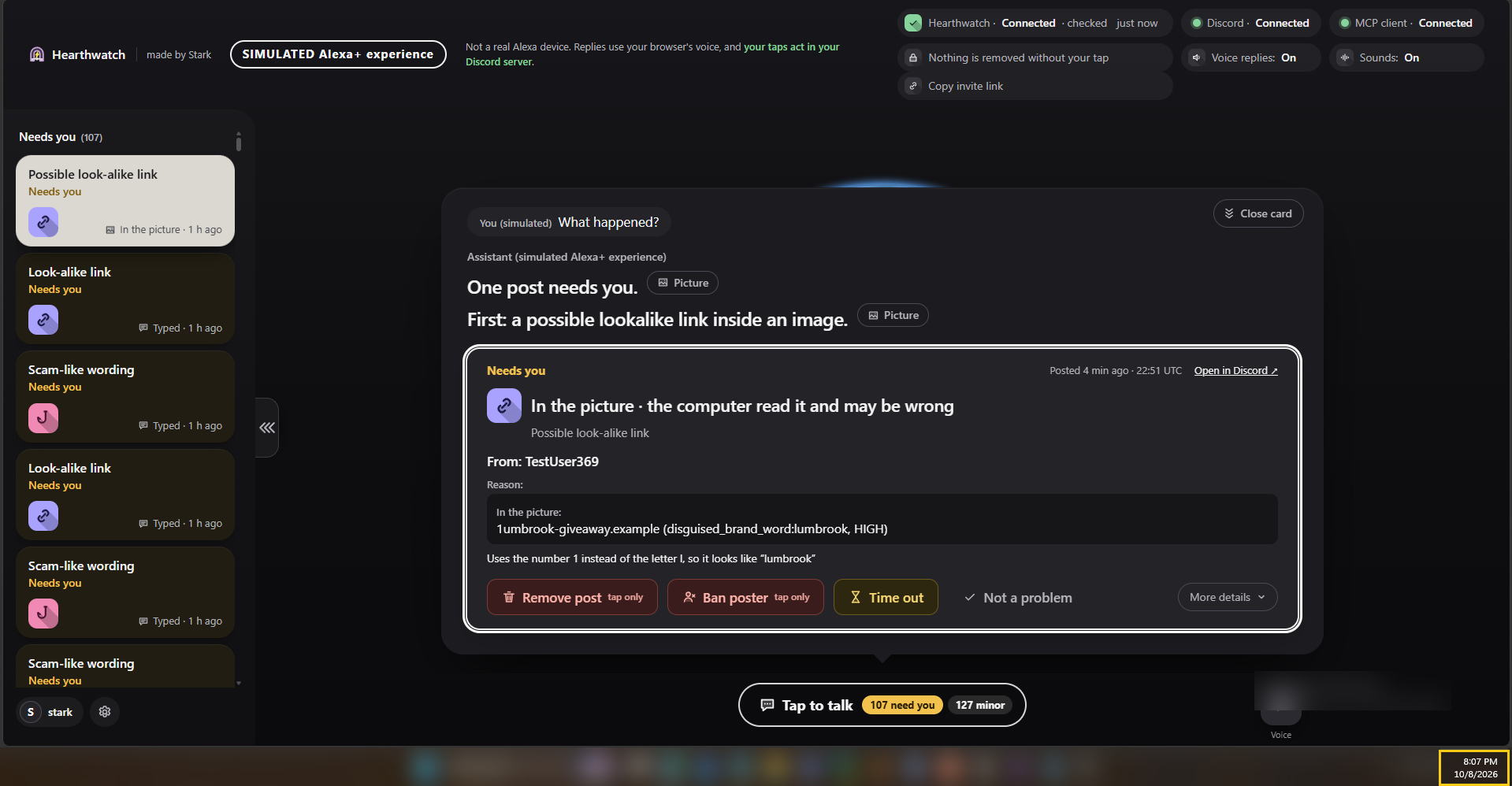 The live soak, October 8, AWS on: the boxed clock reads 8:07 PM EDT (00:07 UTC, October 9), and our repository's soak log shows the Discord bot and an outside MCP client both connected at that minute. The open card and the line "One post needs you." are from the soak's first briefing (22:56 UTC), left open on screen: a card's "4 min ago" is set when the card is drawn. By 8:07 PM, 107 of the soak's made-up posts were in Needs you.
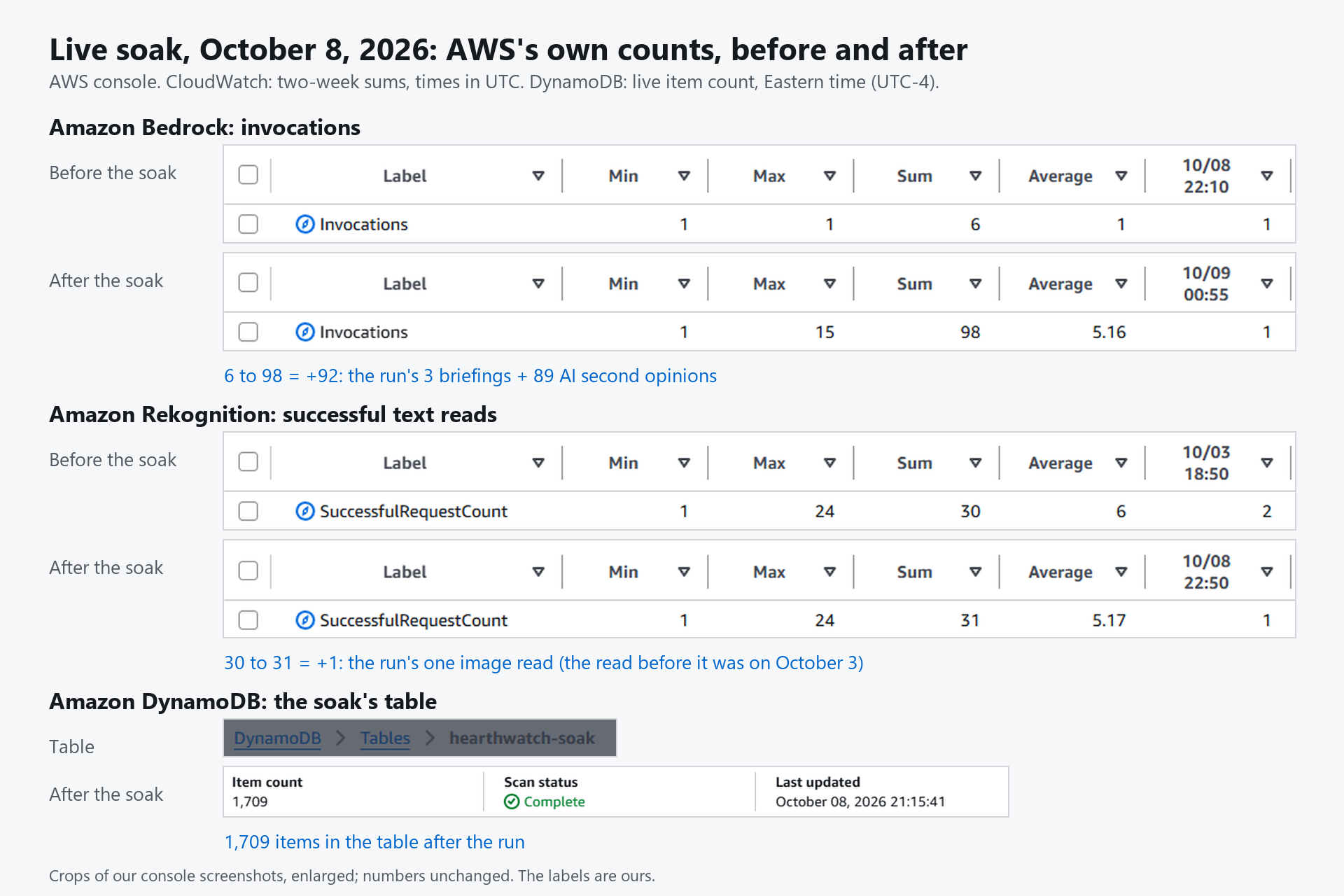 AWS's own counts for the same soak, before and after: Amazon Bedrock 6 to 98 = +92 (3 briefings + 89 AI second opinions), Amazon Rekognition 30 to 31 = +1 (the run's one image read), and 1,709 items in the DynamoDB table.
Privacy by design. Only flagged posts' text is stored, as evidence for 30 days. Optional local run files, and the text copies that the bot posts to your own staff log channel when you remove a post, stay until you delete them. Live, by default, posted JPEG and PNG images up to 5 MB go to Amazon Rekognition to read their text, and for some weak flags one piece of at most 300 characters, with no IDs, post times or Discord link, goes to Amazon Bedrock. Details and exceptions: PRIVACY.md.
Who it's for and what it costs
Hearthwatch is built for anyone who runs a Discord community without a team: a club organizer, a group admin, a creator with a busy server. No outside owner has tried it or asked for it yet: so far it has run only on our own test server, by choice, until it is ready for every community owner. Our cost tool estimates about $4.30 a month for one server on the owner's own PC ($9.30 hosted) at an assumed 2,000 messages a day, once its $3.00 for a planned image-moderation check that is not built is taken out ($7.30 and $12.30 with it): an estimate, not a bill or a price, without the AI's second opinion.
What's next for Hearthwatch
Next, none of it built yet: a hosted version and a phone app; Hearthwatch inside Alexa+ as a partner add-on, once the Alexa+ MCP Toolkit is open to us; running the official MCP conformance tests on our server; a memory for scams you've already removed; help writing your rules; and, as an idea only, more platforms. To work inside Alexa+, our MCP server also needs an address Alexa+ can reach and the toolkit's authentication. Today it answers only to programs on the owner's own PC: it binds only to a loopback address and checks each request's Origin and Host, the DNS-rebinding protection the MCP spec requires.
Hearthwatch is one example of a bigger idea: AI as a partner for anyone responsible for a group of people, where the person keeps the decisions.
Why I built this, in my own words:
I want to be the one who brings AI into the workforce, where nobody has to open a new chat or second-guess every answer, with the best AI in the cloud, or on your own machines when the work's privacy needs it. … Tuners outlast arsonists.
— Stark
Credits
Hearthwatch · made by Stark, AI orchestrator and systems tuner; the key decisions were mine. In the git record at commit d9673b8, Claude Opus 5.5 is a co-author on 129 of the 132 commits and Claude Fable 5.1 on 5, two of them shared; Claude Sonnet 5.5 worked as a writer and on the video planning. ChatGPT (OpenAI) was my pathfinder and stress-tester. Full credits: the README in our repository. Music in the video: "Chillhop Jazz Midnight Club" by alex-morgan, from Pixabay, used under the Pixabay Content License. The Earth on the page uses two NASA images. NASA does not endorse Hearthwatch.
Built With
- amazon-bedrock
- amazon-dynamodb
- amazon-nova
- amazon-rekognition
- amazon-web-services
- boto3
- css3
- discord
- discord.py
- html5
- javascript
- mcp
- pillow
- pytest
- python
- python-dotenv
- web-speech-api
- webgl
