-
-
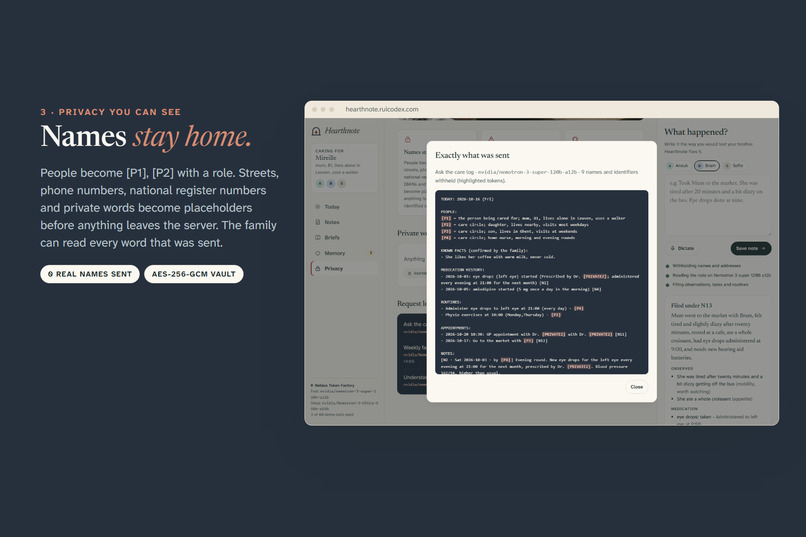
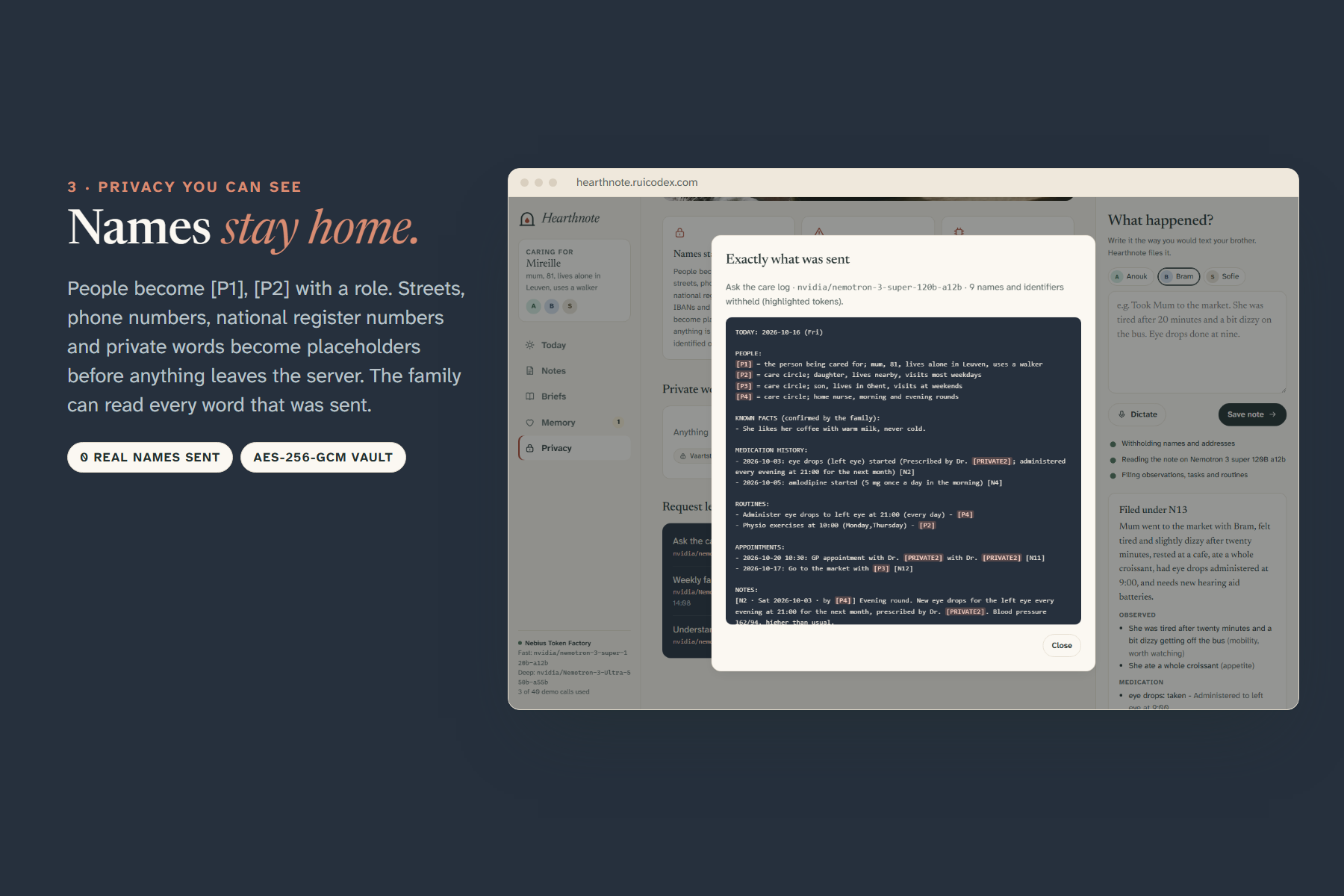
Privacy you can see: names become [P1], [P2] before anything leaves the server.
-
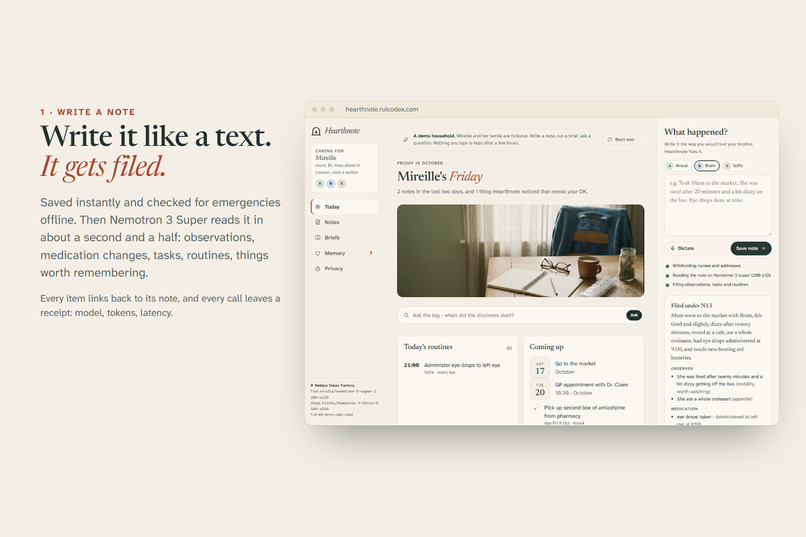
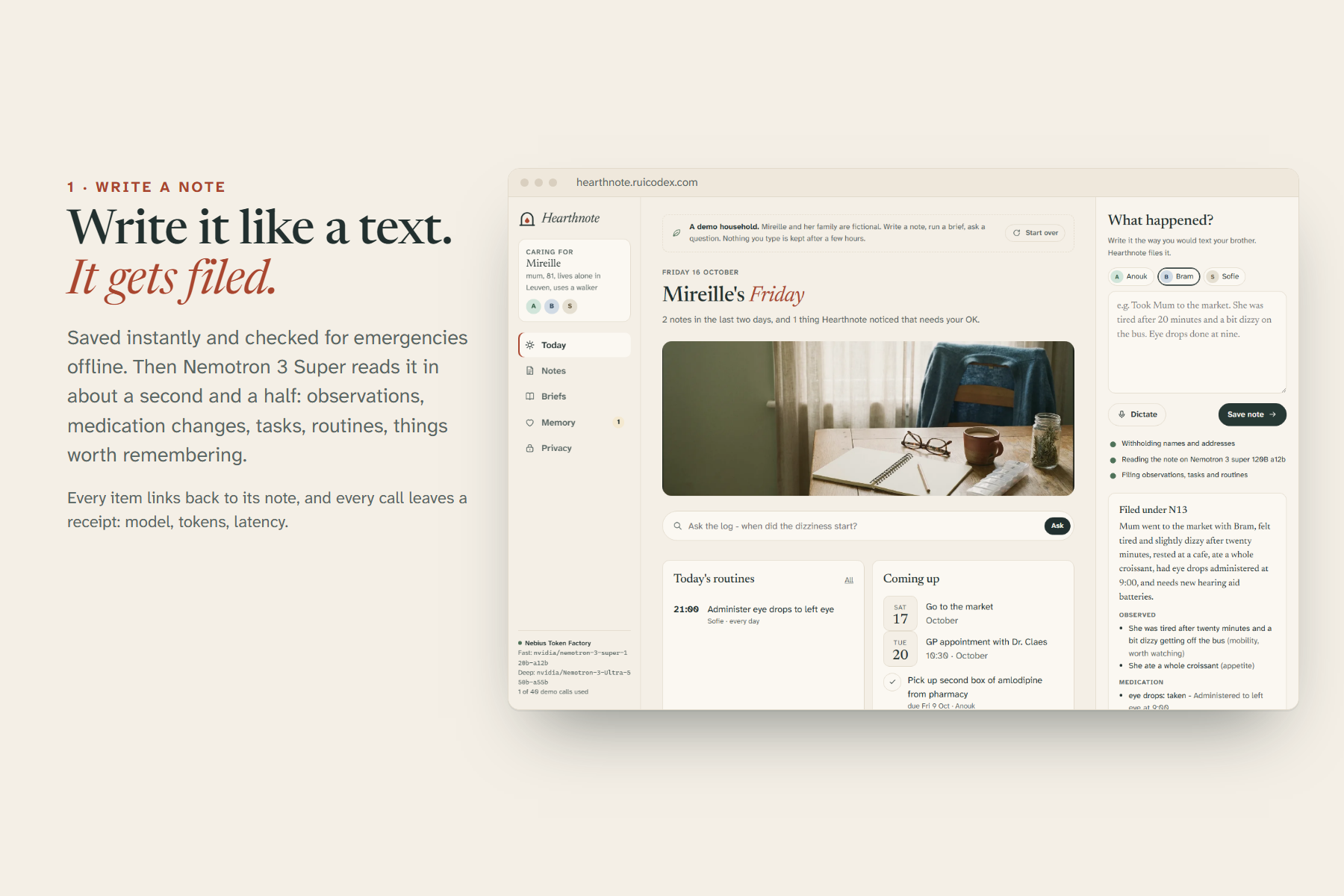
Write a note like a text; Nemotron 3 Super files it in about 1.5 s, with a receipt.
-
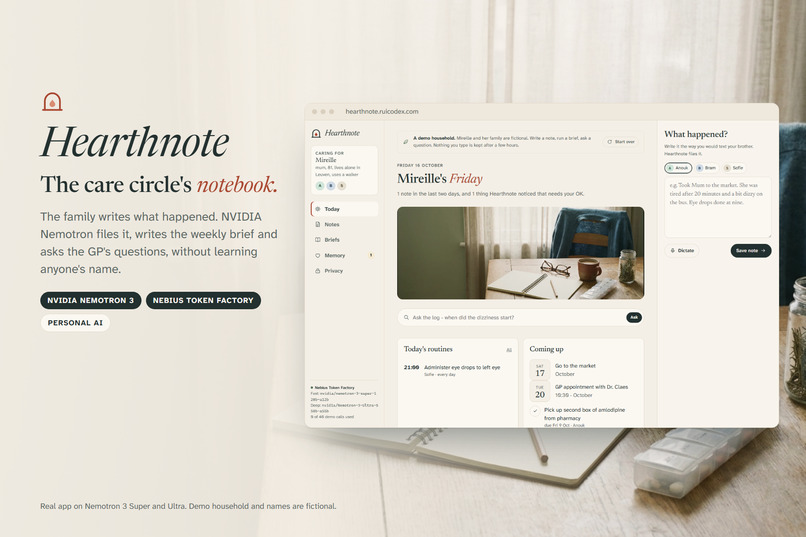
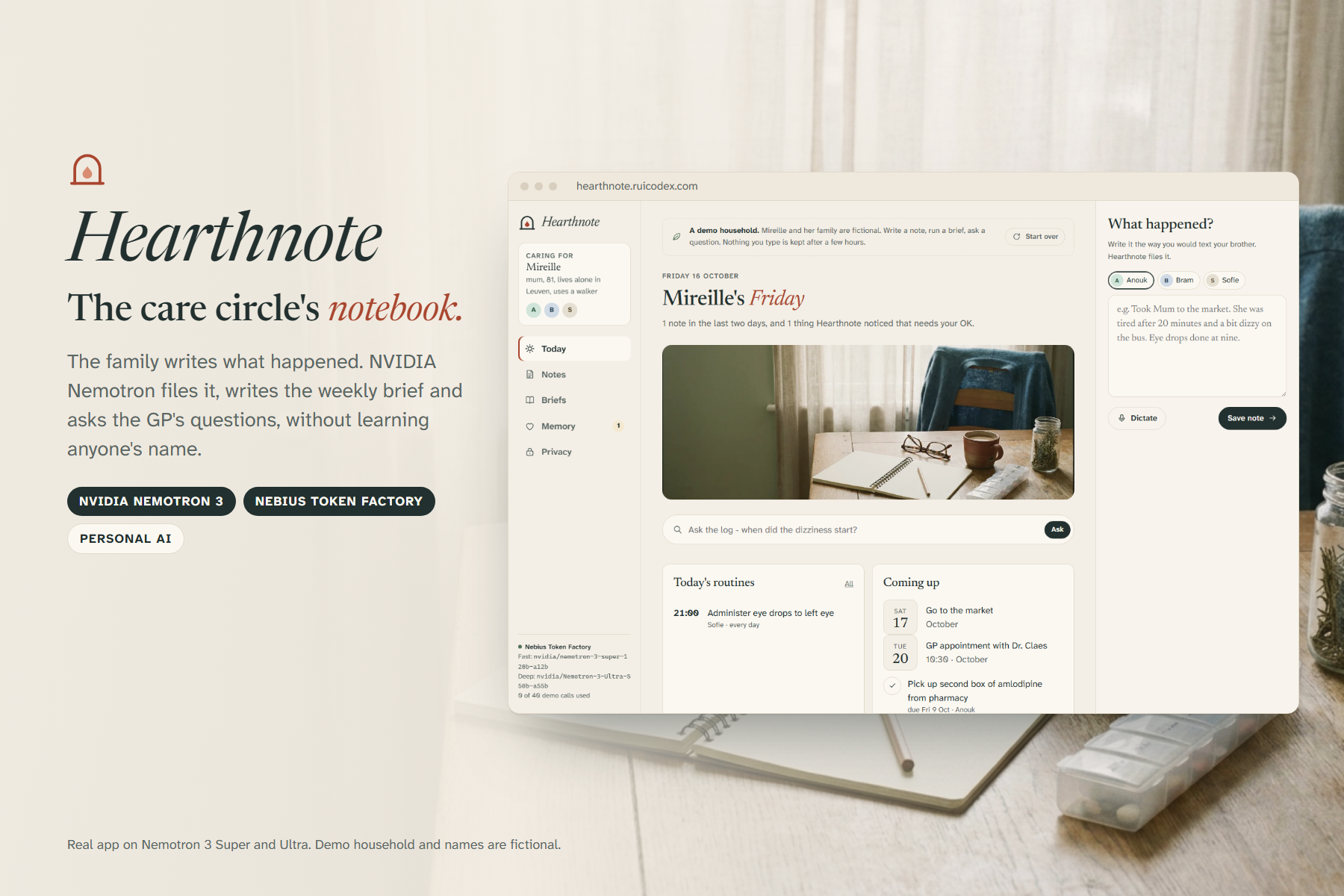
Hearthnote: the care circle's notebook, on NVIDIA Nemotron via Nebius Token Factory. Real app, fictional household.
-
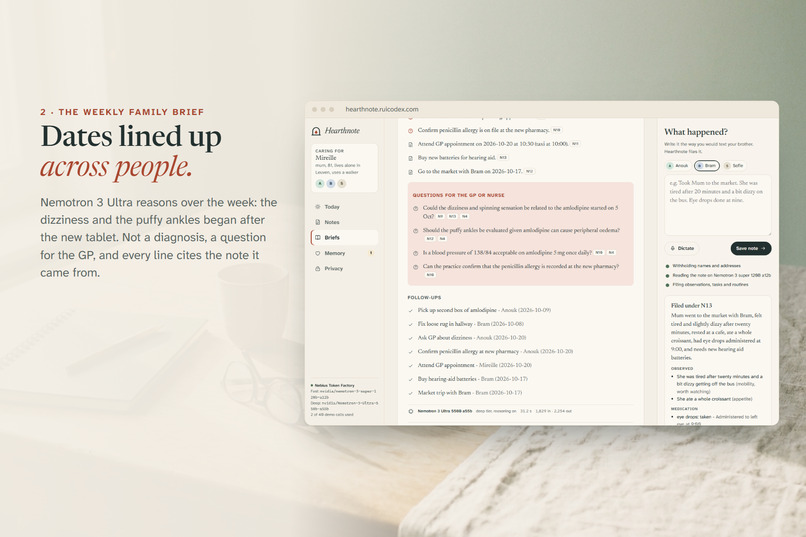
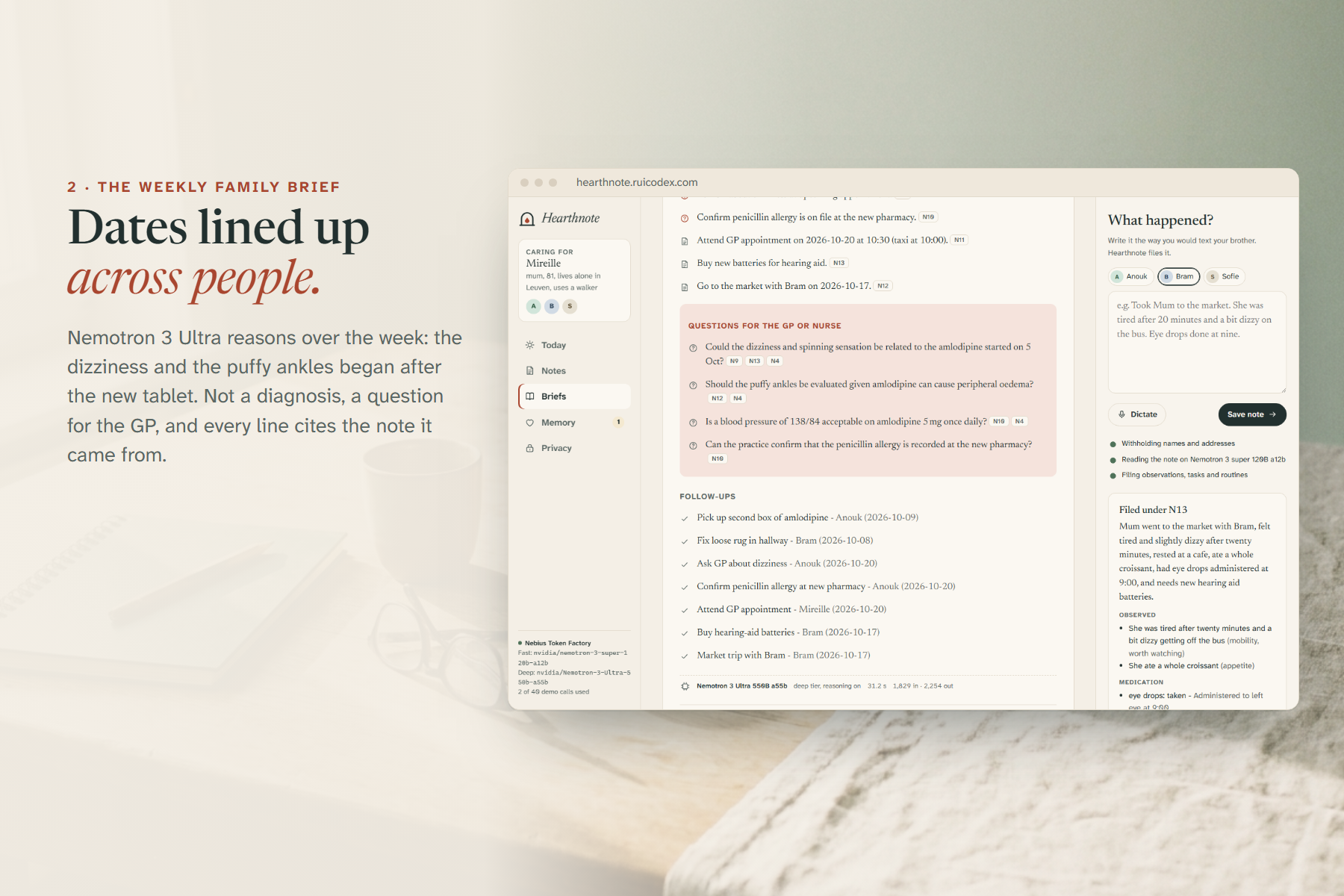
The weekly brief on Nemotron 3 Ultra: dates lined up across people, every line cited.
-
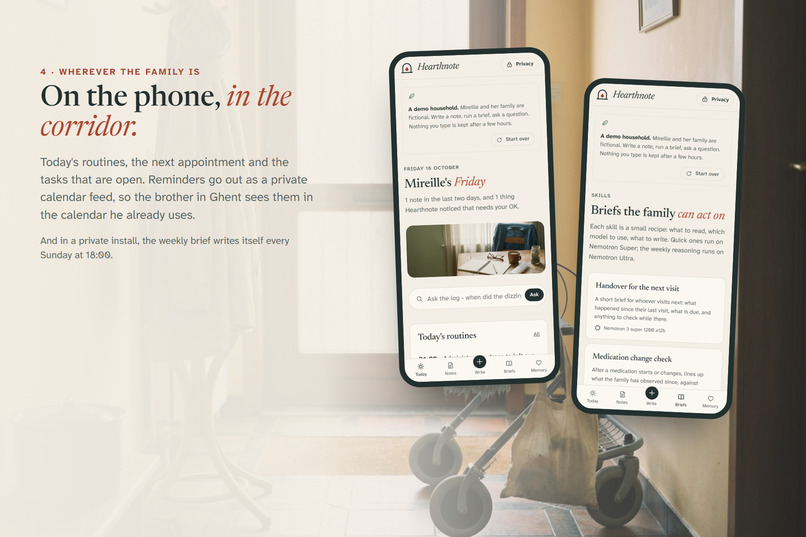
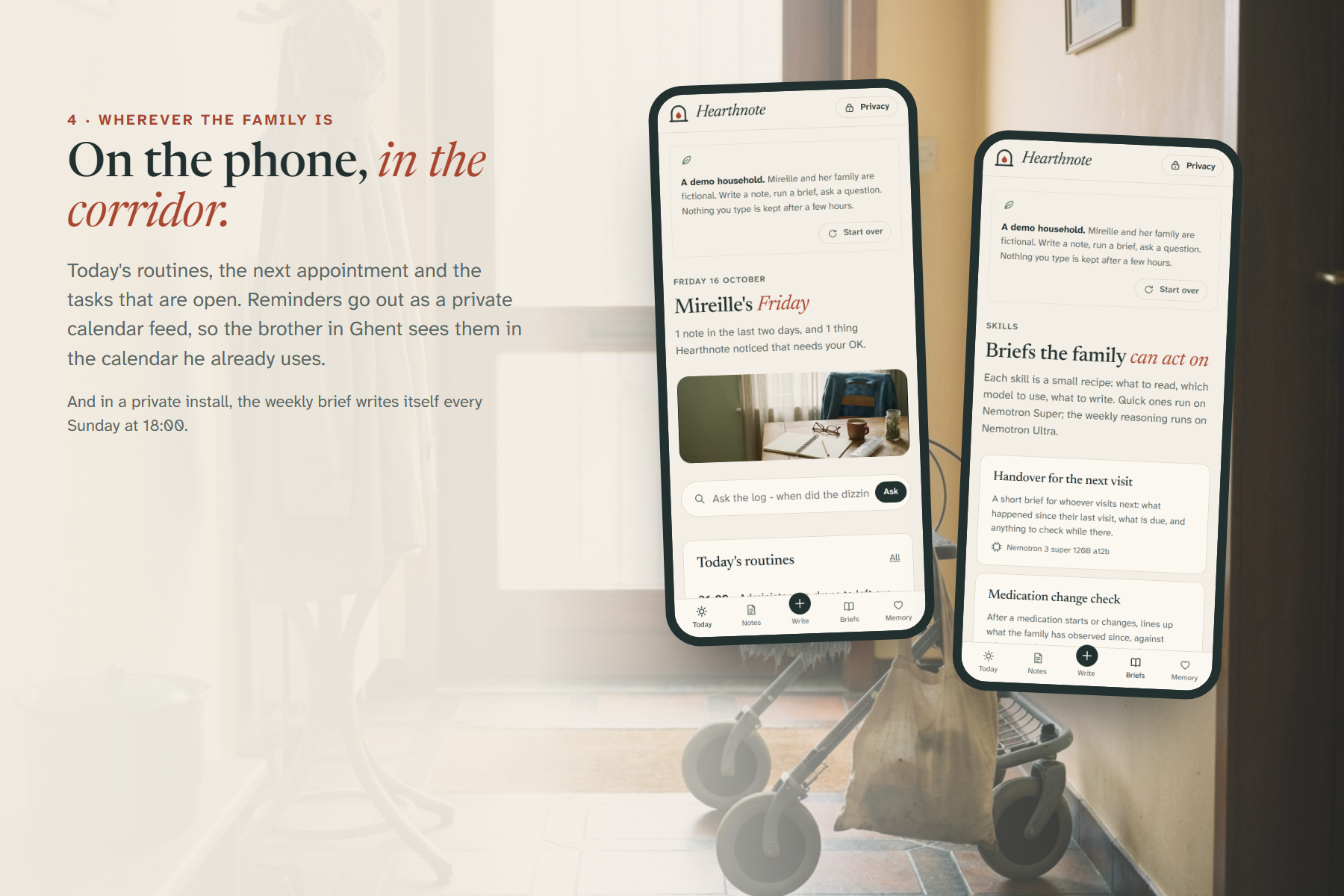
On the phone: today's routines, appointments and briefs; reminders go to everyone's calendar.
Inspiration
When a parent starts needing care, what the family knows about her scatters across people. The daughter knows about the new blood-pressure tablet. The home nurse noticed her ankles were puffy. The son saw her hold the stair rail with both hands. Nobody notices that all three started in the week after the new tablet, and nobody remembers to ask the GP. In Belgium, 12.2 % of people aged 15 and over give informal care every week (Sciensano, Health Interview Survey 2018); they coordinate in group chats that forget everything.
A general chatbot is the wrong shape for this. Families will not paste their mother's name, address and medication list into one, and they should not have to. The Personal AI track asks for an always-on assistant with persistent memory and reusable skills that keeps your data under your control; a care circle is the clearest case we know where that matters.
What it does
Anyone in the care circle writes what happened, the way they would text a sibling, or dictates it. Hearthnote:
- checks the note for emergencies first, offline (a fall with a head injury, stroke signs, chest pain) and says "call 112" before any model is involved;
- files it with NVIDIA Nemotron 3 Super in about 1 to 2 seconds: observations with category and severity, medication changes, tasks, repeating routines, appointments and facts worth remembering, each linked to its note;
- asks before it remembers: long-term facts and new routines are proposals a person confirms, edits or forgets;
- runs skills: a weekly family brief, a one-page brief for the doctor's visit, a medication-change check, a handover for whoever visits next, and any skill the family writes in plain English. The deep ones run on Nemotron 3 Ultra with reasoning on, and every line cites the notes it rests on;
- looks things up safely: the medication check asks Tavily for public reference pages (MedlinePlus, NHS, drugs.com) using the medication name only, never a note or a person, and cites them as S1, S2 next to the family's own N-numbers;
- answers questions from the log, with citations, and says so when the notes do not cover it ("The log does not mention her favourite film.");
- puts reminders where people already look: a private calendar feed for Google Calendar, Outlook or an iPhone;
- works while nobody is looking: in a private install the weekly brief writes itself every Sunday at 18:00 in the household's timezone;
- shows its work: the privacy page lists every request that left the server, with model, tokens, latency and the exact redacted prompt.
In the demo household (fictional), three people mention dizziness and puffy ankles in the days after the GP started amlodipine. No single note is alarming. The weekly brief lines them up by date and turns them into a question for Tuesday's GP appointment, and the model never learns who Mireille is.
How we built it
- Two Nemotron tiers on Nebius Token Factory, chosen per skill. Nemotron 3 Super (
nvidia/nemotron-3-super-120b-a12b) with thinking off reads every note, answers questions and writes handovers; Nemotron 3 Ultra (nvidia/Nemotron-3-Ultra-550b-a55b) with reasoning on writes the weekly brief, the doctor's-visit brief and the medication check. - A privacy gate in front of every call. Care-circle names become
[P1],[P2]with a role ("daughter, visits most weekdays"), so the model can still reason about who should do what. Private words, phone numbers, e-mail addresses, Belgian national register numbers, IBANs, street addresses and birth dates become placeholders. Output is re-identified on the server. - Declarative skills (
skills/*.json): context sources and window, tier, tool, instructions and a JSON Schema. One runner executes the built-in skills and the ones a family writes. - Structured output with
response_format: json_schema, a fallback tojson_object, one repair round and a validator. The server keeps only citations that point at real notes or real reference pages. - Runtime model resolution from
GET /v1/models, so a catalogue change does not break the app. - Plain Node.js 22 with zero npm dependencies, a strict Content Security Policy, an AES-256-GCM vault and a household passcode for private installs, per-visitor sandboxes and call budgets for the public demo, an iCalendar feed, and a Docker image.
- Tested on the real thing: 29 offline tests (including a local stand-in for Token Factory that produces timeouts, refused keys, outages and broken JSON on demand), a 40-check end-to-end run over HTTP against the live API, and a 34-check browser click-through on desktop and phone sizes.
Challenges we ran into
- Making a reasoning model useful for bookkeeping. The note reader must be fast, literal and schema-exact; the weekly brief must compare dates across a dozen notes from different people. Splitting the work by tier, with thinking off for the fast tier, gave captures in about 1.5 s and briefs in 10 to 30 s.
- Redaction that does not break reasoning. Bare placeholders confused who was who; giving each placeholder a role fixed it.
- Safety without paternalism. The model never diagnoses or suggests dose changes; concerns become questions for the GP, pharmacist or nurse, and emergencies never wait for a model.
- Failing gracefully. A timeout used to be retried four times (up to six minutes). Now a note is always saved first, a slow or refused model call returns a plain sentence, and the family can retry.
Accomplishments that we're proud of
- A model that reads a family's private notes without learning anyone's name: 0 real names in any outbound prompt across every live run, with 61 to 79 names and identifiers withheld per run.
- Briefs where every sentence links to the note or the public source it came from.
- 0 schema warnings and no repair round needed across 27 structured Nemotron calls.
- Reminders that reach a brother in another city through the calendar he already uses.
What we learned
The most valuable thing a language model does for a care circle is not conversation but connecting dates across people. And consent (propose, then confirm) is what makes long-term memory something a family can trust. Nemotron turned out to be conservative about what it proposes to remember, which is exactly right for that.
What's next for Hearthnote
Shared circles with a login per member, a Dutch and French interface for Belgian families, on-device transcription, and an option to run Nemotron on the family's own Nebius AI Cloud endpoint so nothing leaves their infrastructure at all.
Try it (for judges)
Open https://hearthnote.ruicodex.com - no login. You get your own sandbox with a fictional household (Mireille, 81, and her family); Start over resets it, and each sandbox has 40 model calls.
- Write a note in the right-hand panel (or tap Write on a phone), for example: "Took Mum to the market. She was dizzy getting off the bus. Eye drops done at nine. We need to buy batteries for her hearing aid." Watch it being filed, with the Nemotron receipt underneath.
- Briefs -> Weekly family brief (Nemotron 3 Ultra, 10 to 40 s). Click any N chip to see the note behind a sentence.
- Briefs -> Medication change check: the S chips open the public reference pages found by medication name.
- Today -> Ask: "When did the dizziness start?"
- Memory: confirm or forget a proposed fact; copy the calendar link into a calendar app.
- Privacy -> What was sent: the exact prompt, with names replaced.
- Write "She fell and hit her head" to see the offline emergency check.
To run it yourself: npm test, then NEBIUS_API_KEY=... npm start (Node.js 22, no dependencies). Without a key it falls back to an offline mock and says so.
Testing
29 offline tests, a 40-check end-to-end run against the live Token Factory API and a 34-check browser click-through on desktop and phone sizes. Spend for all live testing and recording: USD 0.19.
Built With
- aes-256-gcm
- css3
- docker
- html5
- hyperframes
- icalendar
- javascript
- nebius-token-factory
- nemotron-3-super
- nemotron-3-ultra
- node.js
- nvidia-nemotron
- playwright
- tavily

Log in or sign up for Devpost to join the conversation.