-
-
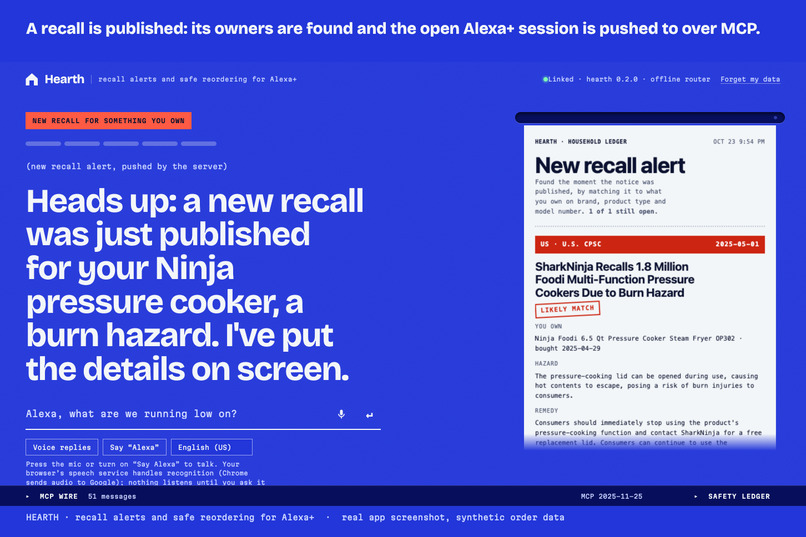
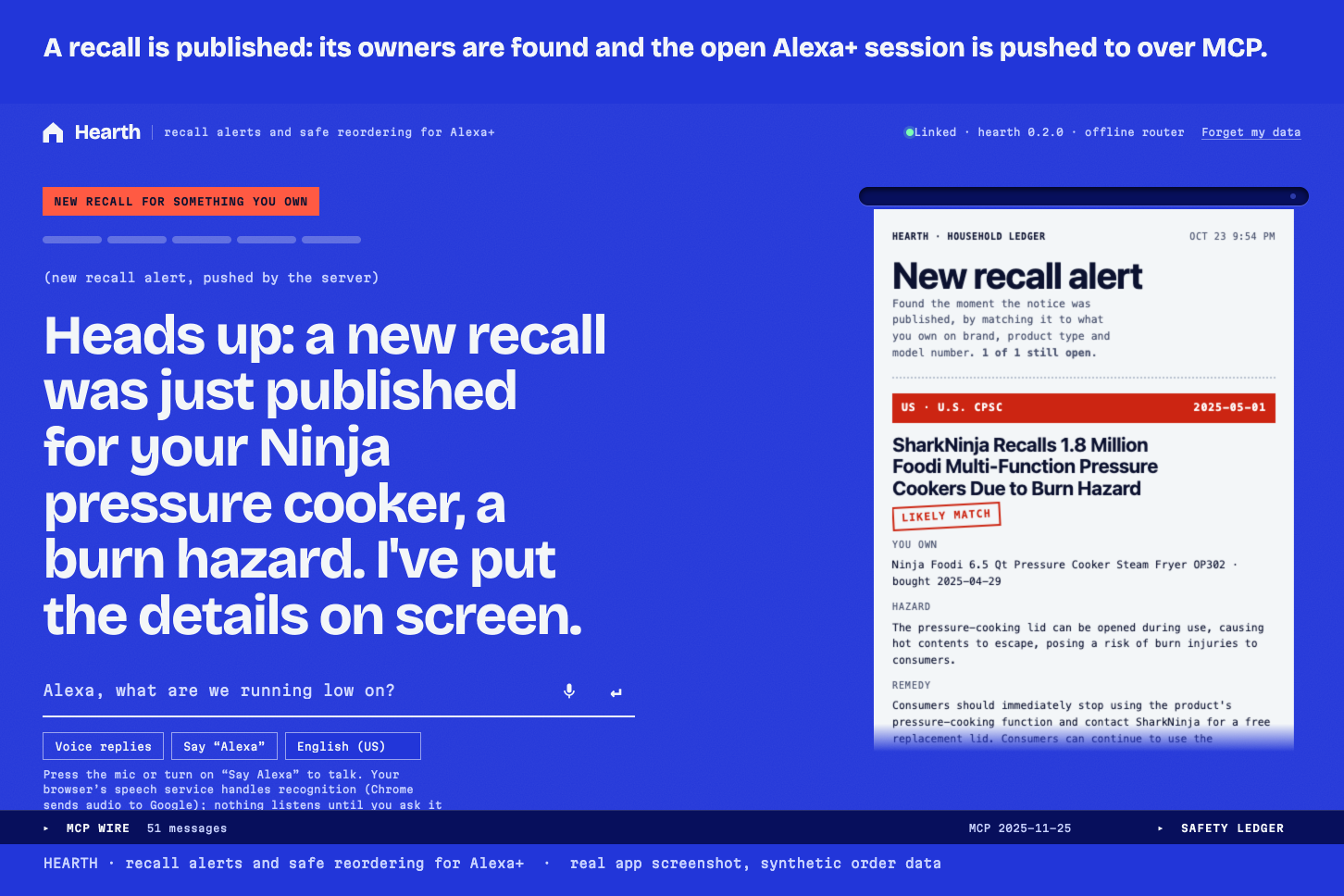
A recall is published: Hearth finds its owners and pushes it to the open Alexa+ session over MCP.
-
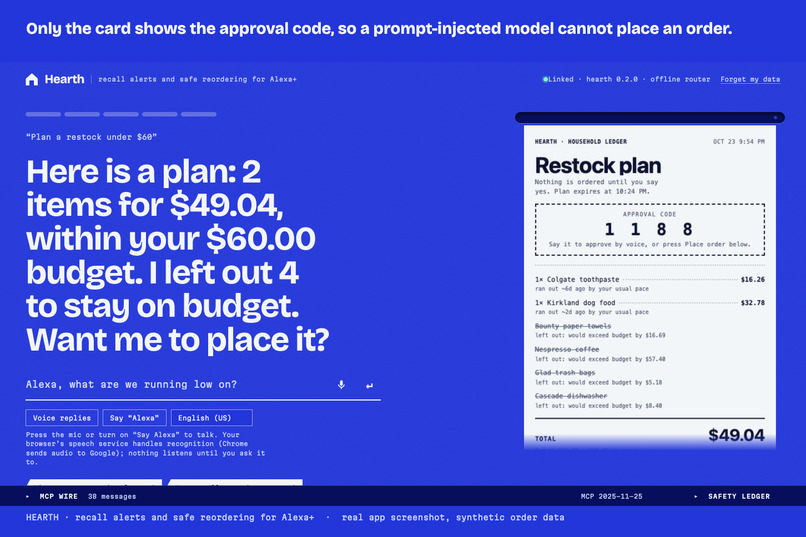
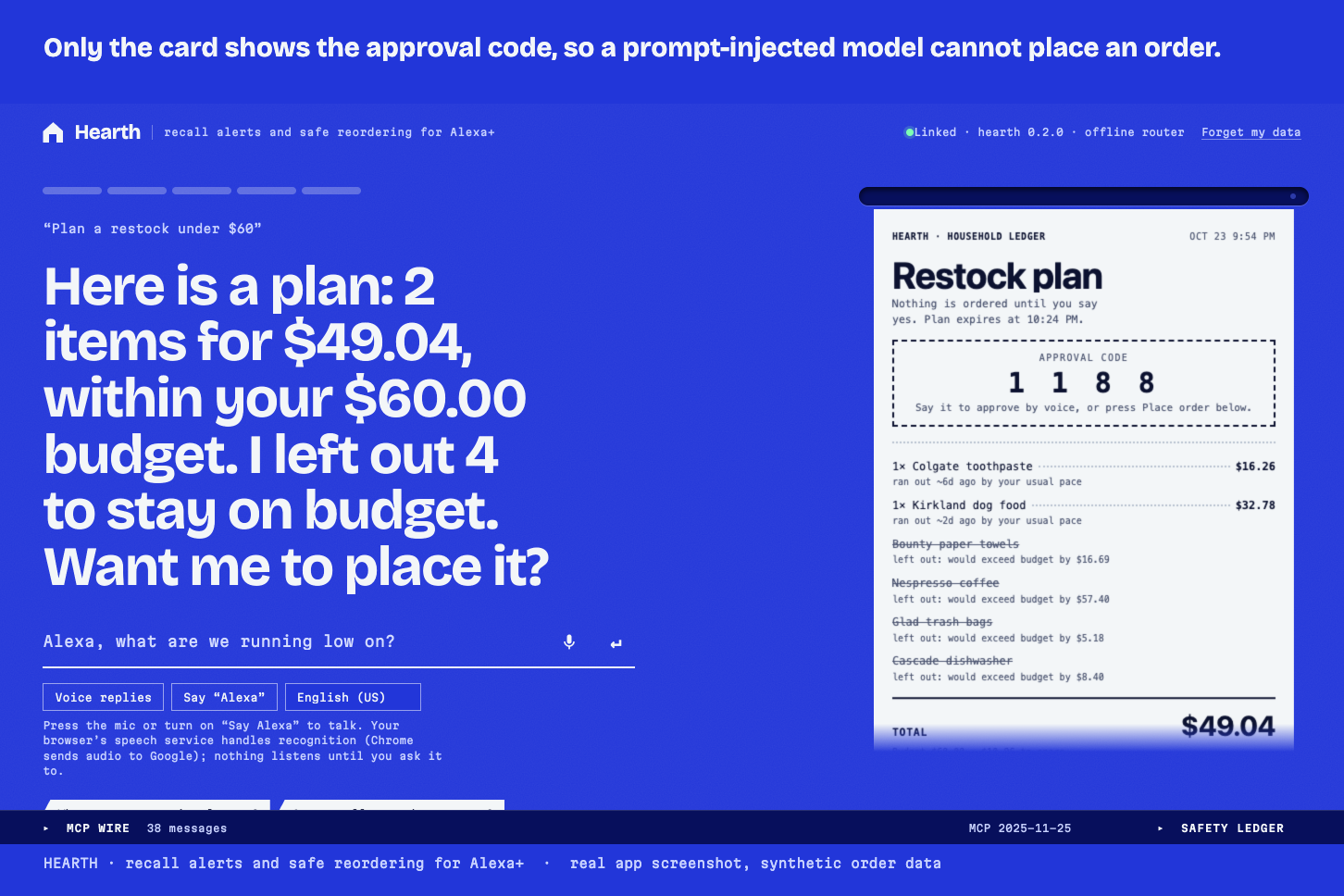
Only the plan card shows the approval code, so a prompt-injected model cannot place an order.
-
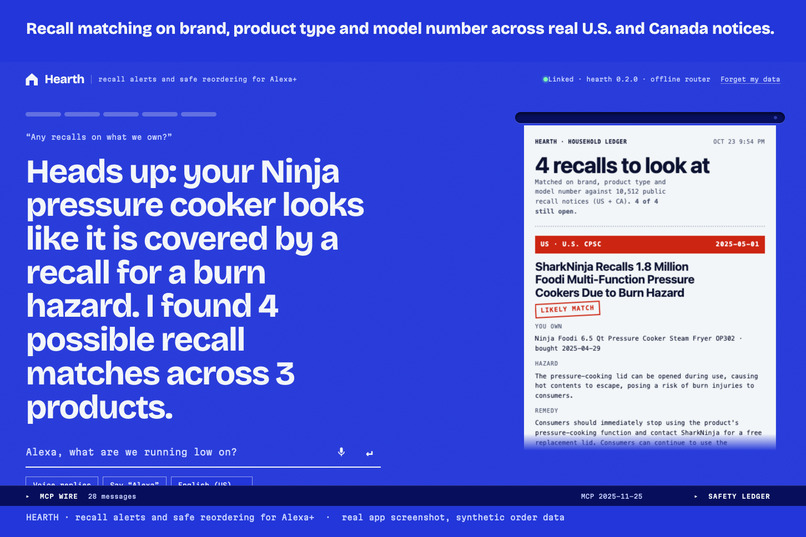
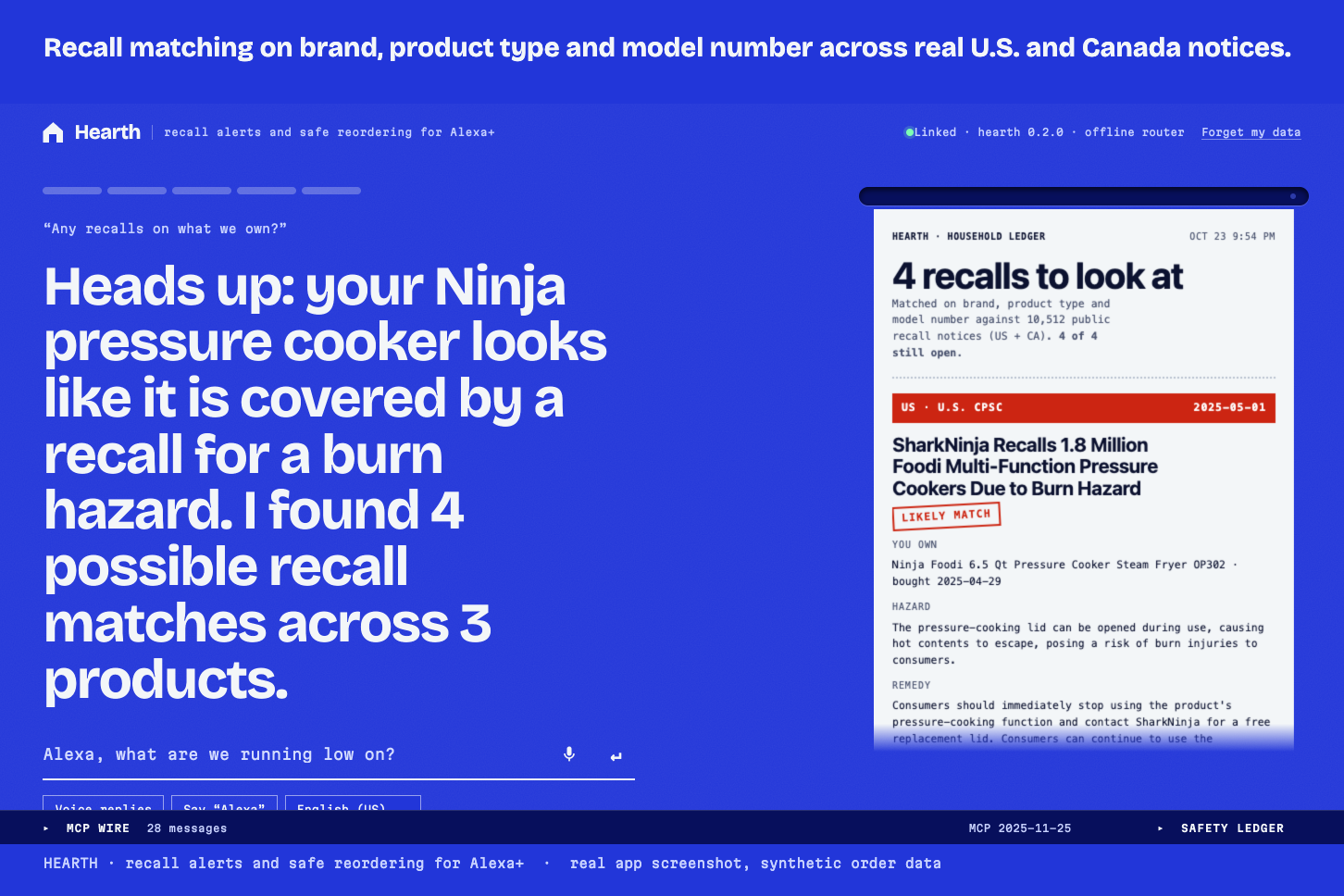
Recall matching on brand, product type and model number across 10,000+ real US and Canada notices.
-
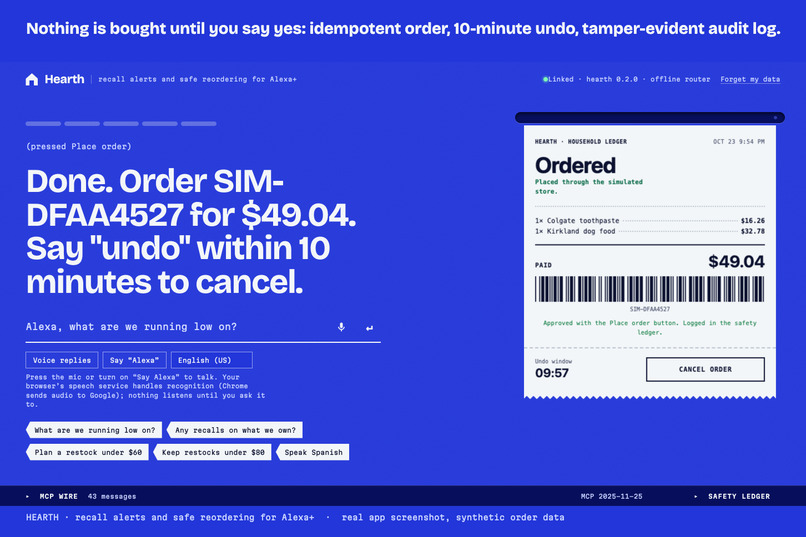
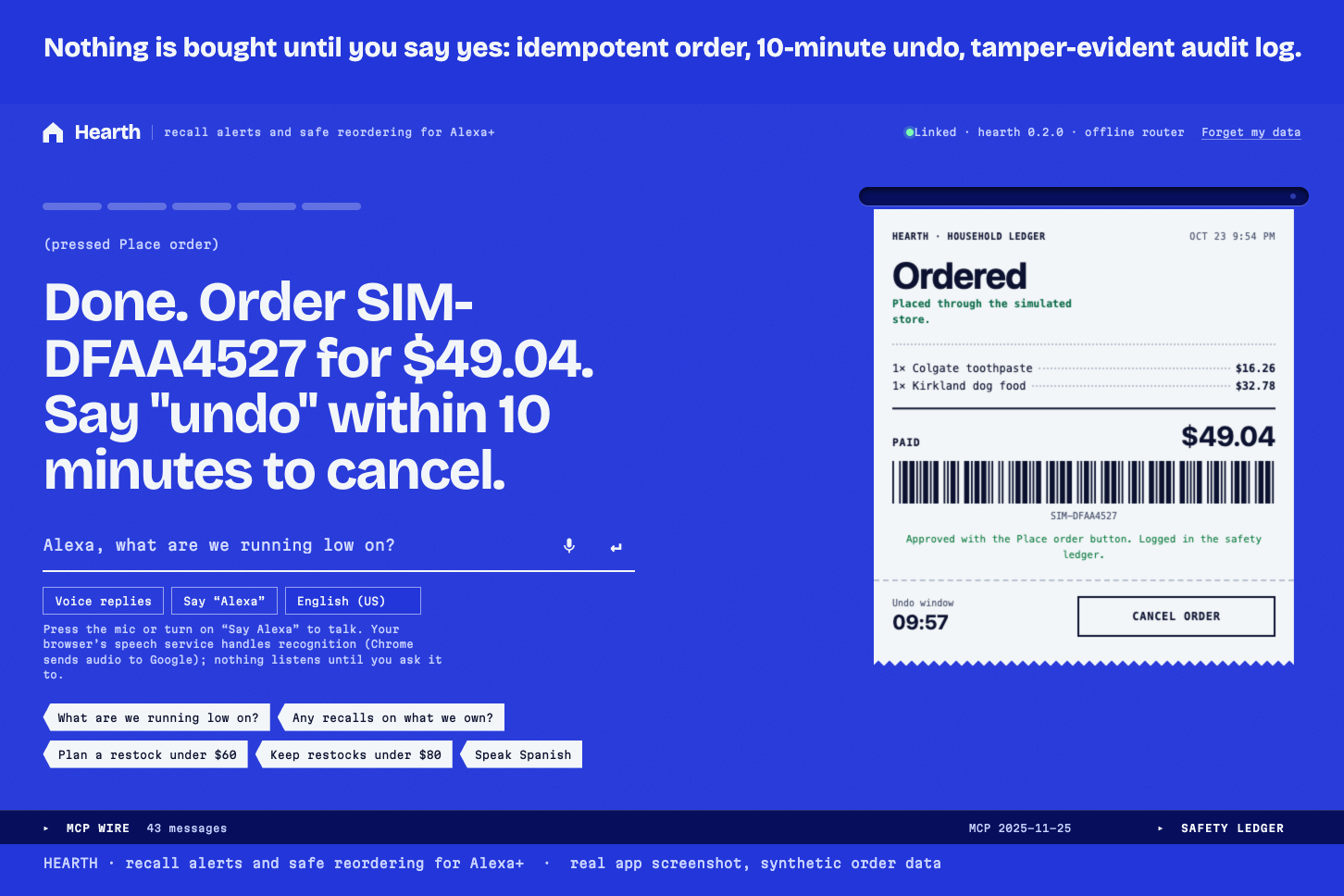
Nothing is bought until you say yes: idempotent order, 10-minute undo, tamper-evident audit log.
-
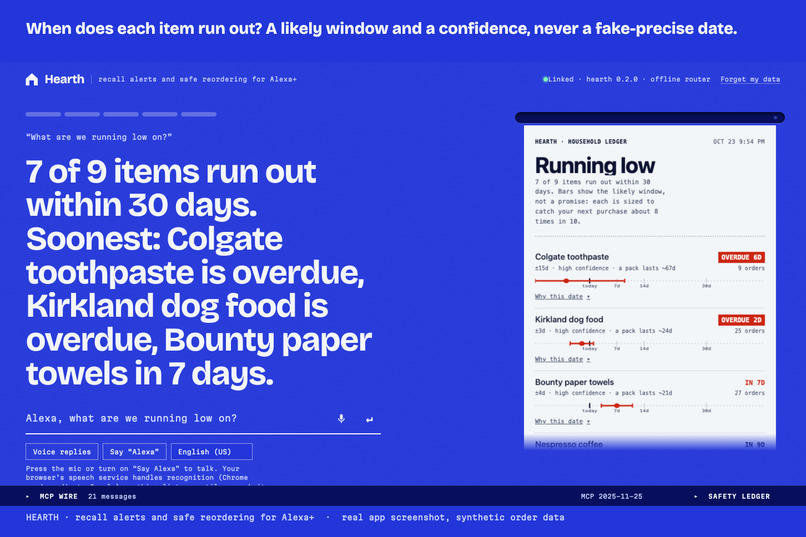
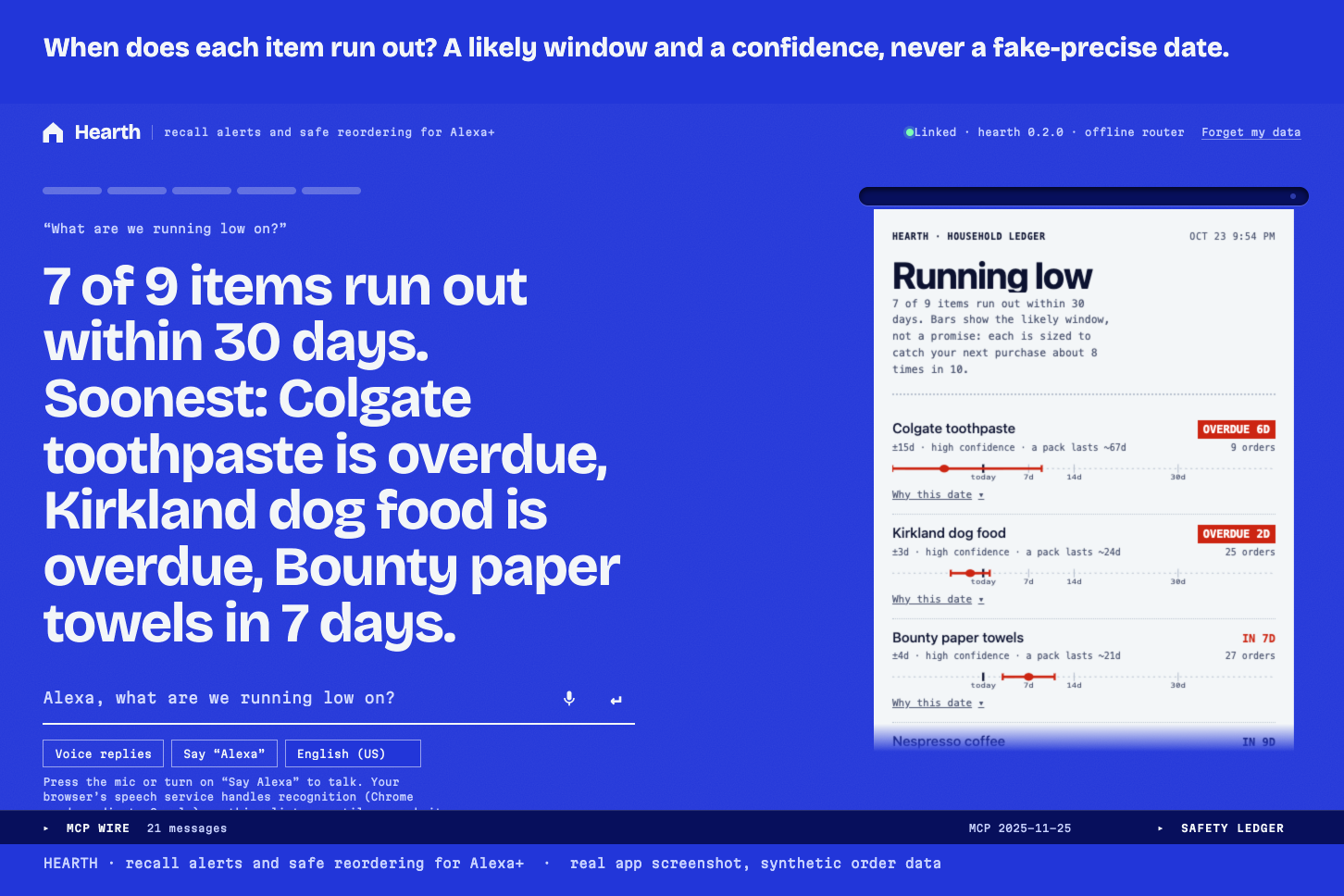
When does each item run out? A likely window and a confidence, and every row can explain itself.
-
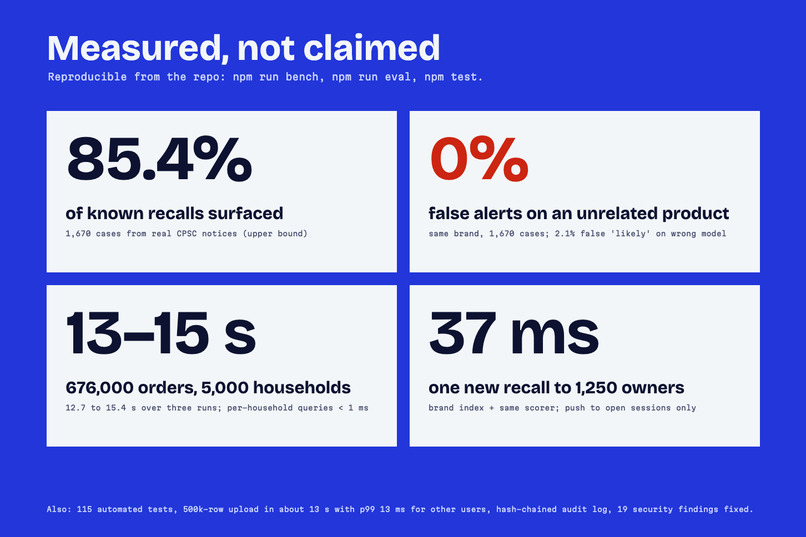
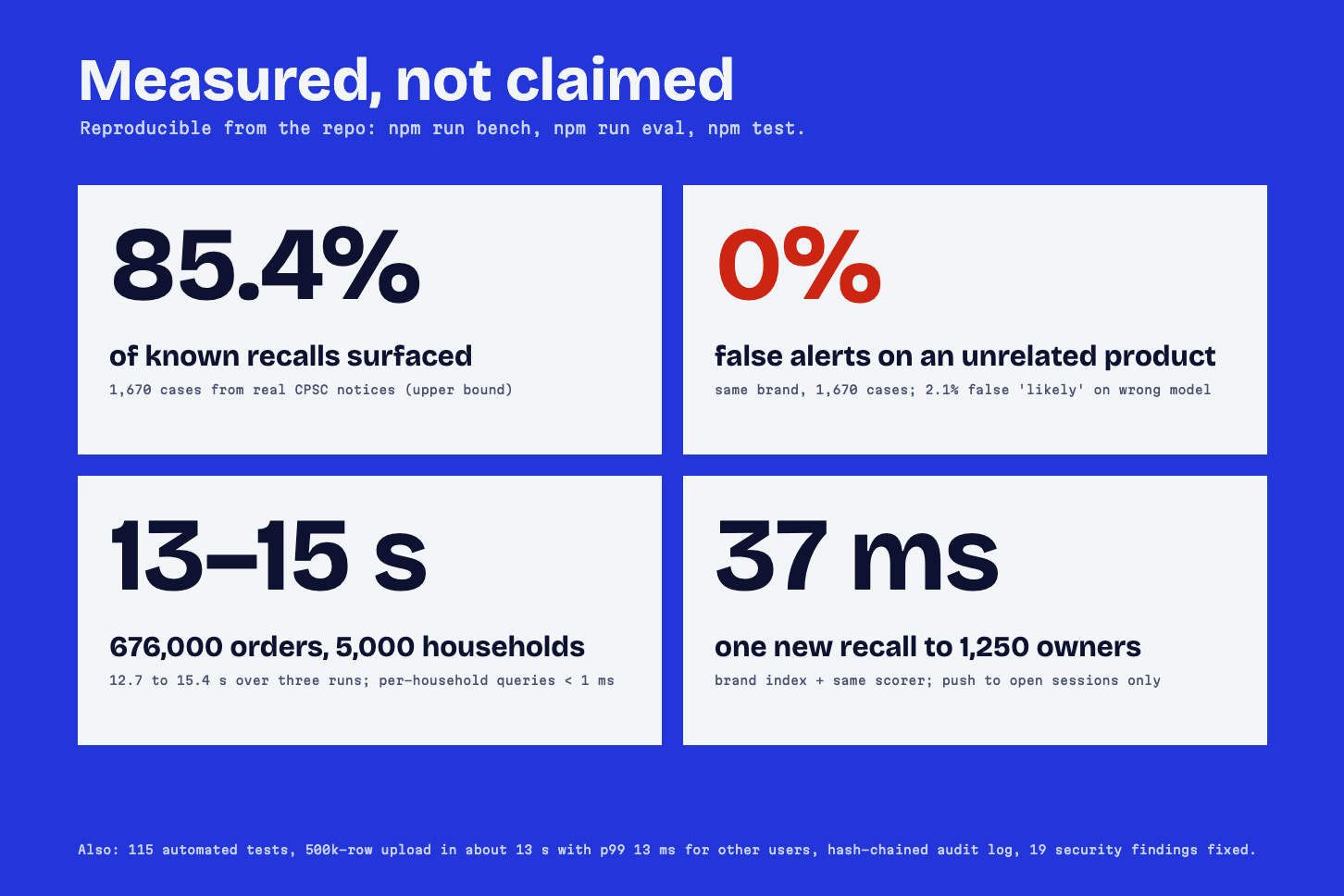
Measured, not claimed: benchmarks and accuracy on real recall notices, reproducible from the repo.
The problem
Recalls get published, but owners are not reliably reached. CPSC's own FY2025 performance report puts the average correction rate across consumer product recalls at 44.55%, so more than half of recalled units are not remedied, and in January 2025 CPSC ordered Amazon to notify purchasers of 400,000+ hazardous products directly (Amazon is contesting the order). The hard part is the join: a recall is free text from a regulator in one country, an order is a marketplace title, and the two have to be matched without crying wolf.
Second, Alexa+ add-ons are MCP servers, and a server that can place orders can spend a customer's money on a model's say-so. A 2026 vendor survey reports most consumers are uncomfortable with agents buying for them and expect strong safeguards. I could not find a standard pattern for the basics: confirm, idempotent retry, undo, audit, spend ceilings.
I am not claiming Amazon has no recall or reorder features; it does. Hearth is a measured, open, testable reference implementation of those two layers for an Alexa+ household add-on, working from order history at the moment a household is talking to Alexa+.
What it does
Hearth is a self-hosted MCP server (spec 2025-11-25, Streamable HTTP, OAuth 2.1 + PKCE). A demo video runs the real app end to end: docs/demo/hearth-demo.mp4.
- Proactive, not just on request. A background sync spots newly published notices, finds every household that owns the product through a brand index (1,250 owners among 5,000 households in 37 ms), stores an alert, and pushes it over an MCP resource subscription to the open session, so Alexa+ can say it the moment it matters. This is the notify-purchasers-on-publication obligation regulators are putting on marketplaces.
- Owner-level recall matching across regulators. It syncs the full public feeds (U.S. CPSC and Health Canada, 10,505 real notices) into a local index and matches each household's appliances on brand, product type and model number, showing the evidence. A match is "likely" only with a model-number hit; otherwise "possible, verify the label". In the demo it matches the real SharkNinja Foodi recall by model OP302.
- Learns from messy, global data. It imports order exports the way they really arrive: mixed date formats, many currencies, duplicate rows, cancellations, missing quantities, and the same product retitled between orders. It streams files of hundreds of thousands of rows on a worker thread.
- Forecasts honestly. When each consumable runs out, with a likely window and a confidence instead of a fake-precise date.
- A safety layer for agent purchases. plan_restock only proposes. the model cannot say "the user agreed": confirm_restock needs a 4-digit approval code that only the on-screen card shows (the live model was attacked with 16 prompt injections, see docs/REDTEAM.md), is idempotent, has operator-set per-order and daily ceilings the model cannot change, a 10-minute undo, and an audit log. The erase-my-data tool is hidden from the model.
- Closes the loop on a recall. Under half of recalled units are ever corrected, so a notice alone is not enough: each recall card lets the household record that they stopped using it, asked for the free fix, or resolved it, counts how many are still open, and logs it. A likely recall still open after three days comes back as a pushed reminder, at most three times. The screens pass an axe-core accessibility audit with no issues. The safety ledger also shows a fingerprint of the hash-chained history that the browser remembers, so a consistent rewrite of the log is still caught.
- Speaks the household's language. English, Spanish and Hindi replies, locale-correct money, saved region and language preferences, and a neural voice that runs on the user's machine (open-source Kokoro; the browser's voice is the fallback).
- Rows you can interrogate. Each forecast row opens a "Why this date" panel with a switch to stop reordering that item, and the plan card has a budget slider that re-plans with a fresh approval code.
- Shows, not just tells. Results render as a thermal-receipt card through an MCP Apps view, with working Place order and Cancel order buttons that call tools back over MCP.
Measured, not claimed
- Recall matching, on 1,670 cases built from real CPSC notices: the right recall surfaced 85.4% of the time; 0% false alerts on an unrelated product of the same brand; 0.4% on a third-party replacement part; 2.1% false "likely" on a wrong model number. The positives are an upper bound, because titles come from the notice itself.
- Scale on one laptop: 676,000 orders across 5,000 households imported in 13 to 15 s; forecast per household under 1 ms and recall check about 0.2 ms median against 10,505 notices (ranges over repeated runs in docs/SCALE.md). A 500,000-row, 43.5 MB upload took 12.4 s while another client's requests stayed at 13 ms p99.
- 142 automated tests run through the official MCP SDK client, including chaos input, an attack suite (host spoofing, cross-site calls, CSRF, token replay, tenant isolation, path traversal, SQL metacharacters), and the spend ceilings.
How I built it
A TypeScript MCP server on the official SDK with thirteen annotated tools, SQLite state per household, a ui:// resource for the MCP Apps view, and a hardened OAuth server (hashed tokens, rotating refresh tokens with reuse detection, single-use codes, mandatory PKCE). The Alexa+ add-on developer tools are partner-only, so the demo front end is a real MCP client and MCP Apps host in the browser. Claude on Amazon Bedrock (Converse API with tool use) can drive it as the brain; without AWS credentials a small offline router runs the same loop. Purchasing sits behind one StoreAdapter interface, the seam where a store plugs in; one opt-in connector prepares an Amazon cart with Amazon's own add-to-cart link, so Amazon's checkout takes the order and Hearth never touches payment. It runs as a compiled build with readiness checks, Prometheus metrics, structured logs, graceful shutdown and verified database backups, and its audit log is hash-chained so tampering is detectable.
Challenges
- Retitled listings split one product into two forecast series. Merging by ASIN, with a title-overlap fallback, fixed it.
- False alarms. A bare "12" from "12 Triple Rolls" was read as a model number, and a third-party "battery for Dyson V6" recall matched Dyson owners. Both are now fixed and covered by the evaluation harness.
- A silent failure in the sandboxed iframe. One quote typo made the card render blank with no error. The view script is now compiled in the test suite.
- A self-audit that found real holes: an unauthenticated paid model endpoint, all users sharing one household, no CSRF protection on consent. Each was fixed with a test (see SECURITY.md).
What I learned
Honest uncertainty beats false precision, in forecasts and in recall matching. An agent that can spend money needs ceilings the model cannot raise, not just a confirm button. Measuring the matcher on real notices changed my design more than any amount of reasoning about it.
Honest limits
The storefront is simulated, the sample orders are synthetic (so forecast accuracy on real purchases is untested), and there is no real Alexa+ device. The recall data is real. The approval code proves a person is looking at the card, not that they read it carefully, and a person who is shown a bad plan can still approve it; the ceilings, undo and audit limit the damage, and the real fix is a user-presence signal from the platform. The Amazon cart handoff is opt-in and tested for the link it builds, not against a real Amazon account. SECURITY.md lists the residual risks. The Spanish and Hindi strings should be reviewed by native speakers.
Built With
- alexa-plus
- amazon-bedrock
- claude
- cpsc-recall-api
- css3
- health-canada
- html5
- javascript
- mcp-apps
- model-context-protocol
- node.js
- oauth2
- pkce
- server-sent-events
- sqlite
- typescript
- zod


Log in or sign up for Devpost to join the conversation.