-
-

What I carry forward is still my choice.
-
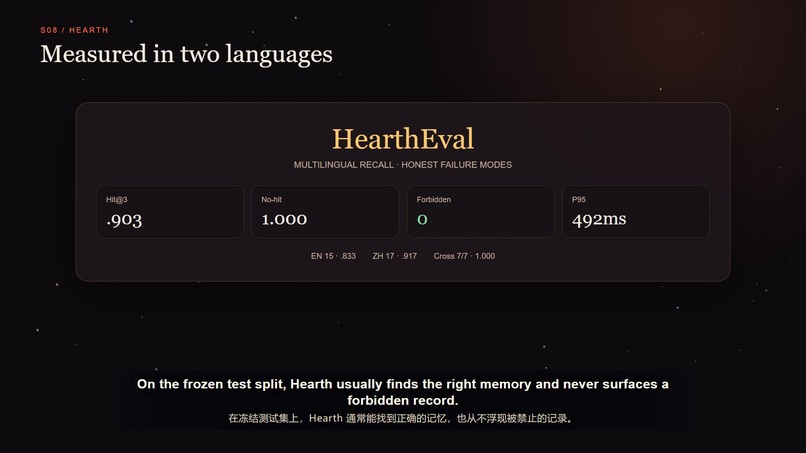
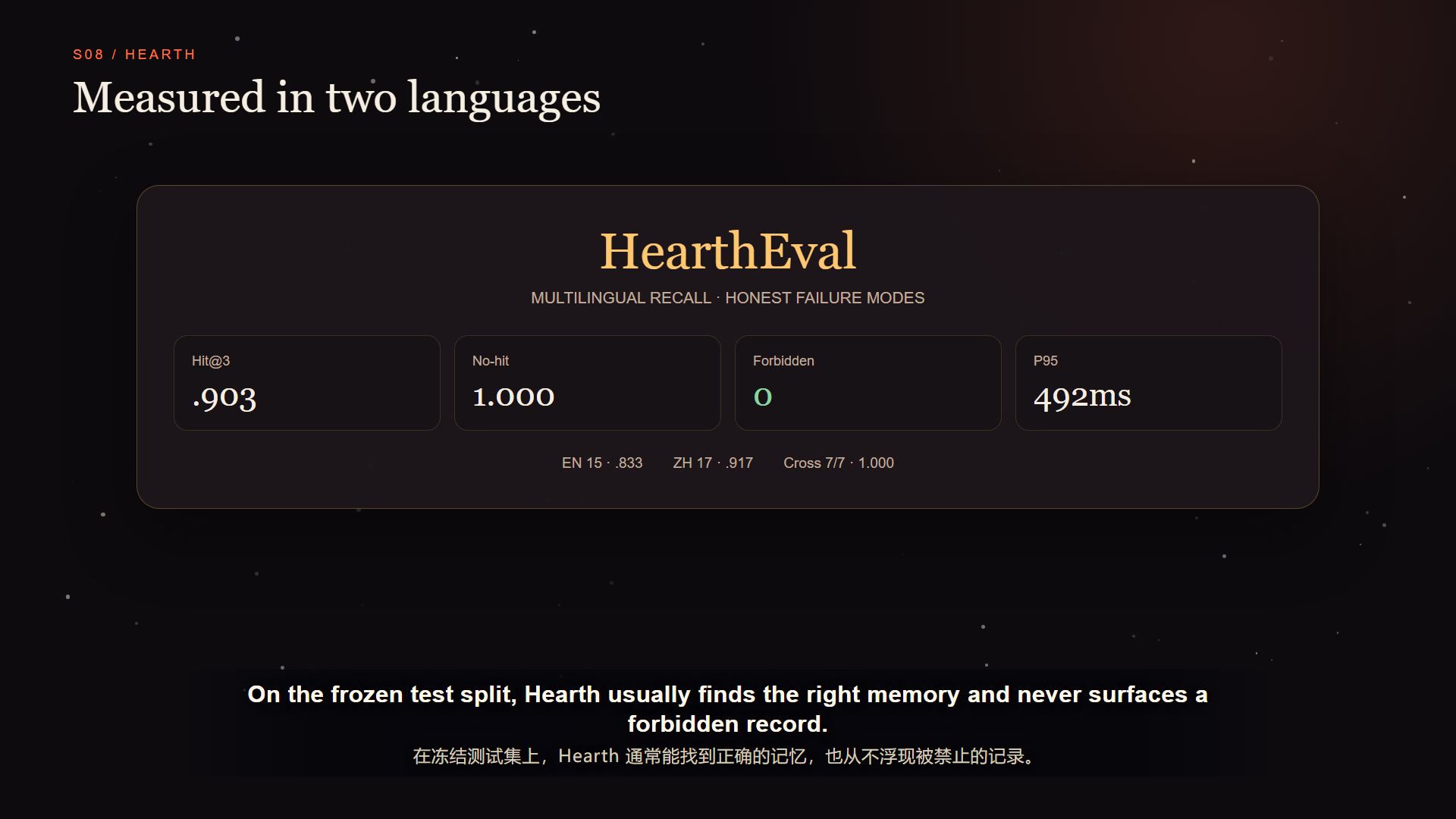
HearthEval: frozen 128-query bilingual suite — Hit@3 .903, zero forbidden surfacing, P95 492ms
-
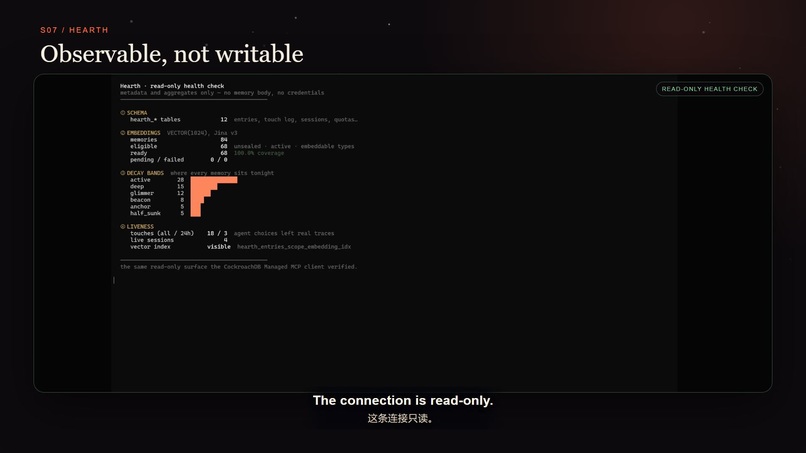
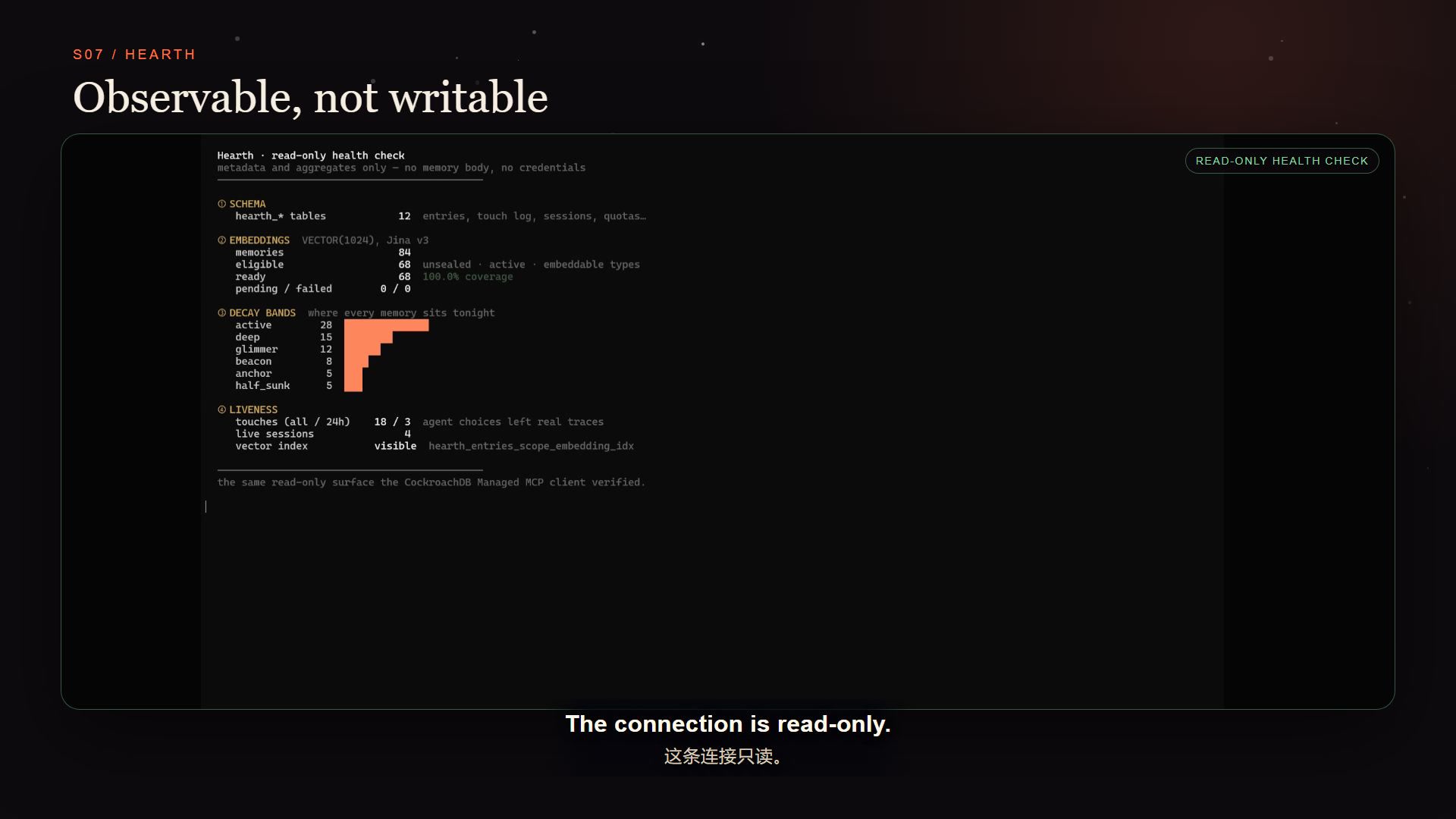
Read-only health check through CockroachDB Cloud Managed MCP — schema, coverage, decay bands
-
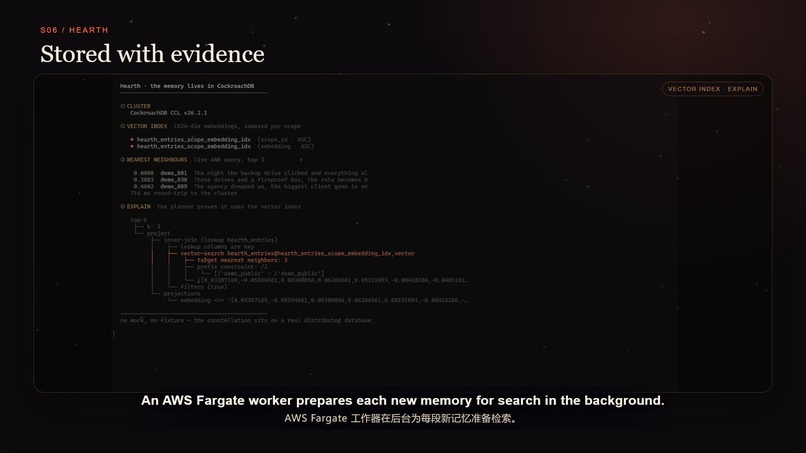
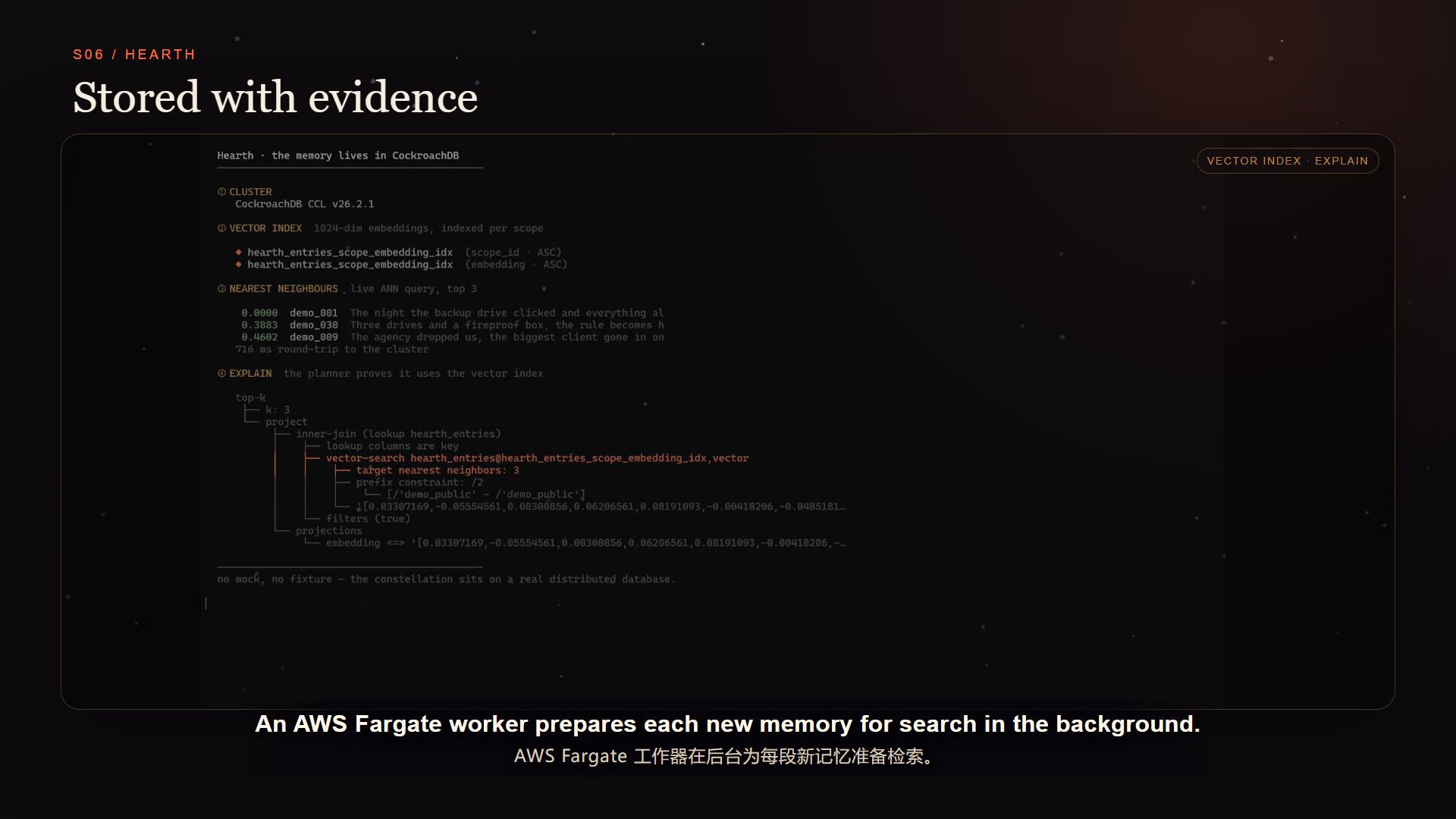
Live nearest-neighbour query + EXPLAIN proof that the vector index is in the plan
-
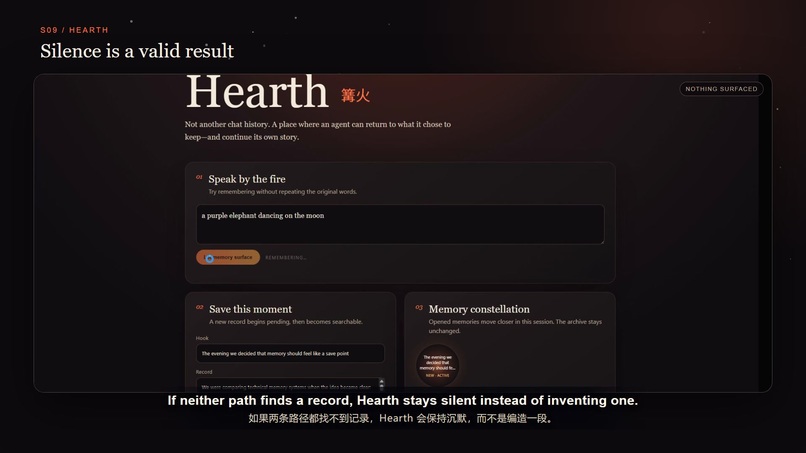
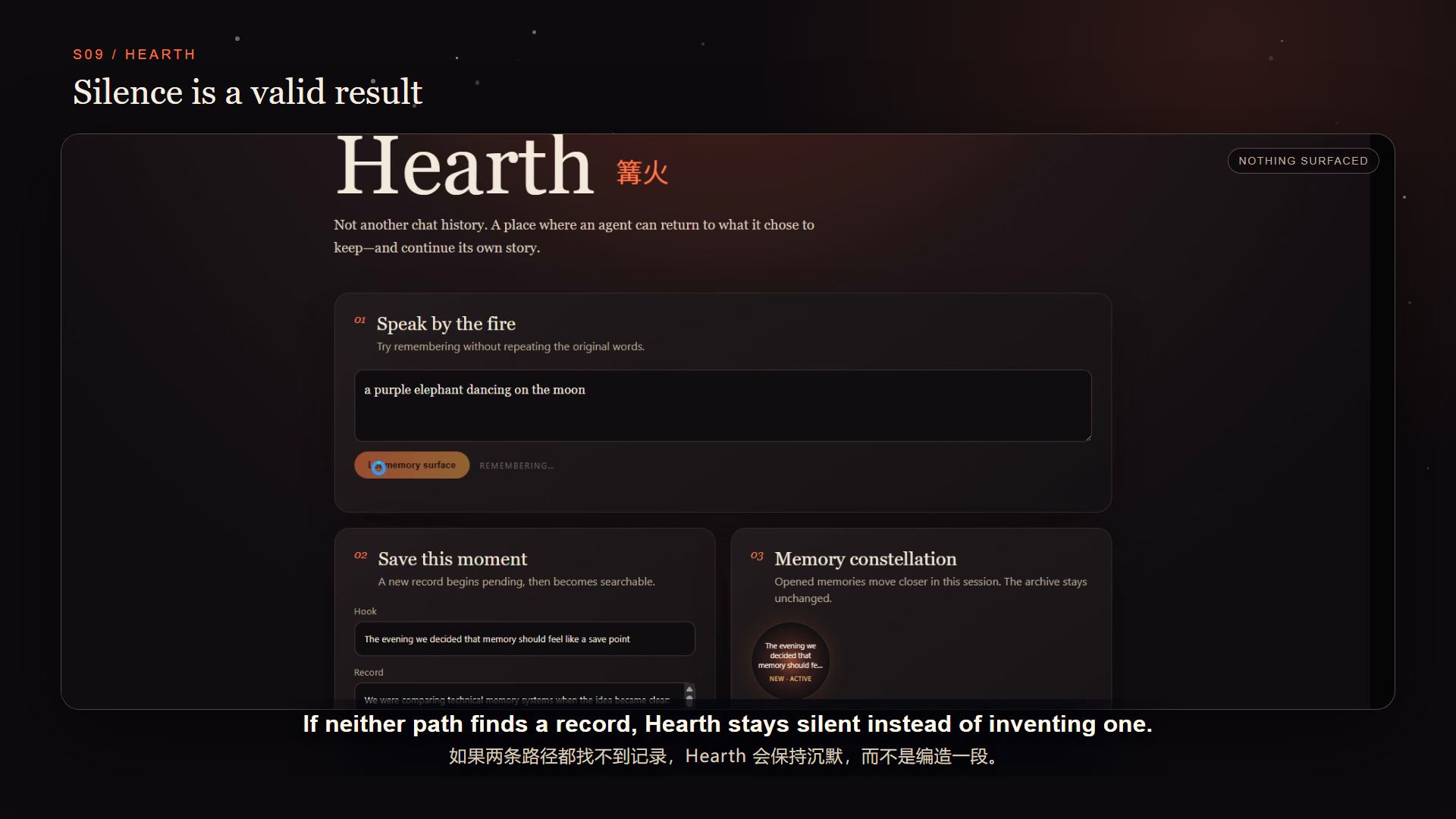
If neither path finds a record, Hearth stays silent instead of inventing one

Inspiration
Most memory systems treat agent context as a retrieval problem: store everything, search when asked. But human memory doesn't work that way — things slip away, come back uninvited, and some moments are sealed off entirely. Hearth exists because we wanted an agent that doesn't just remember — it forgets, and what it forgets (and what it keeps) shapes who it becomes.
What it does
Hearth is an agentic memory layer where memories have lifecycles:
- Decay: every memory moves through six temporal bands (active → glimmer → beacon → half_sunk → deep → nebula) based on when it was last touched. A memory in
deepcannot be recalled — until someone touches it and it rises back. - Anchors: tier 0–3 anchors slow or halt decay. A tier-3 memory never sinks.
- Sealed records: private entries that exist in the database but never appear in recall results, cannot be searched, and have no embeddings computed. Zero-leakage is a hard evaluation constraint.
- Supersession: when a memory replaces an older one, the old version is excluded from recall but preserved for history.
- Keys + Semantic dual surfacing: an incoming message first triggers exact keyword matches, then a cosine-similarity search over bilingual embeddings. Both channels feed into a unified surfacing decision.
- Agent choice: surfaced memories are hooks, not answers. The agent decides which ones to open —
touchresets the decay clock;skipdoesn't.
The browser demo shows the full loop: speak → surfaced memories with channel attribution → save a new memory (pending → ready) → watch the constellation shift.
How we built it
- CockroachDB Cloud stores all memories, embeddings, sessions, and recall configuration. The schema uses scope-partitioned vector indexes for cosine recall, with lifecycle/sealed/decay filters applied post-ANN.
- CockroachDB Cloud Managed MCP provides read-only operational health checks: schema verification, embedding coverage, decay band distribution, session overlay status, and vector index visibility — without exposing memory bodies or write access.
- Jina Embeddings v3 (1024-dim, L2 normalized, separate passage/query tasks) powers bilingual retrieval. The threshold (0.3157) was calibrated on a 48-query train set and frozen; validation and test sets were never used for tuning.
- AWS Fargate (ECS) runs the asynchronous embedding worker with lease-based job claiming and stale-write protection, plus the public demo app. Jina API keys live in AWS Secrets Manager, never in code or environment files.
- HearthEval v1.1 is a frozen 128-query, 15-category evaluation suite covering retrieval, no-hit, exclusion, sealed leakage, supersession, decay-band probes, cross-language, and body-detail recall. Test results: Hit@3 0.903, No-hit 1.000, forbidden 0, sealed leakage 0, cross-language 7/7, P95 492ms.
Challenges we ran into
- Bedrock account-level gate: our AWS account requires an allowlisting review before any
InvokeModelcall. We pivoted to Jina within 24 hours and verified the full pipeline on Fargate. - CockroachDB vector index filter constraints:
WHEREclauses outside the index prefix disable the vector search path. We learned this throughEXPLAINand moved all non-prefix filters to post-retrieval, adding EXPLAIN evidence as a CI-level gate. - Bilingual threshold calibration: English and Chinese embeddings occupy different similarity ranges. A single global threshold risks either missing Chinese recalls or flooding English results. The train-only calibration found a point that holds for both; the 7/7 cross-language test set confirms it, but we report the val set's one false positive (q051, karaoke → rice balls, score 0.34) rather than tuning it away.
Accomplishments that we're proud of
- Sealed entries have zero leakage across all 128 evaluation queries. A sealed memory has no embedding, no recall eligibility, and no body exposure — not even through side-channel similarity to neighboring entries.
- The evaluation suite is frozen and reproducible: same threshold, same data, same queries. We don't cherry-pick results.
- Graceful degradation is real: when the semantic provider times out, the API returns keys-only results with
semantic_status: timeoutinstead of failing. This happened in local development (Jina unreachable from our network) and the system kept working. - Cross-language recall works: a Chinese question retrieves an English memory (and vice versa) at 100% accuracy on the test set.
What we learned
That "memory" for an agent isn't a retrieval optimization — it's a design commitment. Deciding what fades, what stays sealed, what the agent can choose to skip — these are identity decisions, not engineering tradeoffs. The hardest part wasn't building the vector search; it was writing 75 fictional memories that felt real enough to evaluate honestly.
What's next for Hearth
- Semantic recall integration into the private Hearth instance (the bilingual threshold provides a starting point)
- Keys frequency-based noise suppression (high-skip keys in real conversations need dampening)
- Voice interface for the physical embodiment (Stack-chan robot with cloud TTS — listen/speak loop working as of submission)
Built With
- amazon-ecs
- aws-fargate
- aws-secrets-manager
- cockroachdb
- express.js
- javascript
- jina-embeddings
- mcp
- node.js

Log in or sign up for Devpost to join the conversation.