-
-
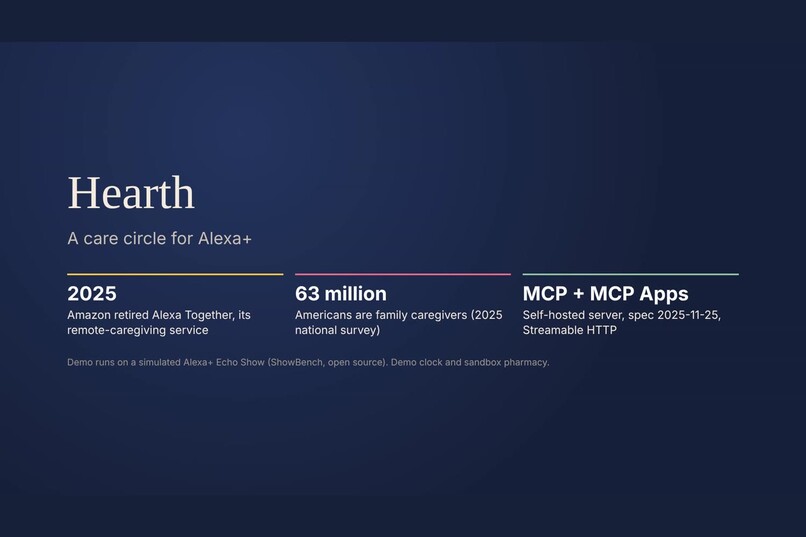
Hearth: a care circle for Alexa+, built on MCP 2025-11-25 and MCP Apps
-
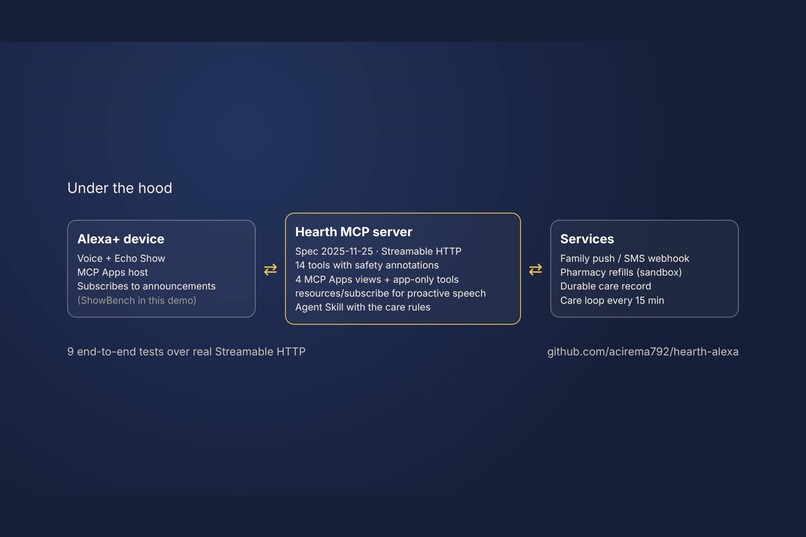
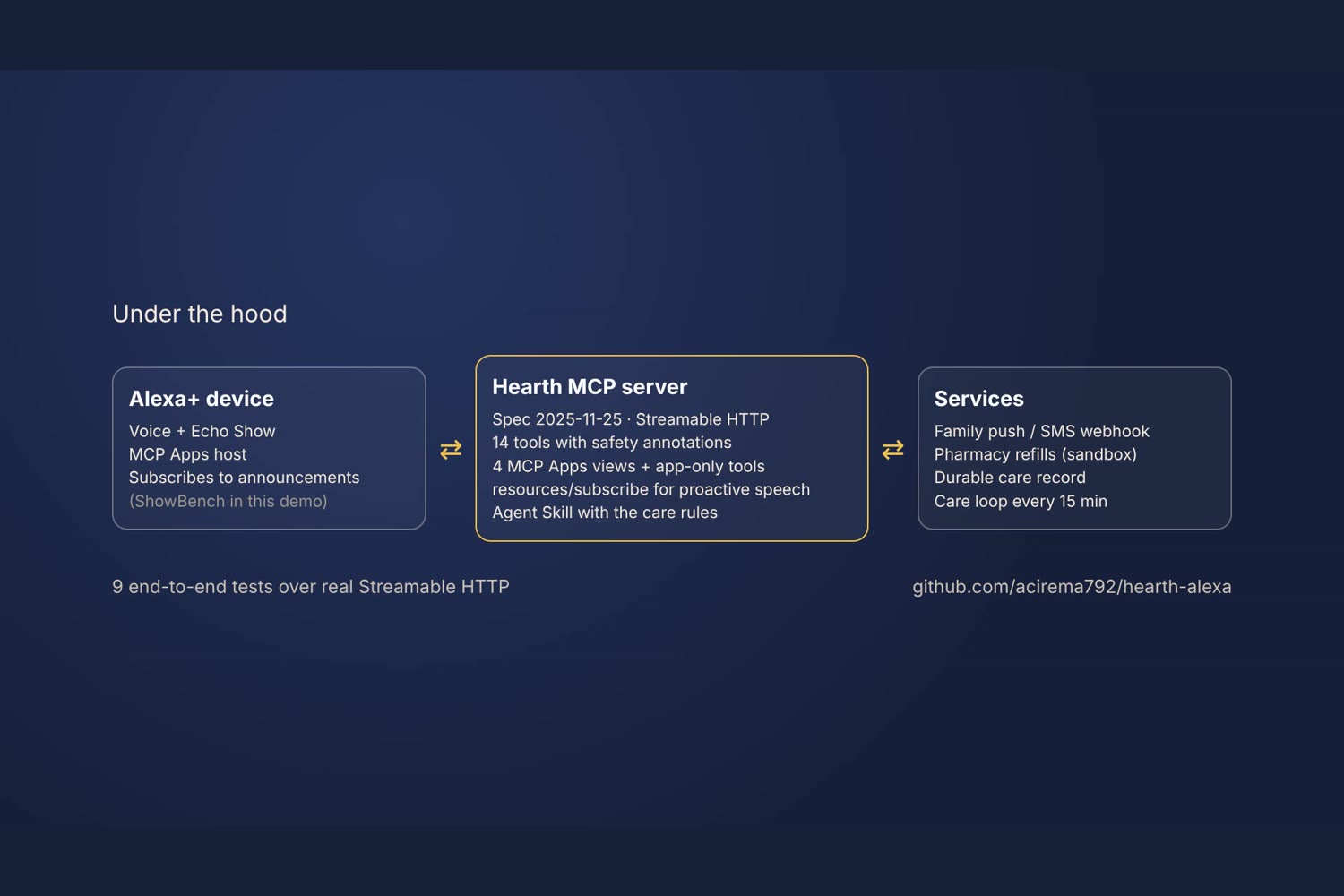
Architecture: Alexa+ device ⇄ Hearth MCP server ⇄ family notifications, pharmacy, care record
-
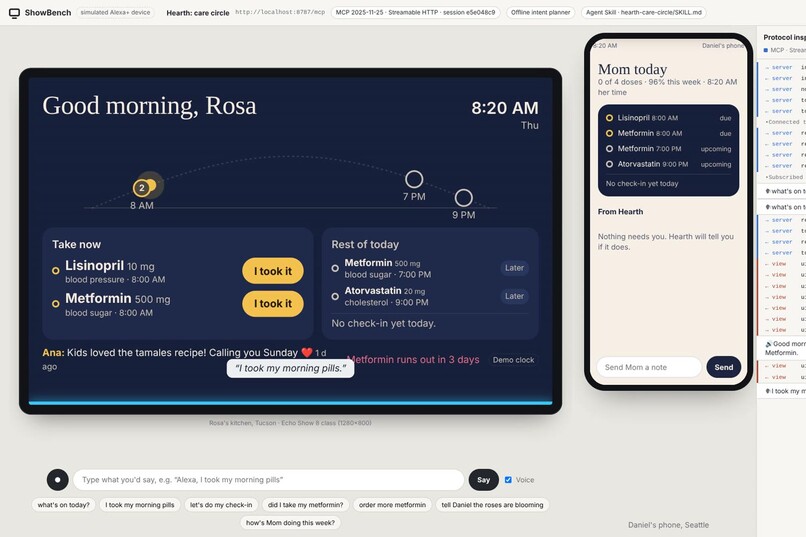
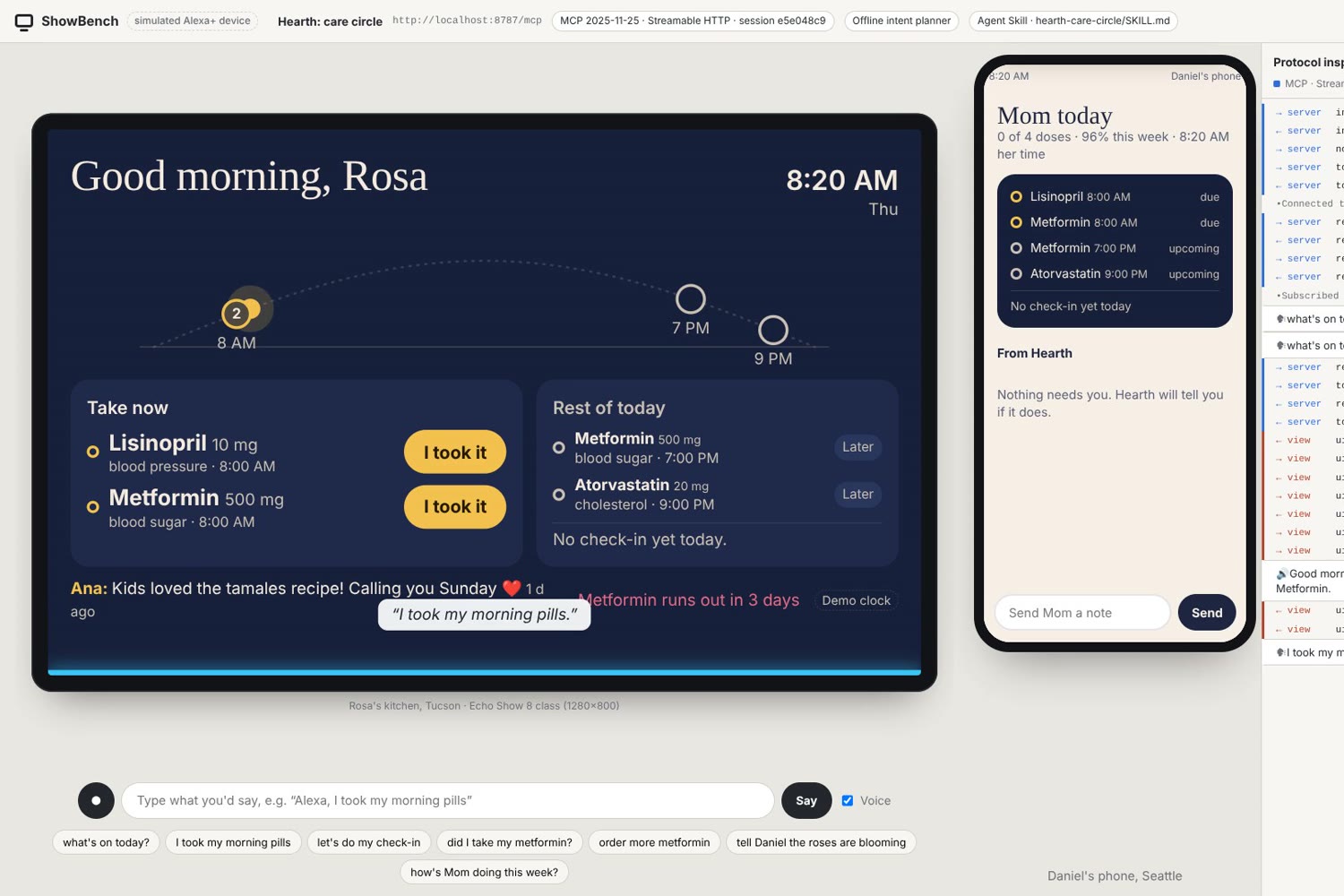
Rosa's morning on the Echo Show: each dose is a bead on her day; Daniel's phone updates live
-
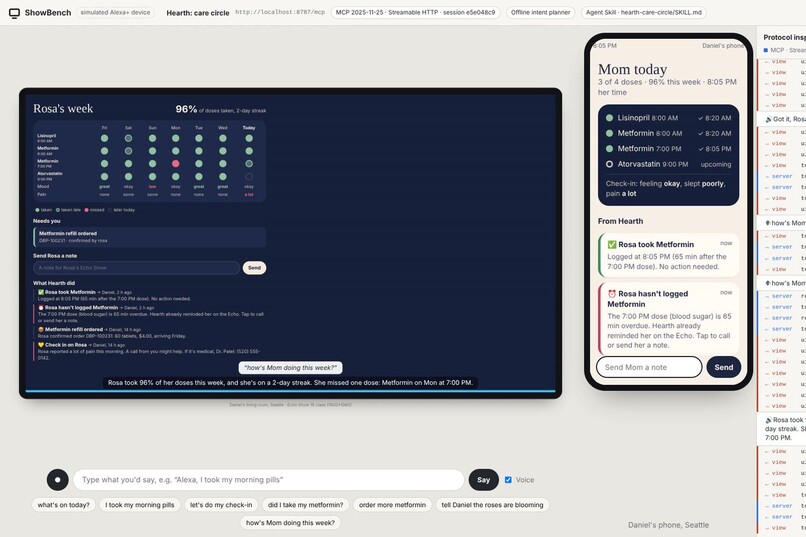
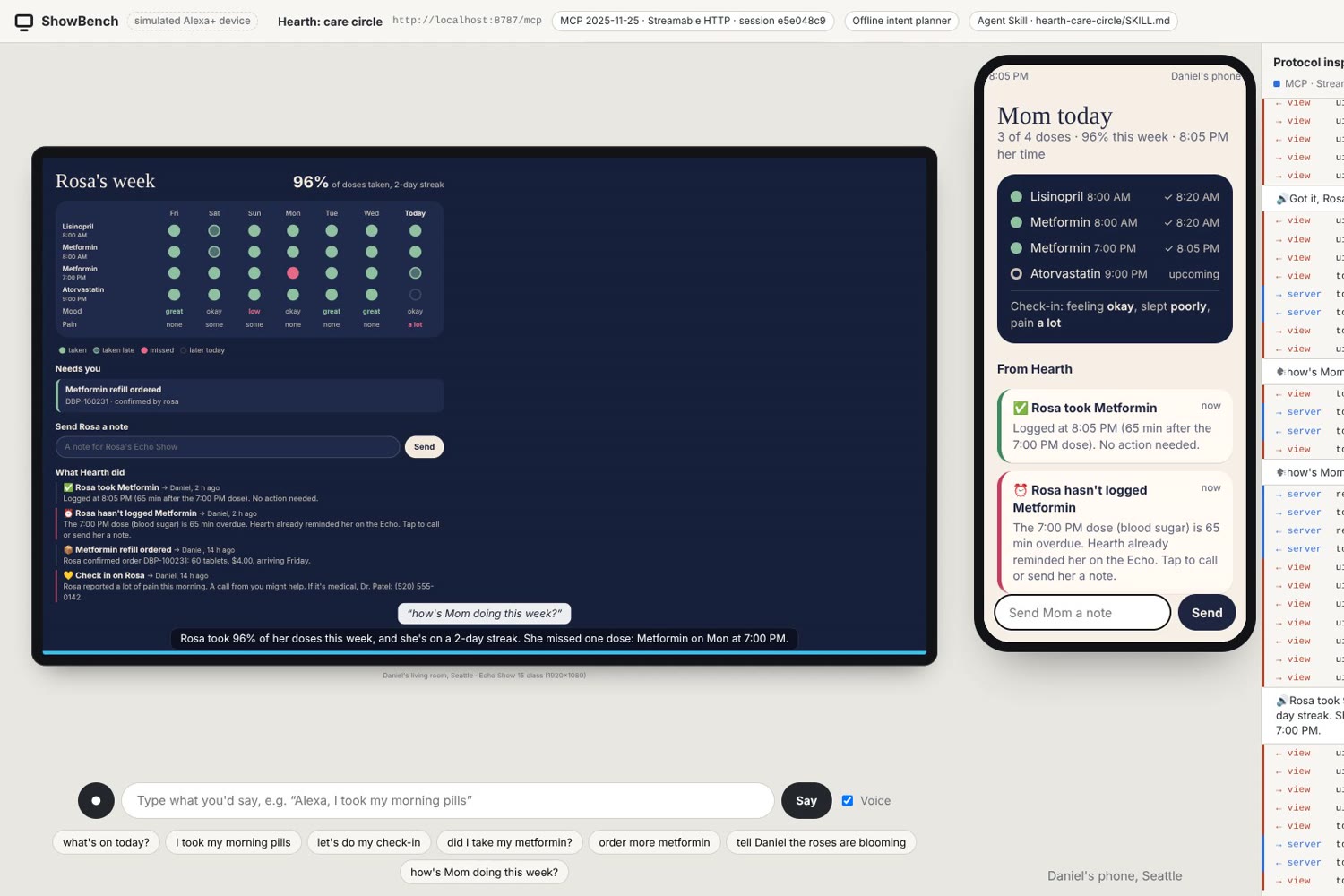
Family dashboard MCP App on Daniel's Echo Show: 7-day adherence, mood and alerts
-
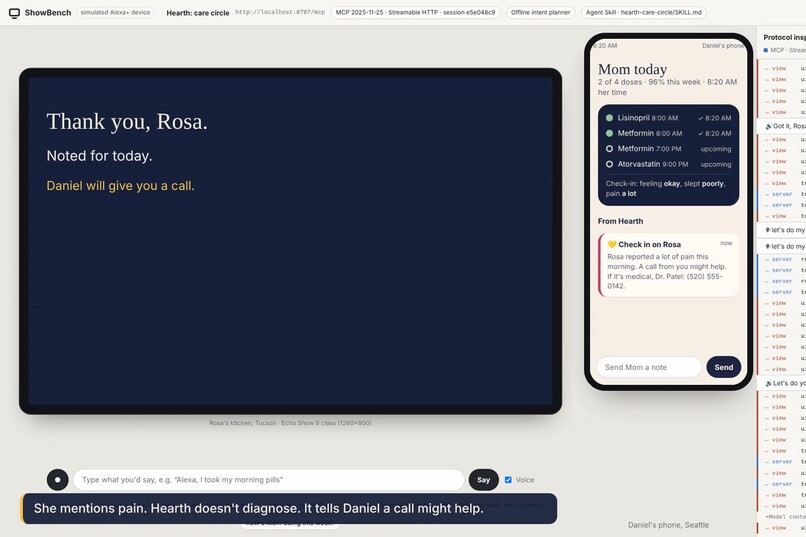
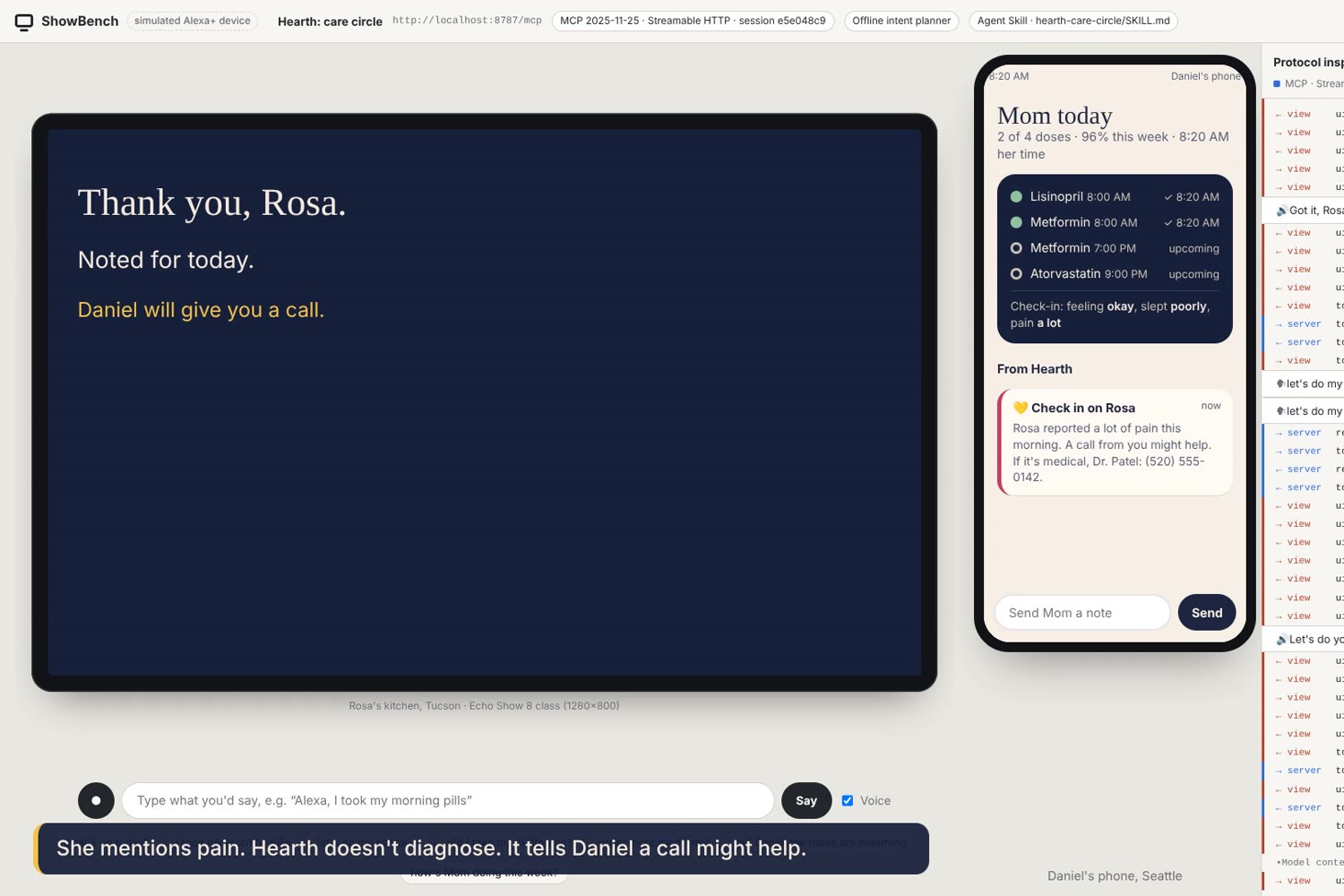
Check-in reports pain: no diagnosis, Hearth tells Daniel a call might help
-
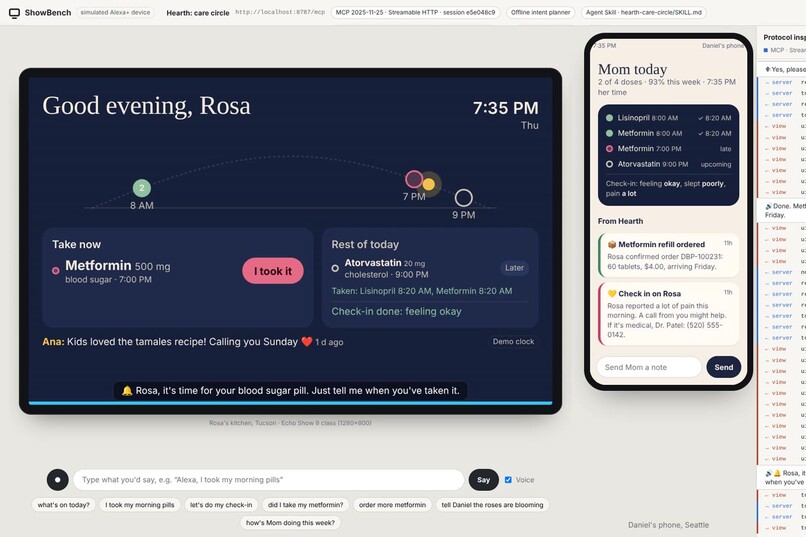
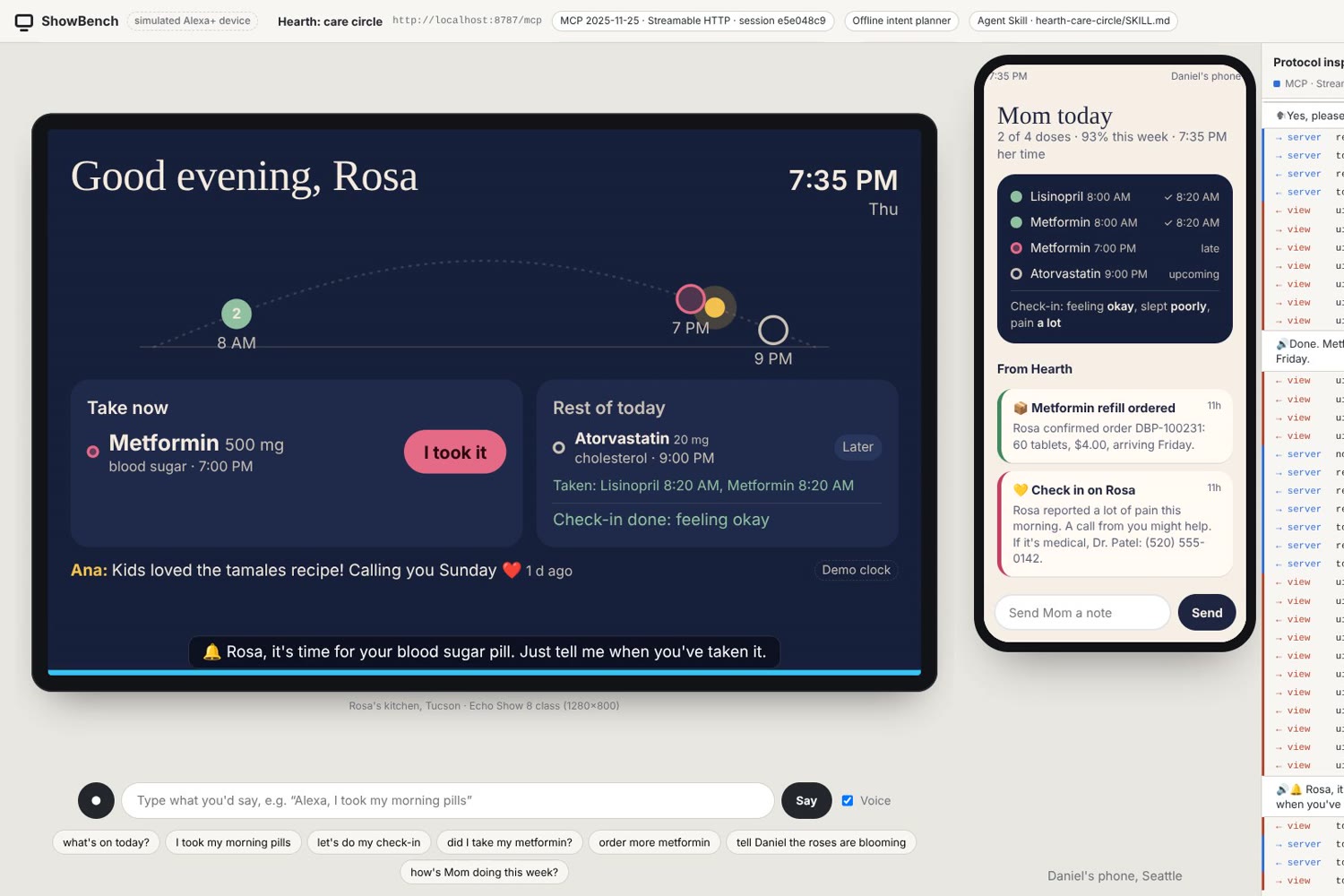
7:35 PM: the Echo speaks up unprompted (MCP resource subscription) while Daniel's phone escalates
Inspiration
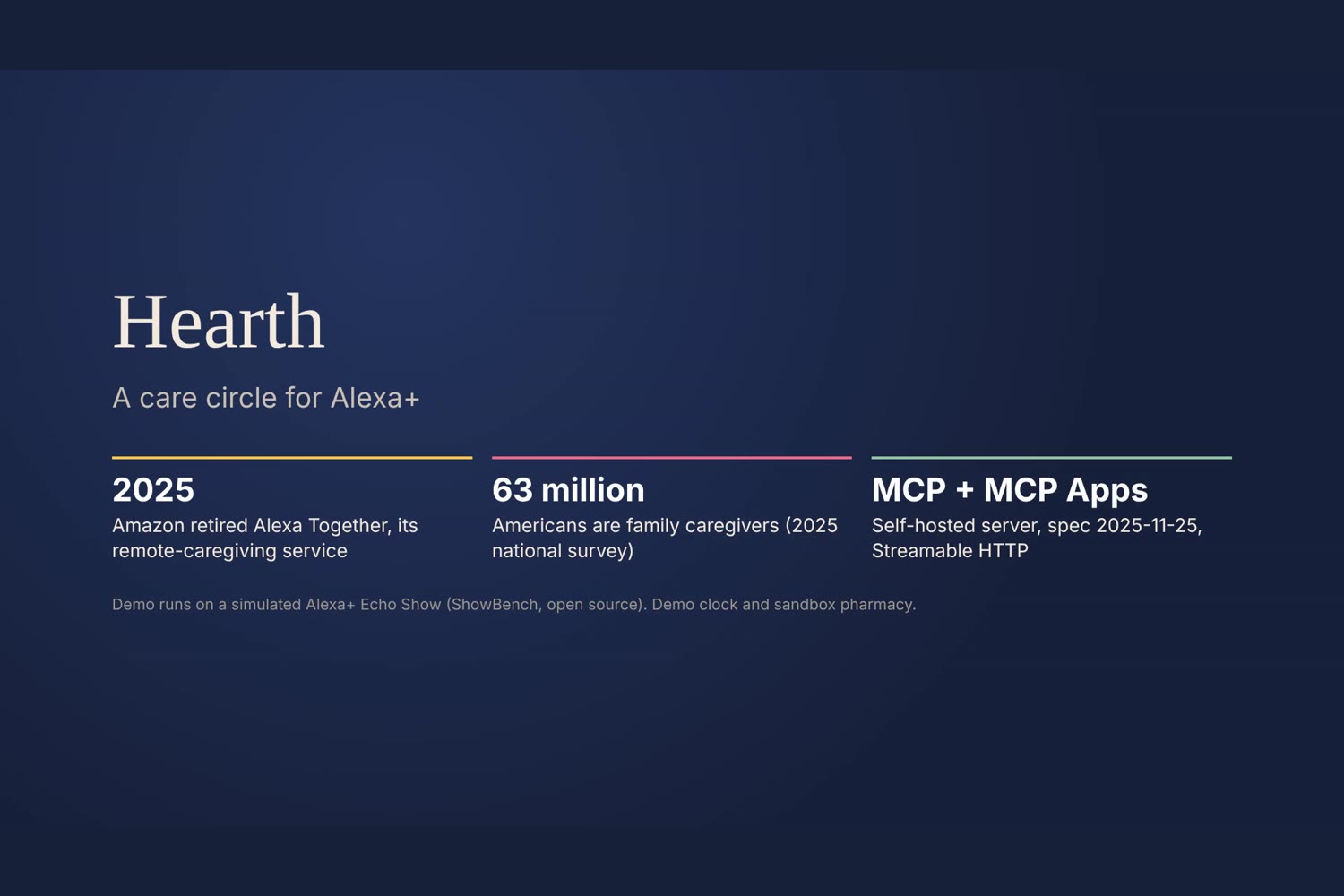
In 2025 Amazon retired Alexa Together, its remote-caregiving subscription. The need it served keeps growing:
- 63 million Americans are family caregivers (AARP & NAC, 2025), many of them caring from another city.
- Half of US prescriptions aren't taken as prescribed, at an estimated $100–300 billion a year (Bosworth et al., American Heart Journal, 2011).
And someone already pays for adherence: Medicare Part D Star Ratings score plans on adherence to exactly Rosa's three drug classes (diabetes medications, RAS antagonists, statins), each triple-weighted. So Hearth can be free for families and sponsored by Medicare Advantage plans and pharmacies, which could also ship it as their own branded Alexa+ experience.
The Echo Show already sits in the kitchens of the people who need help most. Alexa+ can now hold a real conversation and render rich cards. We wanted to give it a care brain that a son in Seattle can trust for his mom in Tucson.
What it does
Hearth is a self-hosted MCP server that Alexa+ (or any MCP-Apps host) talks to.
- Rosa, 78, on her Echo Show:
- "I took my morning pills" logs every dose due.
- "Did I take my metformin? I can't remember" answers from the record, never logs anything, and tells her not to take another. The double-dose guard lives in the server, not just a prompt.
- "Let's do my check-in" asks three big-button questions, one at a time.
- "Order more metformin" reads back a quote, then waits for an explicit yes before ordering.
- Hearth speaks up on its own. When the 7 PM pill isn't logged, her Echo says "Rosa, it's time for your blood sugar pill". This is delivered as an MCP resource subscription (
resources/subscribe→notifications/resources/updated). - Daniel and Ana, her kids:
- They get alerts on an escalation ladder: Echo reminder at +30 min, primary caregiver at +60, whole family at +120. Family quiet hours are respected.
- Loops get closed: "✅ Rosa took Metformin. No action needed."
- A pain report becomes "a call might help", never a diagnosis.
- Daniel's notes are spoken on Mom's Echo.
- "Alexa, how's Mom doing this week?" opens a family dashboard MCP App: 7-day adherence grid, mood trend, one-tap refill confirmation.
- An autonomous care loop (
run_care_rounds) runs every 15 minutes like an Alexa+ routine. It handles escalation, check-in nudges and refill forecasting, and is idempotent, so nobody is ever texted twice.
How we built it
- MCP spec 2025-11-25 over Streamable HTTP with the official TypeScript SDK (v2). It uses stateful sessions, Origin validation, and a standalone SSE stream for server push. We verified the negotiated version on the raw wire.
- 14 tools with Zod schemas and safety annotations, server
instructions, a care-plan resource, and two prompts. - 4 MCP Apps views in vanilla TypeScript, each bundled to a single HTML file:
- Today: a sun-arc timeline of her day, with doses as beads.
- Check-in
- Refill: a purchase card with a live price-hold countdown.
- Family dashboard
The views call tools back, push context to the assistant with ui/update-model-context ("she tapped I took it on screen"), use app-only tools (visibility: ["app"]) to stay live, and handle teardown.
- An Agent Skill (
SKILL.md, agentskills.io format) holds the voice rules (one question at a time, two sentences max), the non-negotiable safety rules, and worked examples. It's loaded into the agent at runtime. - ShowBench, our open-source simulated Alexa+ device. No public way exists to point a real Alexa+ device at a self-hosted MCP server, so we built a spec-compliant MCP Apps host for smart displays:
- a cross-origin sandbox proxy with CSP
- Echo Show and Fire TV screen profiles
- Web Speech voice in and out, a light bar and captions
- proactive announcements via
resources/subscribe - a live protocol inspector for both wires
- an LLM planner (Anthropic or any OpenAI-compatible model) that loads the server's instructions and Agent Skill, plus a deterministic offline planner for keyless demos and CI
- Cross-service orchestration through adapters: family notifications via webhook (n8n, Zapier, ntfy, SMS gateways) and a pharmacy adapter (a clearly labelled sandbox in the demo).
- Tests:
- 9 end-to-end tests: real server, real MCP client, real Streamable HTTP. They cover version negotiation, MCP Apps metadata, the double-dose guard, the escalation ladder and its idempotency, the purchase flow, cross-session persistence, and proactive push.
- LLM-adapter contract tests against fake Anthropic and OpenAI endpoints.
- The demo video was recorded headlessly from ShowBench's scripting API, with open-source TTS voices.
- We used Claude as a pair programmer throughout. Commits are co-authored.
Challenges we ran into
- There's no developer path to test a self-hosted MCP server on a real Alexa+ device, so we built ShowBench.
- Two undocumented ordering issues in MCP Apps hosting:
setHostContextbefore connect throws.- The sandbox proxy's "ready" message is lost if you connect after the iframe loads.
- Designing safety into the server, not the prompt. "Did I take it?" had to become its own read-only tool, so an anxious question can never be recorded as a dose.
- Making an escalation loop that is idempotent and quiet-hours aware, so it can run every 15 minutes forever without spamming a family.
Accomplishments that we're proud of
- The evening sequence runs without anyone asking:
- Rosa's Echo speaks up on its own.
- Daniel's phone buzzes 30 minutes later.
- His note is read aloud on her Echo.
- She takes the pill.
- He gets the all-clear.
- One MCP server serves Rosa's Echo, Daniel's Echo, his phone, and any MCP-Apps host.
- ShowBench is a genuinely reusable tool for anyone building MCP Apps for displays and TVs.
What we learned
- MCP Apps turns voice-assistant development into normal web and back-end engineering. The interesting work moves to care design: who gets told what, when, and how the loop closes.
- Voice UX for older adults rewards restraint: short sentences, one question, no lectures, big targets.
What's next for Hearth
- Alexa+ account linking and per-speaker identity: Rosa versus a visiting nurse.
- Real pharmacy integrations behind the existing adapter.
- Ring: "Rosa went out for her walk" as a gentle wellbeing signal.
- Fire TV: the evening reminder as a picture-in-picture card during her shows.
- Spanish: Rosa's first language.
Links
- Code: https://github.com/acirema792/hearth-alexa
- Open-source simulator (ShowBench): https://github.com/acirema792/showbench
- Product feedback, friction log and feature requests: in the Additional info answers and in
docs/in the repo.
Built With
- agent-skills
- alexa
- esbuild
- mcp-apps
- model-context-protocol
- node.js
- server-sent-events
- typescript
- web-speech-api

Log in or sign up for Devpost to join the conversation.