Inspiration
HeartGuardianAI was inspired by the gap between occasional medical checkups and the changes people experience in their everyday health. A single measurement can provide a useful snapshot, but it may miss gradual changes between appointments. We wanted to explore a more continuous, personalized approach—one that looks beyond population-wide thresholds to understand what is normal for each individual.
As a team from Boston University, we envisioned using wearable technology and AI to help people recognize meaningful changes earlier and bring clearer information to conversations with their healthcare providers. Our guiding idea is simple: move from snapshots to continuous insight.
What it does
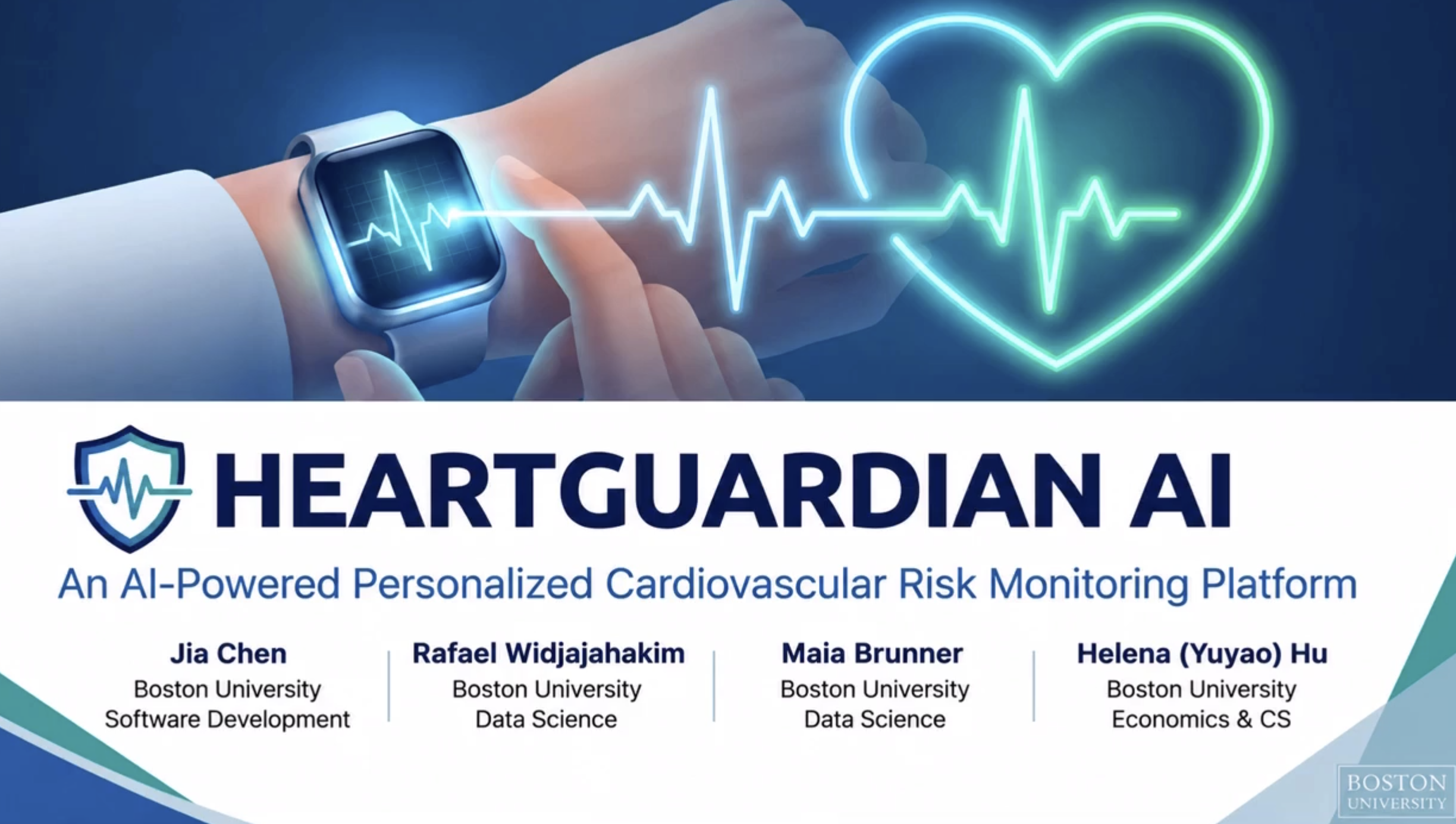
HeartGuardianAI is an interactive prototype that demonstrates how wearable measurements could support personalized cardiovascular monitoring. It brings together heart rate, heart rate variability, blood oxygen, sleep, and activity in one monitoring experience.
The prototype includes:
A real-time monitoring dashboard for viewing physiological measurements.
Historical trends that help users explore changes over time.
An Insights page that explains detected changes.
Configurable monitoring preferences and healthcare provider contacts.
A first-use medical disclaimer and safety guidance.
Our approach centers on personalization: rather than treating one unusual reading as the whole story, the system is designed to consider patterns across multiple measurements relative to an individual’s baseline. The current demonstration uses simulated wearable data and does not provide medical diagnoses.
How we built it
During Hackachusetts, our team (Jia Chen, Rafael Widjajahakim, Maia Brunner, and Helena (Yuyao) Hu) used Amazon Kiro to build the interactive HeartGuardianAI prototype.
We used simulated wearable data to demonstrate the experience from monitoring and visualization to personalized insights and safety guidance. A five-week example illustrates our intended time-series anomaly-detection approach: examining changes over time, such as rising resting heart rate alongside declining heart rate variability and reduced sleep, rather than reacting to a single measurement. This allowed us to demonstrate the product concept while keeping real-device integration and clinical validation as future work.
Challenges we ran into
A central design challenge was translating complex physiological trends into information that users could understand without presenting those trends as a diagnosis. We needed to communicate why a combination of changes might deserve attention while making the prototype’s limitations clear.
Another challenge was demonstrating a continuous, personalized monitoring experience before integrating real wearable devices. Simulated data let us illustrate the workflow, but it also required us to distinguish clearly between what the prototype demonstrates today and what will require further development and validation. Privacy and appropriate medical follow-up were important considerations throughout the concept.
Accomplishments that we're proud of
We’re proud of turning our preventive-health concept into an interactive prototype during Hackachusetts. Rather than presenting only an idea, we built an experience that connects a monitoring dashboard, historical trends, explanatory insights, and user preferences.
We’re also proud of keeping responsible communication central to the experience. The prototype includes a medical disclaimer and safety guidance, and our vision positions HeartGuardianAI as a tool to support and not to replace physicians. Our five-week demonstration makes the core concept tangible: several small changes over time may tell a more useful story than an isolated reading.
What we learned
Developing HeartGuardianAI reinforced the importance of looking at health measurements in context. Our project explores how an individual’s baseline and patterns across several signals can provide a different perspective from a single measurement or a general threshold.
We also learned that communicating an insight is an essential part of designing a health-focused AI experience. Users need to understand what changed, why it was flagged, and the limits of what the system can conclude. Building the prototype helped us clarify the distinction between demonstrating a promising monitoring concept and establishing a clinically validated tool.
What's next for HeartGuardianAI
Our next steps are to connect the prototype to real wearable devices, develop more advanced AI models for personalized time-series analysis, and explore secure integration with electronic health records.
Further clinical validation will be essential to evaluate whether the approach can support useful, reliable monitoring in practice. Our long-term goal is to help individuals understand their health trends and give healthcare providers better longitudinal information—supporting timely assessment without replacing clinical judgment.
Built With
- kiro
- python

Log in or sign up for Devpost to join the conversation.