-
-

Video Call Between Doctor and Patient
-
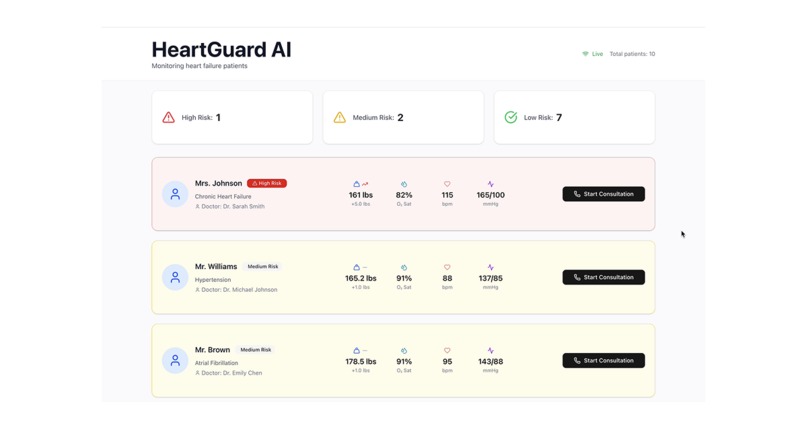
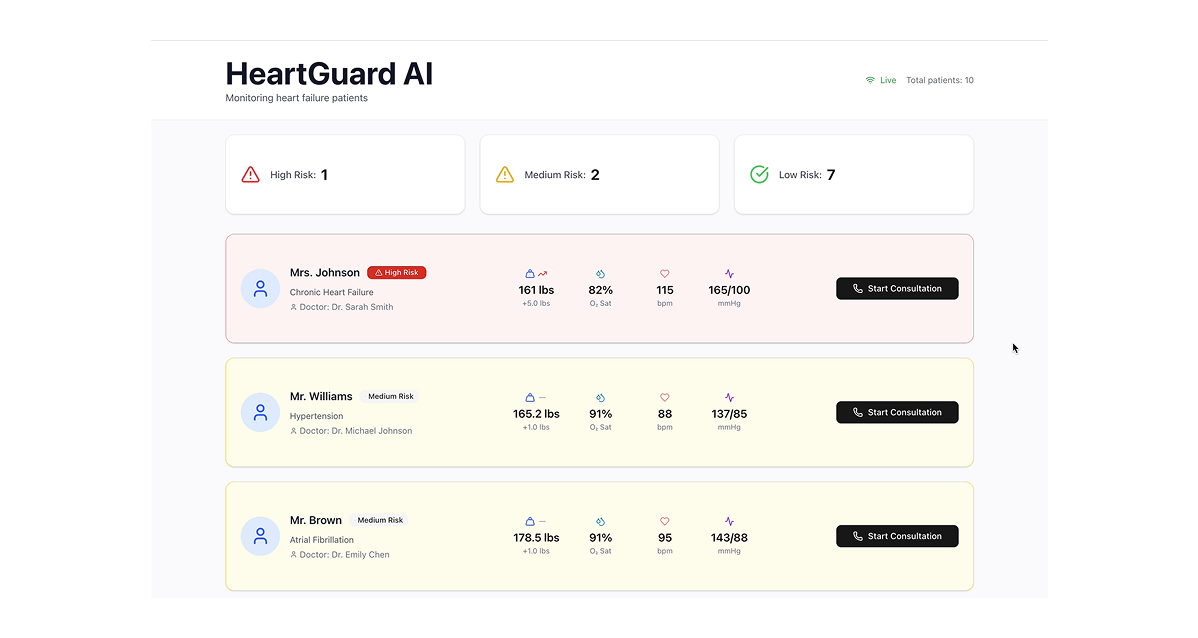
Patients List With Statuses
-
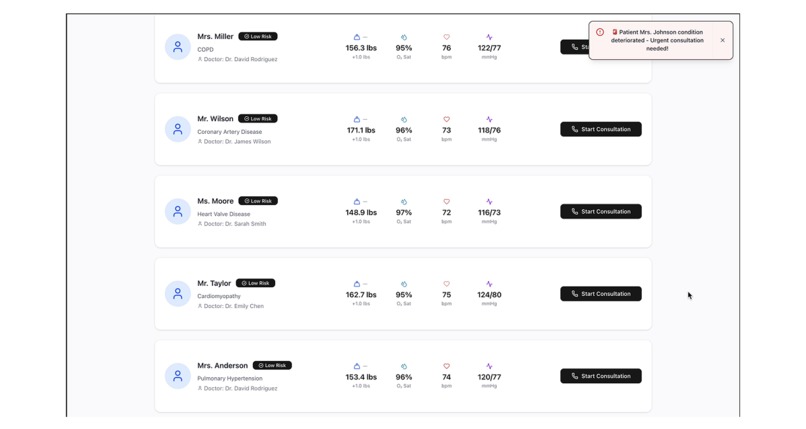
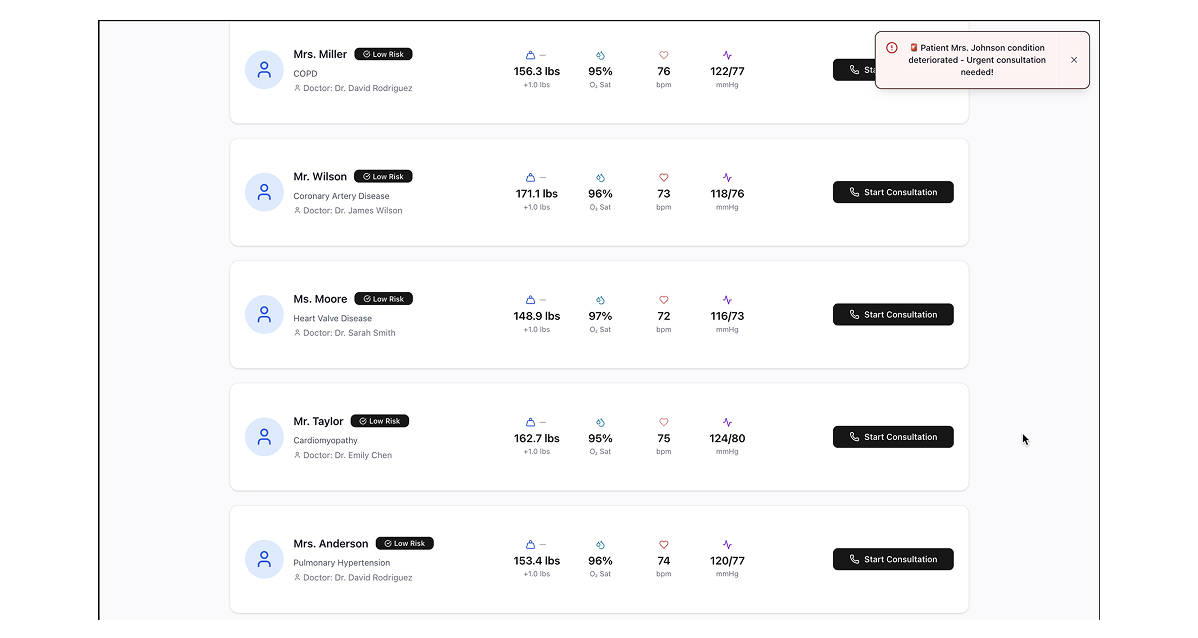
Patients List

The Problem We Couldn't Ignore
My doctor friend told me recently that millions of heart failure patients silently slide into crisis, not because care isn’t available, but because they don’t realize they’re in danger.
Their bodies adjust. Symptoms creep in slowly. By the time they seek help, it’s too late, and the bill is $15,000+ per emergency hospitalization.
That’s not just broken -- it’s insane.
So we asked:
"What if a doctor could know a patient’s heart was failing… before the patient did?"
"What if we could see the danger before it happened, and act instantly?"
That’s why we built HeartGuard AI.
Inspiration
We started with a simple but powerful insight I once heard from my doctor friend:
“The body whispers before it screams.”
We saw that wearables and IoT devices already track data that patients ignore -- weight gain, shortness of breath, subtle biometric drift.
And we realized: AI could connect the dots faster than any human.
What it does
Our platform continuously evaluates patient data, detects decompensation patterns using AI models, and instantly triggers physician outreach.
Patients don’t have to do anything. The system watches. Doctors don’t have to guess -- they get objective alerts, not vague symptoms.
It’s like putting a guardian angel in the cloud, watching every heartbeat.
Doctor an patient can do a video call on the platform where AI listen to the conversation in realtime and provide suggestions to the doctor.
How we built it
- Fronted – ReactJS
- Backend – NodeJS/Express
- Realtime communication – Websockets
- Database – Sqllite
- AWS IoT Core – for ingesting real-time health data from patient devices
- Amazon Bedrock – to power our intelligent clinical decision-making layer
- Video Call Integration (webrtc) – so a doctor can jump in the moment danger strikes
- OpenAI Whisper – to give AI ability to "listen" what patient says and match with the metrics
What We Learned
- "Real-time" matters -- catching a downward spiral even 1 hour earlier can change everything.
- Trust = clarity + design -- we spent extra time on making the UI feel safe and intuitive.
- AI isn’t replacing doctors -- it’s replacing delay.
The Hard Parts
- Streaming and processing real-time IoT data without false alarms -- especially tricky for conditions with lots of noise.
- Tuning LLMs to generate structured clinical alerts instead of vague suggestions.
- Syncing AI decisions with real-world medical protocols in a way that physicians trust.
But the pain was worth it. Because...
The Outcome
HeartGuard AI isn’t just a hackathon project -- it’s a prototype for a future where no one dies because they didn’t know they were getting worse.
Each prevented hospitalization saves $15,000+ and weeks of suffering. 30% readmission rate within 30 days. Now multiply that by 6.5 million Americans with heart failure and $43B market.
We built this to win the hackathon. But the truth is -- if we get this right, everyone wins.
Built With
- amazon
- amazon-web-services
- antropic
- bedrock
- claude
- iot
- node.js
- react
- typescript


Log in or sign up for Devpost to join the conversation.