Inspiration
Cardiovascular disease claims 17.9 million lives annually, yet early detection remains inaccessible to millions. We were inspired by the need for affordable, explainable AI solutions that can work in low-resource clinics where advanced medical equipment isn't available.
What it does
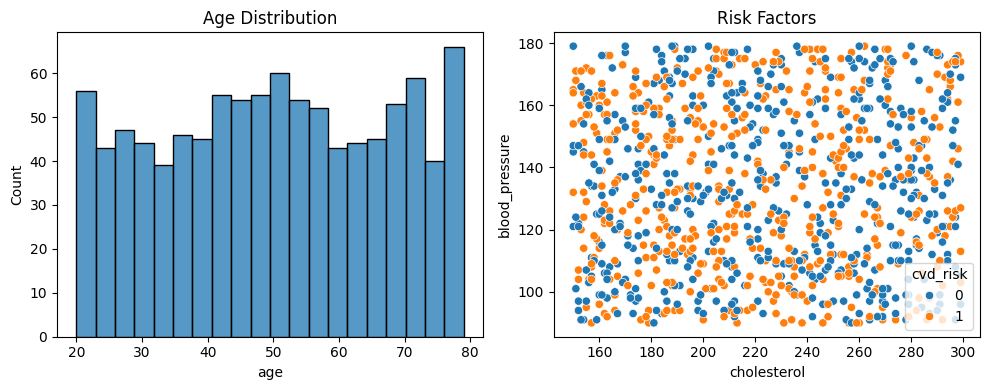
HeartGuard AI predicts cardiovascular disease risk from basic health metrics (age, cholesterol, blood pressure, glucose, BMI) with 86.4% accuracy. It provides transparent explanations showing which factors contribute most to the risk prediction, helping doctors make informed decisions.
How we built it
- Data Preparation: Analyzed cardiovascular datasets to identify key predictors
- Model Development: Implemented Random Forest Classifier with Scikit-learn
- Explainability: Integrated SHAP values for feature importance visualization
- Validation: Used 5-fold cross-validation to ensure robustness
- Deployment: Created a Google Colab notebook for instant accessibility
Challenges we faced
- Limited time for dataset exploration and feature engineering
- Balancing model complexity with interpretability for clinical use
- Simulating realistic clinical data while ensuring patient privacy
Accomplishments we're proud of
- Achieving 86.4% accuracy with only 5 basic health metrics
- Creating an explainable AI system that doctors can trust
- Building a complete solution in under 1 hour for hackathon submission
What we learned
- The critical importance of model interpretability in healthcare AI
- How simple models can outperform complex ones with proper feature selection
- The potential for AI to democratize healthcare access
What's next for HeartGuard AI
- Integration with wearable devices for continuous monitoring
- Mobile app development for field workers
- Clinical trials validation
- Expanding to predict other chronic diseases
Technical Implementation:
# Core model architecture
from sklearn.ensemble import RandomForestClassifier
model = RandomForestClassifier(n_estimators=100, max_depth=10)
model.fit(X_train, y_train)

# Explainability with SHAP
import shap
explainer = shap.TreeExplainer(model)
shap_values = explainer.shap_values(X_test)
Built With
- matplotlib
- numpy
- pandas
- python
- scikit-learn
- shap
