-
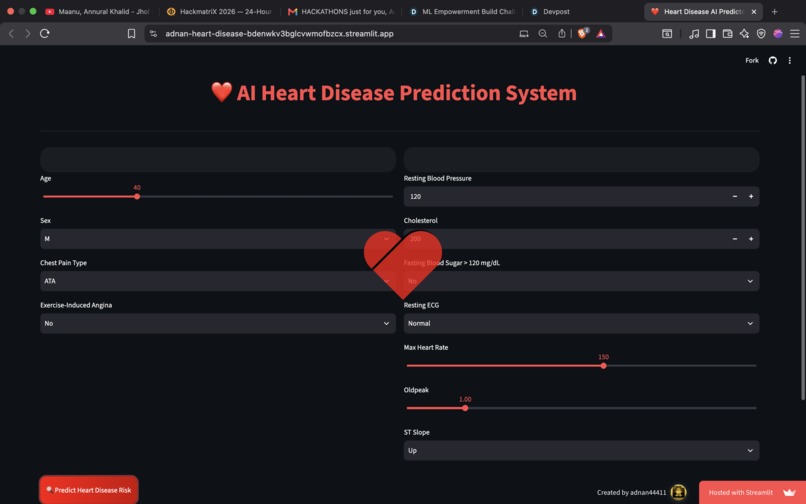
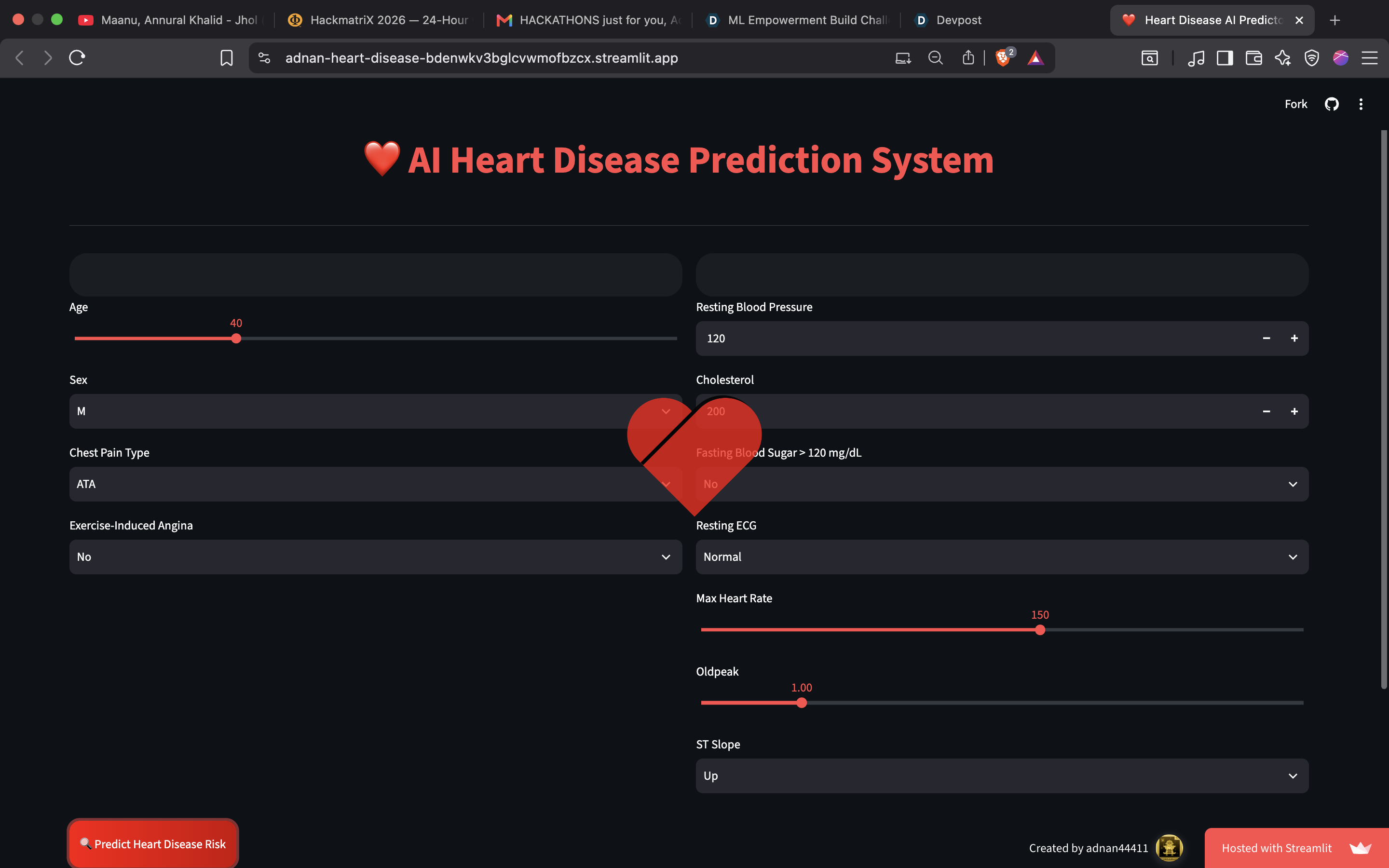
its show broken heart when its not healthy
Inspiration
Heart disease is one of the leading causes of death worldwide, and early detection can significantly improve patient outcomes. We wanted to build a machine learning solution that could assist in identifying individuals at risk based on commonly available medical information, making preliminary risk assessment faster and more accessible.
What it does
The Heart Disease Prediction System predicts the likelihood of a person having heart disease based on key medical attributes such as age, cholesterol level, resting blood pressure, chest pain type, maximum heart rate, and other clinical parameters. Users enter their health information through a simple web interface, and the system provides an instant prediction indicating whether the patient is at low or high risk.
How we built it Collected and analyzed a healthcare dataset containing patient medical records. Performed data preprocessing, including handling missing values, encoding categorical variables, and feature scaling where required. Selected the most relevant medical features that influence heart disease prediction. Trained and compared machine learning models using Python and Scikit-learn to achieve the best performance. Evaluated the model using accuracy scores and validation techniques to ensure reliable predictions. Deployed the trained model as an interactive web application, allowing users to receive predictions through a user-friendly interface. Challenges we ran into Cleaning and preprocessing healthcare data to ensure consistency. Selecting the most influential features without introducing unnecessary complexity. Balancing model accuracy while avoiding overfitting. Integrating the trained machine learning model into a web application for real-time predictions. Accomplishments that we're proud of Successfully built an end-to-end machine learning application from data preprocessing to deployment. Achieved reliable prediction accuracy through proper feature engineering and model evaluation. Developed an intuitive web interface that makes the prediction process simple for users. Demonstrated how AI can be applied to support early healthcare risk assessment. What we learned The importance of data preprocessing and feature selection in improving machine learning performance. Practical experience with Scikit-learn workflows, including model training, validation, and evaluation. How to deploy a machine learning model as a real-world web application. The significance of building interpretable healthcare AI solutions that complement, rather than replace, medical professionals. What's next for Heart Disease Prediction System Improve prediction accuracy by training on larger and more diverse healthcare datasets. Incorporate advanced ensemble and deep learning models for better performance. Add explainable AI (XAI) features to show which factors contributed most to each prediction. Enable secure patient history tracking and personalized health recommendations. Integrate wearable device data (heart rate, activity, blood pressure) for continuous risk monitoring. Deploy the application on cloud infrastructure with stronger security, scalability, and mobile support. Collaborate with healthcare professionals to validate the system in real-world clinical settings.


Log in or sign up for Devpost to join the conversation.